Is the Space Race Over?

You probably thought the space race ended when America put a man on the Moon.  If not, you probably thought it at least ended with the Cold War.  Apparently you were wrong.  The United States is still competing with Russia for dominance in space, and it’s become such a cutthroat battle that the US went so far as to sabotage Russia’s latest mission to Mars.

At least, that’s what the Russians claim.  The head of the Russian Space Agency recently suggested that something may have happened to their Mars probe while it was in “the shadow.”  The shadow supposedly refers to the far side of the planet, which from Russia’s perspective happens to be where the US is.

The Russian probe, named Phobos Grunt, was supposed to land on one of Mars’ moons and return to Earth carrying soil samples.  For some reason, it failed to fire its rockets once in Earth orbit.  This is the fourth time Russia has tried to send a probe to Mars and failed, while NASA keeps sending one rover after another.  Phobos Grunt is expected to crash to Earth sometime this weekend.

So did the United States attack Russia’s probe?  Did the US fear Phobos Grunt would steal some of the limelight from NASA’s latest Mars rover?  Did the American government, which recently slashed NASA’s budget, still care enough to conduct secret operations against an unmanned Russian science mission?

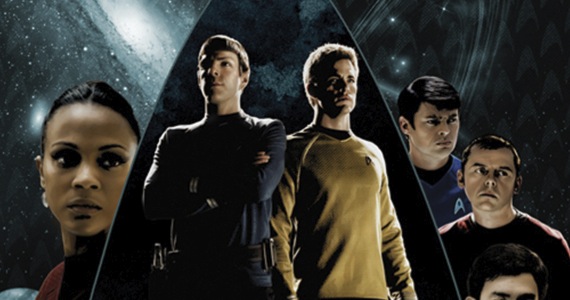
As an American, I find this unlikely.  Americans love international cooperation in space.  The Hubble Space Telescope and the International Space Station both happened because of partnerships with other countries, and there’s a good chance the first humans on Mars will be part of an international team.  We even put a Russian character on the bridge of the Enterprise.  I for one was excited about Phobos Grunt and hoped the fourth time would be the charm.

What do you think?  Did the space race end, or is it still going on?

The World’s Smartest Dinosaur

Fans of Jurassic Park already know how smart Velociraptors were.  Trekkies may remember an episode of Star Trek: Voyager where Voyager encountered a reptilian species that evolved from dinosaurs and fled Earth before the mass extinction.  If science fiction is any judge, it seems clear that dinosaurs had a lot of potential before they all died out.  So what does science fact say?

Allow me to introduce the Troodon (pronounced TRUE-o-don).  Scientists say this is the most intelligent dinosaur ever discovered.  Most dinosaur brains were tiny, like walnuts; Troodon’s was much bigger, though not nearly as big as a human brain.  As a predator, it spent much of its time and energy learning how to hunt and kill prey, putting that relatively big brain to good use.  It also had a feature we humans depend on: opposable thumbs (or at least “partially opposable” thumbs).

In 1982, a man named Dale Russell proposed a thought experiment, asking what would have happened if dinosaurs had not gone extinct and Troodon had continued to evolve.  Its big brain and partially opposable thumbs gave it the same tools our ape ancestors had.  He and others concluded it would have become a “dinosauroid” like the one pictured below.

Of course there is one big difference between our ancestors and those of the hypothetical dinosauroids: ours weren’t predators (at least not exclusively).  It would be interesting to speculate how an intelligent, predatory species would differ from us.  How would their society view violence, war, and death?  What would they think of us, if we had to share this planet?
Here are some links with more information on Troodon and how it could have evolved.

Big Day

Today is a big day for me.  I’ve posted the first story for The Tomorrow News Network, a series of short stories featuring Talie Tappler, a time traveling journalist.  I’m planning to write nine more stories this year, publishing one a month until October.  I suspect I’ll be very busy from now until November.

The first story is about a boy living on a colony at the frontier of space.  He’s seen Talie Tappler’s reports before and knows the kind of story she covers.  Her arrival cannot be good news.  If he could just get a little information out of her, maybe he could save the colony, but as a journalist Talie only reports the news, she must not interfere and must not change it.  Click here to read the story FOR FREE.

Also today, I have the honor of being a guest blogger at Clarion Blog, where I wrote a short piece on how my past experience with acting and film production helped with my writing.  Clarion Blog is associated with the Clarion Science Fiction and Fantasy Writers’ Workshop, an organization to help teach new speculative fiction writers.  The blog is a great resource for aspiring authors like myself, and I often take advantage of the information they provide.  Click here to read my article.

2012 is off to a great start, and you can expect to hear much more from me about The Tomorrow News Network, but I’ll keep posting on this blog too about various sciency and science fictiony things.  On Wednesday, it’ll be dinosaurs.  Do you think you’re smarter than them?

Start Your Own Space Program

Space travel was once something only governments could do.  Now private companies are getting into it, and soon private citizens as well.  I’m not talking about the super expensive space flights offered by companies like Virgin Galactic.  I mean everyday people building their own personal space programs.

In the last decade, CubeSats have become increasingly popular.  CubeSats are small, cubical satellites that can be bundled together and launched in small groups.  This allows anyone from major corporations to small universities to individuals tinkering in their garages to conduct science experiments in space at a relatively low cost.  Groups of CubeSats are sometimes launched along with other space missions, lowering the cost even more.  For more on CubeSats, click here.

A group in Germany, with the noble goal of providing censorship-free Internet to everyone, is planning to launch their own satellites into orbit.  If successful, the Hackerspace Global Grid (H.G.G.) would provide an Internet connection to everyone in the world, bypassing any restrictions imposed by terrestrial governments.  China has strict censorship rules about Internet access, and the United States is considering some strict rules or its own with the proposed Stop Online Piracy Act.  For more on H.G.G., click here.

One family in New York recently launched a video camera into space.  They built a “space capsule” with an HD camera, an iPhone (for its GPS function), and some hand warmers to keep the electronics from freezing.  They attached it to a weather balloon and let it fly into the upper reaches of Earth’s atmosphere.  Here is the video their camera brought back.

The most advanced technology of the 1960’s is obsolete now, but that technology was good enough to take a man to the Moon.  As the cost of technology continues to drop, space travel will become more and more affordable.  Of course it still isn’t what you’d call “cheap.”  A CubeSat could cost tens of thousands of dollars to build and launch, but that’s still less expensive than traditional space launches and makes space accessible to a wider range of people.

Is Time Travel Possible?

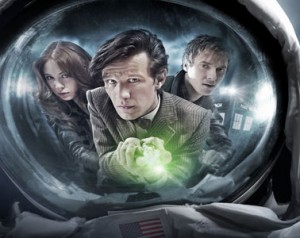
Doctor Who does it, it’s happened a bunch of times on Star Trek, and my new Tomorrow News Network series is all about it.  But is time travel really possible?  I don’t know.  I’ve never done it myself, and most likely neither have you (if you have, please leave a comment and explain).  Many physicists say it’s impossible.  Many other physicists disagree.

There are two big ideas in modern physics, both of them well beyond our everyday experience.  One is Relativity, which deals with very large things like stars and galaxies and very fast things like the speed of light.  The other is Quantum Mechanics, which deals with very small things like atoms and subatomic particles.  Both defy common sense, including our common sense understanding of time.

Relativity tells us that as we approach the speed of light or enter the enormous gravity of something like a black hole, time stretches.  A minute from our perspective could be a day, a year, or even a century to the rest of the universe.  Even when you’re driving down the highway, time moves at a different rate for you than for someone standing still; the difference is just too small to notice.  Click here for a video on how Relativity makes time travel work.

In Quantum Mechanics, time is at best irrelevant.  Subatomic particles spend their lives doing all kinds of crazy things, existing in multiple places at once, popping into and out of existence for no apparent reason, and entangling with each other so they can do even weirder stuff.  Sometimes when particles interact, a few of them appear to turn around and move backwards in time.

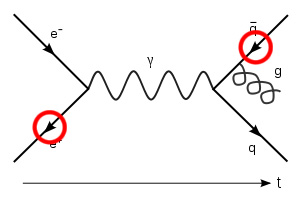
This is a diagram of subatomic particles interacting.  Don’t panic, you don’t have to understand it.  I only want to point out two things.  Notice the line across the bottom marked t, which represents the forward motion of time.  Now notice which way the two arrows I’ve circled are pointing.  Scientists have other ways to explain this kind of interaction without time travel, but for some reason they seem to find this way easiest.

I am not a scientist.  I am a science enthusiast and sometimes a science journalist.  What I have learned from all my research is that time is flexible, both on the large scale of Relativity and the small scale of Quantum Mechanics.  If time is flexible, it’s easy to believe that someday someone like Dr. Who, Mr. Spock, or Talie Tappler will find a way to manipulate it.  Maybe they already have.

Earth’s Neighbor

You may think of the Moon as old news.  It’s extremely close to Earth, and we’ve been studying it for centuries.  Human beings have landed there and brought back samples.  What more is there to learn?  A great deal, it turns out.

Image courtesy of wpclipart.com

First of all, where the heck did it come from?  Scientists developed a workable theory on that within the last few decades, but unlike evolution this theory is still open to debate (click here for the Giant Impact Theory).  Also, why does the far side look completely different from the side facing Earth?  A theory explaining that was first published only last year (click here for the Double Moon Theory).  Lastly, although we’ve studied the surface of the Moon in great detail, we have no idea what’s inside.

As planet Earth rang in the New Year, a pair of NASA spacecraft entered lunar orbit to begin finding some answers.  The probes, named Grail-A and Grail-B, will orbit the Moon, making detailed measurements of the Moon’s gravitational field.  From that data, researchers say they can map the Moon’s interior.

Seeing the inside of the Moon should give us a much clearer idea of how the Moon formed and changed over it’s history.  It will answer a lot of questions.  It will probably raise a lot of new questions too when we find things we weren’t expecting.  Click here for more on the Grail mission.

P.S.: Students at participating schools get to take part in the Grail Mission.  For more on that, click here.

Science Fiction in 2012

Science fiction nerds like me have a lot to be excited about in the new year.  Here’s a short list.

    • Filming begins on the next Star Trek movie, and I’m sure we’ll hear lots of juicy rumors before its release in 2013.
    • The Star Wars movies are returning to theatres, this time in 3D.  The Phantom Menace comes out in February.
    • The movie adaptation of The Hunger Games comes out in March.  It looks like one of those rare and exciting cases where Hollywood decided to stick to the original book as much as possible.
    • Ridley Scott’s Prometheus comes out in June, and looking at the trailer it seems like a prequel to Alien.
  • Doctor Who, Series 7 comes out in the fall.  Matt Smith will continue to play the Eleventh Doctor, and Karen Gillan and Arthur Darvill (Amy and Rory) will make an appearance, but it is not yet clear if they will be the Doctor’s companions through the full series.
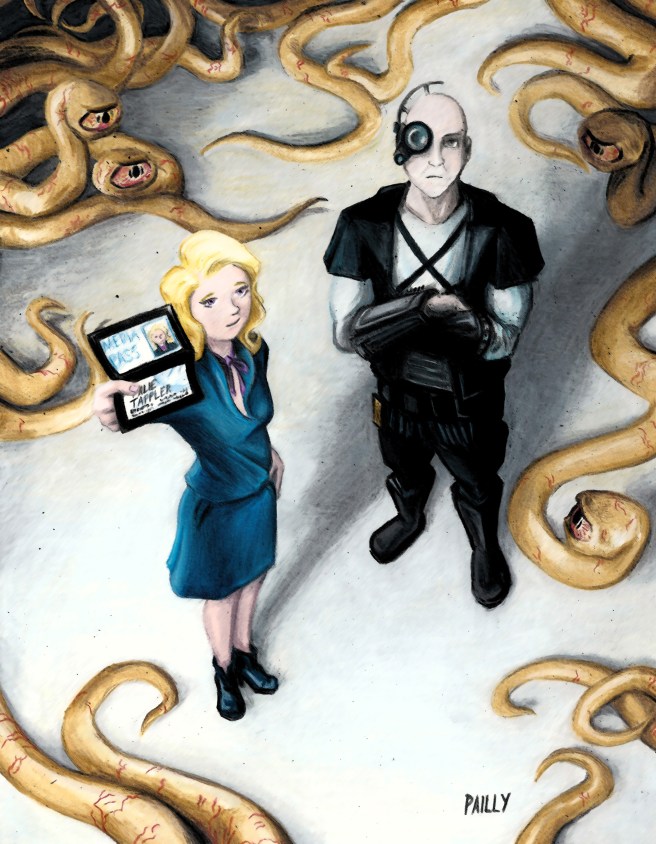
And of course, starting January 9th you’ll be able to read my new short story series, The Tomorrow News Network (click here to visit the website).  Each month, I will post a new story featuring time traveler and journalist Talie Tappler and her cyborg cameraman, Mr. Cognis.  I hope you’ll have as much fun reading about their adventures as I’ve had writing them.

Everybody have a safe and happy 2012.  May the Force be with you, live long and prosper, etc, etc…
Science in 2012

2011 has been a good year.  We’ve discovered lots of new planets, including a few that could be able to support life, found out neutrinos might travel faster than light, and learned that quantum mechanics, the science of atoms and subatomic partials, sometimes works on much larger scales.  As exciting as all that was, next year promises to be even better.

In February, SpaceX will become the first private company to send a spaceship to the International Space Station.  Following NASA’s deep budget cuts in 2010, the private space industry has expanded rapidly.  Privately owned spacecraft are no longer just for tourists; they will also become a taxi service for NASA astronauts.  If all goes well, February’s SpaceX mission will be the first of many.

In August, the largest robotic probe ever sent to another planet will land safely (crosses fingers) on Mars.  The Curiosity rover will search for signs of Martian life, either living or extinct.  Resent studies have shown that Mars is not as barren as we once thought and that it has many of the chemicals and conditions needed for life to develop.  There’s even circumstantial evidence that microscopic life exists there right now.

Lastly, scientists say they will either discover the Higgs Boson by the end of 2012 or prove that it doesn’t exist.  The Higgs Boson is predicted by the standard model of particle physics, but no one has been able to find it.  Soon, they will run out of places to look.  If it turns out the Higgs doesn’t exist than there is something wrong with the standard model, and physicists will have to develop a whole new theory to explain how subatomic particles work.

These are just some of the stories we already know about.  Imagine all the surprises 2012 will bring in addition to the things we’ve scheduled and are able to predict!

Tomorrow: Science Fiction in 2012.

Are Animals Smarter Than You?

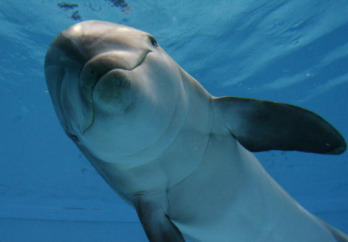
Fans of the Hitchhiker’s Guide to the Galaxy already know that humans are only the third most intelligent species on Earth.  Dolphins are the second, and white mice are the first, for obvious reasons.  But what animal is the fourth most intelligent, or the fifth?  Scientists are making progress finding out.

Biologists in Scotland have been studying the songs of sperm whales and believe whales have names, just like we do.  Before they sing, each whale tends to start with a series of tones unique to that whale, as though they’re announcing themselves before they speak.  A possible translation could be something like, “This is Bob.  I noticed some fish over there.  Let’s go get them.”  For more on whale names, click here.

Researchers at the University of Michigan say they’ve found evidence that wasps have the ability to recognize each other’s faces.  If you ask me, all wasps look the same, but apparently individual paper wasps have subtle differences of facial structure and can recognize each other the same way humans do.  This is the first time anyone has discovered human-like behavior in an insect.  For more on wasp facial recognition, click here.

Since we already know humans and chimpanzees are related through evolution, it shouldn’t surprise us too much to learn that they display human-like behavior.  Yet recent research, again in Scotland, has found that they even share some of our feelings about death.  Scientists are a Safari Park observed chimps gathering around the deathbed of a fellow chimp, mourning for it, holding vigils, and caring for the remains after death.  For more on chimpanzee death rituals, click here.

These are not the only examples.  Squid and cuttlefish change colors and may have their own language (click here).  Dolphins, which the Hitchhiker’s Guide already told us are smarter than us, have been observed inventing new tools to help them fish (click here).  Crows make tools and communicate as well, and scientists have also observed them playing practical jokes on each other (click here).

By studying animals and finding similarities between their behavior and ours, we are also learning about human intelligence and how it developed.  Our ancestors surely began in a similar way.  Given time, maybe sperm whales or paper wasps or one of the other species listed here could evolve to our level.  Maybe, on some other planet, they already have.