The Future of Cameras

Mr. Cognis from The Tomorrow News Network is not just a regular cameraman.  He’s a cybernetic cameraman with his camera surgically attached to his head.  Of course, cybernetic cameras haven’t been invented yet, so we’ll have to make due with the technology we have.  Fortunately, camera makers have developed some pretty cool new ways to use what we have, and cameras are doing things no one would have expected just a few years ago.

Researchers at Stanford University have been working on an open source camera, nicknamed “Frankencamera.”  Most digital cameras are closed source, meaning you cannot alter the programming inside them.  An open source camera like Frankencamera allows clever computer people to change the way the camera works, potentially inventing new photography methods no one would have thought of otherwise.  The source code for Frankencamera has been released and is in use on Nokia’s N900 smart phone.

Another new camera technology on the market is called Lytro.  This is the camera for anyone who’s ever taken a photograph only to discover it was blurry afterwards.  The Lytro camera has an extra set of lenses inside, allowing it to capture more information than a traditional camera.  Using that additional information, you can go back later and change the focus so that your picture isn’t blurry anymore.  Click here to go to the Lytro website, and check out the photo gallery where you can try changing the focus of various sample images.

The Pelican Imaging Corporaion, headquartered in California, has developed technology even cooler than Lytro.  Not only can their camera allow you to refocus an image after you take it, but it can see through obstacles like fence posts or the branches of a tree (click here to see a video of how they do this).  Pelican’s camera is actually an array of 25 teeny, tiny cameras all working together.  Just like Lytro’s extra lenses, these extra cameras supply additional information so that images can be refocused or adjusted later.  Best of all, this array of cameras is small enough to fit inside a smart phone.

Digital cameras are changing rapidly.  Other tricks include seeing around corners and picking out images from the reflections in people’s eyes.  Click here for the full article on all the cameras I’ve mentioned and more from Science News.  Of course, no computer processes visual information as well as the human brain, an advantage cyborgs like Mr. Cognis still have over the rest of us.

Clara’s Molecule

The classic story of an inventor tinkering in his basement is a thing of the past.  Most new discoveries require NASA sized budgets, enormous research facilities, and the support of governments, large corporations, or major universities.  Except that isn’t always true.

Recently, a fifth-grade student named Clara Lazen invented an entirely new molecule.  Her science teacher had handed out the traditional ball and stick model pieces to make molecules, and she assembled a bunch of carbon, oxygen, and nitrogen in a completely new and unexpected way.  When she was done, she asked if she’d made a real molecule.

Clara and her science teacher.

Her teacher and a chemist at Humboldt State University have determined that it is an entirely new molecule.  Clara’s molecule, which has the catchy name of tetranitratoxycarbon, may even be useful for energy storage.  Now her name will appear on a paper in a major scientific journal.

Everyday people like Clara can still make major discoveries.  Science is not just for the well-funded.  Tetranitratoxycarbon might even help us solve the energy crisis, but most importantly, Clara and her classmates reportedly have a new enthusiasm for science, something that is rare in American children these days.

Click here for the original article from themarysue.com.

How Much of “99 White Balloons” is True?

February’s edition of The Tomorrow News Network is posted.  This month, time traveling journalist Talie Tappler goes back to July 4th, 1947, the day a spaceship crashed near Roswell, New Mexico.  Turns out the weather balloon story wasn’t a complete lie.  Click here to read “99 White Balloons.”

So how much of “99 White Balloons” is true?  Probably not much.  I’ve never done a historical piece before, and in the course of my research on Roswell… well… let’s just say I’ve been to some pretty strange places on the Internet lately.

However, there are a few somewhat credible sources on Roswell.  In 1995, Congressman Steve Schiff of New Mexico launched an investigation into what really happened and forced the release of many documents concerning the recovery of what was described as a “flying disk.”

Two important terms uncovered in Congressman Schiff’s investigation were “Project Mogul” and “Majestic Twelve,” both of which appear in “99 White Balloons.”  The meaning of these terms—in fact, the authenticity of their existence—is open to debate.

According to the government, Project Mogul was a top secret experiment in the late 1940’s which used weather balloons to listen for the sound of Russian nuclear tests.  Scientists supposedly believed sound waves might become trapped in the upper atmosphere the way they sometimes become trapped in thermal layers of the deep ocean.  We now know that is not true.  In fact, the idea is a little silly when you think about it (air in the upper atmosphere is too thin to transmit sound well), which is why conspiracy theorists say Project Mogul was invented after the fact to cover up the truth about the UFO crash.

The Majestic Twelve (sometimes referred to as MJ 12) is an even more mysterious term, and people have interpreted it in many different ways.  In “99 White Balloons,” I have chosen to present it as a group of twelve experts on extra terrestrial affairs who arrive at Roswell Army Air Field shortly after the crash.  They serve as the stereotypical men in black characters.

The rest of my research focused on the US military of the late 1940’s.  1947 was the year the Army Air Force transitioned into the modern Air Force.  Much of Roswell Army Air Field, the base where the UFO wreckage was supposedly taken, is still there.  It was renamed Walker Air Force Base and remained in use until 1967.  It is now an industrial airport.

Personally, I’m not a big fan of UFO conspiracy theories.  I’m a science enthusiast, and very few UFO sightings come with hard, scientific evidence; however, I know people who say they’ve seen spaceships in the sky and are pretty adamant about it.  Whether any of these stories are true or not, I’ve enjoyed studying them and writing about them.  I hope you’ll enjoy reading my interpretation of the Roswell Incident over at tomorrownewsnetwork.com.

Why Newt Gingrich’s Moon Base Matters

Newt Gingrich has been widely ridiculed by both the media and his fellow Republicans for wanting to return to the Moon and establish a lunar colony by 2020.  What hasn’t been discussed is that the Moon and the rest of the Solar System are packed full of untapped natural resources.  The Moon in particular has plentiful helium-3, which could be used as a carbon-free, radiation free fuel source.

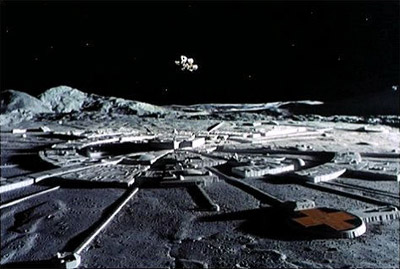
Moon Base Alpha as seen in Space: 1999.

In the last decade, the Chinese government has engaged in an aggressive space program.  They’ve sent men into space, done spacewalks, and are now building their own space station to compete with the International Space Station (ISS).  At the rate they’re going, experts believe China could establish a permanent presence on the Moon as early as 2022 and claim it as their territory.

A new space race is on, whether the American public knows it or not, and I for one do not want China to call dibs on the Moon’s helium-3.  We should take Gingrich’s proposal seriously, not mock him (at least not for this).

The good news, especially for anyone who doesn’t want to vote for Gingrich, is that his proposal is not the only one.  According to a report from Space.com, the Russian space agency is talking to NASA and ESA (the European Space Agency) about building a Moon base as a project of international cooperation, just like the ISS.

I’d prefer to see an international Moon base rather than the Americans only one Gingrich proposes so that the Moon’s resources can be shared by all of humanity and not hoarded by one country.  The important thing right now is that we’re talking about it.  The more the public learns about this issue, the more they’ll understand it and the more they will want to see a permanent outpost on the Moon.

Links

Talie Tappler Gets Interviewed

Time traveling journalist Talie Tappler is usually the one interviewing people, but today she’s the one being interviewed.  The blog Reality Skimming does a regular feature called “Continuing Characters” where they interview a recurring character from a fantasy or science fiction series.  They usually ask the author a few questions too.

Talie is the main character in my Tomorrow News Network series.  Each month, I’ll be publishing a new short story about her and her adventures.  The first story, “The Medusa Effect,” is already up.  The next will be published Monday, February 6th.

See what Talie has to say for herself at Reality Skimming by clicking here.

You can also check out Talie’s adventures with the Tomorrow News Network by clicking here.

Green Women

I’m not looking forward to the kind of stuff I’ll get in the spam filter for this, but here goes…

The classy people who brought us the Moonlight Bunny Ranch—America’s most famous brothel—have come up with a new idea.  According to an article from a CBS affiliate in Las Vegas, they plan to open a science fiction themed brothel.  The population of geeks in this country is growing, and as the stereotype tells us none of them have girlfriends.  So obviously they’ll all jump at this.

Dennis Hof, the man who created and owns the Moonlight Bunny Ranch, is even hoping to get Sci Fi celebrities like William Shatner to support his new project.  I suppose the slogan could be, “Now you too can make love to green women.”

I only have one thing to say about the Sci Fi brothel.  Mr. Shatner, please don’t do this.  Please, please do not do this.

For the CBS article, click here.

Should the Moon Become the 51st State?

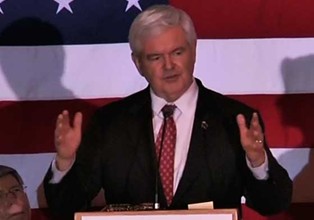
On Wednesday (January 25, 2012), Republican Presidential candidate Newt Gingrich visited Florida’s space coast, the region surrounding the Kennedy Space Center, and gave a speech about the current state of the American space program.  He called it an embarrassment, citing the current arrangement to fly US astronauts on Russian space craft, and explained his bold vision for how to fix it.

Image courtesy of C-SPAN.

Gingrich’s three main goals were to establish a base on the Moon, create more Near Earth activity (including science, tourism, and manufacturing in space), and develop a continuous propulsion spacecraft capable of reaching Mars.  He called for NASA to change its bureaucratic ways and for private enterprise to take on more of the burden of space flight.  He also said he wants space launches to become routine.  He wants to see five to eight launches a day.

Image courtesy of wpclipart.com

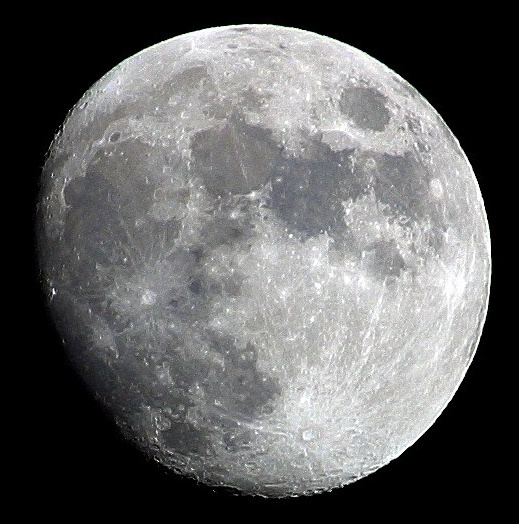
As for that Moon base, which he plans to establish by the end of his second term, he wants to allow American citizens living on the Moon to petition Congress to become a state once the lunar population reaches 13,000.  I would prefer to see the Moon base as a project of international cooperation, like the I.S.S., but I understand Gingrich’s thinking.  He says he wants young Americans to dream of being one of those 13,000 lunar pioneers so that they’ll want to study math and science, and they’ll want to take part in this new space race.

I have some problems with Gingrich and his policies, but he and I have at least one thing in common.  He described his romantic belief that our destiny is in space, a belief shaped in part by science fiction writers like Isaac Asimov.  I share his belief, and I am also a fan of Asimov.

I’m not saying I’ll vote for him, and I’m not advocating that you should or should not vote for him either.  Space policy is one of many issues to consider when choosing a president, but I find it refreshing and even exciting to hear a major presidential candidate talk about returning to the Moon and going to Mars.

In last night’s GOP debate, it seemed clear none of the other Republican candidates know or care to know much about space.  That was disappointing.  If Gingrich does become the Republican nominee, it would be interesting to see him and President Obama debate the current and future state of the American space program.

Click here to see Gingrich’s full speech on C-SPAN.

Looking for Moons in All the Wrong Places

The first story in my Tomorrow News Network series is set on a moon orbiting the planet 55 Cancri f, which the characters refer to as “Cancriph.”  Cancriph is a real planet, one of the first discovered in the habitable zone of any star.  Since Cancriph is a gas giant, not a rocky world like Earth, it cannot support life as we know it, but there is no reason to believe it doesn’t have habitable moons like the one in my story.

The surface of Cancriph's second moon.

Now astronomers think they’ve learned enough about exoplanets (planets outside our Solar System) to start looking for exomoons.  Using data already obtained by the Kepler Space Telescope, a team of researchers hopes to find subtle differences in the orbits of known exoplanets which might be caused by their accompanying moons.

Make no mistake: this is going to be painstaking work.  It’s hard enough to find exoplanets, even gas giants like Cancriph; finding their tiny moons is next to impossible.  But our planet detecting techniques have improved over the years.  Just recently, scientists announced the discovery of exoplanets smaller than Earth and the possible discovery of an exoplanet with Saturn-like rings.  With time and practice, I’m sure they’ll be able to find moons too.

And when they do, I hope someone takes a good, long look at the second moon of Cancriph before we send people there.

For more information on the search for exomoons, click here.

To read “The Medusa Effect,” set on Cancriph’s second moon, click here.

SOPA and PIPA

The 21st Century is turning out to be pretty cool.  We don’t have flying cars (yet), but we do have smart phones, and privately funded space travel looks promising.  We also have the Internet, a vast forum powered by technology where everyone can make their voices heard, even little known science fiction writers like me.  It’s perhaps the greatest advancement in free speech since the First Amendment was written.

By now I’m sure you’ve heard about SOPA (Stop Online Piracy Act) and its companion, PIPA (Protect Intellectual Property Act), two bills proposed in Congress meant to protect copyright holders from online piracy.  Unfortunately, it turns out Congress is run by old people individuals aged 60+ who don’t know how computers work, and the bills they’ve written will most likely destroy free speech on the Internet.  Many websites, regardless of their innocence or guilt, would not survive the lawsuits SOPA and PIPA would generate.

China already censors the Internet.  Many Middle Eastern dictators wish they had, but social media sites like Facebook and Twitter have already helped overthrow them.  If the United States wants to spread freedom and democracy throughout the world, the Internet is one of its best tools.  Far more effective than guns or bombs.  So why would the US government attack the Internet?

I’ve put a great deal of work into this blog and my short story series, The Tomorrow News Network, which is published online.  I don’t want to lose it all when some corporation decides—on a whim—that I’ve violated their copyright.  If a company as big as Google feels threatened by SOPA and PIPA, what chance do I have?  What chance does any private citizen have?

I live in Pennsylvania.  I’m represented in Congress by Senators Pat Toomey (Republican) and Bob Casey (Democrat).  We just went though some gerrymandering redistricting, so I don’t know who represents me in the House anymore.  But Senator Toomey, Senator Casey, Congressman Whoever, I want you to know something: if you vote to censor the Internet, I will vote against you.  I doubt you read this blog, and I doubt you even care about my vote, but I promise I will vote for whoever runs against you in your next election.

* * *

Update (January 29, 2012): Last I heard, Congress canceled votes on both SOPA and PIPA; however, the issue has not gone away.  Politicians in Washington are still looking for ways to stop online piracy.  Whether they choose to do so responsibly or not is still an open question.

My God! It’s Full of Planets!

Fans of 2001: A Space Odyssey will remember Dave Bowman’s last words before disappearing into the alien monolith: “My God!  It’s full of stars!”  Turns out where there are stars, there are even more planets.  Scientists are discovering new planets everywhere, some in stranger places than ever expected.

When the search for planets outside our Solar System (aka: exoplanets) began, even a planet as large as Jupiter was too small to find.  Now we’ve found the first exoplanets smaller than Earth.  Although they are all too close to their parent star to be habitable, their discovery proves that our technology and techniques are improving.  I expect in the next few years scientists will discover so many smaller-than-Earth planets they won’t be able to study all of them.  Click here for more on the KOI-961 system and its tiny planets.
Quadruple Saturn Moon Transit Snapped By Hubble
Source: Hubblesite.org

New research suggests the planet Saturn isn’t as special as we thought.  Scientists have discovered another astronomical body with large rings, but they’re not exactly sure what the rings encircle.  It may be a planet, or it may be a brown dwarf.  It could even be a small star with rings, which—with all due respect to Saturn—would be way cooler.  For more on this Saturn-like object, click here.

Scientists have even discovered planets that really live up to their name.  Planet is Greek for wanderer, and a recent survey of the sky found at least ten Jupiter-size planets wandering aimlessly through space.  These planets once orbited stars but, for one reason or another, were ejected out of their original orbits.  These rogue planets are incredibly hard to find, but if there are ten as big as Jupiter we can assume there are many more, both big and small, hiding in the darkness.  Click here for more on rogue planets.

When the day comes that the human race ventures beyond our own Solar System, we’ll have plenty of places to go.  The nearest known exoplanets are orbiting Epsilon Eridani, roughly 10.5 light years away, but there are stars even closer and I wouldn’t be surprised if they have planets too.  Who knows?  A rogue planet might be right on our doorstep waiting to be explored.