The Orion War

In the distant future, religion is illegal. Commodore Isaac Matheson leads a fleet of exiled Christians to find a new home in the far off Orion Nebula, a swirling cloud of gas and dust where brand new stars and planets are forming. But when the fleet is attacked, the search transforms into a long, bitter crusade.
HubbleSource: Hubblesite.org

Time traveling journalist Talie Tappler comes to interview Isaac. She’s not supposed to interfere with history. She’s not supposed to do anything to change it. And yet she drops subtle hints, warning Isaac that he will have to do something terrible to bring this holy war to an end.

Click here to read “The Orion War” at the Tomorrow News Network website.

Angry Birds in Space

Just when I thought I’d gotten over my obsession with Angry Birds, Rovio announces they’re releasing a new Angry Birds game set in space.  They even got an astronaut on the International Space Station to announce it for them.  Best of all, it looks like Angry Birds: Space takes advantage of weightlessness and gravity in the game play.

Science Gone Wild

Whether it’s a newly discovered planet, enormous dinosaur fleas, or Virgin Galactic’s latest spaceship design, science news tends to get me excited.  If you’re a regular reader of this blog, it probably gets you excited too.   But sometimes scientists do things that are more amusing than exciting.  Here are a few recent examples.

Last year, scientists working at CERN, a European research facility, measured neutrinos traveling slightly faster than light.  Neutrinos are a somewhat mysterious type of subatomic particle; however, Einstein’s Theory of Relativity said nothing can travel faster than light.   Scientists involved in the experiment now believe a faulty cable gave them inaccurate readings.  So it seems out Einstein was right after all.  For more on this faulty cable, click here.

A scientist from Lithuania has designed a fun, new way to commit suicide.  The Euthanasia Roller Coaster takes victims high into the air then sends them plummeting towards the ground, passing through a series of loops on the way.  The G forces built up during the ride are high enough to be lethal.  As far as I can tell, this roller coaster is only in the design phase, and there are no plans to actually build it.  Click here for more information.

Lastly, a new study claims to prove that rich people are more likely to steal candy from babies than poor people.  It also shows they are more willing to lie or cheat to get ahead in life.  The greed of the rich is now apparently a scientific fact.  I guess the Occupy Wall Street protestors know what they’re talking about.  For more on that, click here.

I read a lot of science news during the course of my day.  Some of it is pretty cool.  Some of it gives me ideas for science fiction stories.  And sometimes it just makes me laugh.  These three stories made me laugh (not all for the same reason).  How about you?  Please leave a comment on your reaction or share some piece of wacky science news of your own.

Dino Fleas

Next time you hop in your time machine and go on vacation in dinosaur times, be careful.  You already know to look out for Velociraptors and to stay away from the Tyrannosaurus rex, but even more frightening than these carnivores are the fleas dinosaurs carried.

Time traveler goes on dinosaur safari, gets bitten by enormous flea.

According to the Associated Press, fossilized fleas have been found in China.  They date back to about 165 million years ago, which puts them somewhere in the Jurassic Period.  They’re described as growing to at least an inch long, and their proboscis (the straw-like thing they use to suck blood) is out of proportion to their already large bodies.

Oh, and that proboscis has serrated edges too.  I guess it’s not easy biting through the thick hide of an Apatosaurus.

With that it mind, I expect Jurassic era fleas will find human skin much easier to penetrate.  You’ve been warned.  Bring lots of bug spray and a really, really big fly swatter in your time machine.

What Is Element Zero?

This weekend, BioWare launched a copy of their new video game, Mass Effect 3, into space via weather balloon.  Whoever found it when it landed, wherever it landed, could keep it.  My friend Jim and I spent Saturday chasing this weather balloon, tracking its GPS signal, and were within 10 miles of its landing site when someone else claimed it.

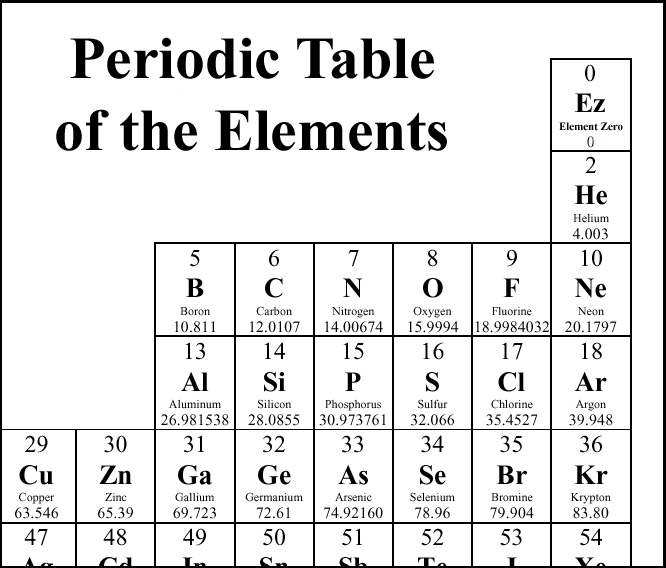
Fun publicity stunts aside, Mass Effect is a good game for those of us who enjoy the science part of science fiction.  Much of the story revolves around the discovery of a new element on the periodic table, an element with an atomic number of zero.  The strange qualities of “element zero” make all kinds of things possible, from artificial gravity to faster than light travel, as well as a few pretty cool guns.
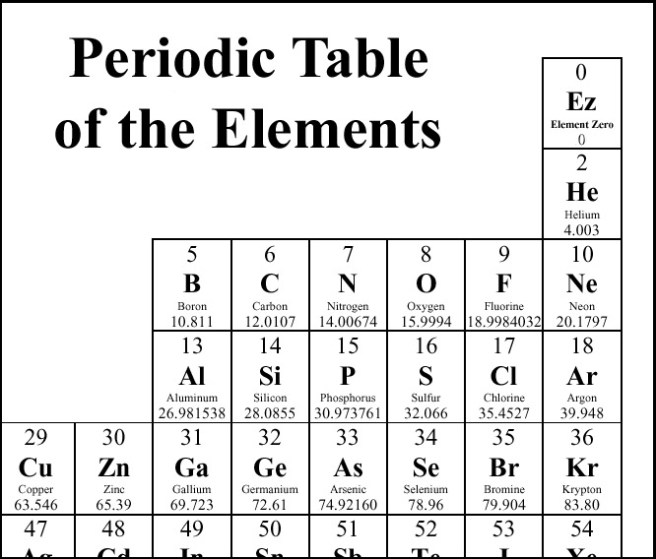
Thing is, scientists once thought to include an element zero in the real periodic table.  They called it neutronium.  As you may remember from high school science, most atoms are made from protons, neutrons, and electrons, with the number of protons determining the atomic number.  A neutronium atom has no protons; it is a single, free-floating neutron.

Scientists today don’t generally consider free-floating neutrons to be atoms in their own right, and so neutronium is not listed in the periodic table.  However, the term has been used in science fiction many times, usually to refer to incredibly strong substances produced in the heart of neutron stars.

Obviously, Mass Effect’s element zero is different than neutronium (unless you want to consider neutronium an element zero isotope).  But if a massless, atomic numberless element really did exist, it would definitely have some strange properties.  Maybe even the properties predicted by the game.

Click here for more on element zero.

Cryogenics is Really Cool

Ellen Ripley from the Alien movies, Kahn Noonien Singh from Star Trek, and even Eric Cartman from South Park were all cryogenically frozen at one time or another.  Cryogenic freezing would be a nice way to travel through space.  Unfortunately, the ice crystals that would form in your blood would slice open all your cells, killing you while you slept.  However, thanks to scientists in Russia, there may yet be life after freezing.

Eric Cartman freezes himself.

According to a report in the New York Times (click here to read it), researchers were able to grow plants from seeds that had been frozen for roughly 10,000 years.  While this is not exactly the same as bringing a person back to life after 10,000 years in ice, it’s promising.  At the very least, it proves genetic material survives the freezing process.

Given more time and research, scientists may learn to extract DNA from frozen animals, like one of those woolly mammoths preserved in glaciers.  Who doesn’t want to see a woolly mammoth at the zoo?  They might even find a way to make this safe for humans, making long voyages through space a little easier.

Baby Steps

With all of NASA’s budget cuts, it’s easy to lose sight of the big picture when it comes to space exploration.  Right now, we hear nothing but bad news.  But we have to remember the International Space Station is still up in the sky, astronomers are still finding lots of new planets, and private companies are very close to taking over where NASA left off.

At a conference for the advancement of science, Canadian Astronaut Chris Hadfield said humanity will look back on the 21st Century as a series of baby steps into space.  Yes, we’ll fall down a lot and get a few bruises, but we’re still learning, and we have to take those baby steps before we can go a lot further.

Diagram showing which countries contributed which parts to the International Space Station. Click picture to enlarge.

Hadfield is scheduled to go to the International Space Station in December.  During his time aboard the ISS, he says he will be trying to solve basic problems about human space travel, like blood chemistry, nutrition, and waste.  Astronauts aboard the ISS are working on approximately 100 different experiments to make it safer and easier for humans in the future to travel beyond Earth orbit.

For about two months, Hadfield will be in command of the space station.  He will be the first Canadian to have that honor.

For the original article on Chris Hadfield’s statements, click here.

Stop Wasting NASA’s Money

Dear Federal Government,

Once again, you are cutting funding for one of NASA’s most exciting and promising projects.  This time, it’s ExoMars, a project done in partnership with the European Space Agency (ESA).  The ExoMars Mission was to determine if life exists or ever did exist on Mars.

Although I am disappointed, I do understand, and I certainly can’t say NASA is being treated unfairly.  The budgets of almost every government agency, at both the state and federal level, are being slashed, and with the national debt as high as it is the US must try to reduce spending.  As important as ExoMars is, I know other important programs are suffering too.

However, tens of millions of dollars were already spent on ExoMars, according to Dr. G. Scott Hubbard, a planetary scientist for NASA and a professor at Stanford University, in addition to a reported 200 million euros spent by ESA.  An estimated $10 billion was already spent on the Constellation program, NASA’s effort to return to the Moon, before that was cut last year.

So, Federal Government, whatever program you decide to let NASA work on next, give them a chance to finish it.  It is a far greater waste of money to cancel one program after another than to allow one of them run to completion.

Signed,

James S. Pailly

Science Enthusiast and Concerned Citizen.

Star Trek and Doctor Who: Together at Last

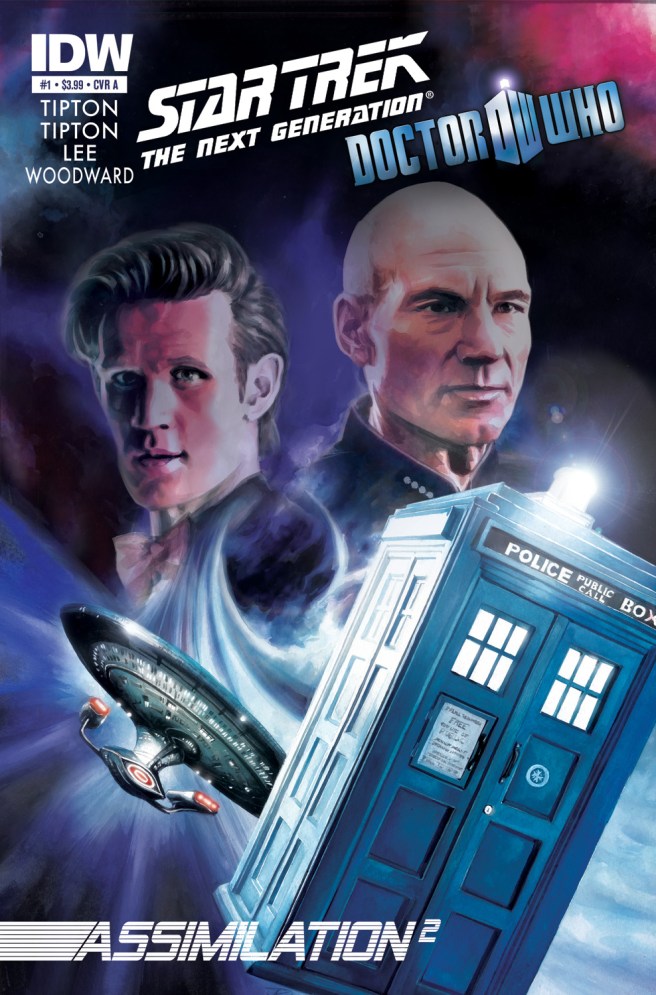
It’s been a long time since I’ve bought a comic book, but I might have to go get this one.  IDW Publishing has announced the first ever comic book crossover between Star Trek and Doctor Who.  These are the two longest running science fiction television shows of all time, and in my opinion they are two of the best.

According to the IDW website, the story will feature the Eleventh Doctor teaming up with Captain Picard and the crew of the Enterprise-D to defeat the Borg and the Cybermen.  Anyone familiar with both series should immediately see why these two enemies would join together.  The only thing that would make this even better is if Darth Vader showed up somehow.

There were rumors awhile back that Paramount and the BBC were talking about a crossover staring the Tenth Doctor and the crew from Star Trek: Enterprise.  But nothing ever came of it.

Click here to visit the IDW website and learn more about the Star Trek/Doctor Who crossover.