
IWSG: Confession of a Perfectionist

Insecure Writers Support Group Badge

Today’s post is part of the Insecure Writer’s Support Group. It’s a blog hop where insecure writers like myself can share our writing worries and offer each other advice and encouragement. Click here to find out more about IWSG, see a full list of participating blogs, and maybe sign up yourself.

* * *

What if journalists could travel through time? That’s the premise of my Tomorrow News Network series. T.N.N. reporter Talie Tappler and her cyborg cameraman, Mr. Cognis, cover the biggest, most earth-shattering stories in galactic history before they happen.

Sometimes their stories are literally Earth-shattering.

Talie's Violet Eyes

I’m currently preparing to relaunch this project in ebook form. Tomorrow News Network, Volume One, will include the first five short stories. Volume Two will include the next five, and so forth.

It’s important to me that I get this right. It’s really, really important to me that I get this right. And that’s been a problem.

My fear of getting this wrong, even in some minor detail, has seriously held me back. So my plan is to get over my perfectionism and take a chance, knowing that I’ll probably make some stupid mistakes along the way.

I’m relaunching Tomorrow News Network, personal fears and insecurities be damned. And if I do screw this up, I’ll call it a learning experience and try to move on. Because there’s one thing I know for certain: I won’t learn anything if I just sit here worrying about my imperfections as a writer.
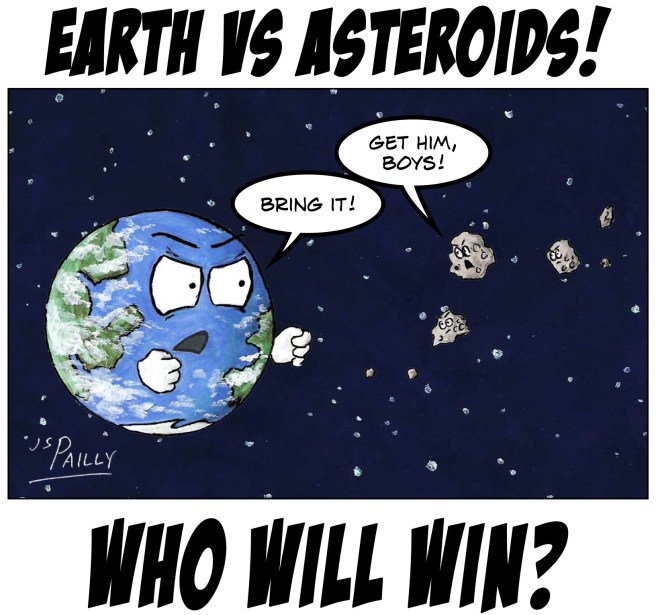
Earth vs. Asteroids

My25 Earth vs Asteroids

Is your planet safe? Nobody wants another Tunguska Event. Certainly we don’t want another K-T Event. So what are we doing to protect ourselves?

Thanks to grant money from NASA, the University of Hawaii has started setting up a series of telescopes specially designed to hunt for Near Earth Objects (N.E.O.s). These are objects, such as asteroids, with orbital paths that approach or cross Earth’s orbit.

The University of Hawaii’s new telescopes are collectively known as ATLAS (Asteroid Terrestrial-impact Last Alert System). Once fully operational, ATLAS promises to provide us with several weeks notice for large, incoming asteroids. For smaller, though still hazardous asteroids, ATLAS should give us at least a few hours warning.

So is our planet safe?

As more and more programs like ATLAS come online, we should get better coverage of the night sky and longer warning times for incoming objects. But there will still be a problem—a huge problem.

You see, you can’t really do astronomy during the day. That means asteroids coming at us from a sunward direction will go completely undetected. You may remember back in 2013 when a significantly-sized asteroid exploded over Russia, shattering windows and injuring over a thousand people. That asteroid came from a sunward direction.

No amount of ground-based telescopes could have detected that 2013 asteroid. But perhaps a space telescope, similar to the SOHO telescope we use to monitor solar flares, could help plug this gap in our planet’s defenses.

Picasso and the Moon Landing

I wish I’d been around to see the Moon landing. The good news is I’ll probably be alive to see the first humans land on Mars. That’s exciting. It’s hard for me to imagine not being excited about these things.

So it was with some shock that I read this quote from Pablo Picasso. Apparently in 1969, the New York Times asked Picasso what he thought about the Apollo 11 mission, and he said:

It means nothing to me. I have no opinion about it, and I don’t care.

Now it’s not like Picasso didn’t have some appreciation for science. Based on what I know about art history, I’m given to understand that the weirdness of Picasso’s work was influenced, to some extent, by the weirdness of Einstein’s physics.

The multiple perspectives unified in a Picasso painting supposedly reflect the multiple frames of reference that are unified in the theory of relativity. Or at least, that’s what I’ve read in art history books and in books on the history of science.

So why did Picasso think so little of the Moon landing? I think I can guess. “It means nothing to me. I have no opinion about it, and I don’t care.” I sense a touch of bitterness in those words. Maybe Picasso was just upset he didn’t get to go to the Moon himself.

If so, then I can understand where he’s coming from.

John Oliver Talks About Science

The popular press misrepresents 93% of the scientific findings it reports on. This according to a new paper in the journal My Imagination. But seriously, science gets misreported by the media a lot.

I’ve wanted to write something about this for a while now. Fortunately, I don’t have to. John Oliver from Last Week Tonight just did it for me. Thanks, Mr. Oliver!

Mars vs. the Moon: Where Do You Want to Go?

Okay, fellow humans. Where should we go next? Should we return to the Moon or push onward to Mars?

Ap12 Mars vs the Moon

It would be nice if we could do both, but space exploration is expensive. So at least in the near future, we as a species will probably have to choose.

If you pay any attention to NASA’s public relations, you know the United States is aimed for Mars. Almost every new piece of NASA tech is billed as Mars-ready or Mars-capable. Almost every experiment, including Scott Kelly’s Year in Space mission, is somehow Mars related. NASA has produced tons of videos, posters, and infographics, and they’ve made #JourneytoMars a thing on Twitter.

But an actual Mars landing is still at least twenty years away. A lot could happen in twenty years, politically and economically speaking. Regarding the politics of space exploration, international partnerships play a key role. Big, expensive projects become a lot more feasible when costs are divvied up among multiple countries.

Right now, the European Space Agency (ESA) is mulling over the idea of establishing a permanent outpost on the Moon. This moon base, or “moon village” as it’s sometimes called, would be the successor to the International Space Station.

If ESA does get their moon village started, no doubt the Russians and the Japanese will want to be part of it. And so will the U.S. But where will that leave NASA’s #JourneytoMars ambitions?

Personally, I’d really like human beings to finally set foot on Mars, preferably in my lifetime. But ESA’s moon base proposal seems more achievable in the near-term. In a way, it does feel like a logical next step after the International Space Station. But that’s just my opinion.

So what do you think? Were do you, fellow humans, want to go next: back to the Moon or onward to Mars?

I’ve Crossed a Doorway Between Worlds

I’m postponing today’s Molecular Monday post until next week. Why? Because I was just interviewed by Sue Archer from Doorway Between Worlds, and the interview came out today!

You should click here. I might have some interesting things to say. Or I might not. You won’t know unless you click the link.

And if you’re disappointed about not having chemistry stuff to read today, don’t worry. Sue and I ended up talking quite a bit about chemistry. More than I was expecting, to be honest.

Europa: My Favorite Moon

Fun fact about me: Europa is my favorite moon.

Mr07 Moon 1

Oh, sorry Moon. You’re cool too. It’s just… you don’t have an ocean. Or chaos terrain. Or possible alien life. It’s nothing personal.

Mr07 Moon 2

Anyway, on Monday I told you that Congress wants NASA to put a robotic lander on the surface of Europa. But the really interesting bit is deep beneath the surface, where the ice turns to liquid water. Is anything alive down there? Any microbes? Maybe fish? What about alien mermaids?

A lander can’t investigate that sort of stuff. At least not directly. But if you’ve ever seen a picture of Europa…

Mr07 Europa

… you’ll notice the surface is covered in dark reddish-colored lines. These lines appear to be cracks. It’s believed that warm water sometimes forces its way to the surface, carrying with it a mix of minerals and possibly other materials from the oceans below. It’s these minerals which cause the reddish discoloration.

So while a lander can’t sample the ocean water directly, it could examine the materials that have been deposited on the surface. Now, if you’ll allow me to switch my science blogger hat for my science fiction writer hat, I’ll tell you exactly what the Europa lander will find.

Salt. Lots of salt. That won’t surprise anyone. It’s been long assumed that Europa’s ocean is much saltier than the oceans here on Earth. It must be; otherwise the ocean would freeze.

The lander will also detect other minerals as well. And amino acids. That’ll raise some eyebrows, but amino acids aren’t that uncommon. We’ve found them on other planets and we’ve found spectrographic evidence of them all across space. As I reported in last week’s Molecular Monday post, there are literally hundreds or perhaps thousands of different kinds of amino acids in our universe.

Mr07 Surface of Europa

That will make headlines. No, it’s not the same 21 amino acids coded for by human DNA, but this cannot be a coincidence. What natural phenomenon, other than life, could produce such a select few amino acids in such large quantities?

But wait, there’s more. These 21 amino acids have something in common. They have the same chirality. And that’s the part where the entire scientific community freaks out.

Tune in for Friday’s edition of Sciency Words to find out what the heck chirality is and why it’s so important in the search for alien life.

P.S.: My second favorite moon is Titan, followed by Io, Miranda, and Triton. Oh, and Naiad! I love Naiad. But Earth’s Moon totally makes in my top ten. Probably.

Europa: To Land or Not to Land?

NASA has big plans for Europa. It is, after all, Jupiter’s most interesting moon.

Ag04 Europa Blush

But the details of these big plans have been in a state of flux for a while. The mission would undoubtedly include an orbiter, but should it orbit Europa or Jupiter? What about also sending a lander or rover? Or maybe a submarine? Europa does have an ocean somewhere beneath its icy shell.

Okay, there’s no way Congress would pay for all that, so NASA decided to scale down its ambitions. In other words, the mission was descoped. No landers, no rovers, and definitely no submarines. Also, the orbiter would orbit Jupiter. Entering orbit of Jupiter requires less delta-v, and therefore less fuel, than trying to enter orbit of any specific Jovian moon.

But even after scaling everything down, this Europa mission would still come with a hefty price tag. Congress held hearings. This couldn’t go well. So what happened?

Congress told NASA to put the lander back in the mission plan and put up money to pay for it.

Mr06 Europa 1

That’s right. Congress suggested—no, commanded—that NASA include a lander as part of its Europa Clipper mission and provided money to pay for it. I guess you could say this mission was de-descoped. Or maybe it was rescoped.

Now I’m not naïve enough to think that Congress has suddenly developed a deep appreciation for planetary science. It’s more likely this lander will be built by some company that donated generously to someone’s campaign, or maybe it will be built within some influential congress-person’s district.

I’m not a political blogger, so I don’t want to get into that. What I do want to say is this: we’re going to Europa, baby!

Mr06 Europa 2

Links

We’re Going to Europa from SciShow Space.

A Lander for NASA’s Europa Mission from The Planetary Society.

Congress: NASA Must Not Only Go to Europa, It Must Land from Ars Technica. This last link is particular interesting because it suggests that NASA doesn’t really want to go to Europa at all, but Congress is forcing them to do it.

How I Met a LIGO Scientist

Today’s post is sort of a personal story. Back in November, I attended a rather ritzy fundraising gala. A dear friend of mine was being honored with an award at this gala.

It just so happens that while I was at this event, I met Dr. Beverly Berger. That’s right. The Beverly Berger. The retired program director for gravitational physics at the U.S. National Science Foundation, although right now she’s better known for her association with LIGO. (If you haven’t heard of LIGO, I suggest you click here or here or here or here. They’ve been in the news a lot lately.)

Turns out Dr. Berger is related to my friend by marriage. She was introduced to me only as “a physicist” (it was much later in the evening that I learned of her connection to LIGO). I was introduced to her as a science fiction writer.

Here’s the funny part of the story: someone commented that, as a scientist and a science fiction writer, we should have plenty to talk about. Dr. Berger responded with a wry smile, saying, “Oh, I’m not so sure about that.”

I smiled too. Of course, I knew exactly what she meant. Despite the fact that the word “science” is in “science fiction,” there seems to be an odd disconnect between science fiction and real life science. To a physicist of Dr. Berger’s caliber, any discussion of laser guns, hyperspace, or teleportation must seem quaint at best and profoundly silly at worst.

In my own writing, I do at least try to get the science right. Well, my main character is still a time traveler, and the aliens from Roswell are still among her principle antagonists. But aside from that stuff, I try to get the science right.

I can only hope that, in the course of our conversation, Dr. Berger recognized that I do make an effort. She seemed somewhat interested in my Sciency Words series, so that’s a plus.

One final note: that evening, back in November, I asked Dr. Berger how soon LIGO might be able to detect gravitational waves. She gave me a rather non-committal answer: “Maybe soon.” I thought nothing of that at the time, other than a respect for her confidence in the LIGO project.  Of course, I now know that LIGO had already detected these waves. It had picked up the signal back in September, but the data was still being reviewed and could not be revealed to the public just yet.

That Beverly Berger… she is a cagey one!