The End for Juno?

We’ve always known the Juno Mission to Jupiter would be a short one.  Often times planetary science missions like Juno will get extra funding for extended missions, because it costs less to keep using a spacecraft you already have than it does to design, build, and launch a new one.  But as I wrote two years ago, this really wouldn’t be an option for Juno.

The reason is that Jupiter has at least one moon (Europa) and perhaps two others (Ganymede and Callisto) which may be home to alien life.  Based on everything I’ve read about Europa in particular, I think it would be a bigger surprise if we didn’t find life there; that’s how promising the place looks.

NASA absolutely cannot risk letting Juno crash into and contaminate any of those moons (especially Europa).  So after completing its scheduled mission, which was meant to take about two years, Juno would do a suicide run into Jupiter’s atmosphere, destroying itself to ensure there are no future accidents, and also collecting a little extra atmospheric data in the process.

Except shortly after Juno arrived in Jupiter orbit, it ran into some engine trouble, something to do with a pressure valve opening too slowly. As a result, Juno wound up stuck in a much wider and much longer orbit than originally planned.  Rather than getting a science pass every 14 days, we’re getting them every 53 days, which has dramatically slowed down Juno’s progress.

Juno’s two years are almost up, but because of that pressure valve malfunction its mission is only half complete.  So now Juno needs that mission extension that it was never supposed to get.  A planetary scientist working on the Juno Mission was recently quoted as saying: “I think for sure the continuation mission will go on.”  He then added: “I’m hopeful but nervous.”

Funding for the Juno mission (for ground operations, mission control stuff, etc) will run out in July of this year. Given the circumstances, I have to assume NASA will grant Juno an extension, but as of this writing they have not done so.  Navigating the bureaucracy here on Earth can be just as nerve-wracking as all the hazards of space.

I’m not sure how much Congress is involved in the decision making process here, so maybe that’s what’s holding things up. Or maybe Juno has run into other technical issues which NASA hasn’t made public yet.  I don’t know, but if anything else went wrong with the spacecraft during its extended mission, we might lose control of it, and we really, really do not want it crashing into those icy-on-the-outside, watery-on-the-inside moons.

So fingers crossed.  Hopefully everything works out okay and Juno can get its extended mission.

New Horizons: The Road Goes Ever On

The New Horizons mission has been on my mind recently, in part because of my post last week on Ultima Thule, but also because I just started reading Chasing New Horizons: Inside the Epic First Mission to Pluto by Alan Stern and David Grinspoon.

New Horizons has already visited the most distant “planet” in the Solar System (Pluto was still considered a planet when New Horizons launched), and now it’s going to explore an object even more distant than that. And after that?  Onwards to interstellar space, just like Voyager I and Voyager II, to continue exploring the universe for us.

But as I said, all this has got me thinking about travel and exploration and discovery, and also strangely (or perhaps not so strangely) about J.R.R. Tolkien.  So today I’d like to share a piece of Tolkien’s poetry, something that fit nicely into The Lord of the Rings but also fits nicely (I think) into the ongoing saga of the New Horizons mission.

Didymos, Didymoon, and Didy-me

I’m a huge space enthusiast and science enthusiast, but I am not an actual scientist.  I’m an outsider looking in, drooling a little as I watch all those real scientists doing all that real science.  But even as an outsider, I still sometimes get the chance to contribute in my own small way to the cause of science and space exploration.

Coming up in June of 2018, the Didymos Observer Workshop will be held in Prague, Czeck Republic.  For those of you who don’t recognize the name, Didymos is a large asteroid with an orbit that sometimes brings it alarmingly close to Earth.  It’s also one of those asteroids that has its own tiny moon, a moon which is informally known as “Didymoon.”

The Didymos Observer Workshop will be discussing the upcoming AIDA mission, a joint venture between NASA and ESA.  According to the workshop’s website, “AIDA will be the first space experiment to demonstrate asteroid impact hazard mitigation by using a kinetic impactor to deflect an asteroid.”  In other words, we’re going to whack Didymoon really hard to see how much we can change its orbit around Didymos.

Honestly, I feel a little bad for Didymoon, but the results of this experiment will help us prepare for the day when we need to smack an incoming asteroid off of a collision course with Earth. This is important for science, and someday it may save a whole lot of lives.

And I am really, really proud to say that one of my drawings is being used (with permission, of course) in the Didymos Observer Workshop’s promotional material.  Click here to check it out!

Molecular Monday: In Desperate Need of Nitrogen

Today’s post is part of a bi-weekly series here on Planet Pailly called Molecular Mondays, where we take a closer look at the atoms and molecules that make up our physical universe, both in reality and in science fiction.

Imagine you’re a traveler in space, living in a time two or three centuries hence, engaging in the trade of resources between Earth, the Moon, Mars, and the asteroid belt.  What is the rarest and most precious resource necessary for your survival out there?

You might think it’s oxygen, or perhaps water.  Those are difficult resources to find in space, but not that difficult.  A surprising number of asteroids do, in fact, have a surprising amount of frozen water on them or inside them.  And if you can get water, you can easily split water molecules into hydrogen and oxygen through the magic of electrolysis.

No, of all the resources you absolutely must have to stay alive, the hardest one to find out there may actually be nitrogen.  I first read about this nitrogen problem in a book called Asteroid Mining 101: Wealth for the New Space Economy, which says:

Nitrogen presents a more significant problem [than other essential resources]. Because of the great stability and high volatility of molecular nitrogen, it is poorly retained by solid minerals and poorly represented in meteorites.

Volatility, in this context, refers to the tendency of a chemical substance to turn itself into a gas. Planets and moons and asteroids (especially asteroids) have a really tough time holding onto volatile chemicals, also referred to as “volatiles.”  And the closer a celestial body happens to be to the Sun, the more likely it is to lose its volatiles to the solar wind.

Your best bet for finding nitrogen in space would be the carbonaceous asteroids that tend to be found in the outer reaches of the asteroid belt.  They’re a little bit farther from the Sun, and therefore have held on to their volatiles a little bit better.  These carbonaceous asteroids are also one of the best places to go looking for water.

But according to Asteroid Mining 101, nitrogen has been found to make up only about 0.25% of the mass of carbonaceous meteorites, mostly in the form of organic polymers.  “The figure of 0.25% is not very impressive […],” the book goes on to say (what an understatement of the problem!), but if you manage to capture a large enough carbonaceous asteroid, you could still potentially harvest a fair amount of nitrogen from it.

Of course if we were to imagine ourselves living in the even more distant future, in an era when humanity has expanded well beyond the asteroid belt, perhaps making it all the way out to the Kuiper belt, then nitrogen might not be such a ridiculously scarce resource. Based on what we’ve learned about Pluto and other Kuiper belt objects, it seems frozen nitrogen is a whole lot more common out there.

Out Sick

Welcome to another episode of Molecular Mondays, a special bi-weekly series here on Planet Pailly about chemistry.  Every other Monday, we take a closer look at the atoms and molecules that—

Turns out my muse won’t let me write when I’m sick.  I’ve come down with a really bad cold, or maybe it’s the flu.  I don’t really know, but I should be well enough to write again in time for Sciency Words on Friday.

In the meantime, I’ll do my best to get better, with a little help from this chemical and this chemical and this chemical.

Fish in Space!

So the cartoon… I mean, the highly technical diagram in yesterday’s post implied that being in space wouldn’t be much of a thrill for fish. I mean, they swim up, they swim down… they swim in whatever direction they want, right?

But then I found a video showing a side-by-side comparison of the fish tank aboard the International Space Station and an identical fish tank down here on Earth, and it looks like I was very, very wrong. Fish do change their swimming behavior in microgravity. It’s really pretty, actually, watching them spin and twirl about.

Molecular Monday: Venus’s (Formerly) Unknown Absorber

Today’s post is part of a bi-weekly series here on Planet Pailly called Molecular Mondays, where we take a closer look at the atoms and molecules that make up our physical universe.

Okay, I know I said March would be Mars Month here on Planet Pailly, but for today’s episode of Molecular Mondays, we really must talk about the latest news from Venus. Our best lead for finding life on Venus has just dried up.

The idea of life on Venus has always been a long shot, but for the last few decades planetary scientists have been puzzled by a mysterious something in the Venusian atmosphere. A something that absorbs large quantities of light in the ultraviolet and near-ultraviolet part of the spectrum. This unknown UV absorbing substance has come to be known as the “unknown absorber.”

In his book Venus Revealed, planetary scientist David Grinspoon hypothesizes that the unknown absorber could perhaps maybe possibly be a “photosynthetic pigment” similar to chlorophyll. If so, that would mean there are little, photosynthetic microorganisms swarming about in Venus’s atmosphere, gobbling up UV radiation and converting it into usable energy. This hypothesis is extremely unlikely—Grinspoon makes that abundantly clear—but we could never rule the idea out entirely.

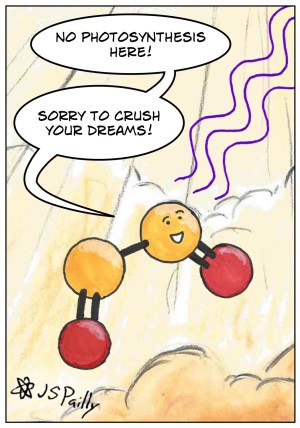
Except, unfortunately, we can now rule this idea out entirely. The unknown absorber has been identified. It’s not a photosynthetic molecule. It’s not even a particularly complicated molecule. It’s just a simple sulfur/oxygen compound called disulfur dioxide.

The story goes like this: sulfur monoxide (SO), which is fairly common in Venus’s atmosphere, combines with itself to form disulfur dioxide (S2O2). Specifically, it creates two different versions (or isomers) of disulfur dioxide called cis-OSSO (which has its oxygen atoms oriented in the same direction, as pictured above) and trans-OSSO (which has its oxygen atoms oriented in opposite directions). Then when cis- and trans-OSSO absorb ultraviolet light, they break back down into sulfur monoxide, and the cycle begins anew.

So our best hope for finding life on Venus appears to be gone. Oh well. It was a long shot anyway. I still have high hopes for finding life (probably fossilized life) on Mars.

Mars Month!!!

I took some time off from my special Mars mission this year because… well, because I felt like blogging about some other stuff for a while. But I always intended to pick this up again where I left off.

The month of March seems like a pretty good time to do it. March is, after all, named in honor of Mars. Mars the god of war, obviously, rather than the planet… but still, March is now officially Mars Month here on Planet Pailly, and that feels right to me.

IWSG: Star Trek Wisdom

Today’s post is part of the Insecure Writer’s Support Group, a blog hop where insecure writers like myself can share our worries and offer advice and encouragement. Click here to find out more about IWSG and to see a list of participating blogs.

* * *

I’ve been debating with myself how much I should reveal for this month’s IWSG. I’ve decided this is a case where less is more.

I had an extremely rough week last week, which was the culmination of a rough month, which was ultimately the culmination of a year that did not go according to plan. The important thing is that I feel like I should have seen all this coming, that I should have done something to protect myself or prepare myself better.

In other words, I feel like what happened was my own fault. That, more than anything else, took a psychological toll on me. That, more than anything else, is the reason why I recently took some time off from blogging and from writing in general, and I actually wasn’t sure for a while if I had it in me to ever pick up the pen again.

But then I ended up watching some old episodes of Star Trek, and Captain Picard said exactly what I needed to hear: […] it is possible to commit no mistakes and still lose. That is not a weakness. That is life.”

I’m sharing this today for two reasons. First, because I think there’s a good chance someone else out there might need to hear those words, just like I did. And second, because this is another example of what fiction (even so-called escapist fiction) can do for people.

Yes, Star Trek allowed me to escape for a little while from my real life problems; that in and of itself has some value. But it also helped me see my problems in a new light. That kind of clarity is a valuable gift. We need more of that, which is why I’m leaving my own hesitation and self-doubt behind and getting back to writing. And I hope that, no matter what insecurities the rest of you might be dealing with, you will keep writing too.

Back to Earth

Quick programming note: I’m currently dealing with a small personal matter. I’d rather not go into any details about it, but it’s nothing serious. No need to worry.

However this small matter does require me to come back down to Earth for a little while, which means I’ll have to take a brief hiatus from blogging.

I expect things to return to normal by the end of the week, so I should be able to resume my special Mars Mission next Monday. I’ll have some weird rocks to tell you about; trust me, it’s a lot more interesting than it sounds. So stay tuned!