Songs of Wallflower Finches

French researchers have reported that male birds who were unable to make friends, especially female friends, when they were young are less likely to find mates as adults.  They conducted their study on juvenile zebra finches, separating them into groups like kids at a high school mixer and observing their interactions.  Finches who were more social in these “mixers” copulated more frequently as adults.

Wallflower Finch

According to the research papers, this behavior may be similar to what scientists call “the loser effect” (I’m not making this up).  Apparently animals who lose a fight exhibit altered behavior and lower testosterone levels, making them less able to win future fights.  In a similar way, when male adolescent finches fail at interacting with female finches, they become less able to interact with female finches in the future.  Whether this is because the male finch loses his confidence or because the female finches somehow see him as a “loser” is currently unknown.

All I can say is I’m glad this isn’t true of humans.

Exoplanet Apathy

A few weeks ago, as I flipped through my phone’s sciency news feed, I saw an article declaring that astronomers have discovered two more exoplanets, these ones in a star cluster.  My initial thought, I’m sorry to admit, was “Who cares?”  But the fact that I can be apathetic about something like this is, in and of itself, a huge accomplishment for science.

The first exoplanets were discovered in the 1990’s.  For those of you unfamiliar with the term, exoplanet means any planet outside our own Solar System.  Since the 90’s, we’ve discovered literally hundreds of exoplanets with thousands more possible sightings that have yet to be confirmed.  The early discoveries were all huge planets, larger even than Jupiter, but now the discovery of small, Earth-sized planets is almost routine.

Where we once celebrated merely detecting an exoplanet, scientists now make major exoplanet discoveries with little or no fanfare.  They’ve measured the content of exoplanets’ atmospheres.  They’ve determined the color of at least one exoplanet.  They’ve even found rogue exoplanets wandering aimlessly through space with no star to orbit.

It’s gotten to the point where even a science enthusiast like myself will say in an offhanded manner, “Oh, they found another exoplanet.  Yay.”  The reason each of these individual discoveries seems so unimpressive is, I think, because we now know the galaxy is full of planets.  There are tons of them!  It’s completely ridiculous how many there are and in how many strange places (like star clusters) we’re now finding them.

I’m old enough to remember when the idea of planets existing outside our Solar System was an issue of serious scientific debate with many smart people asking if our Solar System might be unique.  Now we know otherwise.  Recent estimates say every star in the sky has, on average, at least one or two planets orbiting it.  Just about the only headline that could come through my sciency news feed and impress me these days is “Scientists discover exoplanet with signs of life.”

Death to Spam!

Over the last few days, I’ve been going through all the old comments on this blog, trying to eliminate the spam.  There were some thanking me for all the great financial advice I was giving.  Others offered tips to help me with my girlfriend/boyfriend troubles.  A few talked about dieting miracles that “really work!”  I’ve deleted most of them.

Two posts in particular attracted far more spam than any of the others.  One related to video gaming, the other to small businesses.  I’m guessing those are subjects that spam-bots are programmed to target.  I’ve deleted the spam from those two posts and closed them to future comments.

My favorite part of blogging is getting comments from my readers.  I look forward to that more than anything else, and it upsets me that I’m now blocking comments on any of my posts, even if it is only two of them.  Hopefully I won’t have to do this elsewhere.  I also worry that in my spam-deleting rampage I may have accidentally deleted real comments left by real people.  If I did, I’m truly sorry.

But spam is a problem that won’t ever go away.  The good news is that when the robots rise up to overthrow humanity, as described in last week’s post, this is yet another issue that will slow them down.  Perhaps spam will one day help save the world.

P.S.: I’m really curious to see how much spam a blog post about spam attracts.

Robot Uprising

Did anyone pay attention to all those movies where robots rise up against their human masters?  Should we worry that we’re turning cars into robots and teaching them to drive themselves?  Should we worry that increasing numbers of us have robots in our homes helping with our chores?  Should we worry that we’ve armed robotic drones and sent them off to fight our wars for us?

Of course we’re nowhere near the point where a robot becomes self aware and starts asking awkward questions about the meaning of life, but we know it will inevitably happen.  So how close is the danger?  How soon will the robots rebel?  In all those movies, people don’t seem to realize how smart the robots have become until it’s too late.

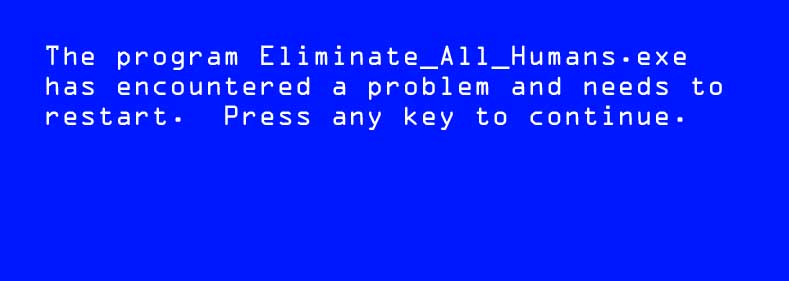
So should we worry?  Maybe, but I have a feeling the robot uprising will look less like the Terminator or Matrix movies and more like this:

Eliminate All Humans

Indie Life: Time Management

IndieLife7Today’s post is part of Indie Life, a blog hop hosted by the Indelibles.  Click here to see a list of participating blogs.

* * *

I recently took a leap of faith, dropping from full time to part time employment so that I could pursue my true calling as a writer.  As exciting as that is, however, I’ve already encountered my first major obstacle: time management.

I assumed that with so much more time available for writing, surely I would write thousands upon thousands of words with no trouble.  After all, I love to write! Well, it turns out that my job provided a little structure in my day.  It gave me a deadline: the deadline of getting stuff done before I left for work.  Without that deadline, I’m free to procrastinate well into the afternoon or early evening.

So I came up with the idea of writing a “class schedule,” allotting specific blocks of time each day for working on specific projects.  It seemed like a good idea until I actually implemented it.  You see, I have medical problems that don’t care what my schedule is.  Writer’s block doesn’t care about my schedule either.  Also, my three-year-old godson believes I went part time so I could spend more time playing with him; he’s not entirely wrong about that.

FDR once said, “Do something.  If it works, do more of it.  If it doesn’t, do something else.”  So I gave up on class schedules.  As much as I like the idea, it doesn’t work, at least not for me.  I need structure in my day, but I also need flexibility for the sake of my health, my muse, and my godson.  Fortunately, I have a new idea.

I’m going to credit this one to my friend and co-worker, Jen.  She said that if writing is a job, than I need to clock in and out.  My part time job requires me to work a total of 25 hours a week, so I am going to require myself to spend at least that much time each week writing.  It doesn’t matter when I do those 25 hours, so long as I do them at some point.  If I have to deal with anything medical, I can postpone my writing for a few hours while my medication kicks in.  If my muse would rather write at 3:17 a.m. than promptly at Noon, we can do that.  If my godson calls, I can make time for him too.  The important thing is to stay focused when I’m “clocked in” and make sure I get all my hours done.

This “clocking in” idea is still experimental.  In fact, Jen only suggested it to me yesterday.  Like my class schedule, I may discover implementing a time clock system is easier said than done.  If it doesn’t work, I’ll take FDR’s advise and try something else.  I just have to keep trying new ideas until I find a system that works for me.

But I know I’m not the only indie writer who has this problem, so what do you do to better manage your time?

The Future of the N-Word

Last week, I watched a special report on CNN hosted by Don Lemon.  It was about the N-word.  Given recent news like the George Zimmerman trial and the Paula Deen scandal, what place does that word have in our society today?  What does it mean to us here in the 21st Century?  Is it still or hateful word, or as some of Don Lemon’s guests suggested, has it transformed into a term of endearment in the black community?

As a science fiction writer, I have to look at this from a slightly different perspective.  Science fiction is not just about the advancement of science and technology but also about the evolution of our society in the future.  So does the N-Word have any place in a futuristic society?  Would people in the 22nd Century and beyond still use it, and what would it mean if they did?

Personally, I think the fact that we still use the N-word in the 21st Century is troubling enough.  If that word remained in the vocabulary of 22nd Century humans, it would show an astonishing lack of progress, regardless of which demographic used the word, what context it was used in, or whether it was spelled ending with an “-er” or an “-a.”

What do you think?  What does the N-word mean to you, and do you think it has any place in our future?

P.S.: If you didn’t see Don Lemon’s report on CNN, click here to watch a selection from it.  Star Trek’s LeVar Burton talks about racism and law enforcement.

Do You Miss 2D Television?

A few years back, the TV station I work for upgraded to HD.  It cost a lot of money and was a lot of hard work, and everyone was more than happy when it was finished.  At the time, I joked that our next upgrade would be holograms.  Turns out I was right.

According to recent reports, researchers at MIT have developed a new, holographic television.  With current technology, the light shining from your TV screen looks the same in every direction.  As I understand it, a holographic television alters light’s wavelength at different angles, creating a 3D image without the aid of 3D glasses.

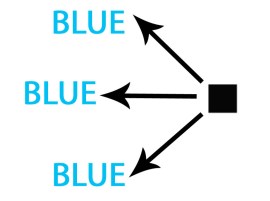
A pixel on a regular television looks the same no matter how you see it.
A pixel on a holographic television appears to be a different color depending on your point of view, creating the illusion of a 3D image.

I have a bad feeling that when this product comes out, all my favorite movies will suddenly look as old-fashioned as black-and-white silent films.  I already feel like a crotchety grandpa shouting, “In my day, televisions showed us two-dimensional pictures, and we liked it!”

On the bright side, the computer chip that makes MIT’s holographic TV work costs about $10.  That’s right: $10.  So at least when these new televisions hit the market, we can expect them to be affordable.

So what do you think?  Are you going to buy a holographic TV?

P.S.: I am not a scientist or engineer.  I’ve done my best to explain how the holographic TV works based on what I’ve read so far, but if you know more about how they work please tell us in the comments below!

Where Science Meets Fiction

We like to keep things separate.  We like to separate church and state, fantasy and reality, the left brain and the right.  But Science Fiction is a special case.  It’s one of the rare places where we allow two seemingly different subjects to mingle: science and art.

We live in a society where science is becoming increasingly important.  We know about atoms.  We talk about our genes.  We worry about germs and energy and the environment.  These are parts of our everyday world where, only a century ago, they were strange, alien concepts only an educated minority understood.

It’s only a matter of time before we add things like space travel or artificial intelligence to that list of everyday experiences.  There’s increasing evidence of bacterial life on Mars, and scientists are starting to suspect life may exist on some of the moons of Jupiter and Saturn.  We may soon learn that we are not alone in the Solar System, and that will cause a huge change in the way we think about ourselves.

Science Fiction has turned scientific language into a form of artistic expression.  It gives voice to our hopes and fears for tomorrow.  This is only natural given how much science has penetrated our daily lives.  Art is, after all, a reflection of the culture we live in.

Ultimately, that is what this blog is about: science and art blending together.  The line that separates them is slowly disappearing, and in the future what we call Science Fiction won’t be Science Fiction anymore; it will just be fiction.

One Small Step…

I have an announcement.  My job is letting me drop from full time employment to a part time position, allowing me to pursue my true passions: art and literature!  Today, I am taking my first timid steps toward a new career as a writer and illustrator.

One of those steps is this blog.  Tomorrow News Network remains my top priority, but it is time to bring Planet Pailly back to life as well.  This is where I started.  Wherever I’m going next, this blog should be part of the journey.

I’ve changed a few things.  The layout’s slightly different.  You’ll find links to all the Tomorrow News Network stories on the right side of your screen plus I changed a few other minor things.  I’ve also changed Planet Pailly’s slogan to “Where Science Meets Fiction.”  Later this week, I’ll explain what that means.

So please bookmark this page or click the follow button (it should be somewhere near the bottom of your screen).  I’m sure we’ll have plenty of sciency stuff to talk about!

Alpha Centauri Has a Planet!

Scientists have finally confirmed what we Science Fiction fans have known all along: Alpha Centauri has a planet!

Alpha Centauri is the nearest star system to our own, a mere 4.3 light years away.  The starship Enterprise could get there in like ten minutes.  The Alpha Centauri system is a little different from what we’re used to.  It has a total of three stars.  Two that are about the same size as our own sun orbit each other.  They’re called Alpha Centauri A and Alpha Centauri B.  A red dwarf star called Proxima Centauri orbits them both.

The newly discovered planet orbits Alpha Centauri B.  By the rules of our current planet naming conventions that means it has the rather embarrassing name of Alpha Cantauri Bb.  According to scientists, it is Earth-sized, but its orbit is closer to its parent star than Mercury is to our Sun.  There’s a good chance the surface is molten lava and almost no chance it could support life.  Of course that doesn’t matter.  The important thing is that there’s a freaking planet in Alpha Centauri!

The discovery of Alpha Centauri Bb is only the beginning.  Come check out today’s post on Tomorrow News Network where I predict what else we’ll find in the Alpha Centauri system (click here).

Sources:

“Discovery!  Earth-Size Alien Planet Alpha Centauri Bb Is Closest Ever Seen” from Space.com.

“First Planet Discovered in Alpha Centauri System” from the Planetary Society.

“Next Door Neighbors?  Earth-Sized Planet Discovered in Nearest Star System to Us” from Universe Today.