IWSG: The Perils of Word Counts

InsecureWritersSupportGroupToday’s post is part of the Insecure Writer’s Support Group, a blog hop hosted by Alex J. Cavanaugh.  It’s a way for insecure writers like myself give each other advice and encouragement.  Click here to see a full list of participating blogs.

* * *

Here’s a piece of advice attributed to one of my role models: “Not everything that counts can be counted, and not everything that can be counted counts.”  These words are often attributed to Albert Einstein, although there is some scholarly debate as to whether or not Einstein actually said this.  But that’s not important right now.  The words themselves have weighed heavily on my mind of late, regardless of their historical origin.

I’m the kind of writer who keeps scrupulous records of everything: deadlines, word counts, the number of hours I spend writing…  I even make pie charts about this stuff.  In short, I do a lot of counting, and that usually serves me well.  Counting keeps me on schedule and forces me to work a little harder to get that extra thousand words done.  Also, because of my scrupulous record keeping, I can flip back through old calendars and see how my writing discipline has increased over the years.  Where once I struggled to complete 3,000 words in a week, I now routinely write that much in a day.

The down side is that on days when I don’t write, or for reasons beyond my control I can’t write, I see this unmarked day in my records, and that makes me feel like a failure.  It’s exponentially worse when I see a series of unmarked days in a row.

Due to a recent family emergency, I now have over a week of zero writing.  Despite the circumstances, I feel guilty.  Yes, a close relative was hospitalized, and yes, I had to travel a long distance to see her, and yes, my presence seemed to make a difference, BUT WHAT ABOUT MY WRITING QUOTA!!!

It’s only because of that quote from Einstein (or whoever) that I am able to keep things in perspective and remember that some things are more important than word counts.

Snow: Good or Bad?

I’ve heard a lot of complaining these last few weeks about snow.  Here in the North Eastern U.S., we got a lot of it.  Far more than we’re used to, and perhaps a bit more than we know how to handle.

Now I certainly understand why some people hate snow.  It’s not only inconvenient; it can also be dangerous.  Snow contributes to people getting sick.  It makes driving more difficult.  It even makes walking difficult.

IMG_1118

At the same time, snow is beautiful.  Just because it’s dangerous doesn’t change its beauty.  The Sun is dangerous, bombarding our planet with high quantities of radiation, but we still think sunshine is beautiful.  The ocean is dangerous, with all those sharks and jellyfish and, of course, the possibility of drowning, yet I think most of us would agree that it is beautiful.  So why should snow be different?

For those of you who harbor a deep, seething hatred for snow, I’m only asking one thing: take a moment to stop, look out at the fluffy, white landscape, and try to enjoy the beauty.  Just for a moment.  You can go back to complaining later, but don’t let your grumbling suck all the joy out of life.

Indie Life: Space Program

IndieLife7Today’s post is part of Indie Life, a blog hop for independent authors hosted by the Indelibles.  Click here to see a list of participating blogs.

* * *

For my Indie Life post from February of last year, I listed several reasons why being an indie writer is like running the space program.

  • Much like NASA scientists, most indie writers have unrealistic concepts about money, making it impossible to write a budget or manage the financial side of the writing business.
  • Indie authors set deadlines that sound reasonable, provide plenty of time to check and double check our work, and ensure our story/spaceship is at peak performance, but somehow we always end up behind schedule.  Maybe it’s due to the weather, maybe it’s due to technological snafus, or maybe it’s because we spend too much time “working” on Angry Birds: Space and lose track of the other stuff we’re supposed to be doing.
  • Just as getting accurate data about the hydrocarbon content of Martian soil may not sound exciting to the general public, some people may not realize how important one book sale, one new contact, one re-tweet, or one positive review on Amazon can be.  Sure, it’s not the same as landing on the Moon, but every small achievement gets us just a little tiny bit closer to our ultimate goal, and those small achievement are always worth celebrating.
  • There will always be someone who thinks this (the space program or the life of an indie writer) is a waste of time and money.  Those people are frustrating, but we have to try to ignore them.  If they don’t understand the value of such bold and ambitious endeavors, they probably never will.

One year later, I can say that I’m happy with the progress of my personal “space program.”  I’m probably better funded than NASA, given how much Congress has slashed NASA’s budget.  I also have the good fortune of having many supportive friends who understand the importance of what I’m doing.  Even the one or two critics in my extended family have decided to keep their mouths shut.

But I still have one ongoing problem: deadlines.  No matter how much time I allot for any given project, it always seems to take twice that long.  This very blog post wasn’t finished until Wednesday afternoon (I’d scheduled it to be complete Tuesday night).  The issue may be that I’m nitpicking small things when I should be moving forward with my writing.

I’m not sure how to overcome this obstacle.  Any suggestions would be welcome, and I’d love to hear how you’re doing with your own personal “space program.”

Evolution vs. Creationism

I am going to say something that may shock you: I believe in God, I believe in Jesus Christ, and I believe in the Theory of Evolution.  And I see no contradiction there.  Despite what common knowledge and popular culture may insinuate about science versus religion, many churchgoing Christians have no objection to evolution or the Big Bang.  Many of us find meaning and value in the Bible without taking it 100% literally.  And many of us cringe when Christian fundamentalists start shoving their beliefs down everyone else’s throats.

This weekend, I sat down and watched the two and a half hour debate between Bill Nye the Science Guy and Ken Ham of Answers in Genesis.  The crux of the matter seems to be a question of authority.  Do we trust the authority of God as presented in the Bible (specifically the English translation of the Bible), or do we trust the authority of human beings like Charles Darwin?  At least this is the question Ham wants us to ask.

According to Ham, science is an effective tool for studying the world as it is today, but we cannot use it to study the past because in the past the laws of physics and nature might have been different.  For example, how old is the Earth?  We can’t use carbon dating to determine the age of our planet because the radioactive decay chain of carbon 14 might have been different a few thousand years ago.  We can’t ask astronomers to measure the age of the universe because the speed of light might have somehow changed.  According to Ham, we can’t even trust tree rings to tell us how old a tree is.

Science is apparently so unreliable that we can’t really know anything for certain, Ham tells us, so we should all just accept a literal interpretation of the Bible.  After all, the Bible is the infallible word of God.  We know this because it says so in the Bible!

If you have any doubt that creationism or intelligent design or whatever it’s called these days is not a subversive attempt to teach religion in science class, please watch this debate.  Take note of how difficult it is for Ham to stay on topic.  Notice how often he strays from the “science” of creationism into a diatribe on how Christ died for our sins, how gay marriage is wrong, and how God will reveal Himself only to His true believers.  Bill Nye showed up for a debate on science.  Ken Ham wanted to talk about other things.

As for Christians like myself who acknowledge evolution, Ham says that we “have a problem.”  I mentioned earlier that the crux of the matter is a question of authority.  Ham described the debate as a debate between the authority of God and the authority of Man, but that is not so.  This was a debate between the authority of Man—specifically one man named Ken Ham—and the authority of science.  And whenever one man claims to speak for God, claims to know God’s mind and understand His intentions—and whenever that man throws the Bible at anyone who would dare to disagree—yes, I “have a problem” with that.

Four Sciency Things

Today, I’d like to share a few science and science fiction related links.

  • NASA asks the public for help searching for extrasolar planets.  Click here to read “NASA’s Crowdsourced Search for Planetary Habitats” from Science in My Fiction.
  • How do you feel about inter-species romance in science fiction?  Are you comfortable with graphic depictions of inter-species sex?  Click here to read “Will Relaxed Sex Standards Help SF on TV?” from A Futurist’s Observations.
  • It’s been twenty years since Babylon 5 first appeared on TV.  In an interview with Zap 2 It, J. Michael Straczynski reflects on how his show changed television.  Click here to read the interview.
  • Lastly, here’s some newly released video of Felix Baumgartner’s freefall jump from low Earth orbit.

Sciency Words: Graphene

Sciency Words Logo

Today’s post is part of a special series here on Planet Pailly called Sciency Words.  Every Friday, we take a look at a new and interesting scientific word to help us all expand our scientific vocabularies together.  Today’s word is:

GRAPHENE

In Tuesday’s State of the Union, President Obama mentioned a “paper-thin material that’s stronger than steel.”  He was talking about American innovation or industry or something—who really cares?—but that super thin, super strong material he referenced was graphene, a recently discovered nanostructure that is only one atom thick.

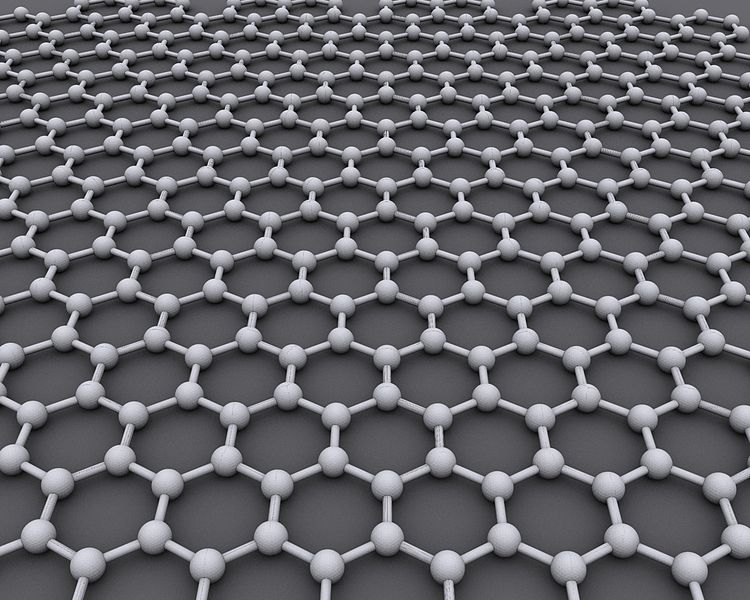
In graphene, carbon atoms link together to form an endless web of two-dimensional hexagons.
In graphene, carbon atoms link together to form an endless web of hexagons.

You’re probably familiar with graphite, the material we use as pencil lead.  We now know that graphite is merely layer upon layer of graphene.  When these individual layers are separated, we have a unique, crystalline structure that is light and absurdly strong, with a wide variety of potential applications.  The discovery of graphene won the 2010 Nobel Prize in Physics.

To talk about graphene is to talk in absolutes.  It is the absolute thinnest material ever discovered.  Being only one atom thick, graphene is as close to a perfectly two-dimensional structure as anything in our universe is ever likely to be.  It is also the absolute strongest material, the lightest material, the most impermeable (meaning gas cannot diffuse through it at all), the best conductor of heat, and the best conductor of electricity known to modern science.

Making small quantities of graphene is easy.  You can do it with a #2 pencil and some sticky tape (in fact, these are the high-tech tools that were used to discover it in the first place!)  Producing graphene on an industrial scale, however, remains difficult and expensive, though the costs are already beginning to come down.

Soon, we’re going to start seeing more and more products on the market that are either coated in graphene or include graphene parts or, perhaps, are composed of 100% pure graphene.  This is likely to become one of the most basic materials in the world, like plastic or aluminum or glass.  We are going to live in a future made of graphene.

I’d say all that deserves some mention in the President’s State of the Union, but it’s worth noting that graphene was discovered in Britain, not the United States, by two physicists of Russian ancestry.  As far as I can tell, American innovation and industry had nothing to do with the discovery of graphene at all.

Oh, Please, Please, Please Tell Me There’s Life on Mars!

There are plenty of people who don’t want evolution to be true or who don’t want to believe in global warming, and they’ll latch onto any shred of evidence to support their worldview.  This is sometimes called confirmation bias: the inability to believe anything that challenges your preexisting conclusions.  Scientists and science enthusiasts like myself are supposed to be immune to confirmation bias.  We’re supposed to keep an open mind to new discoveries and new ideas.  We’re supposed to be skeptics.  Except I have a small confession: I have a little confirmation bias of my own.

Mars Near Opposition 1995-2005: 1995
Source: Hubblesite.org

I am firmly convinced there is life on Mars.  I don’t think it’s anything more substantial than bacteria eking out an existence near the polar regions, but that’s still life, damn it.  Maybe, if I’m lucky, something more complex is buried underground, protecting itself from deadly solar radiation and simultaneously from probing, human eyes.

At the moment, scientific evidence seems to support my belief.  The Curiosity rover has found certain chemicals on Mars that suggest life could have evolved there.  Curiosity also recently discovered evidence that there are small quantities of liquid water present in Martian soil, and since Martian sand storms often spread across the whole planet, scientists say it’s likely these traces of water are present everywhere.

A Global Dust Storm on Mars
Mars before a sandstorm and Mars durning a sandstorm.

Source: Hubblesite.org

There’s also the unresolved mystery of the methane gas in Mars’s atmosphere.  Several different probes have detected it, but no one knows where it’s coming from.  It’s possible bacterial life forms produce it.  Unfortunately, the Curiosity rover is now telling us this methane doesn’t exist.  The rover can’t find any sign of it.  This challenges my faith in the existence of Martian bacteria, so when I read about these new test results I quickly commented that Curiosity must have made a mistake.

What will happen if Curiosity’s next experiment further challenges my beliefs?  I’ll tell you what will happen: I’ll be heartbroken.  I don’t think I’ll break down in tears, but I’ll probably feel a tiny bit depressed for a few days if not a few weeks.  I’ll probably go into denial and argue that the new data only means the possibility of life currently existing on Mars is diminished, but it’s still not impossible.  I might also start talking about how native Martian life might be so different from life on Earth that we wouldn’t recognize it even if we did find it.

I try to be a good skeptic.  I try not to jump to conclusions, no matter how awesome those conclusions might be.  So much as I may want there to be life on Mars, I have to try to curb my enthusiasm.  I have to prepare myself for the possibility that I’m wrong.  But it’s really difficult.  I can understand what creationists and global warming deniers are going through.  It’s hard to overcome confirmation bias, no matter what your confirmation bias is about.

P.S.: There is totally life on Mars, and I think some Martian creature probably threw a rock at the Curiosity rover.  Click here to find out more.

China’s Clone Factory

The BBC recently reported that China has opened the world’s first cloning factory.  It’s unclear how long this factory has been in operation, but according to the BBC report, it produces 500 cloned pigs per year for use in medical testing, and the company that owns the factory has ambitious plans for more cloning and more genetic research.  Some people have described this cloning factory as “shocking” or “creepy.”  We should be alarmed by these advances in Chinese science, or so we’re told.

The Chinese company behind this cloning factory, the Beijing Genomics Institute (or BGI), was the first to sequence the genome of rice, a staple food for much of the world.  They also sequenced the genome of the SARS virus and developed a kit to help detect and treat that disease.  Both of these research projects have surely served the greater good.  Wang Jun, BGI’s chief executive, has been quoted saying, “If it tastes good, you should sequence it.  You should know what’s in the genes of that species.”

I can’t argue with that.  As we, the human race, plan to colonize other worlds and face the dangers of climate change here on Earth, shouldn’t we study those plants and animals we depend upon for food?  Shouldn’t we be prepared to clone them if the need arises?  Wang Jun’s other criteria for genetic sequencing include animals used for industrial purposes, especially in medical research, and also animals that look cute, such as penguins.  Although some commentators have mocked these criteria, I don’t think Mr. Jun is being totally unreasonable.  I like penguins.  If sequencing penguin DNA will ensure that the species doesn’t go extinct, then I wholeheartedly support BGI’s efforts.

It should be noted that, according to the BBC article, this cloning factory is not exactly hygienic.  Gene sequencing is being done essentially by hand with minimal computer support, and flies buzz about in the “laboratory” where cloned pig embryos are implanted into the uteruses of female pigs.  Animal rights activists have cause for concern, but genetic research and cloning are not in and of themselves shocking or creepy.  I suspect this cloning factory has alarmed people not so much because it exists but because it exists in China, a country that many in the West already consider a military and economic threat.

But what do you think?  Should we worry, or is the alarm over this clone factory more about geo-political issues and less about the science itself?

P.S.: Click here to read the original article from the BBC by David Shukman.

How Will Religion Evolve?

The stereotypical Sci-Fi writer is either an atheist or an agnostic.  I’ve read more than a few science fiction novels that glowingly predicted the day when humanity “outgrows” religion.  Somehow, I doubt that day will ever come.  For better or worse, religion is here to stay, and I would find it far more interesting to read a science fiction novel about how religion might evolve and adapt to the science, technology, and cultural values of a futuristic society.

Today, I want to share a few links that relate somewhat to the future of religion.  First, we have an interview with an anonymous woman who is in what she calls a “polyamorous” marriage, meaning a marriage of more than two people.  Now, I’m a pretty open-minded guy, but even I am struggling to accept some of the things this woman has to say.  It’s easy to imagine a future where our religious leaders come into conflict with the polyamorous community.  Click here to read “A Love Bigger Than Two” by John Shore.

Next, we have an article on free will courtesy of Self Aware Patterns.  The author takes a look at whether or not we human beings can be held morally responsible for our actions.  From a scientific perspective, maybe it’s all a matter of genes and environment.  Even the non-deterministic physics of quantum mechanics, often sighted as proof that free will exists, might not prove anything of the sort.  Click here to read “Free Will?  Free of What?” by Michael Smith.

Finally, in a surprisingly candid interview with the atheist editor of an Italian newspaper, Pope Francis discusses his vision for the future of the Roman Catholic Church.  In Pope Francis’s typically enigmatic fashion, it’s hard to tell what exactly he plans to do, but it sounds like big changes are coming.  Click here to read “The Pope: How the Church will Change” by Eugenio Scalfari.

Please note that I do not necessarily agree with or endorse the views presented in any of these articles.  I offer them merely as food for thought and hopefully as a springboard for further conversation on how religious beliefs might evolve in the future.

Welcome to the World of Tomorrow

Ladies and gentlemen, we have traveled another year into the future!  It looks like we still don’t have flying cars or robotic butlers, and we still haven’t made contact with any alien civilizations, but the 21st Century is young.  Just look at some of the advances in science and technology we saw in 2013, and you’ll know awesome things are around the corner.

In early 2013, scientists confirmed the discovery of the Higgs Boson, a critical missing piece in the standard model of quantum physics.  As a science fiction writer, I found this to be rather disappointing.  Science fiction depends on those unknown elements of science, and failure to find the Higgs would have created a lot of fresh unknowns.  Still, there is one question that remains unanswered: now that we’ve discovered this powerful and elusive particle, what are we going to do with it?

Science fiction got a big boost last year from the Curiosity rover on Mars.  For decades, astronomers assumed Mars was totally barren, severely limiting our story telling options.  Now it seems the Red Planet might be able to support life after all.  Curiosity has discovered the basic chemical components necessary for life.  It also discovered trace amounts of liquid water.  Scientists now believe water is everywhere, scattered across the Martian surface by sandstorms.  Two questions remain: did Mars support life at some point in its past, and might there be something living there today?

Lastly, Amazon got a lot of attention by suggesting it might offer an aerial delivery service using robotic drones.  Drones are becoming increasingly common in our skies.  Hobbyists use them for fun, the military uses them to spy on enemy combatants, and the NSA uses them (probably) to spy on everyone else.  The media is starting to use them as well, sending “journalistic drones” where no journalist has gone before.  The big question is do we want all these drones zipping around overhead?  I suspect either Congress or the FAA will address that question soon, probably by the end of 2014.

On a personal note, I had a lot of bad luck in 2013 and fell way behind on my writing schedule.  That’s not to say 2013 was a complete disaster, but now that it’s over I say good riddance and look forward to a happier and more productive 2014.  With all these unanswered sciency questions, I’m sure I’ll have plenty of material to write about.

What are you looking forward to in 2014?