Planet Nine from Outer Space

Dang it, I thought I was finished exploring the Solar System. Now there’s another planet!?! Are we sure this isn’t yet another false alarm over Planet X?

To escape the hype over this alleged ninth planet, I decided to find the original source for this story, a paper entitled “Evidence for a Distant Giant Planet in the Solar System.” It was published on January 20, 2016, in The Astronomical Journal (click here).

First off, this paper does not announce the discovery of a new planet. Instead, it examines a peculiar trend astronomers have noticed in a region of the Solar System called the scattered disk (a region which partially overlaps the Kuiper belt). This odd trend is offered as circumstantial evidence that an extra planet might exist.

For the purposes of today’s post, I’ve named this hypothetical planet “Neo-Pluto.”

If Neo-Pluto is Real…

Billions of years ago, as the Sun shed its first rays of sunlight, a certain number of planets coalesced from the protoplanetary disk. That number was greater than eight. It was also greater than nine. A lot greater.

Like unruly children, these early planets jostled around in their orbits, pushing and pulling each other with their gravity, and sometimes colliding. One such collision led to the formation of Earth’s moon. Another probably knocked Venus into its retrograde rotation, and another may have tipped Uranus sideways.

Jupiter likely formed at the outermost edge of the protoplanetary disk, but it didn’t stay there. As this giant planet migrated inward, it wreaked havoc on the young Solar System. Smaller objects that wandered too close were either gobbled up, adding to Jupiter’s already considerable mass, or they were hurled out of the Solar System by Jupiter’s colossal gravity.

Neo-Pluto was one of those unlucky objects to be ejected from its original orbit, but it was not sent into total exile. It managed to stay within the gravitational influence of the Sun, and today it lingers in the cold depths of space, brooding over its fate.

Ja09 Neo-Pluto

But Neo-Pluto isn’t exactly a lightweight either. At approximately ten Earth masses, it has considerable gravity of its own, and the effects of that gravity have been noticed in the scattered disk.

Scattered disk objects (SDOs) are… well… scattered. They have highly eccentric (non-circular) and highly inclined (tilted) orbits; however, many known SDOs have almost the same perihelion (point of closest approach to the Sun). That can’t be a coincidence. It seems that just as Jupiter perturbs the orbits of asteroids in the asteroid belt, Neo-Pluto has pushed scattered disk objects into certain orbital trajectories, causing their perihelia to cluster.

Or so it seems. This all assumes that Neo-Pluto exists.

If Neo-Pluto Is NOT Real…

The authors of this “Distant Giant Planet” paper use a hypothetical planet to explain what’s happening in the scattered disk, and they clearly prefer that explanation, but they do acknowledge other possibilities.

  • Instead of one large planet, there could be a great many smaller planets and/or dwarf planets affecting the scattered disk.
  • A passing star might have disrupted the scattered disk long ago.
  • Observational bias may be at work, meaning that SDOs with a specific perihelion might be easier to see from out vantage point here on Earth. It’s unclear why that might happen, but a more thorough survey of the scattered disk could reveal a more random distribution of perihelia.

The best way to prove that Neo-Pluto exists is to find it. Alternatively, we could continue studying the scattered disk to see if this perihelion-clustering trend continues.

Until then, all we can say for certain is that the Solar System has at least eight planets.

P.S.: In part because of this latest new planet “discovery” as well as other rumored “discoveries” in recent months, today Sci-Fi Ideas is reposting my Sciency Words article on “Planet X.” Click here to check that out.

Unicorns are Real!

Back in January, I pitched an idea to Mark Ball, the editor of Sci-Fi Ideas, for an article about unicorns. What if unicorns were real? What might these animals be like from an evolutionary biology perspective?

unicorn1

I must confess that my initial enthusiasm for this article (ask any of my friends; I was hyper-enthusiastic about unicorns back in January and February) soon waned. The research… the writing… What made me think I knew anything about evolutionary biology? Why did I pitch this crazy idea in the first place?

I can’t thank Mark enough for being patient with me while I struggled through this project. The final article came out yesterday on Sci-Fi Ideas. As it so happens, it ended up being a nice tie-in for Sci-Fi Ideas’ Alien August contest—a contest any budding science fiction writer should seriously consider entering.

This unicorn article may be my proudest accomplishment as a writer, despite the headache it was to research and write (or perhaps because of that). So please click here and find out what things might be like if unicorns were real!

A Brief Hiatus

Internet friends, I’m taking a one-week blogging hiatus so I can spend some time working on Tomorrow News Network. I need to figure out what I want to do with that project going forward. If all goes well, I should be able to make some sort of announcement on the T.N.N. blog soon.

I’ll return to regular blogging on June 1st. The 2015 Mission to the Solar System will continue with a month-long visit to Mars—that planet that I, for one, have been looking forward to more than any other.

In the meantime, keep it sciency, everyone!

Twinkle, Twinkle, Little Dark Matter Particles

Atoms have unique fingerprints called absorption and emission spectrums. We touched on this in last week’s post entitled “What Color is the Sun?” Pictured below are rough approximations of the absorption and emission spectrums of hydrogen atoms.

All the colors of the rainbow, except a few are missing.  This is an absorption spectrum.
All the colors of the rainbow, except a few are missing. This is an absorption spectrum.
No rainbow, just a few specific colors.  This is an emission spectrum.
No rainbow, just a few specific colors. This is an emission spectrum.

But atoms, or at least atoms as we know them, only make up a tiny percentage of the physical universe. The rest is composed of dark matter, an invisible yet ubiquitous substance that has puzzled scientists for decades.

We’re aware of dark matter mainly due to its gravitational effects, but also because of its incessantly childish taunting.

Now, astronomers in Switzerland and the Netherlands report that they have detected x-ray flashes in regions of space where large masses of dark matter are predicted to exist. X-ray flashes that look an awful lot like an emission spectrum but do not match the spectrum of any known atom or any other known physical phenomenon.

I know what you’re thinking: holy @$&%, we just found dark matter! But we’re talking about science, which means we have to wear our skeptical hats. Hold off any parties or celebratory gunfire until these observations are confirmed by other researchers and scientists have ruled out alternative explanations for these emission lines. We don’t want to repeat the mistakes we made after BICEP2’s “discovery” of gravity waves.

But still… holy @$&%, we may have found dark matter!

Sources

X-Ray Signal from Andromeda, Other Galaxies Could Be Evidence of Dark Matter from Sci-News.com.

New Signal May Be Evidence of Dark Matter, Researchers Say from Universe Today.

Invariance vs. Relativity: An Interview with Thanh Nguyen

One of the cool things about science is that no theory, no matter how widely accepted, is safe. Some of the greatest scientific minds in history have had their work corrected or overturned by new discoveries. This could even happen to the cherished Theory of Relativity.

Today, we’re talking with Thanh Nguyen, whose Theory of Invariance challenges some of the ideas espoused by Einstein’s Relativity.


James Pailly: Thanh, thank you for joining us. First off, can you tell us a little about your scientific background?

Thanh Nguyen: I am at college level in Physics.

J.P.: So what is the Theory of Invariance and how is it different from the Theory of Relativity?

T.N.: The Special Theory of Relativity is a study of structure of space-time. It states that space and time cannot be separated and space-time can change depending on motion. While the Theory of Invariance was established on the perspective of absolute space and time. It is a study of relationship among energy, momentum, mass, motion and gravitation. Interestingly, the legendary equation E = mc2 can be simply derived from this classical perspective.

J.P.: How do you define the speed of light, and how is it deferent than the definition used by relativity?

T.N.: In relativity, the speed of light in vacuum, denoted c, is defined as the distance light can travel through vacuum in a unit of time, and it is a constant. This definition causes a conflict between electromagnetism and classical mechanics in a universe of absolute space and time. The Special Theory of Relativity was established to reconcile the conflict with the concept of relativistic space-time.

While, in invariance, the speed of light in vacuum, denoted c, is defined as the rate of change of the distance between light and objects which are shined with the light, in a unit of time, in vacuum, and c is also a constant. The invariant definition does not cause any conflict between electromagnetism and classical mechanics in a universe of absolute space and time, and it is perfectly appropriate with empirical results of the Michelson-Morley experiment or the De Sitter binary stars observations.

J.P.: One thing that really caught my attention while reading your paper is the claim that black holes do not have event horizons.  This seems like a testable prediction that could help astronomers determine the validity of your theory.  Could you tell us more about black holes and how they function in an invariant universe?

T.N.: Black holes are mysterious objects predicted from the General Theory of Relativity. They are defined as regions of space having a gravitational field so intense that no matter or radiation can escape. Though most people have deeply believed in the existence of black holes, the Theory of Invariance disagrees with their existence. In the theory, I wrote “A black hole, if it exists, is a point with no volume and no event horizon.” It is one of ways to say that black holes do not exist. According to the Theory of Invariance, no matter how intense a gravitational field is, it cannot hold light.

J.P.: But haven’t astronomers already confirmed the existence of black holes?

T.N.: In relation to the existence of black holes, a mainstream scientist may answer: To the best knowledge of our current scientific understanding, black holes do exist. However, an anti-relativity scientist may have a different answer: To the best knowledge of our current scientific understanding, black holes do exist in a specific theory. Besides, we also have another answer in Wikipedia: http://en.wikipedia.org/wiki/Black_hole

J.P.: Do you see the theory of invariance as an improvement upon Einstein’s relativity, or should we throw out relativity in favor of this new theory?

T.N.: I would see my theory as an improvement upon Newtonian mechanics instead of Einstein’s theory since it is based on the perspective of absolute space and time. In science, we should not put a theory aside until we have convincing evidences against it. Though anti-relativity fans so far have provided some negative experimental evidences, scientists who support the Theory of Relativity persistently say that it has passed every real experiment. So if we have stronger evidences, mainstream scientists might re-examine the Theory of Relativity. Currently, I have no experimental evidence against relativity. However, I thought of a low-cost experiment, which, if performed, will yield results falling in only one of two cases, being against relativity or against invariance.


Thanh has provided two links for anyone who would like to learn more about the theory of invariance:

  • Click here for the introduction to the Theory of Invariance.
  • Click here for Thanh’s paper on Theory of Invariance.

And remember: keep it sciency, my friends.

Do You Watch Educational Television?

I don’t think television makes people stupid. It seems to me that the more people watch television, the stupider the television becomes. I hate to sound like a cranky, old man complaining about the way things are these days, but T.V. just isn’t as good as it used to be.

television

Self Aware Paterns recently did an interesting blog post about the Science Channel. The quality of educational television has dropped, with only a few niche channels (like the Science Channel) holding out. And even in that case, the Science Channel might be starting to slip.

I can’t really say whether I agree or disagree with Self Aware Patterns’ assessment of the Science Channel. I canceled my cable subscription several years ago, right around the time when the Discovery Channel was starting to lose my interest.

When I want to learn something about science—or any other topic—I turn to other resources than television. Such as:

Meanwhile, it seems educational television continues to try to increase its viewership by dumbing down its programming: a trend that may apply to television in general.

So what resources do you use when you want to learn something? Are there any educational T.V. shows right now that are worth watching?

Can Scientism Be a Good Thing?

Scientism means science is awesome and everything else sucks. Religion sucks. Art and philosophy suck. History sucks, or at least it did until we started applying scientific methods to historical research. When I began searching for a definition of scientism, that’s the overall impression I got… at first.

Chemistry 2As I continued to read more about scientism, I found I agreed with some points. Scientific knowledge is often more reliable than other kinds of knowledge, and applying scientific methodology to other fields (like history) can improve those fields.

As a writer, I’ve improved my writing by studying the science of linguistics. In a way, I’ve also used the scientific method to hone my writing technique, testing the hypotheses I encounter as “writing advice” and evaluating the results by surveying beta readers. Does that mean I’m a scientismist?

SCIENTISM: MORE NUANCED THAN IT SEEMS?

Scientismists (the awkward but apparently correct term for adherents of scientism) are quite a diverse bunch. Maybe we should think of scientism the way we think of the political terms conservatism and liberalism. Physics 1There’s a wide spectrum of beliefs contained within one -ism, ranging from moderate to radical.

I’d call myself a moderate scientismist (emphasis on moderate). I don’t think science is the answer to everything. Some things are forever beyond science’s grasp. But I do think science is special and that scientific knowledge—when collected by diligent and skeptical scientists—trumps other belief systems.

WHAT IS SCIENTISM FOR YOU?

Thanks to linguistic science, I know defining a new word is a tricky prospect. Two of my favorite blogs recently did posts on scientism, so please check out the links below to get a broader perspective on this idea. Also, click here for last week’s edition of Sciency Words, which focused on scientism.

And remember, keep it sciency, my friends!

Blogging Holiday

I’m taking a short break from blogging to reorganize my writing operation and put Tomorrow News Network back on track. I’ve debated with myself for a while whether or not this is a good idea, and I want to thank Shelina from A Writer Inspired for helping me finally settle the matter. Her Insecure Writer’s Support Group post this month is a must read for struggling writers like myself.

I also want to thank Michelle Joelle from Soliloquies for her post on Kafka and Literary Temporality for helping me see things from a new perspective. I have spent so much time focused on my writing quota each day that I may have lost touch with the reason I write in the first place. I need to fix that.

I’ll also be withdrawing from my rather limited participation on Facebook, Twitter, and other social media. I need to reevaluate the role these things play in my life. Everyone says writers must be engaged in social media, but sometimes I wonder how true that is. Advice and insight from fellow writers would be much appreciated!

I’ll be back on August 6th for the next posting of the Insecure Writer’s Support Group, so I won’t be gone for long. In the meantime, keep it sciency, my friends.

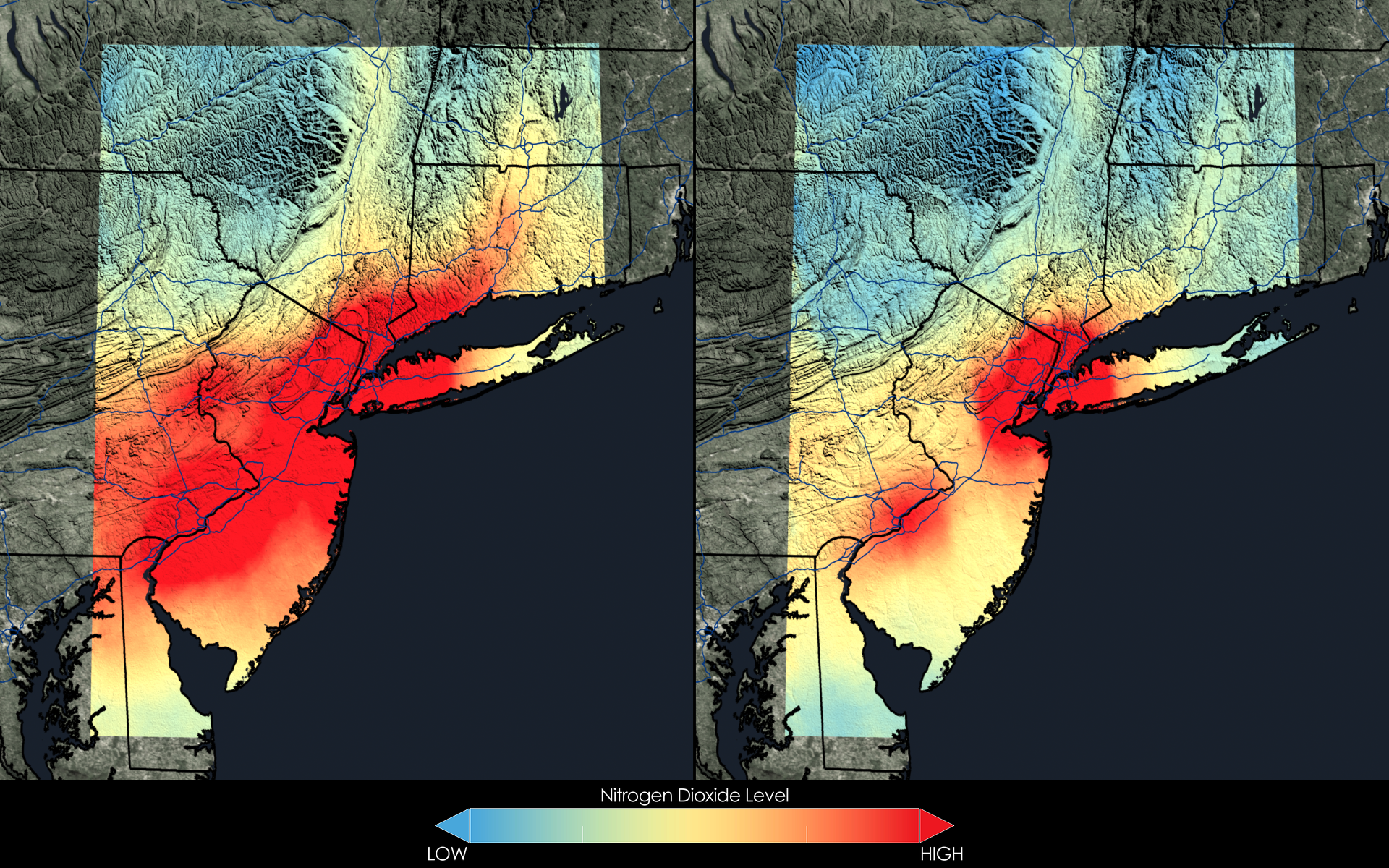
Breathe Easier: There’s Less Nitrogen Dioxide in the Air

Whenever we hear news about the environment, it’s usually bad news. Levels of such and such pollutant continue to rise. We have only X years before the damage becomes irreversible. All the cute and cuddly animals are going extinct. I think one of the reasons people don’t seem to care about the environment is that we, as individuals, feel helpless, but finally new reports show we’ve made some progress.

Image courtesy of NASA Goddard's Scientific Visualization Studio
Image courtesy of NASA.

Images from NASA’s Aura satellite reveal that the levels of nitrogen dioxide (NO2) in our atmosphere have declined by 50% or more across the continental U.S. Even major urban areas like New York City show definite improvement. Nitrogen dioxide is one of six common air contaminants monitored by the E.P.A.

Image courtesy of Greenhorn1 and Wikipeida.
Image courtesy of Greenhorn1 and Wikipedia.

When concentrated in smog form, nitrogen dioxide appears as a reddish or yellowish gas (according to Wikipedia, the color depends on the temperature). It has an acrid smell, and when inhaled it basically f***s up your lungs, though the effects are not immediately felt. It comes from car emissions, power plants, and other sources.

Yes, we as individuals can and do make a difference.

I’ll be happy to breathe 50% less of this stuff. And part of the credit goes to everyone who decided to walk to the store rather than drive, or rode a bike to work, or took advantage of public transportation. If we all keep doing stuff like that, maybe we’ll start seeing more good news about the environment.