Why Haven’t We Found Planets in Alpha Centauri?

Hello, friends!  Today I’d like to take you on a quick tour of the Alpha Centauri star system, the Solar System’s next door neighbors.

Alpha Centauri consists of three stars.  Two of those stars orbit in a tight binary formation, sort of like this:
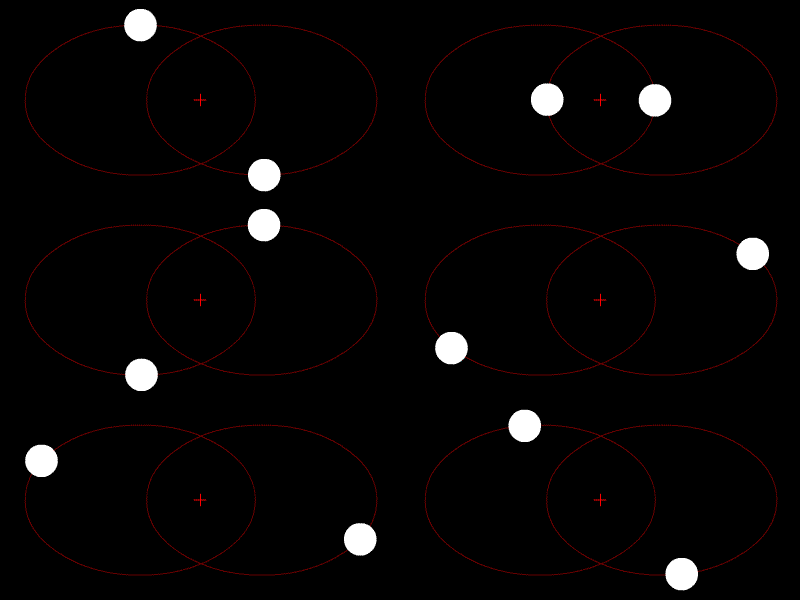
Animation courtesy of Wikipedia.

The third star is known as Proxima Centauri.  It’s a tiny red dwarf star, orbiting very far away from that central binary pair.  Proxima is known to have at least one (possibly two) planets, but we’ll visit Proxima’s planets in a future post.

Today, I really just want to focus on Alpha Centauri A and B, the two stars in that central binary, to see if they have any planets.  In 2012, astronomers announced the discovery of a planet orbiting Alpha Centauri B, but that discovery turned out to be a ghost in the data.  Otherwise, astronomers have found nothing out there.

Over the last decade or so, we’ve found so many exoplanets, both near and far.  Given how close-by Alpha Centauri is, you’d think we would have found something there by now.  It’s enough to make you wonder if, maybe, there’s nothing to find.  But it turns out there’s a very good reason why we’re having so much trouble finding Alpha Centauri’s planets.

As Alpha Centauri A and B move through their figure-eight orbital paths, sometimes they’re close together, and sometimes they’re far apart.  Over the past decade or so, it just so happens that they’ve been very close together, at least from our vantage point here on Earth.  Even with all the advanced planet hunting techniques we’ve developed in the past ten years, the double glare of those two stars would’ve concealed any signs of a planet from our view.

But that’s about to change.  In February of 2016, Alpha Centauri A and B were as close together as they’ll get (as seen from Earth).  They’ve been moving away from each other ever since, and according to this article from Scientific American, 2020 is the magical year when A and B are finally far enough apart that our telescopes can observe them separately.

Based on the metallicity of those two stars, they should be just as capable of forming planets as our own Sun.  Planetary orbits would be stable up to 2.5 astronomical units away from either star, according to Scientific American (our entire inner Solar System could fit comfortably inside that 2.5 A.U. radius).  And computer simulations produce many plausible scenarios where Earth-like planets could exist in the Alpha Centauri binary.

In some of those computer simulations, an Alpha Centaurian planet might be even more suitable for life than Earth!  So stay tuned.  In the next few years, we may finally get news about habitable planets—or even a superhabitable planets—in Alpha Centauri.

Next time on Planet Pailly, how are you preparing for the robot rebellion?

Dancing with the Binary Stars

Hello, friends!

Today I just want to share a thing that came up during my research for last week’s episode of Sciency Words.  It has to do with our next-door neighbors, the Alpha Centauri star system.

Alpha Centauri is, famously, the nearest star system to our own Solar System.  As such, Alpha Centauri gets a lot of love from science fiction writers.  So many space aliens come from there, and so many human space adventurers will be heading Alpha Centauri’s way, just as soon as we invent faster-than-light technology.

Alpha Centauri is also, famously, a binary star system: two stars locked in orbit together1.  But the way the Alpha Centauri binary is portrayed in science fiction is… well, I think a lot of Sci-Fi writers get this wrong.  I know I’ve gotten it wrong in the past.

Which brings me to the thing I want to share with you today.  It’s a simple but absolutely perfect visualization of the way Alpha Centauri A and B dance around their common center of mass (a.k.a. their barycenter).

Image courtesy of Wikipedia.

In my experience, a lot of science fiction writers make it sound like Alpha Centauri A and B are right next to each other.  They make it sound like you could stand on the surface of a planet, look up, and see two suns side by side, like you’re Luke Skywalker watching the double sunset on Tattooine.

But even at closest approach, Alpha Centauri A and B are approximately 11 astronomical units apart (roughly equivalent to the distance between the Sun and Saturn).  And at maximum separation, they’re approximately 36 astronomical units apart (roughly equivalent to the distance between the Sun and Pluto).

Yes, watching a double sunset like that scene in Star Wars would be incredible.  But this figure-eight dance that happens in Alpha Centauri (and in many other binary star systems too) is even more amazing, in my opinion.

Next time on Planet Pailly, we’ll meet some insects who would really appreciate it if we’d change their name already.

1 Umm, actually Alpha Centauri has three stars: two Sun-like stars in the middle and a tiny red dwarf star orbiting much farther out.

Wait, What Do You Mean There’s No “Life” on Mars?

Hello, friends!

The other day, someone wanted to pick a fight with me.  This person said to me in a forceful, almost rude tone, that there is absolutely no chance we will ever discover life on Mars.  If you know me at all, you must surely know: them’s fightin’ words!

Except before this conversation could escalate into a full blown argument, it became apparent (to me, at least) that we were not actually talking about the same thing.  You see when I talk about life on Mars, I mean life of any kind, including microorganisms—especially microorganisms.  This other person was using the word “life” to mean, specifically and exclusively, intelligent life.

No, I do not expect we’ll find intelligent life on Mars.  There are no canals, no cities—none of that stuff Percival Lowell once imagined he saw in his telescope.  Nor do I expect to find non-intelligent animals or any kind of plant life.

The best we can hope for is that there might be Martian microorganisms hiding under a glacier, subsisting off a trickle of meltwater.  And to be honest, I’m not overly optimistic about finding even that much life on Mars.  But to say it is absolutely impossible?  No, I cannot agree with that.

And after explaining what I mean when I talk about life on Mars and what my expectations actually are, this person conceded (grudgingly, perhaps) that I might have a point.  Thus what could have been a bitter and fruitless argument turned into an opportunity to educate someone about the science of astrobiology.  Why?  Because I asked the question “Wait, what do you mean by life?”

Language is not as precise a tool as we often imagine.  People sometimes use the same words to mean very different things, leading to misunderstandings, hurt feelings, and unproductive arguments.  I think a lot of those arguments, both big and small, could be avoided if more people would stop and ask: “Wait, what do you mean by (fill in the blank)?”

Next time on Planet Pailly, am I too judgmental?  We’ll find out in this month’s posting of the Insecure Writer’s Support Group.

The Great Red Spot: More Than Skin Deep?

You and I may think of the Great Red Spot as Jupiter’s defining characteristic, but Jupiter himself is rather embarrassed about his spot.  He’s been trying for some time now to get rid of it.

The Great Red Spot (or G.R.S., as all the cool kids call it) has been shrinking for decades now, and the rate of shrinkage has been accelerating.  Just this year, long streams of red stuff seemed to break free, as it the G.R.S. were “unspooling.”

So why has the G.R.S. gone into decline?  Well, a better question might be why did it last so long in the first place?  Apparently, according to most fluid dynamics models, the G.R.S. should have only lasted a few years.  Instead, it’s been going strong for centuries.  Astronomers first noticed it as early as 1664.

In 2013, physicists Philip Marcus of U.C. Berkley and Pedram Hassanzadeh of Harvard gave us a partial answer.  According to this article from phys.org, they were the first to model the G.R.S. not as a 2D surface feature but as a 3D structure, with a vortex extending into the depths of Jupiter’s atmosphere.

Marcus and Hassanzadeh found that vertical flow (hot and cold air moving up and down inside the G.R.S.) was doing a lot to help keep the storm system going.  As Hassanzadeh explains in that same phys.org article:

In the past, researchers either ignored the vertical flow because they thought it was not important, or they used simpler equations because it was too difficult to model.

Late last month, Marcus and Hassanzadeh gave a presentation at the annual meeting of the American Physical Society, and according to that presentation, fans of the Great Red Spot have nothing to worry about.

As Marcus explains in this article for Astronomy Magazine, we can monitor the vortex beneath the G.R.S. by observing the behavior of other nearby storm systems.  And based on those observations, Marcus says, “[…] there is no evidence that that vortex itself has changed its size or intensity.”

Personally, I think Marcus and Hassanzadeh make a pretty compelling case that the G.R.S. is as strong as ever, even if it appears, superficially, to be shrinking.  But I still don’t really understand what’s caused that superficial shrinkage, and I’m left wondering how long it will be before the visible part of the G.R.S. starts to expand again.  Surely it will start expanding again, right?

I guess there’s always more to learn.

Sciency Words: Love Numbers

Sciency Words: (proper noun) a special series here on Planet Pailly focusing on the definitions and etymologies of science or science-related terms.  Today’s Sciency Word is:

LOVE NUMBERS

My friends, I was recently doing research about the planet Neptune.  Astronomers have a new model for the Neptune system, a model that seems to do a better job predicting the orbits of all those unruly and rambunctious Neptunian moons.  While reading about this new model, I came across the following statement: “We also investigated sensitivity of the fit to Neptune’s Love number […].”  And that gave me a delightful mental picture:

“Love numbers” are named after English mathematician Augustus Edward Hough Love.  They’re also sometimes referred to as “Love and Shida numbers” to recognize the contribution of Japanese scientist T. Shida.

In the early 20th Century, Love introduced two ratios—traditionally represented by the variables h and kh has to do with the elasticity (stretchiness) of a planetary body, and k is related to the redistribution of mass within a planetary body as it stretches.  Shortly thereafter, Shida introduced a third ratio—represented by the variable l—involving the horizontal displacement of a planetary crust.

Taken together, h, k, and l tell you how much a planet, moon, or other celestial body can flex due to tidal forces.  As explained in this paper on Earth’s Love numbers:

If the Earth would be a completely rigid body, [its Love numbers] would be equal to zero, and there would be no tidal deformation of the surface.

But of course Earth is not a completely rigid body.  Tidal forces caused by the Sun and Moon cause Earth to flex “up to tens of centimeters,” according to that same paper.  Tens of centimeters doesn’t sound like much, but as we all know, it’s enough to keep the ocean tides going!

In conclusion, I guess you might say that what’s true for planets is also true for people.  Being completely rigid produces Love numbers equal to zero.  So be flexible.  Allow yourself to stretch a little, and your Love numbers will go up.

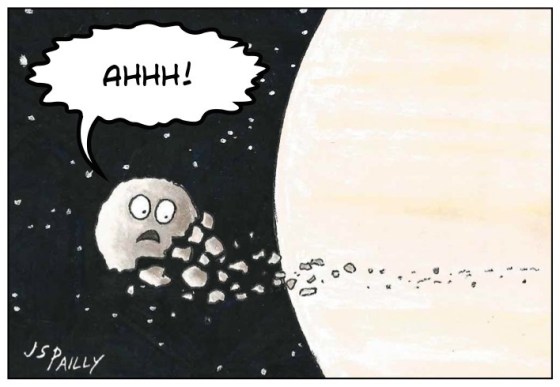
P.S.: Being flexible is healthy in any relationship, but at the same time don’t let others tug on you too hard.  Know your limits—your Roche limit, I mean—because you don’t want to end up like this:

Moons Gone Wild: Naiad and Thalassa

Naiad is one of the more rambunctious and troublesome moons in our Solar System.  She was first discovered in 1989 when NASA’s Voyager 2 spacecraft flew by Neptune.  Naiad then spent more than a decade playing hide and seek with us, to the annoyance of many professional astronomers, I’m sure.

In 2004, the Hubble Space Telescope happened to catch Naiad in a few images of Neptune, but no one noticed she was there.  It wasn’t until 2013, thanks to new and improved image processing techniques, that astronomers found Naiad in those pictures.

Articles from the time (like this one or this one) described Naiad’s orbit as “wibbly wobbly” or said Naiad had somehow “drifted off course.”  That’s why we’d had such a hard time finding her.

But new research published this month in the journal Icarus gives us a clearer sense of what Naiad’s been up to all this time.  Naiad’s orbit is just… I don’t know how to describe it.  Just look at this orbit!  It’s bizarre!

According to that paper in Icarus, Naiad is caught in an orbital resonance with the neighboring moon of Thalassa.  That orbital resonance, combined with a high inclination (orbital tilt), causes Naiad to travel in a “sinusoidal pattern,” as the authors of that paper call it.

Naiad and Thalassa orbit dangerously close to each other.  Naiad zips past Thalassa every seven hours, approximately.  But because of that weird sinusoidal thing Naiad’s doing, Naiad always passes safely over Thalassa’s north pole or safely under Thalassa’s south pole.  The two moons are in no danger of getting into any sort of accident with each other, at least not in the near future.

But there are still a lot of uncertainties baked into our models of Neptune and his family of moons.  Even our newest, most up-to-date model—the model that revealed Naiad’s orbital resonance with Thalassa—still depends heavily on data collected by Voyager 2.  And as the authors of that Icarus paper note: “The orbital uncertainties show that the positions of the satellites are known within several hundred kilometers until at least 2030.”

But beyond 2030?  I guess we can’t accurately predict where Naiad, Thalassa, or any of Neptune’s other moons might end up.  If only somebody would send another space probe out to Neptune!  I’m really glad we have Voyager 2’s data, of course, but that data is from 1989.  A follow up mission is long overdue!

Sciency Words: Dial Tone

Sciency Words: (proper noun) a special series here on Planet Pailly focusing on the definitions and etymologies of science or science-related terms.  Today’s Sciency Word is:

DIAL TONE

Some of you may be too young to know what a dial tone is, so here’s an instructional video explaining the concept.

According to this article from Teletech Services, it was German engineer August Kruckow who invented the dial tone back in 1908.  A dial tone is a buzzing or humming sound that landline telephones make to let you know they’re connected and working.

It’s hard to say when “dial tone” became a SETI term, but the earliest usage I was able to find is this 1995 paper by Steven Dick entitled “Consequences of Success in SETI: Lessons from the History of Science.”

In that paper, Dick draws a distinction between extraterrestrial signals that communicate information vs. extraterrestrial signals that serve essentially the same function as a dial tone.  The general public, Dick argues, would react quite differently if we picked up some sort of intergalactic dial tone instead of a “Greetings, Earthlings, would you like to learn more about calculus?” type of message.

Later papers (like this one or this one) continue to use this dial tone metaphor, and in 2018 a special committee on SETI nomenclature adopted the following as the official definition for the term: “A content-free beacon, i.e. one that communicates only the existence of technological life.”

That same committee goes on to note some concern that the conventional meaning of “dial tone” may soon become obsolete; if so, the committee worries, then the continued use of “dial tone” as a SETI term might become problematic.  I’m not sure I agree with that concern, though.  Lots of terms and phrases have stuck around even after their original meanings have faded into history.

In the near future, maybe it won’t be obvious to everyone that “dial tone” originally had something to do with telephones, but if SETI scientists keep using the term, I don’t think it’s that hard for people to understand what the term means… is it?

Sciency Words: Facies

Sciency Words: (proper noun) a special series here on Planet Pailly focusing on the definitions and etymologies of science or science-related terms.  Today’s Sciency Word is:

FACIES

So I’m currently reading a paper entitled “A Field Guide to Finding Fossils on Mars.”  Basically, if you’re hoping to dig up some fossils on Mars, you need to know where to look.  This paper is all about which “facies” are the most likely to have well preserved Martian organisms inside them.

I have to admit I’m having a tough time with the paper.  My first question, and perhaps your first question as well: what the heck is a facies?

The word facies comes straight from Latin, where it meant (believe it or not) face.  It could also mean facial expression or the generalized appearance of a thing.  According to this article from the Encyclopedia Britannica, Danish scientist Nicholas Steno was the first to use facies as a geology term in 1669, but it was Swiss geologist Amanz Gressly who reintroduced the term in 1838, leading to its modern usage.

Gressly was conducting geological research in the Jura Mountains, which lie along the border between France and Switzerland.  It was already known that there were different layers of rock stacked on top of each other.  We call these strata, and it’s now widely recognized that different strata correspond to different time periods in Earth’s past.

But Gressly noticed that, in addition to the strata stacked vertically on top of each other, there were also different “stratigraphic units” arranged horizontally beside each other—the facies, as Gressly decided to call them.  Gressly is quoted in this book as having written:

I think that the petrographic or paleontological changes of a stratigraphic unit in the horizontal are caused by the changes in environment and other circumstances, which still so powerfully influence today the different genera and species which inhabit the ocean and the seas.

In other words, if you find different facies within the same strata, then you’re looking at different environments or ecosystems that existed at the same time, side by side: a lakebed next to a forest, for example.

Or at least that’s what Gressly originally intended the word facies to mean.  But according to that same Encyclopedia Brittanica article, the term has since been generalized “[…] to encompass other types of variation that may be encountered as one moves laterally (e.g., along outcroppings of rock strata exposed in stream valleys or mountain ridges) in a given rock succession.”

So if you’re going fossil hunting on Mars, you want to look for rocks formations dating back to Mars’s Noachian Period—that’s when Mars had lakes and rivers and oceans of liquid water on its surface.  Rock formations from the very early Hesperian Period would also be good.  There was still some liquid water sloshing around at that time.

But within Noachian or Hesperian-aged strata, which facies should you look for?  Well, I’ll have to get back to you on that one.  As I said, I’m having a tough time with this paper, but I am determined to get through it!

P.S.: Bonus Sciency Word!  Those same Jura Mountains where Amanz Gressly did his geological research also gave us the name for Earth’s Jurassic Period.

Learning More About NASA’s New Spacesuits

Following my recent Sciency Words post on “bunny hopping,” I got a lot of questions about NASA’s new spacesuit design.  I wasn’t really able to answer those questions, so today I’d like to share a video from someone who’s a little better qualified to talk about this stuff.

Scott Manly is an astrophysicist and YouTuber.  On his channel, he plays a lot of space-themed video games and talks about scientific accuracies (or inaccuracies) in said video games.  I started watching Mr. Manly back when I was obsessed with Kerbal Space Program.

I think the big takeaway from this video is that NASA’s new spacesuit is not quite finished yet.  It’s still a work in progress.  That might explain some of the confusion over what the new spacesuit is supposed to do for astronauts once they’re on the Moon.

One thing I’m still wondering about: the new space boots.  Several articles I looked at (like this one) describe the new boots as “hiking-style boots with flexible soles.”  That doesn’t really satisfy my curiosity about these boots, so I’ll have to do more research on that.

Quick, Name Those Moons!

I haven’t done enough research this week to put together a Sciency Words post.  I’ve been too busy with other writing.  However, I do have some name-related news to share with you today.

As you may have already heard, astronomers recently discovered twenty new moons orbiting the planet Saturn.  This brings Saturn’s total moon count up to 82, surpassing Jupiter’s total of 79.

These newly discovered moons are each about five kilometers in diameter, according to this press release from Carnegie Science.  That’s really small for moons.  These objects are more like asteroids that happen to be caught in Saturn’s gravity.  Or they might be rubble left over from the destruction of older Saturnian moons.  Saturn may (or may not) have a long history of destroying her own moons.

Now astronomers are asking for you (yes, you!) to help name these newly discovered moons.  Due to established naming conventions, these particular Saturnian moons must be named after giants from Inuit, Norse, or Gallic mythology.  Tweet your suggestions to @SaturnLegacy using the hashtag #NameSaturnsMoons.  Name submissions are due by December 6, 2019.

So go crack open some books on Inuit, Norse, and Gallic mythology, and may the best names win!