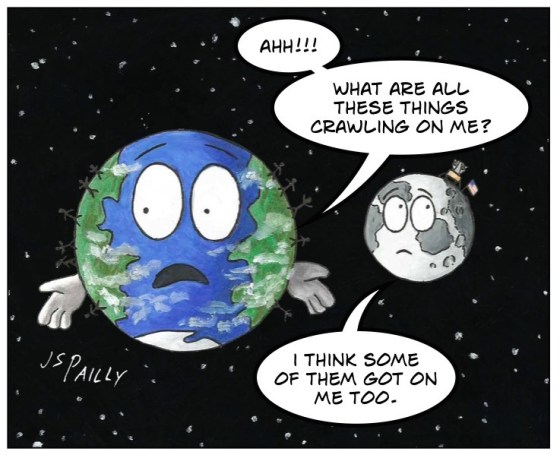
Is There Life on Earth?

Hello, friends!

Let’s imagine some space aliens are cruising by our Solar System.  They turn their scanners on our planet and see… what?

Among other things, they’d notice that Earth’s landmasses are partially covered with a strange, green-colored substance.  Of course, you and I know what that green substance is.  It’s chlorophyll.  But would those extraterrestrial observers, who have no prior knowledge of our planet, be able to figure that out?  Even if they did, would they realize what chlorophyll is used for?  Maybe.  Probably not, though.

Which brings me to my all-time favorite scientific paper: “A search for life on Earth from the Galileo spacecraft,” by Carl Sagan et al.  I love this paper in part because it’s so clearly and concisely written, with jargon kept to a minimum.  Sagan was, after all, a talented science communicator.  But I also love this paper because its conclusions are so shocking, so eye-opening.

In 1990, NASA’s Galileo spacecraft turned all its high-tech instruments toward Earth and detected… not much, actually.  Galileo did pick up radio broadcasts emanating from the planet’s surface.  Aside from that, though, Galileo’s data offered highly suggestive (but also highly circumstantial) evidence on Earthly life.  The lesson: finding life on other planets is hard.  Even using our very best equipment, it was hard for NASA to detect signs of life right here on Earth!

At least that’s what I got out of reading Sagan’s Galileo experiment paper.  And based on various commentaries I’ve read or heard about this paper, that seems to be the lesson other people got out of it too.  So I was surprised to hear Sagan himself, approximately seven-and-a-half minutes into this interview, saying the exact opposite.

We’ve flown by some sixty worlds.  We claim that we haven’t found life anywhere, and that that is a significant result.  That is, that we would have found life had it been there.  But this has never been calibrated.  We’ve never flown by the Earth with a modern interplanetary spacecraft, all instruments on, and detected life here.  And so Galileo, because of this peculiar gravity assist VEEGA trajectory, permits us to do that.  And as I’ll describe tomorrow, we find life five or six different ways, including intelligent life.  And this then means that the negative results that we find elsewhere are, in fact, significant.

I’ve been puzzled by this for a while now, but I think I’ve finally figured out why Sagan would say this.  It’s politics.

On the one hand, scientists need to understand the challenges they’ll face (including the limitations of their own equipment) in searching for life on other worlds.  That really is, I think, the purpose of the Galileo experiment paper.  On the other hand, it would not do to say on public television, to cantankerous taxpayers and the listening ears of Congress, that NASA spends millions of dollars on space probes that are not even capable of detecting life right here on Earth.

Space exploration is expensive.  And like all expensive types of research, sooner or later the researchers involved have to learn how to play politics.


Sciency Words: Safety Ellipse

Hello, friends!  Welcome to Sciency Words, a special series here on Planet Pailly where we talk about those wild and crazy words scientists use.  Today’s Sciency Word is:

SAFETY ELLIPSE

I don’t know about you, but when I’m trying to dock my shuttle pod with another spaceship, I like to take a few long, leisurely loops around that other spaceship first.  You know, like this:

Spaceships are pretty!  Who wouldn’t want to get a good look at them from every conceivable angle before completing docking maneuvers?  But it turns out that circling round and round a spaceship like this is not just for admiring the view.  It’s also for safety!  As explained in this paper:

A “safety ellipse” is an out-of-plane elliptical periodic relative motion trajectory around the primary spacecraft such that the trajectory never crosses the velocity of the primary.

That clear things up?  No?  Okay, how about a quote from this paper instead:

This paper defines a safe trajectory as an approach path that guarantees collision avoidance in the presence of a class of anomalous system behaviors.

Still confused?  Here’s a short video demonstrating what a safety ellipse (a.k.a. a safe trajectory) looks like:

Basically, if your shuttle pod experiences engine failure or any other major malfunction, flying in a safety ellipse ensures that you will not collide with the ship you were trying to dock with.  At least not for a good, long while.

I first heard about this term the other day while watching the livestream of the SpaceX Dragon capsule approaching and docking with the International Space Station.  Several times, the livestream commentators mentioned that Dragon was utilizing a “24 hour safety ellipse” or “24 hour safe trajectory,” meaning that if anything went wrong, mission control would have at least 24 hours to fix it before Dragon and the I.S.S. collided.

So remember, friends: the next time you’re going to dock with another spacecraft, do that out-of-plane elliptical periodic relative motion thing.  In other words, circle around the other ship a few times before making your final approach to dock.  It’s for safety reasons.

P.S.: It’s also for enjoying the view.  Spaceships are pretty!

No Gospel Truth in Science

Hello, friends!

So there’s this notion in the popular press that when a new scientific paper comes out, that paper should be taken as the final definitive word on an issue.  Science has spoken.  This is a scientific fact now.  But that is not how science works.

When new research is published, you should expect there will be followup research, and then that followup research will be followed up by even more research.  A new scientific paper really shouldn’t be seen as a proclamation of fact but rather as the beginning of a dialogue among scientists, or perhaps as the continuation of a dialogue that’s already in progress.

The recent detection of phosphine in the atmosphere of Venus has turned out to be a fantastic example of this ongoing dialogue in action.  The initial research was published in two separate papers (click here or here).  Basically, astronomers found the spectral signature of phosphine (PH3) in the Venusian atmosphere, and they were at a loss to explain where all that phosphine could be coming from.

Based on everything we currently know about Venus, those two papers tried to rule out several possible explanations.  Such a large quantity of phosphine could not be created by Venus’s atmospheric chemistry.  It could not be spewing out of volcanoes on Venus’s surface.  It could not be delivered to Venus by asteroids or comets.  One very intriguing possibility that could not be ruled out: maybe there’s life on Venus.  On Earth, phosphine is produced almost exclusively by living things.

But those two papers were not the definitive final word on the matter.  A dialogue had begun.  Soon, followup research came out suggesting that phosphine could be spewing out of volcanoes after all.  It would still be pretty shocking to discover that Venus has enough active volcanoes to produce that much atmospheric phosphine—but it be nowhere near as shocking as discovering Venus has life.

And then even more followup research came out with this paper, which points out possible errors in the original research and suggests that we may be dealing with a false positive detection.  Venus might not have phosphine after all, or maybe it doesn’t have as much as originally believed.

And the dialogue continues.  More research will come.  More responses will be published, and then there will be responses to those responses, and so forth until the scientific community reaches some sort of consensus about this Venusian phosphine business.  And even then, that scientific consensus still might not be the 100% final word on the matter.

Based on the way the popular press reports science news, you could easily get the impression that scientific papers should be treated as gospel truth.  You would be understandably confused, then, when one scientific paper comes out refuting the findings of another.  Subsequently, you may come to the conclusion (as a great many people apparently have) that science must not know anything at all.  Science just keeps contradicting itself, it seems.

But scientific papers are not meant to be taken as gospel truth.  They’re part of an ongoing back-and-forth dialogue.  So the next time you hear about some new scientific discovery on the news, remember that scientific papers are not intended to be bold proclamations of fact.  And when you hear about some new paper refuting older research, you’ll understand what’s going on.

What Color are All the Planets?

Hello, friends!

So as you know, Earth is “the Blue Planet” and Mars is “the Red Planet.”  By my math, that leaves us with six other planets in our Solar System that don’t have color-related nicknames.  Today, I’d like to try and fix that.

Jupiter was the toughest.  He’s actually lots of different colors: red, grey, white, orange… and then the Juno mission recently showed us that Jupiter’s polar regions are blue!  Of course Jupiter is most famous for being red in that one specific spot, but even the Great Red Spot changes colors from time to time, fading from red to pink to white before turning red again.

Anyway, those are my picks for the color-related nicknames for all the planets.  Do you agree with my picks?  Disagree?  Let me know in the comments below!

Sciency Words: VIRA

Hello, friends!  Welcome to Sciency Words, a special series here on Planet Pailly where we take a closer look at some interesting and new scientific term so we can expand our scientific vocabularies together.  Today’s Sciency Word is:

VIRA

You don’t mind if I do one more post about Venus, do you?  Venus is my favorite planet, after all, and the detection of phosphine (a possible biosignature!) in Venus’s atmosphere has got me really excited.  I’ve been reading lots of papers and articles about Venus lately, and many of those papers and articles mention something called VIRA.

VIRA stands for Venus International Reference Atmosphere.  VIRA is actually a book, originally published in 1985 by an international committee on space research.  The purpose of VIRA was to consolidate everything we knew about Venus’s atmosphere at that time into a single, easy to use reference guide.  As planetary scientist David Grinspoon describes it in his book Venus Revealed:

Although not exactly a best-seller, [VIRA] is a cherished reference among students of Venus’s atmosphere, and many a copy has become dog-eared and worn.  The tables and summaries of atmospheric data found therein are still the standard on Earth for Venus models, and the wide use of this standard allows us to make sure that we are comparing apples with apples, when making models and sharing new results.

One thing I don’t understand: why are Venus researchers still relying so heavily on a reference guide from 1985?  I’ve found several scientific papers (like this one or this one or this one) offering updates and improvements to VIRA.  And yet, unless I’m missing something (I feel like I must be missing something), it sounds like the original 1985 VIRA is still used as the gold standard for modeling Venus’s atmosphere.

Anyway, when people say we can’t explain where Venus’s phosphine comes from, in a sense, what they mean is that there’s nothing in VIRA that helps explain it.  So maybe the discovery of phosphine in Venus’s atmosphere will finally give scientists the push they need to update VIRA for the 21st Century.

P.S.: According to this paper, there’s also a Mars International Reference Atmosphere, or MIRA.  And I’m guessing there are similar reference atmospheres for other planets and moons in our Solar System as well.

Sciency Words: Global Resurfacing

Hello, friends!  Welcome back to Sciency Words, a special series here on Planet Pailly where we talk about those wild and crazy words scientists like to use.  Today on Sciency Words, we’re talking about:

GLOBAL RESURFACING

Venus is a mysterious planet.  Ever since the detection of phosphine in the Venusian atmosphere, the mystery du jour has been: does Venus support life?

We’ll circle back to Venus’s phosphine in a moment, but first I’d like to turn our attention to a different mystery concerning Venus: where did all of Venus’s craters go?

Impact craters are a common sight in the Solar System, especially here in the inner Solar System.  You’ll find plenty of craters on the Moon, of course.  You’ll find lots of them on Mercury, Earth, and Mars as well.  Some of those craters look fresh and new.  Others, due to weathering and erosion, look quite old—sometimes extremely old.

But the surface of Venus is relatively crater free, and the few craters we do find appear to be very, very recent.  In his book Venus Revealed, American planetary scientist David Grinspoon describes Venus’s craters thusly:

All the craters on Venus look unnaturally pristine.  Instead of blending into the volcanic plains that cover most of the planet, they seem planted on top as an afterthought, as though a crew had built a cheap movie-set planet and realized at the last minute that they had better throw in some craters.

Grinspoon goes on to explain how this might have happened:

Suppose that half a billion years ago something happened to Venus, wiping out all older craters.  Vast lava flows occurring simultaneously all over the planet would do the trick.  Then, if there has been relatively little surface activity since that time and Venus has been slowly collecting craters all along, things should look as they do.

This sudden event, when the whole surface of Venus got covered in fresh lava, is called “global resurfacing.” That’s a nice euphemism for an apocalyptic event, isn’t it?

Now this is important: Venus should have had little-to-no volcanic activity since her last global resurfacing event.  Otherwise, those younger, fresher, “unnaturally pristine”-looking craters would have gotten resurfaced too.  But in the last few years, circumstantial evidence has emerged suggesting that there are active volcanoes on Venus after all.

And now, finally, we circle back to the detection of phosphine in the Venusian atmosphere.  Some have suggested that that could be evidence of Venusian life.  But according to this preprint paper, that phosphine signature could also be interpreted as further evidence of volcanic activity.  Maybe global resurfacing was not a one-time event half a billion years ago.  Maybe resurfacing is an ongoing process that’s still happening today!

In a previous post, I said that Venus is about to teach us something we did not know: maybe it’ll be a biology lesson, or maybe it’ll be a chemistry lesson.  But now I think there’s a third possibility: maybe it’ll be a geology lesson.

P.S.: Special thanks to Mike Smith from Self Aware Patterns for sending that preprint paper my way.  At this point, it is just a preprint paper waiting to go through the peer review process, so don’t get too excited.  But the more I think about it, the more I feel like the authors of that paper are on the right track.

Sciency Words: The Unknown Absorber

Hello, friends!  Welcome back to Sciency Words, a special species here on Planet Pailly where we talk about those weird and wonderful words scientists like to use.  Today on Sciency Words, we’re talking about:

THE UNKNOWN ABSORBER

We’ve talked about this one before.  Several times now.  But given the recent news about Venus, I feel like this is a topic worth revisiting right now.

In 1974, NASA’s Mariner 10 spacecraft discovered that an unknown chemical in Venus’s atmosphere was absorbing copious amounts of ultraviolet light.  No one could figure out what this chemical could be.  And whenever science can’t figure something out, people’s imaginations tend to run wild.

What if this unknown ultraviolet absorber were a complicated chlorophyll-like molecule?  That would imply that some sort of organism, perhaps something like Earth’s cyanobacteria, was soaking up U.V. light and using it for some sort of alien version of photosynthesis!

Now you may be wondering how anything could live on a planet as absurdly hot as Venus.  Venus’s surface temperature is approximately 460°C (870°F).  But the unknown absorber wasn’t found on Venus’s surface; it was drifting around in the upper layers of Venus’s clouds, where the temperature is about 30°C (80°F)—almost Earth-like!  And as we learned in a previous Sciency Words post, microorganisms can (and do) use clouds as a habitat.

Don’t get too excited, though.  The unknown absorber was a mystery for a time, but in 2016 it was identified as a fairly simple sulfur compound.  At this point, there is no reason to think the formerly unknown absorber has anything to do with photosynthesis or any other biological process.  It’s just another weird chemical among the many, many weird chemicals found on Venus.

So when you hear about the discovery of phosphine in Venus’s atmosphere, and when you hear speculation about where that phosphine might be coming from, remember the story of the unknown absorber.

More Phosphine Fever with Jupiter and Saturn

Hello, friends!  When the news came out that phosphine gas had been discovered on Venus, I’m sure we were all thinking the same thing: So what?  There’s phosphine on Jupiter and Saturn too.  Everybody knows that (don’t they?), and nobody thinks that means Jupiter or Saturn have life.

Fortunately, the authors of this paper from Nature Astronomy address the obvious Jupiter/Saturn issue right away:

[Phosphine] is found elsewhere in the Solar System only in the reducing atmospheres of gas giant planets, where it is produced in deep atmospheric layers at high temperatures and pressures, and dredged upwards by convection.  Solid surfaces of rocky planets present a barrier to their interiors, and PH3 would be rapidly destroyed in their highly oxidized crusts and atmospheres.

In other words, it’s very simple for astrophysicists to explain how Jupiter and Saturn make their phosphine.  Gas giants with hydrogen-rich atmospheres can do this easily. But how does Venus do it?  That’s a much harder question.  The only other small, rocky planet with phosphine in its atmosphere is Earth, and we know where Earth’s phosphine comes from: life.

And that is why the discovery of phosphine on Venus is so exciting, while the presence of phosphine on Jupiter and Saturn is no big deal.

Venus Has Phosphine Fever

Hello, friends!

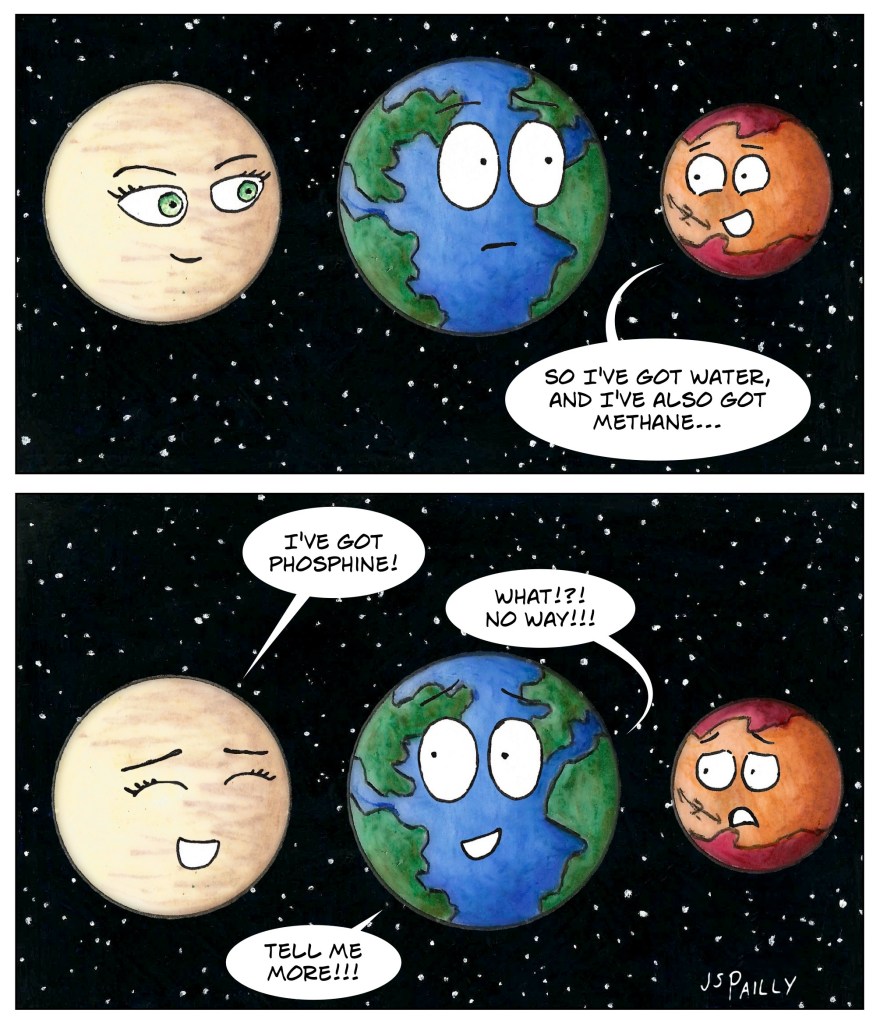
Over the last decade or so, Mars has been trying really hard to convince us that he can (and does) support life.  We’ve seen evidence of liquid water on the Martian surface, and traces of methane have been detected in the Martian atmosphere.  These things are highly suggestive, but none of that proves Martian life exists.

It would be nice if we knew of a chemical that clearly and unambiguously proved that a planet has life, wouldn’t it?  According to this paper published in Nature Astronomy, phosphine (chemical formula PH3) might be the clear and unambiguous biosignature we need.  Here on Earth, phosphine gas is a waste product produced by certain species of anaerobic bacteria.  It’s also produced by humans in our factories.  Either way, the presence of phosphine in Earth’s atmosphere is strong evidence that there’s life on Earth.

And according to that same paper from Nature Astronomy, astronomers have now detected phosphine on another planet.  No, it wasn’t Mars.

Okay, we humans do know of non-biological ways to make phosphine, but they’d require Venus to be a very, very different planet than she currently is.  For example, Venus would need to have a hydrogen-rich atmosphere, or Venus would have to be bombarded constantly with phosphorus-rich asteroids, or the Venusian surface would have to be covered with active volcanoes (more specifically, Venus would need at least 200 times more volcanic activity than Earth).

None of that appears to be true for Venus, so we’re left with two possibilities:

  • There is life on Venus.
  • There’s something we humans don’t know about phosphine, in which case phosphine is not the clear and unambiguous biosignature we hoped it was.

In either event, Venus is about to teach us something.  Maybe it’s a biology lesson.  That would be awesome!  Or maybe it’s a chemistry lesson.  Personally, I’m expecting it to be a chemistry lesson.  There must be some other way to make phosphine that we humans never thought of.

P.S.: Now I’m sure a lot of you are thinking: “Wait a minute, don’t Jupiter and Saturn have phosphine in their atmospheres too?”  You’re right.  They do, and we’ll talk about that in Wednesday’s post.

Sciency Words: Aerobiology

Hello, friends!  Welcome to Sciency Words, a special series here on Planet Pailly where we talk about those weird and wonderful words scientists like to use.  Today on Sciency Words, we’re talking about:

AEROBIOLOGY

You will find life pretty much anywhere you go on Earth.  Living things are in the water, on the land, and up in the air.

Aerobiology comes from three Greek words meaning “air,” “life,” and “the study of.”  So aerobiology is the study of airborne life, specifically airborne microbial life.  According to the Oxford English Dictionary, the term was first introduced in the late 1930’s.

I have to confess I am totally new to aerobiology.  I only found out about this term yesterday, and I don’t want anything I say to misrepresent the field.  But based on what I have read, it sounds like aerobiologists are primarily concerned with protecting public health from the spread of pollen and other allergens, as well as the spread of airborne diseases.

However, aerobiologists also study airborne microbes that are not a direct threat to human health—and this is the part that connects to the outer space stuff I normally write about.  For decades now, aerobiologists have known that algae and other common microorganisms can fly up into Earth’s atmosphere and travel great distances on the wind.  And according to this 2001 paper, microorganisms can (and do) remain active—growing and reproducing—inside the water droplets found in clouds.  As the authors of that 2001 paper explain it, we should start thinking of clouds as microbial habitats.

So what does this have to do with outer space?  Well, if clouds on Earth can serve as a habitat for microorganisms, then maybe microorganisms could exist in the clouds of some other planet.

And by some other planet, I mean Venus.

And by maybe, I mean stay tuned for Monday’s post.