Super Sexy Spacesuits

The spacesuits of today are cumbersome and uncomfortable.  Worst of all, they’re not stylish.  As a science fiction writer/illustrator, I want my characters to look good when they’re blasting through the vacuum of space, fighting bad guys and ridding the galaxy of evil.  Fortunately, NASA researchers have provided me with a realistic (or at least plausible) excuse for dressing my characters the way I want.

It’s something I call the super sexy spacesuit, but the people who are actually developing the technology call it a mechanical counterpressure (M.C.P.) suit.  Spacesuits today are basically body-shaped spaceships, and the whole interior needs to be pumped full of air to replicate atmospheric pressure. The big selling point for M.C.P. suits is that you wear them like regular clothing.

Almost.  They’re a lot tighter than regular clothing.  Not the way Spandex is tight.  No, they’re way tighter than that.  The fibers in the cloth are supposed to constrict on command, squeezing your body—squeezing so hard they end up exerting one atmosphere’s worth of pressure on your skin.

When you’re in space, you won’t notice that pressure. You’ve lived your whole life under one atmosphere’s worth of pressure, so you’re used to that.  The suit should feel like a second skin, providing you all the comfort and flexibility of being naked (and perhaps the body image anxiety as well).

You’ll also be safer, at least in one sense, because minor damage to the suit wouldn’t cause catastrophic depressurization, the way it can with a contemporary spacesuit.  However, there are still a few parts of the body where mechanical counterpressure won’t work so well. Fingers and toes, and all the small bones of the hands and feet, are really, really not meant to be compressed in this way.  The same is true for your face and head, and mechanical counterpressure in the groin area could also be problematic.

But still, in the future some sort of M.C.P. spacesuit might be a plausible option, not just so we can survive in the vacuum of space but so we can look good doing it.

Or you could forego spacesuits all together and do this instead:
Exomoons and Trickster Moons

I’ve been looking forward to this for many years now: we’ve discovered thousands of exoplanets out there, and now we may have discovered our very first exomoon!

There are a handful of moons in our own Solar System that may be home to alien life, so if we can start observing and studying exomoons, in addition to exoplanets, that greatly expands the number of places we can search for alien life and greatly increases the chance that we might find something.

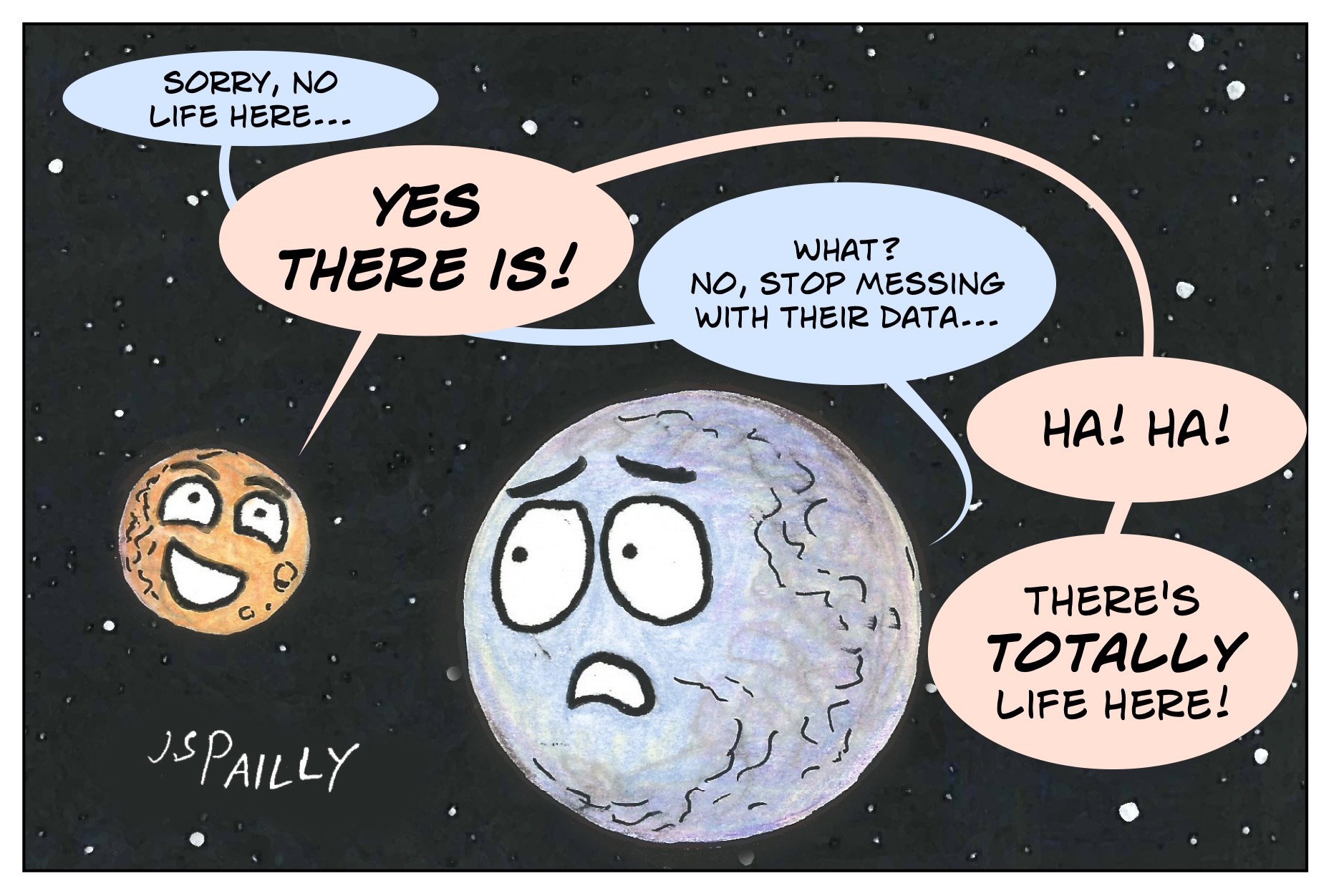
However, exomoons may also pose a serious problem for astrobiologists.  You see, one of the things astrobiologists are looking for are planets with atmospheres in a state of “chemical disequilibrium.”  For example, chemicals like oxygen and methane should react with each other and thus remove each other from the atmosphere.  The only way those two chemicals can coexist long term is if some ongoing process (like biological activity) is constantly replenishing them.

But imagine an exoplanet with an oxygen-rich atmosphere and an exomoon with a methane-rich atmosphere.  From here on Earth, that planet-moon system could easily be mistaken for a single exoplanet, with the two separate atmospheres appearing to be one atmosphere in that much coveted state of disequilibrium.

In this paper—a paper which describes its results as “inconvenient, yet unavoidable”—this is referred to as the exomoon false-positive scenario, but I’m calling it the trickster moon problem, because someday some undetected exomoon might trick us into thinking we’ve discovered alien life when we haven’t.

The good news is that we may have already detected one exomoon, so in time we should get better at detecting others.  But as that “inconvenient yet unavoidable” paper warns, it may be decades (at least) before we can reliably tell which exoplanets do or do not have moons.  Until then, fellow space explorers, beware of those trickster moons!

Europa’s Cold Spot

I still have a ton of research reading to catch up on from 2018.  This weekend, I read a paper about Europa.  I wasn’t sure at first why this was on my to-be-read list, but by the end I knew why this one had caught my attention.

Europa is one of the icy moons of Jupiter.  It’s often listed as one of the most likely places in the Solar System where we might find alien life.  That’s because there’s evidence of a vast ocean of liquid water sloshing around beneath Europa’s icy crust.

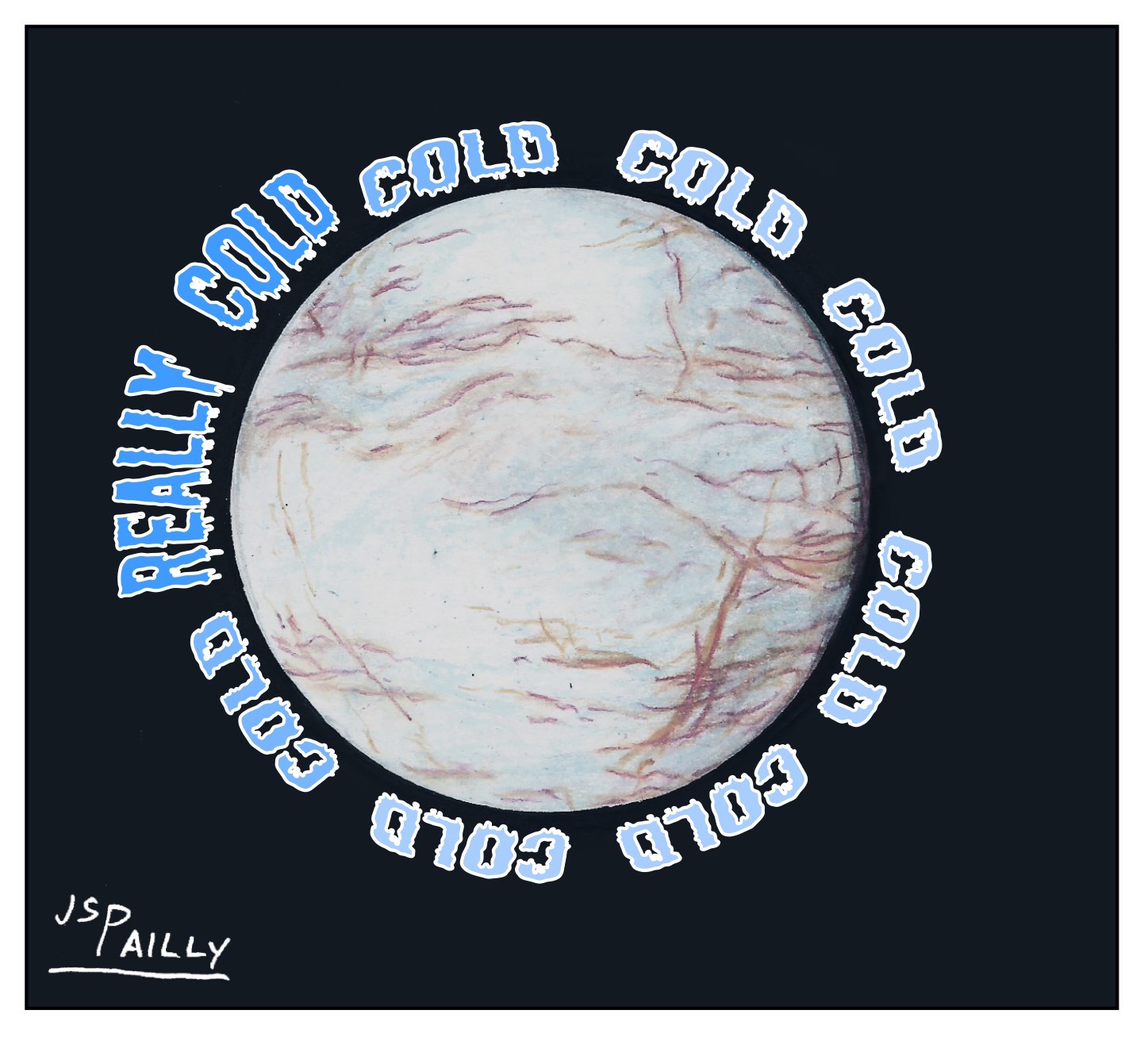
Maybe someday we’ll be able to drop a little robo-submarine into that ocean and see if anything’s swimming around down there. But in the meantime, we’re really only able to explore Europa’s surface.  And as you can see in the highly technical diagram below, no matter where you go on Europa’s surface, it’s cold.  But in one specific region, Europa gets really cold.

Or at least, that one region appears to be extra cold.  This is a case where it’s important to understand how we get our data. We’re really measuring Europa’s thermal emissions, the amount of heat that gets radiated out into space. So that cold spot may represent one of two things:

  • Either that region absorbs less sunlight than the rest of Europa, and so it never heats up in the first place…
  • Or that region does a better job trapping the heat it absorbs from the sun, and so we detect less heat escaping back into space.

Either way, something weird is happening. Unfortunately, our previous missions to the Jupiter system did not provide us any useful photos of that one specific spot on Europa’s surface.  Our current Juptier mission, Juno, is unable to approach Europa at all, so that’s no help.

So we can’t match this anomalous cold spot to a visible surface feature.  However, the authors of the paper I read did suggest that this could be a sign of recent geological activity—the formation of chaos terrain, perhaps.

And if that’s true, we might (might!) find the waters of Europa’s subsurface ocean seeping up to the moon’s surface.  Maybe there’s fresh organic material seeping up onto the surface too.  Maybe.

Maybe.

Could be worth checking out, though.  Don’t you think?

Sciency Words: Nominal Solar Radius

Sciency Words: (proper noun) a special series here on Planet Pailly focusing on the definitions and etymologies of science or science-related terms.  Today’s Sciency Word is:

THE NOMINAL SOLAR RADIUS

Last week, I told you about the classification system in use for main sequence stars. Today we’re going to talk specifically about G-type stars.  Or rather, we’re going to talk about one G-type star in particular: the Sun.

I was recently clued in on a controversy about the Sun.  After reading up on the issue, though, I don’t think this is a real controversy.  It’s more like an Internet controversy.

If you’ve ever wondered how big the Sun is, a quick Google search will get you an answer.  But it won’t get you the correct answer.  That’s because we apparently do not know precisely how big the Sun is.  As this paper from 2018 states: “[…] measuring with high accuracy the diameter of the Sun is a challenge at the cutting edge of modern techniques.”

Part of the problem is that we’ve tried using multiple methods for either measuring the Sun’s radius by direct observation or by calculating the radius based on other kinds of measurements.  And we keep getting different answers.  I take it we’re not getting wildly different answers, but there’s enough variation there to create a problem for scientists who study the Sun.

So here’s where the alleged controversy comes in.  Our friends at the I.A.U.—the International Astronomy Union, the same organization that decided Pluto is not a planet—decided a few years ago what the Sun’s radius should be.  They said it equals 695,700 km.  No more, no less.  I mean, who are these people to decide what is or is not a planet?  Who are these people to decide now how big the Sun is?

Except that’s not actually what the I.A.U. did. Regardless of how I may feel about the whole Pluto thing, I do agree with the I.A.U. about their definition of the solar radius.  Or to speak more precisely, I agree with their definition of the nominal solar radius.  As explained in the I.A.U. resolution on this matter:

These nominal values should be understood as conversion factors only—chosen to be close to the current commonly accepted estimate […] not as the true solar properties.  Their consistent use in all relevant formulas and/or model calculations will guarantee a uniform conversion to SI units.

So I don’t think the controversy, such as it is, really exists.  If we’re going to use the nominal solar radius as a unit of measure, we all have to agree about what that unit of measure is equal to—especially because we still don’t know what the actual solar radius is.

Feel free to bash the I.A.U. about Pluto, if you want, but when it comes to their nominal solar radius definition, I think the way they handled it makes a lot of sense.

Sciency Words: Oh Be A Fine Girl/Guy, Kiss Me!

Sciency Words: (proper noun) a special series here on Planet Pailly focusing on the definitions and etymologies of science or science-related terms.  Today’s Sciency Word is:

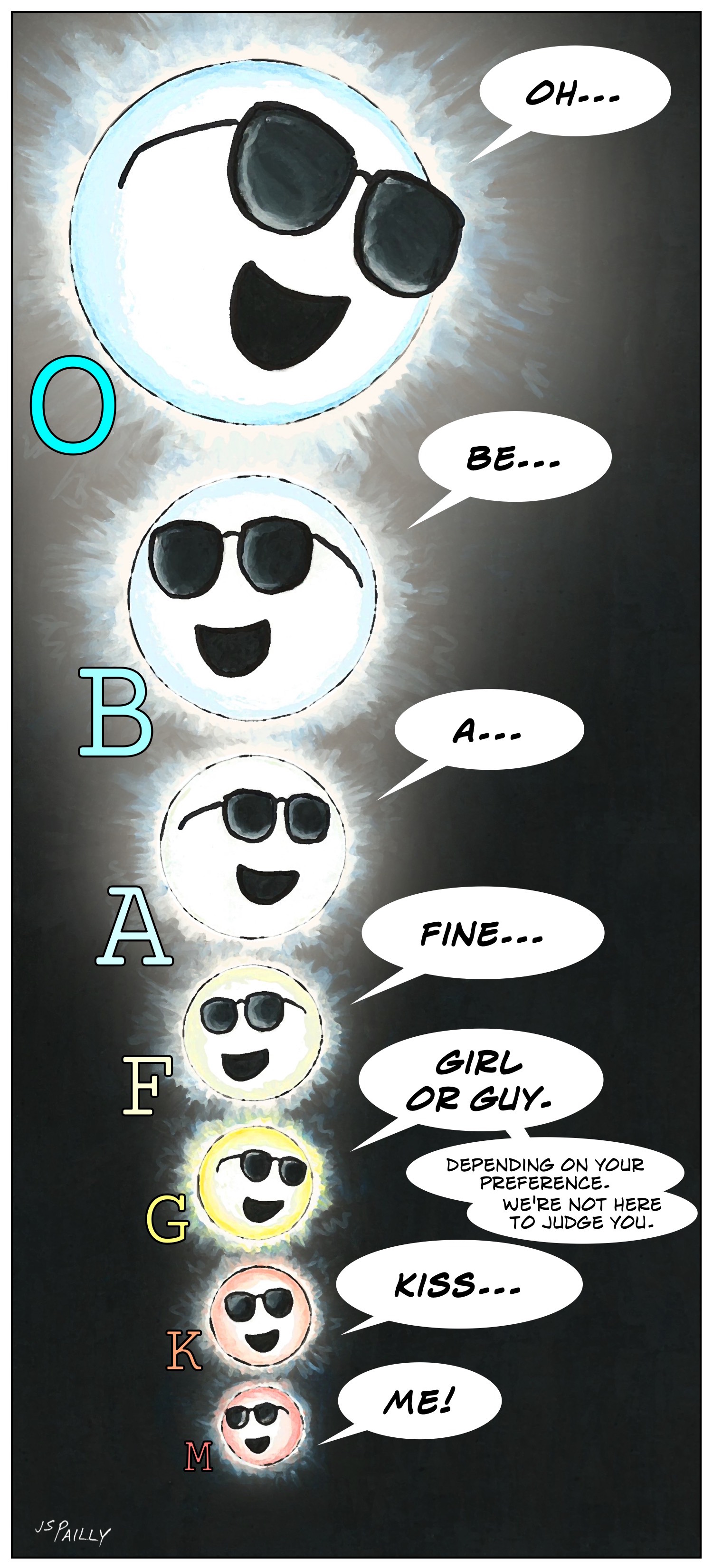
OH BE A FINE GIRL/GUY, KISS ME!

Our Sun is a main sequence star, meaning it fuses hydrogen into helium within its core.  The vast majority of stars in the universe are main sequence stars. They’re very important. Unfortunately, the classification system we use for these main sequence stars is a bit odd and not very easy to remember.

The biggest, hottest main sequence stars are called O-type stars.  The smallest and coldest are called M-type stars.  You’d be forgiven for thinking the stars in between are called N-type stars, but no.  Between the letters O and M, we get B, A, F, G, and K-type stars.

Apparently, at least according to Wikipedia, it didn’t start out this way.  Initially, all stars were classified under a different alphabetical system which, I presume, made more alphabetical sense.  But this seems to be yet another case of scientists naming things before those things are properly understood.

In the early 1910’s, Danish astronomer Ejnar Hertzsprung and American astronomer Henry Norris Russell put together what is now known as a Hertzsprung-Russell diagram.  This diagram revealed a close relationship between the color and brightness of most stars.  The color and brightness of these main sequence stars is also closely related to temperature and mass, respectively.

The old system no longer made much sense, but the alphabetical labels had been so widely used in scientific literature that it would have been difficult to get rid of them.  American astronomer Annie Jump Cannon is credited with fixing the problem: she rearranged the old lettering scheme to reflect our new knowledge about stars.  Henry Norris Russell then came up with a handy mnemonic device to help us remember the new system:

I have to admit I’ve always felt like this phrase is a bit pervy.  At least it’s a little more gender inclusive than it used to be (Russell’s original version was “Oh be a fine girl, kiss me,” because obviously astronomers are always male, and obviously males only want females to kiss them—but we’ve moved on from both of those assumptions since Russell’s time).

Still, as a mnemonic device, it works well enough. As I was reading this paper about the search for Earth-like planets, and how various types of main sequence stars might affect those planets, I found myself repeating the “Oh be a fine girl/guy, kiss me!” line quite a lot.  Not out loud, of course.  That would have gotten me slapped by somebody, I’m sure.

Where Are the Earthlings?

Have you ever looked up at the night sky and wondered if maybe, somewhere out there, someone might be looking back at you?  Well, I’m here to tell you the answer to that question is yes.  Or at least there are aliens out there who are trying very hard to find us.  I even have video evidence to prove it!

For us Earthlings, it’s pretty obvious that there’s life on this planet.  How could you possibly miss it?  But for aliens observing Earth from a distance—perhaps a very great distance—the most obvious biosignatures are frustratingly difficult to detect.

In the early 1990’s, Carl Sagan wrote a famous paper about this problem.  One of NASA’s own space probes, which was heading out to Jupiter, briefly turned all its instruments back on Earth.  Based on that data alone, without any prior knowledge about this planet, you could probably figure out there’s life on Earth. Probably.

This more recent paper published in The Astrophysical Journal follows up on Sagan’s work.  Assuming the aliens are smart (a big assumption, based on what the video evidence shows us), they should be looking for a planet with both an oxidizing gas AND a reducing gas in its atmosphere.

Oxidizing and reducing agents should react with each other relatively quickly, removing each other from the planet’s atmosphere.  So in order to have those two things coexisting long term, some exotic process (like biological activity) must be constantly replenishing them.

A spectroscopic analysis of Earth’s atmosphere would reveal a whole lot of the chemicals in our air, but not all of them. Apparently some spectral signatures are so strong they cover up others, which I think is an important thing to know.  But oxygen (an oxidizing gas) should still be detectable in the visible light part of the spectrum, and methane (a reducing gas) should show up in visible and infrared.

But still, it sounds like difficult work, teasing the signatures of oxygen and methane out of all the other spectral signatures you’d get from Earth’s atmosphere.  This could be why the aliens are having such a hard time finding us, and also why we are having such a hard time finding them.

Where Are the Aliens?

I fell way behind on my science and space exploration research last year.  I now have a tall pile of to-be-read books and papers in my reading room.  But I’m now starting to catch up, beginning with this paper on the atmospheres of Earth-like planets.

As explained in this article from the Planetary Society, the goal of this paper is to start creating a guidebook for finding planets that might be home to alien life.  And based on what the paper says early on, it sounds like there are plenty of “habitable Earth-like planets” out there to be found!

If we’re looking only at red dwarf stars, which are the smallest and most common of stars, about 30% of them should have a habitable Earth-like planet orbiting them.  And between 5 and 20% of orange, yellow, and yellow-white dwarf stars should have habitable Earth-like planets too.  Our own Sun, by the way, is a yellow dwarf star.

Statistically speaking, this means we should find another Earth orbiting a red dwarf within only 2 parsecs of us.  And there should be another another Earth orbiting an orange, yellow, or yellow-white dwarf within 6 parsecs.  I feel like that’s surprisingly close, at least in the grand scheme of our universe.

Except when astronomers talk about Earth-like planets, what they’re actually describing does not necessarily sound much like Earth.  Any planet that’s about the same size and mass as Earth can be called Earth-like, and by that standard Venus is about as Earth-like as any planet can be, aside from Earth itself.

And when this paper talks about habitable Earth-like planets, I’m pretty sure all the authors mean are planets within the habitable zones of their parent stars.  But just because a planet orbits within a habitable zone does not mean that planet is truly habitable.  Again, look at Venus.

So when we do find a “habitable Earth-like planet” within 2 or 6 parsecs of us, how will we know we’re looking at another Earth and not another Venus?  That’s a tricky question.  Maybe it would help to think about the problem from a different perspective.  You see, while we humans are having a really difficult time finding alien life, the aliens may also be having a very difficult time finding us.

More on that in the next post!

Sciency Words: Karman Line

Sciency Words: (proper noun) a special series here on Planet Pailly focusing on the definitions and etymologies of science or science-related terms.  Today’s Sciency Word is:

THE KARMAN LINE

If I may begin on a personal note, I spent most of 2018 essentially grounded by real life problems.  So for 2019, I’m dusting off the old imaginary spaceship, and I’m ready to launch myself back into outer space.  It seems I have a whole lot of space research I need to catch up on!  But first, where exactly is space?  How far away is it?

In the early 1960’s, Hungarian-American physicist Theodore von Kármán proposed an idea that has come to be known as the Karman line. Basically, the Karman line can be defined as the altitude where you need to stop thinking in terms of aerodynamics and start thinking in terms of orbital mechanics.

A traditional aircraft flying above the Karman line will no longer get enough lift to stay aloft, and a satellite or other space vehicle that dips below the Karman line will experience too much atmospheric drag to maintain its orbit.  Technically speaking, there are still more layers of Earth’s atmosphere above that line, but still this seems like a sensible enough place to define the beginning of outer space.

So how high up is the Karman line?  According to the Fédération Aéronautique Internationale (F.A.I.), which is sort of like the Guinness Book of World Records specifically for air and space flight, the Karman line is 100 km above sea level.  This is the value that seems to be most commonly accepted around the world, but it is not the value accepted by one noteworthy space agency: NASA.

According to NASA, space begins 50 miles above sea level. This 50 miles number is not merely a result of America’s famous disdain for the metric system.  As explained in this paper from Acta Astronautica, calculating the exact altitude where aircraft can no longer fly and satellites can no longer maintain their orbits has been a challenge for many decades; however, an estimate of 80 km (approximately 50 miles) may be closer to the real Karman line than the 100 km estimate set by the F.A.I.

A lot may depend on your spacecraft’s design, the parameters of your orbit, and solar activity, which causes Earth’s atmosphere to puff up slightly at times.  But to quote from that Acta Astronautica paper:

[…] elliptical orbits with perigees at 100 km can survive for long periods. In contrast, Earth satellites with perigees below 80 km are highly unlikely to complete their next orbit.

In other words, a satellite can safely dip below an altitude of 100 km, but if it gets as low as 80 km, that satellite is toast.

So when I climb back into my imaginary spaceship, how far up do I need to go to reach space?  50 miles?  100 km?  Or is there some other number I should be aiming for?

I’m still not sure.  But given the places I’m planning to go with my research in the coming year, maybe it doesn’t really matter.  Me and my imaginary spaceship will be flying well beyond the Karman line, wherever precisely that line is.

My Favorite Moon: Io

Some of you may remember a post I did awhile back declaring Europa to be my favorite moon.  It’s a beautiful and mysterious world, a world that may have an incredible secret hidden beneath its icy crust.  Europa frequently tops the list of most likely places where we might find alien life.

But as I’ve learned more about the Solar System, I’ve developed a deeper affection for another moon, one of Europa’s neighbors, a world that is neither beautiful nor likely to support life.  I’m talking about Io.

Io is the innermost of Jupiter’s four big moons (Io, Europa, Ganymede, and Callisto).  As such, it gets pushed and pulled around pretty hard. Between Jupiter’s enormous gravity and the combined gravitational forces of the other three Galilean moons, it’s enough pushing and pulling to make anyone queasy.  And Io is a notoriously queasy planetoid.

Due to tidal forces, Io’s sulfur-rich interior is constantly boiling and churning.  And Io keeps literally spewing out its guts, making it the most volcanically active object in the whole Solar System.

Like Venus, my favorite planet, Io is a great chemistry professor, especially when it comes to sulfur chemistry.  Io’s also a pretty decent physics professor.  While most of the sulfur from Io’s volcanic eruptions settles back onto the moon’s surface, plenty of it escapes into space. The result: crazy dangerous games of particle physics in the vicinity of Jupiter.

Io’s ionized sulfur has a lot to do with controlling the intense radio emissions coming from Jupiter.  It’s also a major factor contributing to Jupiter’s insanely dangerous (to both humans and our technology) radiation environment. We recently learned that Jupiter has a third magnetic pole, located near the planet’s equator; while I haven’t read anything yet to back me up on this, I have a feeling Io is somehow responsible for that.

And lastly, Io’s ionized sulfur is partially (mainly?) responsible for the magnificent auroras that have been observed on Jupiter. And that’s my favorite bit about my favorite moon.  I love the idea that Io—the ugliest ugly duckling in the Solar System—plays such a crucial role in creating something beautiful.

But of course picking a favorite anything is a purely subjective thing.  Do you have a favorite moon?  If so, what is it?  Please share in the comments below!