Sciency Words A to Z: Goldilocks Zone

Welcome to a special A to Z Challenge edition of Sciency Words!  Sciency Words is an ongoing series here on Planet Pailly about the definitions and etymologies of science or science-related terms.  In today’s post, G is for:

GOLDILOCKS ZONE

Once upon a time, there was a little girl from outer space who came to visit the Solar System.  Her name was Goldilocks.  First, she landed on Mars, but she didn’t like it there.  It was too cold.  Then she tried to land on Venus, but she didn’t like it there either. It was too hot—way too hot.  And then finally, Goldilocks landed her spaceship on Earth.  When she came out of the airlock and walked down the landing ramp, she said to the astonished Earthlings, “Ah yes, this planet is just right!”

At least that’s how my version of the Goldilocks story goes.

Anyway, the concept of a Goldilocks zone (also known as a habitable zone, continuously habitable zone, or circumstellar habitable zone) is pretty simple.  Fairy tale simple, you might say.  The Goldilocks zone is the region of space around a star where liquid water can exist on a planet’s surface.  And as you know, if a planet has liquid water on its surface, then it could have life!

For a long time, our search for alien life has focused almost exclusively on Goldilocks planets.  But there are problems with limiting our search in that way.

In my post on carbon chauvinism, I told you there are other chauvinisms that astrobiologists have to deal with. One of them is water chauvinism, the presumption that water is necessary for life.  Another is surface chauvinism, the presumption that life can only exist on a planet’s surface.  Our obsession with Goldilocks zones is largely based on those two chauvinisms.

But looking to the moons of Jupiter and Saturn, we’ve already learned that there is more liquid water outside the Goldilocks zone than in it!  Several of those moons have vast oceans of liquid water beneath their surface, with only a relatively thin crust of ice overtop.  These subsurface oceans might be ideal environments for alien life.  So much for our surface chauvinism.

And then there’s Titan, a moon of Saturn, which has lakes of liquid methane and ethane on its surface.  Could those liquid hydrocarbons serve as a substitute for water in an alien biochemistry?  We don’t know.  It’s possible.  We certainly shouldn’t rule that possibility out.  And thus, so much for our water chauvinism.

To quote from Exoplanets by Michael Summers and James Trefil, “[…] the current focus on finding a Goldilocks planet amounts to a search for the least likely location of water and, presumably, life.”  I think there’s a bit of hyperbole in that statement, but I agree with the general point.  There are probably far more worlds in our galaxy like Europa, Enceladus, or Titan than there are like Earth.

Next time on Sciency Words A to Z, we’ll crack the surface of one of those icy moons and see what might be hidden in those dark, extraterrestrial depths.

Sciency Words A to Z: The Fermi Paradox

Welcome to a special A to Z Challenge edition of Sciency Words!  Sciency Words is an ongoing series here on Planet Pailly about the definitions and etymologies of science or science-related terms.  In today’s post, F is for:

THE FERMI PARADOX

The birth of the Fermi Paradox is, perhaps, one of the most poorly documented scientific events in recent history.  Nuclear physicist Enrico Fermi did not present his famous paradox at some scientific symposium or write it up for some academic journal. No, the whole thing started (apparently) with a comment Fermi made half-jokingly over lunch.

I normally draw all the illustrations on this blog, but I’m making an exception today.  In 1950, New York City was suffering an epidemic of disappearing garbage cans.  No one could figure out where the city’s garbage cans were going or who was taking them, so the New Yorker published this cartoon offering one possible explanation:

According to the historical narrative reconstructed in this report, that summer (or sometime thereabout) Fermi was visiting the Los Alamos National Laboratory in New Mexico.  He and a bunch of old friends from the Manhattan Project had seen that cartoon and were joking about extraterrestrial life over lunch.

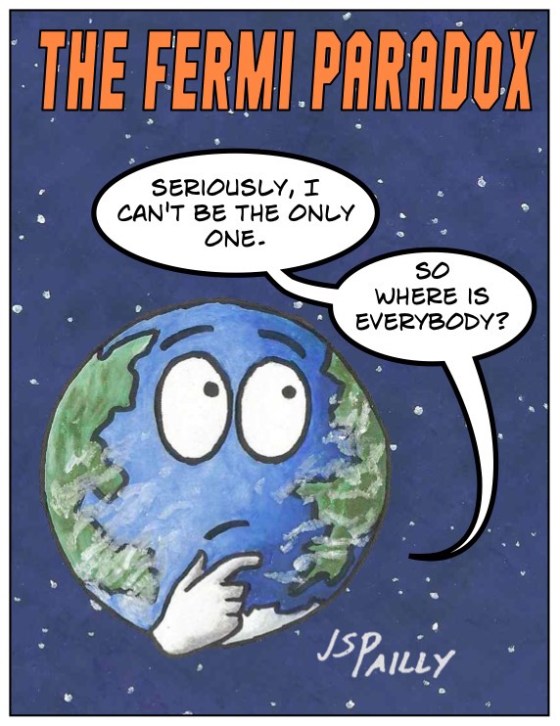
As the conversation progressed, Fermi suddenly, almost out of the blue, said these fateful words: “But where is everybody?”  He then proceeded to lay out the fundamental problem that is now known as the Fermi Paradox.

In short, our galaxy is old—over ten billion years old by most estimations.  Earth is less than half that age, and our civilization—why, we’ve been around for barely a blink of an eye on the cosmic scale.  If civilizations like ours can pop up so suddenly, so abruptly, then over the last ten billion years advanced civilizations should have filled up the whole galaxy.  The aliens should be everywhere, and yet we can’t seem to find any evidence of their existence.

So where is everybody?

Many answers to that question have been proposed over the years.  Fermi and company are said to have run through most of them that day while they finished up their lunch.

  • Maybe Earth is part of a galactic nature preserve, or maybe intergalactic law forbids anyone from making contact with “primitive” cultures like our own.
  • Maybe Earth is out in the boondocks of the galaxy, far, far away from where all the aliens like to hang out.
  • Maybe interstellar travel is harder than we think, and so all the alien civilizations tend to keep to themselves and never leave their home planets or home solar systems.
  • Maybe intelligent life has an innate tendency to destroy itself.

That last one is a sobering thought, especially when you remember that these were the people who worked on the Manhattan Project!

Personally, I kind of like the notion that we’re part of a nature preserve.  I have no scientific justification for thinking that; I just find it comforting to suppose that maybe the aliens do know about us and think we’re worth preserving.  But what do you think the solution to the Fermi Paradox might be?  Let me know in the comments!

Next time on Sciency Words: A to Z, why is Earth “just right” for life?

Correction/Clarification: After reading some of the responses to this post, I think I may have been a little too flippant about the galactic nature preserve thing. I think that’s a cool idea, and I think it’s a fun thing to think about. But there is absolutely no scientific evidence to support that hypothesis at this point, and I do not actually take the idea seriously. I should have been clearer about that.

Sciency Words A to Z: Earth Similarity Index

Welcome to a special A to Z Challenge edition of Sciency Words!  Sciency Words is an ongoing series here on Planet Pailly about the definitions and etymologies of science or science-related terms.  In today’s post, E is for:

EARTH SIMILARITY INDEX

From time to time, you might hear on the news that scientists have discovered a new Earth-like planet.  You’d think that would be huge news, but it’s rarely presented that way.  It’s more like a fluff story, the kind of thing news anchors can banter about before tossing to weather.  It’s enough to make you wonder what, exactly, the term Earth-like planet really means.

In 2011, this paper appeared in the journal Astrobiology.  The authors of that paper proposed a new system for quantifying how Earth-like another planet is.  They called their system the Earth Similarity Index or E.S.I.  The basic idea is you take four measurable properties—a planet’s mass, density, surface gravity (represented by escape velocity), and surface temperature—plug that information into an equation, and get a number between zero and one.

Numbers close to zero represent planets that are about as un-Earth-like as possible.  Numbers close to one represent planets that are almost exact matches for Earth. So in most cases, when people talk about Earth-like planets, what they mean are planets that scored highly on the E.S.I.

Unfortunately, because of the limits of current technology, a lot of guesswork has to go into our E.S.I. calculations.  Most of the time, we just can’t get the precise measurements we need.  Measuring a distant exoplanet’s surface temperature seems to be especially problematic.  But even if that weren’t the case, the E.S.I. still wouldn’t account for things like a planet’s atmosphere or the presence of liquid water, or many other key things that make Earth the planet that it is.

That same 2011 paper also proposes another system called the Potential Habitability Index or P.H.I.  Taken together, the E.S.I. and P.H.I. should give you a clear idea of just how Earth-like another planet really is.  A very clear idea.  But the stuff you have to measure for the P.H.I.—we’re not even close to being able to measure that stuff.  Not yet.

Someday in the future, as we continue to refine out observational techniques, maybe we’ll be able to put the E.S.I. and P.H.I. to good use.  Until then, any news you hear about newly discovered Earth-like planets is probably not as exciting as it sounds.  Unless, of course, this is the newscast you’re watching:

Next time on Sciency Words A to Z, nuclear physicist Enrico Fermi said it first: where is everybody?

Sciency Words A to Z: The Drake Equation

Welcome to a special A to Z Challenge edition of Sciency Words!  Sciency Words is an ongoing series here on Planet Pailly about the definitions and etymologies of science or science-related terms.  In today’s post, D is for:

THE DRAKE EQUATION

In 1961, American astronomer Frank Drake proved that alien life exists.  He didn’t do this with a telescope or by analyzing a Martian meteorite. No, Frank Drake proved it with math, pure and simple.  Or at least that’s the impression some people seem to get when they first hear about the Drake equation.

The Drake equation was first presented in 1961 at a conference held at the Green Bank Telescope in West Virginia. Only ten people were in the audience when Drake gave his presentation (one of those ten people, by the way, was a young Carl Sagan).  And the topic to be discussed at this conference: a new and highly controversial idea called SETI.

In this article from Universe Today, Drake is quoted explaining what inspired his equation:

As I planned the meeting, I realized a few day[s] ahead of time we needed an agenda. And so I wrote down all the things you needed to know to predict how hard it’s going to be to detect extraterrestrial life.  And looking at them it became pretty evident that if you multiplied all these together, you got a number, N, which is the number of detectable civilizations in our galaxy.

After reading All These Worlds Are Yours by Jon Willis, I’ve come to think of the Drake equation as a to-do list for astrobiologists.

N = R* · fp · ne · fl · fi · fc · L
  • Figure out how many stars are born in our galaxy per year (R*).
  • Figure out how many of those stars have planets (fp).
  • Figure out how many of those planets could support life (ne).
  • Figure out how many planets that could support life actually do (fl).
  • Figure out how often life evolves into intelligent life (fi).
  • Figure out how often intelligent life develops radio communications that we could detect (fc).
  • Figure out how long the average intelligent civilization keeps its radio equipment working (L).

Like I said, it’s a to-do list.  It’s presented in the form of an equation because… well, you know… scientists.

At this point, we have a pretty good feel for the first two variables in the Drake equation.  As stated in this article from Astronomy Magazine, 1.5 to 3 new stars are born per year in our galaxy, and each star has at least one planet, on average.  Current and upcoming missions should start to pin down real numbers for the number of planets that could potentially support life.

Beyond that, those questions do get progressively harder, but astrobiologists are steadily working their way down their to-do list—or rather, they’re working their way through the equation, starting from the left and heading to the right.  Answers are coming, slowly but surely.

Next time on Sciency Words A to Z, when astrobiologists talk about Earth-like planets, what exactly does that mean?

Sciency Words A to Z: Carbon Chauvinism

Welcome to a special A to Z Challenge edition of Sciency Words!  Sciency Words is an ongoing series here on Planet Pailly about the definitions and etymologies of science or science-related terms.  In today’s post, C is for:

CARBON CHAUVINISM

According to legend, Nicolas Chauvin was a French soldier during the Napoleonic Wars.  He’s described as being boastfully patriotic and doggedly loyal to Napoleon even long after Napoleon was defeated.  He was basically a joke, a caricature of a Napoleon supporter in a post-Napoleonic Europe.  And it is from Nicolas Chauvin’s name that we get the word chauvinism.

Carbon chauvinism is a term coined by Carl Sagan.  It refers to a common attitude among scientists that carbon-based life is the only kind of life that’s possible in our universe.  There are other kinds of chauvinism that the science of astrobiology has to contend with (just you wait until we get to the letter R), but carbon chauvinism is the big one, followed closely by water chauvinism.

In this 1973 interview with Rolling Stone, Sagan had this to say:

There’s carbon chauvinism, water chauvinism—you know, people who say that life elsewhere can only be based on the same chemical assumptions as we are.  Well, maybe that’s right.  But because the guys making that statement are based on carbon and water, I’m a little suspicious.

And yet despite Sagan’s little suspicions, he goes on to say in that same interview that he is a carbon chauvinist himself. And I have to admit, so am I. Carbon chauvinism is the one and only chauvinism I know of that seems to be justified.  As Sagan says:

Having gone through the alternative possibilities, I find that carbon is much better suited for making complex molecules, and much more abundant than the other things that you might think of.

Silicon is often suggested as a possible alternative to carbon, and silicon-based life forms are everywhere in science fiction. Carbon and silicon do have a great deal in common, chemically speaking.  But where carbon-based molecules are nice and wiggly—perfectly suited for all the wiggly activities of life—silicon-based molecules tend to be inflexible and kind of brittle.

So if you want to be a rock, silicon’s great! But if you want to be a life form, it’s hard to imagine why you would choose to base your biochemistry on silicon rather than carbon—carbon’s just objectively better in every way!

But then again, I am one of those people Sagan was talking about: one of those guys based on carbon.  Maybe you should be a little bit suspicious of my biases.

Next time on Sciency Words A to Z, let’s count our aliens before they’ve hatched, so to speak.  Exactly how many alien civilizations do we expect to find out there?

Sciency Words A to Z: B.S.O.

Welcome to a special A to Z Challenge edition of Sciency Words!  Sciency Words is an ongoing series here on Planet Pailly about the definitions and etymologies of science or science-related terms.  In today’s post, B is for:

B.S.O.

When you study the planets, when you really get to know them well, you soon start to feel like they each have their own unique personalities.  Jupiter is kind of a bully, pushing all the little asteroids around with its gravity.  Venus hates you, and if you try to land on her she will kill you a dozen different ways before you touch the ground. And Mars… I can’t help but feel like Mars is kind of jealous of Earth.

I get the sense that Mars wishes it could be just like Earth, and that Mars is trying its best to prove that it has all the same stuff Earth has.

In 1996, Mars almost had us convinced. A team of NASA scientists led by astrobiologist David McKay announced that they’d found evidence of Martian life.

As reported in this paper, McKay and his colleagues found microscopic structures (among other things) within a Martian meteorite known as ALH84001.  They interpreted those structures to be the fossilized remains of Martian microorganisms.

This was a truly extraordinary claim, but as Carl Sagan famously warned: “extraordinary claims require extraordinary evidence.” Or to put that another way, when it comes to the discovery of alien life, astrobiologists must hold themselves and each other to the same standards as a court of law: proof beyond a reasonable doubt.

In follow-up research, those supposed Martian fossils came to be known as bacteria shaped objects, or B.S.O.s for short.  I kind of wonder if somebody was being a bit cheeky with that term. I wonder if someone was trying to say, in a subtle but clever way, that the whole Martian microbe hypothesis was just B.S.  As this rebuttal paper explains:

Subsequent work has not validated [McKay et al’s] hypothesis; each suggested biomarker has been found to be ambiguous or immaterial.  Nor has their hypothesis been disproved.  Rather, it is now one of several competing hypotheses about the post-magmatic and alteration history of ALH84001.

In other words, those B.S.O.s might very well be fossilized Martian microorganisms.  Yes, they might be.  It is possible.  But no one has been able to prove it beyond a reasonable doubt, and therefore no one can say with any certainty that we’ve found evidence of life on Mars. At least not yet.

Still, the ALH84001 meteorite and its B.S.O.s are an important part of the history of astrobiology.  As that same rebuttal paper says:

[…] it will be remembered for (if nothing else) its galvanizing effect on planetary science.  McKay et al. revitalized study of the martian meteorites and the long-ignored ideas of indigenous life on Mars.  It has brought immediacy to the problem of recognizing extraterrestrial life, and thus materially affected preparations for spacecraft missions to return rock and soil samples from Mars.

Next time on Sciency Words A to Z, are we prejudiced against non-carbon-based life?

Sciency Words A to Z: Astrobiology

Welcome to a special A to Z Challenge edition of Sciency Words!  Sciency Words is an ongoing series here on Planet Pailly about the definitions and etymologies of science or science-related terms.  In today’s post, A is for:

ASTROBIOLOGY

If you’ve ever looked up at the night sky and asked yourself if someone or something might be out there gazing back at you, you’re not alone.  Lot’s of people wonder about that.  Some of those people are scientists—a very special kind of scientist called an astrobiologist.  And those astrobiologists are busily working to find an answer.

In my previous A to Z Challenge, we looked at a lot of scientific terms that don’t quite make sense, like this one or this one. Scientists aren’t always the best at naming things.  Astrobiology is yet another term that people sometimes complain about, because based on a strict translation of the Greek root words, astrobiology should mean the study of life on stars.

And that’s absurd.  Nobody expects to find life on or inside of a star.  Rather, astrobiologists are looking for life on planets and moons, and perhaps also asteroids and comets.  And maybe interstellar dust particles.  But not stars.  Definitely not stars!

To quote from All There Worlds are Yours by Canadian astronomer Jon Willis:

The science of astrobiology has three main goals: to understand the conditions necessary for life on Earth (and perhaps the conditions required by life in general), to look for locations in the universe which supply these conditions, and, finally, to detect life in these locations.

The word astrobiology was coined in 1953 by Russian astronomer Gavriil Adrianovich Tikhov, who’s described in this paper from Interdisciplinary Science Reviews as “an unusual beacon of scientific individualism in a sea of Soviet imposed conformity.”

According to that same paper, the term didn’t really catch on in the West until the 1990’s.  The establishment of NASA’s Astrobiology Institute in 1998 seems to have been a key turning point in the history of this word (prior to that, the scientific search for alien life was generally known as exobiology).

Next time on Sciency Words A to Z, we’ll find out what happened in the 1990’s that made NASA so keen to set up its own Astrobiology Institute.  Until then, keep looking up, and keep wondering!

Mars: The Little Planet That Could

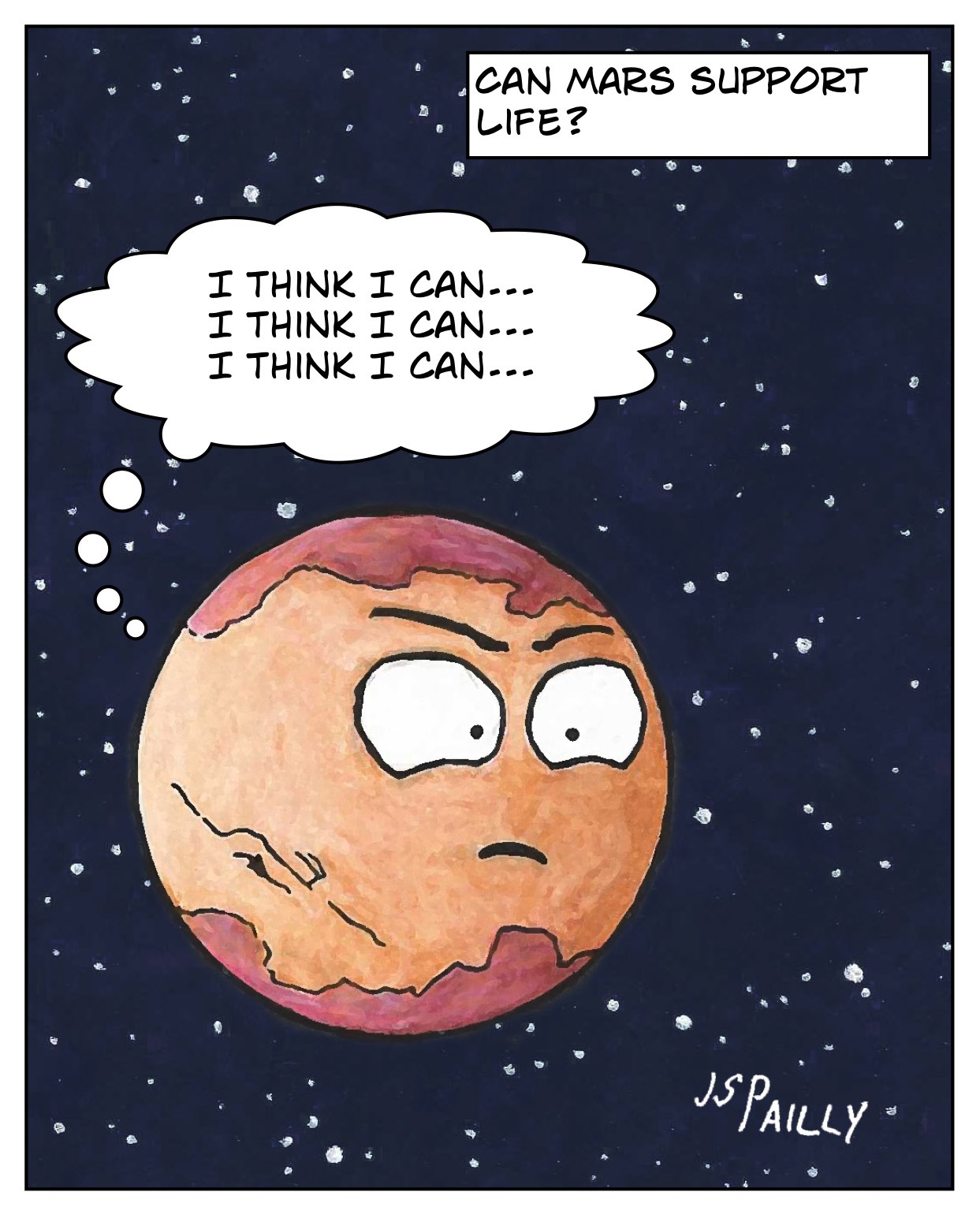
Do you remember the children’s story “The Little Engine That Could”?  Well, I’ve come up with a new nickname for Mars: the little planet that could.  There are plenty of good reasons to believe that Mars is a dead world, totally devoid of life; and yet, stubbornly and persistently, Mars just keeps trying and trying to prove otherwise.

Last year, it was announced that scientists had discovered an underground lake near the Martian south pole, in a region known as Planum Australe.  According to this paper published in the journal Science, radar profiles of Mars’s south polar region revealed “a well-defined, 20-km-wide subsurface anomaly.”

The authors do say this in the abstract of their paper: “We interpret this feature as a stable body of liquid water on Mars.”  So I get why the popular press was calling this an underground lake.  However, based on what it says in the rest of the paper, it sounds more like we’re talking about mud: polar melt water plus Martian regolith.  But I could be misreading this.  And there are apparently a lot of uncertainties about this anomaly anyway due to the technical limitations with our space probe at Mars.  So who knows?

But there can be no doubt about this: we found something. Something anomalous.  A distinctly watery kind of anomaly, based on comparisons with similar radar observations of Greenland and Antarctica. And again, because of the technical limitations of our space probe, there may be more watery anomalies all around the Martian poles.  Maybe the Planum Australe anomaly is just “the big one,” and there are many other patches of mud that are too small for our instruments to detect.

So could Mars support life?  Mars is still a very cold, bleak, hostile place. But yes, more and more it’s looking like Mars could… it could… it could….

Sciency Words: Submoon

Sciency Words: (proper noun) a special series here on Planet Pailly focusing on the definitions and etymologies of science or science-related terms.  Today’s Sciency Word is:

SUBMOON

After my recent post about exomoons and trickster moons, a reader commented asking about moons with moons.  Honestly, I couldn’t think of any reason why that wouldn’t be possible, but I felt like it must be an extremely rare thing. Otherwise we probably would’ve found something like that in our own Solar System by now.

And according to this paper entitled “Can Moons Have Moons?” the answer is yes.  Theoretically, under certain circumstances, a moon could have a very, very tiny moon of its own.

It’s important to note, however, that for an object to truly be considered a moon, its orbit must be stable.  For example, there are multiple objects that are in temporary orbit around Jupiter, but since those objects are not expected to stick around for more than a few years, or maybe a few decades at the most, they are not included in the official count of Jupiter’s moons.

In most cases, a small object caught in orbit around a moon will have a very difficult time maintaining that orbit.  The gravitational attraction of the nearby planet will just keep tugging and tugging, stretching the orbital path into a wider and wider ellipse.  It won’t take long before the moon’s gravity can no longer hold the small object it captured.

But according to that “Can Moons Have Moons?” paper, if a moon is relatively large (like our own Moon) and orbits relatively far away from its host planet (also like our own Moon), and if there aren’t a whole lot of other moons around to make gravitational interactions complicated, then yes: that moon could have a moon in a stable orbit.  A very, very tiny moon.  Something asteroid sized.

The research paper I’m citing proposes calling the moon of a moon a submoon, but that’s not an official scientific term.  Not yet.  It probably won’t be until an actual submoon is discovered somewhere out there.  Until then, other terms have been proposed, like meta-moon, nested moon, grandmoon, and moonmoon.  Moonmoon seems to be the most popular choice on the Internet, probably because of the Internet meme.  Which means when the time comes the I.A.U. will almost certainly not pick that one.  More likely, the I.A.U. will go with “dwarf moon” and insist that no further discussion of the matter shall be permitted.

For right now, I think submoon is the term with the most scientific legitimacy.  For the purposes of Sciency Words and other sciency writings, I think that’s the term to go with.  But what do you think?  What would you call the moon of a moon?