Sciency Words: Planet X

Sciency Words Logo

Today’s post is part of a special series here on Planet Pailly called Sciency Words.  Every Friday, we take a look at a new and interesting scientific term to help us all expand our scientific vocabularies together.  Today’s word is:

PLANET X

Planet X is the name given to any hypothetical planet yet to be discovered in our Solar System.  Percival Lowell originally coined the term back in the early 1900’s.  Lowell is the same astronomer who thought he saw canals on the surface of Mars, “proving” the existence of a Martian civilization.

At one time, Uranus and Neptune could have born the Planet X title.  Scientists long suspected the existence of a seventh planet due to anomalies in the orbit of Saturn.  After Uranus was discovered, anomalies in its orbit hinted at the existence of Neptune, and anomalies in Neptune’s orbit hinted that there might be even more planets beyond it.

Recent data from the Wide-Field Infrared Survey Explorer, a.k.a. WISE, found no evidence of a Planet X, which seemed to put the matter to rest once and for all.  There are lots of dwarf planets out there, like Pluto and Eris, but nothing large enough affect Neptune’s orbit in any meaningful way.

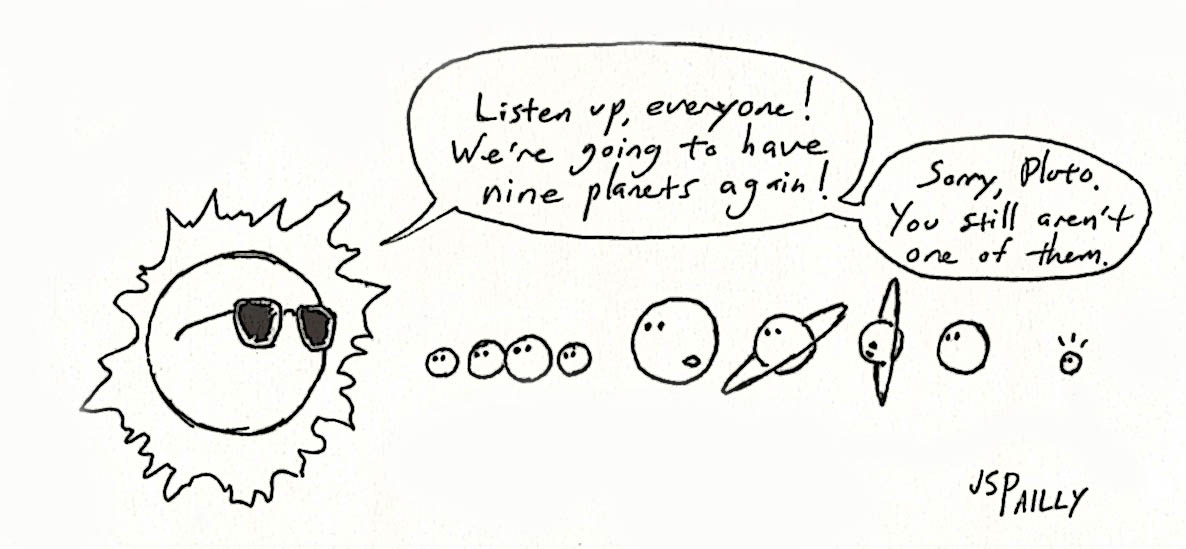
Now NASA scientists are proposing the existence of Planet X again to explain anomalous perturbations in the orbits of two of the most distant known dwarf planets.  To be fair, WISE failed to detect any Saturn or Jupiter-sized planets.  This new Planet X would be much smaller, closer to the size of Earth or Mars.

It seems our Solar System just keeps getting more and more crowded.
9 Planets

Sciency Words: Cyclic Universe Theory

Sciency Words Logo

Today’s post is part of a special series here on Planet Pailly called Sciency Words.  Every Friday, we take a look at a new and interesting scientific term to help us all expand our scientific vocabularies together.  Today’s word is:

Cyclic Universe Theory

How did the universe begin?  Scientists have several competing theories.  You’ve probably heard of the Big Bang theory, but there’s a less well-known alternative called the cyclic universe theory.  I admit I do not understand all the details of these two theories, but I’ll try to muddle through the key concepts as best I can.

According the Big Bang theory, all the matter and energy of our universe was once compact into a microscopic point.  Then, in a singular, cataclysmic event, that matter and energy exploded, triggering a rapid inflation of space-time.  The ensuing mayhem, according to the theory, should have produced massive gravity waves.

The cyclic universe theory tells a different story.  Before that point in time when our current universe began, there was another universe, and before that another and another going back ad infinitum.  Each of these universes reached a point of maximum expansion then began to contract inward, collapsing upon itself in a “Big Crunch,” which would be followed immediately by a “Big Bang.”  According to this theory, the process would not produce gravity waves.

Although the majority of physicists seem to favor the Big Bang theory, they haven’t found any clear evidence to support one theory over the other.  In other words, these two theories are underdetermined.  At least that was the case until now.  New data collected by the BICEP2 telescope in Antarctica indicates that massive gravity waves permeated the early universe, just as the Big Bang theory predicted.

However, the cyclic universe theory still has its adherents, and rightly so.  BICEP2’s data has yet to be confirmed by researchers using other telescopes, and even if those gravity waves did exist, I have no doubt the cyclic universe theory can be modified somehow to account for them.  The Big Bang theory has scored a major victory, but the debate isn’t over.

Personally, I’m hoping the detection of gravity waves will be confirmed, strengthening the Big Bang theory’s case.  I hope this not only because it would constitute a huge advance in our scientific knowledge, but also because The Cyclic Universe Theory would be a terrible name for a sitcom.

431311

Sciency Words: Rotating Disk

Today is a big day for both math and science nerds.  It’s Pi Day, the day we celebrate the magical number 3.141592…, but it also happens to be Albert Einstein’s Birthday.

Sciency Words Logo

So for today’s edition of Sciency Words, we have a term that involves both circles (and the number pi) as well as Einstein’s physics.  Today’s Sciency Word is:

Rotating Disk

The rotating disk thought experiment is one of the strangest ideas to come out of Einstein’s general theory of relativity.  Part of relativity is the concept of length contraction.  If I were to somehow accelerate a yardstick to a speed close to the speed of light, the yardstick’s length would contract or shorten noticeably.  The same thing would happen in an extremely powerful gravitational field, such as the gravitational field of a black hole.

But what happens if a rotating disk is accelerated close to the speed of light?  What happens to the circumference of the disk?  Well, according to Einstein’s thought experiment, the circumference would also contract, just like the straight yardstick.  However, the radius of the disk would not change, because the radius is always perpendicular to the disk’s rotation.

The math can get complicated, as it often does in general relativity, because we are no longer dealing with the Euclidean geometry we all suffered through in high school.  Instead, we are now entering the strange world of non-Euclidean geometry, a world in which parallel lines can intersect, the angles of triangles do not necessarily add up to 180 degrees, and the ratio of a circle’s radius and circumference does not always equal pi.

To put that in a simpler way, pi does not always equal pi.  This is not some weird fluke of mathematics but a real phenomenon, one which was predicted by Einstein and later demonstrated through scientific experiments.  Do we live in a strange universe or what?

Happy Pi Day, everyone, and happy birthday to Albert Einstein!

Sciency Words: Technocracy

Sciency Words Logo

Today’s post is part of a special series here on Planet Pailly called Sciency Words.  Every Friday, we take a look at a new and interesting scientific term to help us all expand our scientific vocabularies together.  Today’s word is:

TECHNOCRACY

Technocracy is a hypothetical form of government in which political power is given to technical experts, mainly scientists and engineers.  Government policy is set not by debates or elections but by experimentation through the scientific method.  The ultimate goal of a technocratic government would be to create a self-sustaining society, a society that lives in maximum comfort given the limits of its natural resources.

Although there have been plenty of examples of scientists contributing to public policy decisions, we have yet to see a true technocracy in action.  I think a technocratic political system might have some advantages.  In democracies, we elect our leaders, but that is no guarantee that the best or brightest people in society will lead.  Too often, it’s the better-funded candidate who wins the election, or if not that, it’s the candidate who does a better job rallying the crowd with an elegant speech.

In the Tomorrow News Network series, the government of the alien race known as the Hykonians is identified as the Hykonian Technocracy.  Also, in the T.N.N. story “Mother Mars,” the ancient Martians appear to have a technocratic form of government.  I find the idea of a technocracy fascinating, and I can see how some might think it’s an improvement over our current democratic institutions.  However, I have chosen to portray these fictional technocracies as deeply flawed and prone to corruption, because no political system is perfect.

In the Tomorrow News Network series, the Hykonian Technocracy has a long history of conflict with the people of Earth.  It all began with a certain incident in Roswell, N.M.

Despite the potential advantages of a government run by Einsteins, I fear the disadvantages are far greater.  There’s probably a good reason this form of government does not already exist somewhere.  But what do you think?  Would we be better off under a technocracy, or should we stick to the political system we already have?

Sciency Words: Particle Zoo

Sciency Words Logo

Today’s post is part of a special series here on Planet Pailly called Sciency Words.  Every Friday, we take a look at a new and interesting scientific word to help us all expand our scientific vocabularies together.  Today’s word is:

PARTICLE ZOO

At some point in the last century, scientists thought they had a pretty good grasp on all the subatomic particles.  They knew about protons, neutrons, and electrons, and they thought they understood more or less how these particles interacted.

Then they discovered the photon and the neutrino and the positron and six different kinds of quarks and a few vector bosons and the Higgs boson and the pion and kaon and gluon… this list can go on for awhile.  Particle physics went from being relatively simple to frustratingly complicated very quickly.

Many of these particles cannot be observed directly.  Some have never been observed at all but are predicted to exist by elaborate, mathematical models.  The existence of the Higgs boson, for example, was only recently confirmed by experiment.

There are literally hundreds of different subatomic particles, many of them composite structures made from other subatomic particles.  Some of these particles are truly bizarre, as different from one another as elephants and crocodiles, giraffes and hippopotami.

Some physicists find this embarrassing and derisively refer to the still-growing list of particles as the “particle zoo.”  I prefer to think of this so-called zoo as a beautiful reminder that the universe is far more complicated and interesting than we humans can possibly imagine.

Sciency Words: Underdetermination

Sciency Words Logo

Today’s post is part of a special series here on Planet Pailly called Sciency Words.  Every Friday, we take a look at a new and interesting scientific word to help us all expand our scientific vocabularies together.  Today’s word is:

UNDERDETERMINATION

This word comes to us not from science itself but from the philosophy of science.  According to the philosophy of science, when we have two competing theories to explain some natural phenomenon, we are supposed to choose which theory is correct based on the evidence available to us.  But what happens when we don’t have enough evidence?

For example, let’s say that I theorize that horses are slow moving animals that can only trot, and you theorize that they are capable of running really fast.  If the only experience either of us has ever had with horses is watching one stand still eating its hay, then our two theories are underdetermined by our lack of experience with horses.

In the recent evolution vs. creationism debate between Bill Nye the Science Guy and Ken Ham of Answers in Genesis, Ken Ham never used the word “underdetermined,” but that is exactly what he was trying to argue: that our choice between evolution and creationism is underdetermined by a lack of evidence.  Of course, that’s not the case at all.  There is an overwhelming amount of evidence in support of evolution and plenty of evidence to refute creationism as well.

One example of genuine underdetermination is in the search for life on Mars, where there are some signs of the possibility of life, some evidence that makes life less likely (but still not impossible), and as of yet no discovery of an actual Martian organism, living or dead.  Another example of underdetermination are the various competing versions of string theory, which as I understand it remain untested and untestable due to the limits of technology.

Underdetermination is always a temporary problem.  It would not take long to prove which of our theories concerning horses is correct.  We’d only have to go to a farm or perhaps a rodeo, or we could simply look up horse videos on YouTube.  As NASA rovers continue exploring Mars, the question of Martian life will be resolved.  As for string theory, I’m sure the necessary technology will be invented eventually.  Of course if some people refuse to accept any evidence that disproves their preferred theory, that is another problem entirely, and the sciency word for that is confirmation bias.

Sciency Words: Osculation

Welcome to this special Valentine’s Day edition of Sciency Words!  Sciency Words is a series here on Planet Pailly where we take a look at new and interesting scientific terms so we can all expand our scientific vocabularies together.  Today’s word is:

OSCULATION

Osculation: noun.  The scientific term for kissing.

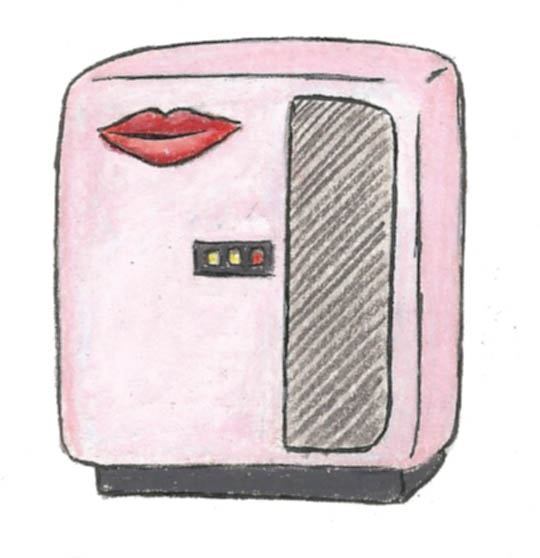
I have no idea why they needed a technical term for this, but I’m glad the word exists because now I know what to call my latest invention.  Ladies and gentlemen, meet the Osculator 5000.

Osculator 500 in Flirty Pink
For all you osculating needs.

Whether you’re spending Valentine’s Day alone or need a little extra practice before tonight’s hot date, this is the machine for you!  The Osculator 5000 comes fully programmed with three settings: peck on the cheek, kiss, and tongue.  To enhance your osculation experience, the Osculator 5000 includes a built in speaker and over a dozen prerecorded sound effects.  Order now, and give the Osculator 5000 a chance to turn you on.

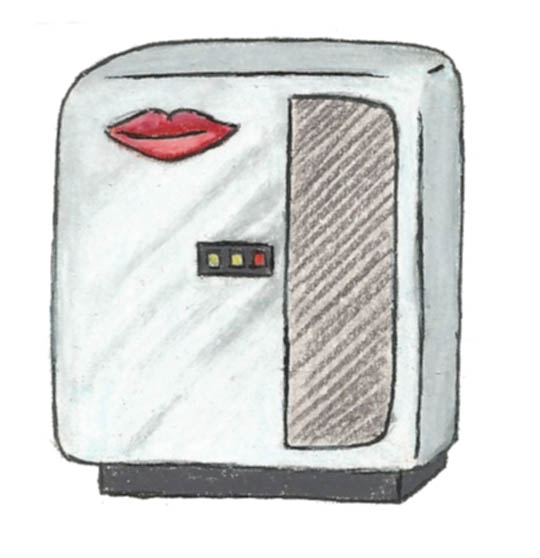
Osculator 500 in Sexy Chrome
Now also available in chrome!

Sciency Words: The Internet

Sciency Words Logo

Today’s post is part of a special series here on Planet Pailly called Sciency Words.  Every Friday, we take a look at a new and interesting scientific word to help us all expand our scientific vocabularies together.  Today’s word is:

THE INTERNET

Okay, yes, I’m sure you already know this word.  Whether you think it was invented by the U.S. Army or scientists at CERN, the European Nuclear Research Agency, or even if you think it was invented by Al Gore, everyone knows what this word means.

What you probably don’t know is that it is “the Internet,” not “the internet.”  Internet is a proper noun, so it is supposed to be capitalized.  Don’t believe me?  Go check the nearest dictionary, or click here to visit dictionary.com.

Sciency Words: Hayflick Limit

Sciency Words Logo

Today’s post is part of a special series here on Planet Pailly called Sciency Words.  Every Friday, we take a look at a new and interesting scientific word to help us all expand our scientific vocabularies.  Today’s word is:

Hayflick Limit

If you dream of immortality, the Hayflick limit is your enemy.  In the human body, cells periodically die and are replaced.  Scientists used to believe that, barring sickness or catastrophic injury, cells could continue to reproduce themselves indefinitely.  They did not suspect that cell division could have anything to do with the aging process or natural death.  That was until a man named Hayflick came along.

The Hayflick limit is determined by the length of the telomeres (excess genetic material) in a cell’s DNA.  Think of it this way: when you tie a knot, you usually leave a little extra string to make sure the knot doesn’t come undone.  Telomeres are like that extra string, but every time your cells divide, your telomeres become a tiny bit shorter.  When a cell has no telomeres left, it has reached its Hayflick limit and can no longer create copies of itself.

We all know our bodies break down as we age.  The Hayflick limit is, if not the sole cause of aging, at least a major part of it.  So if you want to live forever or merely prolong your life for a few centuries, you will have to figure out how to lengthen your telomeres and increase the Hayflick limit of your cells.

Sciency Words: Borborygmus

Sciency Words Logo

Today’s post is part of a special series here on Planet Pailly called Sciency Words.  Every Friday, I’ll bring you a new and interesting scientific word to help us all expand our scientific vocabularies.  Today’s word is:

BORBORYGMUS

They have weird, scientific terms for everything.  This one refers to the rumbling sound your stomach makes when you’re hungry, or when you have indigestion, or simply when you have gas.  The noise is actually caused by muscle contractions in the small intestines, not the stomach.

Now is this a term you’re likely to ever use?  Probably not.  At least not in casual writing or conversation.  This is one of those obscure words that you can’t use without pausing to explain what it means.  However, that didn’t stop Magic: The Gathering, a popular trading card game, from naming an enormous monster Borborygmos—because you do not want to fight a giant monster named for its loudly rumbling stomach.

So perhaps we science fiction writers should still pay attention to these strange and obscure sciency words, if not to use them as words then perhaps to use them as proper nouns.  I continue to hunt for an appropriate way to use the word syzygy in a sentence.  Maybe the solution is to use it as the name for some strange, ethereal space creature.

Now I am currently experiencing a little borborygmus of my own, so it’s time for me to head out to lunch.