Today’s post is part of a special series here on Planet Pailly called Sciency Words. Every Friday, we take a look at a new and interesting scientific term to help us all expand our scientific vocabularies together. Today’s word is:
CARBON SINK
Today’s Sciency Word comes to us courtesy of Sci Show, one of my favorite sources for sciency news and general science knowledge.
A carbon sink is a region of the Earth, like the rainforest, that absorbs some of those harmful carbon emissions we keep pumping into the atmosphere. As Hank Green says in the video, it’s like the Earth is trying to save us from ourselves. Thank goodness we are sparing the rainforests from our wanton destruction of the environment… oh, wait.
Today’s post is part of a special series here on Planet Pailly called Sciency Words. Every Friday, we take a look at a new and interesting scientific term to help us all expand our scientific vocabularies together. Today’s word is:
THE LONGITUDE PRIZE
300 years ago, the British Empire faced a major problem: how can a ship at sea accurately determine its position. Finding your latitude was easy and involved measuring the distance of the Sun or North Star from the horizon, but what about longitude? No one knew, so Parliament offered 20 thousand pounds to anyone who could figure it out.
A British “man of war,” the backbone of the British Navy from the 16th to 19th Centuries.
Today, the Longitude Prize is back. 10 million pounds will be offered to help solve one of six challenges currently facing humanity. Those challenges are:
Antibiotics: What can we do to prevent bacteria from becoming resistant to our antibiotic medications?
Dementia: People live a lot longer than they used to, and that means we’re seeing more cases of Alzheimer’s and dementia. What can we do to help the elderly maintain healthy, independent lifestyles?
Food: How will we feed over 9 billion people in the coming decades?
Flight: Can we build commercial aircraft with zero carbon emissions?
Paralysis: Could new medications and/or cybernetic technology make it so the paralyzed can walk again?
Water: Only a tiny percentage of the water on Earth is safe to drink. Again, the world population is expected to exceed 9 billion in the coming decades, so how will we provide clean drinking water to all those people?
Anyone who has a BBC iD can vote on which of these six projects should get Longitude Prize funding (click here for details). My choice would be either for flight, since I’d love to travel without feeling guilty about the environment, or water, a problem which I suspect affects the greatest number of people worldwide.
So what about you? Which project would get your vote?
P.S.: The original winner of the Longitude Prize was John Harrison who found a way to calculate longitude by comparing the position of the sun (or other astronomical object) to the time of day.
Today’s post is part of a special series here on Planet Pailly called Sciency Words. Every Friday, we take a look at a new and interesting scientific term (or in today’s case, four terms) to help us all expand our scientific vocabularies together.
* * *
Space travel really isn’t complicated once you understand the terminology. Words like left, right, up, and down don’t mean much in zero gravity, nor do words like forward or backward. If you’re aboard a ship that uses centrifugal force to simulate gravity, even the terms port and starboard might cause confusion. So in order to navigate in space, we need to use a whole new vocabulary.
As I discussed on Wednesday, I’ve started playing Kerbal Space Program as a way to learn more about space travel. Thanks to the game and various game F.A.Q.s I’ve found online, I’ve picked up four new sciency words every space navigator needs to know.
Apoapsis: the highest point in your orbital path.
Periapsis: the lowest point in your orbital path.
Retrograde: if you fire your rockets in the opposite direction to your movement, you’re firing them retrograde. This will cause you to slow down.
Prograde: if you fire your rockets in the same direction as your movement, this is prograde, and it will cause you to speed up.
A shot of my first K.S.P. spacecraft to successfully achieve orbit! This was perhaps one of the proudest moments in my life (don’t judge me).
When you want to move your spaceship to a higher orbit, fire your rockets prograde. If you want to lower your orbit, fire your rockets retrograde. According to my research and my experience in Kerbal Space Program, lowering your orbit from your apoapsis (highest point) is the most fuel-efficient option. The same is true for increasing your orbit from your periapsis (lowest point).
These four terms are still new to me. I’ve only been playing Kerbal for a little over a week now. So if anything I’ve written here is mistaken, either in regards to Kerbal Space Program or real life, please let me know in the comments below.
P.S.: Today’s post is related to a series here on Planet Pailly about sciency video games. To find out more, click here.
Today’s post is part of a special series here on Planet Pailly called Sciency Words. Every Friday, we take a look at a new and interesting scientific term to help us all expand our scientific vocabularies together. Today’s word is:
ECCENTRICITY
According to the dictionary, eccentricity means deviating from the established norms, especially in an odd or whimsical manner. I’m sure we’ve all met eccentric people at some point in our lives. In high school, I was involved in musical theatre, so I got to see eccentricity up close and personal. But did you know actors and actresses aren’t the only ones who behave eccentrically? The term can also be applied to the behavior of planets.
The established norm for a planet’s behavior is to orbit a star. To be more specific, planets are supposed to circle stars, as in their orbits should be perfect circles. The less circular a planet’s orbit is, the more eccentric it is said to be. In fact, a planet’s eccentricity can be quantified by measuring just how un-circular its orbit is.
One of my planets in Super Planet Crash has a highly eccentric orbit. Can you guess which one?
The thing is, according to Kepler’s laws, no planet has a perfectly circular orbit. The “established norm” is a myth. They all travel along slightly ovular paths, sometimes coming a little closer to the Sun, sometimes moving a little farther away. So it turns out that, just like people, all planets are at least a little eccentric.
P.S.: Today’s post is related to a series here on Planet Pailly about sciency video games. To find out more, click here. To start playing Super Planet Crash, a game where you can see eccentric planets in action, click here.
Today’s post is part of a special series here on Planet Pailly called Sciency Words. Every Friday, we take a look at a new and interesting scientific term to help us all expand our scientific vocabularies together. Today’s word is:
OUROBOROS
Ouroboros is not a word I ever thought of as a sciency word until I saw this:
Please note: I recommend watching the video with the audio muted. While the video does have educational value, whoever filmed it seems to find a little too much humor in the suffering of animals.
Ouroboros is an ancient symbol depicting a snake or sometimes a dragon curled into a circle, biting its own tail. The image has a lot of historical and mythological significance and has been referenced by many famous philosophers. It usually symbolizes stuff like eternity, rebirth, or the endless circle of life.
After seeing a real-life ouroboros, I think we can guess that the symbol probably originates in something ancient people observed in nature. I can’t imagine snakes commonly try to eat themselves, but if one animal engaged in this self-destructive behavior, surely others have done so as well.
But why would a snake do this to itself in the first place? According to an article from I Fucking Love Science (an awesome name for a website, by the way), this behavior may be the result of stress or perhaps overheating. Snakes are cold blooded and cannot regulate their blood temperature the way mammals do. For the snake in this video, the ouroboros does not represent the circle of life or anything of the sort; it is probably the unfortunate result of someone leaving the heat lamp on for too long.
Today’s post is part of a special series here on Planet Pailly called Sciency Words. Every Friday, we take a look at a new and interesting scientific term to help us all expand our scientific vocabularies together. Today’s word is:
THE THEORY OF INVARIANCE
Albert Einstein made many important contributions to science, but one of his most controversial was the theory of relativity. Not that it was controversial among scientists. Proof of relativity came fairly rapidly after its initial publication, and experiment after experiment have continued confirming its validity ever since. No, the controversy was among the general public, some of whom perceived, for some reason, that relativity in physics led to relativity in morality.
This confusion upset Einstein so much that, later in life, he pushed to have his theory renamed “the theory of invariance.” Where the term relativity applied to the relative frames of reference of different observers, the term invariance refers to the invariant speed of light, which is just as essential to the theory as the relativity part. It would also reassure people that no, morality is not relative.
However, by that time the name relativity had already been around for several decades. The names of scientific principles are not easily changed once they’re established, so for better or worse, the theory of relativity is here to stay.
So what do you think? Do you like relativity, or do you think we should have renamed it invariance as Einstein suggested?
Today’s post is part of a special series here on Planet Pailly called Sciency Words. Every Friday, we take a look at a new and interesting scientific term to help us all expand our scientific vocabularies together. Today’s word is:
MUSCLE MEMORY
Do you remember learning to walk? Of course you do! Who could forget struggling to figure out how to move one leg, maintaining your balance while doing so, bending the knee at just the right angle, then placing your foot squarely on the ground before attempting to move the other leg? Literally hundreds of individual muscles are involved. It’s complicated stuff. If you’re anything like me, you probably fell down a lot while trying to get this right.
But now, walking requires hardly any concentration at all. That’s because of muscle memory, your brain’s ability to memorize which combinations of muscle movements are required to perform basic, everyday tasks. The more you practice doing something (swimming, riding a bicycle, dancing the tango…) the easier it will become because your brain learns to perform all the necessary motions automatically.
There’s a good chance you’ve already heard about muscle memory and already know exactly what it means. I hate sharing stuff most of my readers already know (which is why I have yet to write a blog post defining photosynthesis), but I decided to do this as today’s Sciency Word anyway because for a long time, I misunderstood the meaning of this term.
I assumed muscle memory had more to do with weight training, as in muscles become stronger and better suited to a specific activity, “remembering” in a metaphorical sense how that activity is done. I didn’t know it had anything to do with memory in the literal sense, as in memory stored in the brain.
I figure if I made this erroneous assumption, perhaps some of my readers did as well. Hopefully we will all keep expanding our scientific vocabularies together!
Today’s post is part of a special series here on Planet Pailly called Sciency Words. Every Friday, we take a look at a new and interesting scientific term to help us all expand our scientific vocabularies together. Today’s word is:
BREAKFAST, LUNCH, AND DINNER
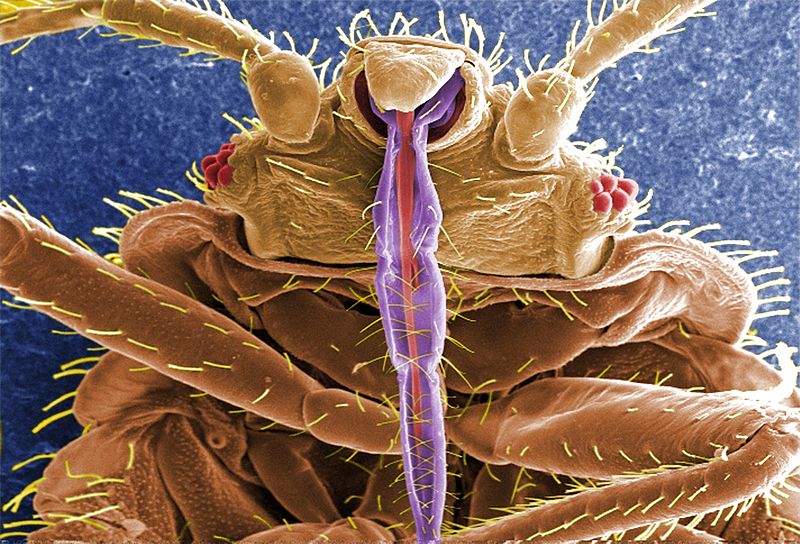
I like to believe there is a God and that everything in the universe serves some purpose, but bedbugs make me wonder. They don’t pollinate flowers or help remove waste. They don’t form symbiotic relationships with other organisms. They’re not even a “benefit” to viruses and bacteria; I’m told they are very poor transmitters of diseases.
Image courtesy of the C.D.C.
Bedbugs don’t do anything except lounge around, suck on people’s blood, and have super disturbing, violent sex. As far as I can tell, they serve no purpose whatsoever. They’re not even cute.
One way to identify whether or not you have a bedbug infestation is the unusual pattern of bite marks they often leave on your skin. For some reason, bedbugs tend to bite their victims three times, leaving a triangle of red bite marks that experts euphemistically call “breakfast, lunch, and dinner.” Click here to see examples of bedbug bites.
So sleep well tonight, and let me know if you can think of any reason why a just and kind God would allow these disgusting creatures to exist.
Today’s post is part of a special series here on Planet Pailly called Sciency Words. Every Friday, we take a look at a new and interesting scientific term to help us all expand our scientific vocabularies together. Today’s word is:
HEURISTIC
Heuristic: adjective. A fancy way of saying your scientific equation, theory, or idea is “close enough.” You’ve provided an easy way to think about a difficult problem, at least under certain specific circumstances. A heuristic theory can only give you a limited degree of precision, and if you stray too far beyond the specific circumstances that heuristic theory applies to, you might get answers that are way, way off the mark.
A good example is the equation E = mc2. We’ve all heard of this equation, but it is only a simplified version of Einstein’s actual mass/energy conversion equation. So long as your velocity equals zero or a value close to zero, E = mc2 is close enough. Otherwise, you’ll have to use the full equation: E2 = (mc2)2 + (pc)2.
We might also consider Newton’s laws to be heuristic. They approximate the behavior of objects in motion under circumstances we humans are likely to experience. But Newton’s laws are ever so slightly off, and on extremely large scales (think super high gravity or velocities approaching the speed of light), these minor discrepancies become significant.
To some extent, we might be able to label almost all scientific theories heuristic. Each new generation of scientists takes our body of scientific knowledge, corrects the errors of the past, and adds a bit more precision to our accepted theories. But I think the word heuristic should be reserved for those theories that only work under certain conditions and are blatantly incorrect under others.
P.S.: The word heuristic has other meanings in fields like psychology and computer science, but I believe the definition I’ve provided here is close enough under most circumstances.
Today’s post is part of a special series here on Planet Pailly called Sciency Words. Every Friday, we take a look at a new and interesting scientific term to help us all expand our scientific vocabularies together. Today’s word is:
CONFLICT MINERALS
Certain rare minerals are essential to our modern, technological world. Unfortunately, our sources for these minerals include countries known for their human rights violations, such as the Democratic Republic of the Congo, which is currently in the midst of a bloody, protracted civil war. When these rare minerals come from such war torn parts of the globe, we call them conflict minerals.
I imagine this term could apply to a wide range of chemical elements, but there are four particular metals of note:
Gold: in addition to being pretty, gold is an exceptionally good conductor of electricity, making it useful in a wide range of electronic devices.
Tin: alloyed with silver, tin is used for soldering electronic components.
Tantalum: used for making capacitors.
Tungsten: no known chemical element has a higher melting point than tungsten, making it ideal for use in light bulbs, vacuum tubes, and any other electronic device that tends to get really hot.
Reportedly, both sides of Congo’s civil war have profited from the mining of these four specific elements. All that money pouring into Congo has no doubt perpetuated the violence and prolonged the war.
According to an article in April’s issue of Scientific American, Intel has decided to stop buying conflict minerals. Obviously, they’ll still use gold, tin, tantalum, and tungsten in their products, just not if they came from places like Congo. The same article states that the U.S. Securities and Exchange Commission will soon require companies to disclose where the metals in their products come from.
P.S.: Many of the rare metals we depend on here on Earth are readily available in space. I’ve written before about how this might be just the incentive we need to make space exploration a priority once again. Maybe it would reduce our dependence on Congolese mining as well.

.jpg#mediaviewer/File:Het_Kanonschot_-_Canon_fired_(Willem_van_de_Velde_II,_1707).jpg)



 Planet Pailly