Sciency Words: Jiffy

Sciency Words MATH

Today’s post is part of a special series here on Planet Pailly called Sciency Words. Every Friday, we take a look at a new and interesting scientific term to help us all expand our scientific vocabularies together. Today’s word is:

JIFFY

Imagine a vast, intergalactic empire with Earth as its capital. Gargantuan starships hurtle through space, traveling at velocities approaching or even exceeding the speed of light. Through commerce, exploration, and occasionally military conflict, humanity continues to expand its power in the galaxy. Now what could all this have to do with a word like jiffy?

Sometime around the turn of the 20th Century, physical chemist Gilbert Newton Lewis proposed jiffy as a unit of time defined as the amount of time it takes light to travel one centimeter in a vacuum. As far as I can tell, the term never caught on and is now a mere footnote in the scientific lexicon.

However, the way jiffies are defined, with their relationship to the speed of light, has some interesting implications in a universe governed by special and general relativity.

According to relativistic physics, our perception of time changes in relation to velocity, acceleration, and even gravity.

My07 Time Dilation

As a spacecraft approaches the speed of light, time noticeably slows down for the spaceship relative to the rest of the universe. For a ship traveling at the speed of light, time stops. If you somehow travel faster than light, some physicists predict time from your perspective would actually reverse. (Click here for a more comprehensive explanation of relativistic time dilation.)

If you hate time zones and jetlag, just think how much more complicated things might be in a futuristic space empire with starships zooming about the galaxy, experiencing time in different ways relative to each other and the rest of the universe.

I don’t know if jiffies (along with kilo-jiffies, mega-jiffies, etc) would ever be accepted as a regular part of space traveler jargon, but the relativistic effects of space travel might necessitate a whole new standard for measuring time, with a specialized system of units defined in relation to the speed of light. Maybe something similar to Gilbert Newton Lewis’s jiffy would be a good place to start.

Sciency Words: Cold Trap

Sciency Words BIO copy

Today’s post is part of a special series here on Planet Pailly called Sciency Words. Every Friday, we take a look at a new and interesting scientific term to help us all expand our scientific vocabularies together. Today’s word is:

COLD TRAP

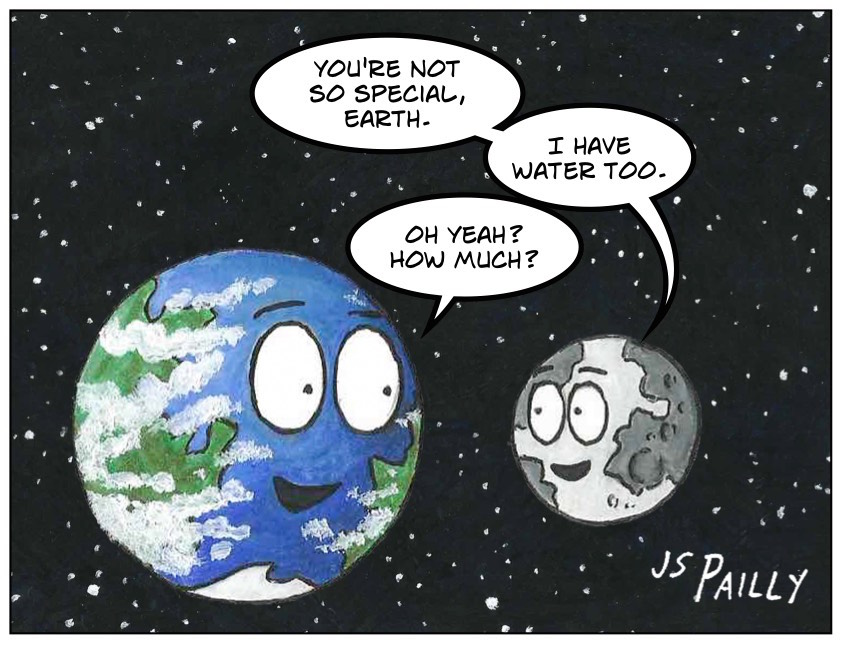
My04 Lunar Water 1The Moon has a lot in common with the planet Mercury, and just like Mercury, the Moon has trouble retaining its volatiles.

Water is a volatile, meaning it’ll spontaneously evaporate or sublimate at relatively low temperatures and/or pressures. Without the protection of an atmosphere or a magnetic field, volatiles like water tend to be swept off into space by the solar wind.

The only way the Moon can hold on to its water is to keep it well hidden from the Sun’s heat. Regions of the Moon (or Mercury) that are dark enough and therefore cold enough to retain water ice are informally known as cold traps.

The Moon’s best cold traps lie near its south pole, within the basins of large craters that remain in perpetual shadow, never seeing the Sun. Temperatures there hover around 100 Kelvin (a.k.a.: -170 degrees Celsius or -280 degrees Fahrenheit or simply “@&%$, that’s cold!”).

Similar craters exist near the Moon’s north pole, but they’re generally smaller and shallower and might not serve as effective cold traps.

My04 Lunar Water 2But just because the Moon has cold traps, that doesn’t prove it has water ice. On Monday, we’ll go exploring one of the Moon’s most famous and controversial cold traps: Shackleton Crater. Feel free to bring your ice skates, but I can’t guarantee you’ll get to use them.

* * *

Today’s post is part of Moon month for the 2015 Mission to the Solar System. Click here for more about this series.


Sciency Words: Thalassocracy

Sciency Words PHYS copy

Sciency Words is a special series here on Planet Pailly where we take a look at new and interesting scientific terms—but today, we’re making an exception. Today’s word is actually a historical term, although it may have some relevance for futuristic space-faring societies.

THALASSOCRACY

Thanks to the ideal rocket equation, launching yourself into space is difficult and highly expensive (and will likely stay that way barring enormous changes in science and technology). In fact, it’s so difficult and expensive that, once you’re in space, it might make more sense to just stay there.

Landing on alien planets might not be worth doing unless you plan to settle there permanently. Instead, you could wander through space, harvesting all the resources you need from asteroids and comets and perhaps smaller planetoids like the Moon.

That brings us to the world of ancient thalassocracies. Thalassocracies are empires of the sea, as opposed to traditional land empires. The word is Greek for “rule of the seas.”

Well known examples include the Phoenicians, Athenians, and Carthaginians. The British Empire might also be described as a thalassocracy, except the British controlled a lot of land in addition to most of the world’s waterways.

Traditional thalassocracies possessed enormous navies. They rarely bothered waging war on land, preferring instead to exert their military power through piracy, naval blockades, and near unrivaled dominance of maritime trade routes.

I’m guessing that space-faring societies will end up behaving more like ancient thalassocracies than modern nation-states. This might be especially true for space-faring civilizations still early in their development and still struggling with the high costs of takeoffs and landings.

So what do you think? Will futuristic space empires act like thalassocracies, or is there some other historical model that might make more sense?

Sciency Words: Ideal Rocket Equation

Sciency Words MATH

Today’s post is part of a special series here on Planet Pailly called Sciency Words. Every Friday, we take a look at a new and interesting scientific term to help us all expand our scientific vocabularies together. Today’s word is:

IDEAL ROCKET EQUATION

April is Earth month here on Planet Pailly, but after two weeks of blogging about the planet Earth, I’m ready to move on.

Ap08 Earth's Pull

Unfortunately, escaping Earth’s gravity is far easier said than done. The high, high cost of getting to space can be quantified using something called the ideal rocket equation (also known as Tsiolkovsky’s rocket equation or simply the rocket equation).

The equation is as follows:

∆v = vln(m0/m1)

Delta-v (∆v) represents the total change in velocity you’re aiming to achieve in any rocket-propelled maneuver, including liftoff. In order to reach low Earth orbit from the ground, your delta-v must equal at least 9.4 kilometers per second. To get that value, you’ll need to adjust the other variables in the equation.

  • Initial mass (m0): The total mass of your spacecraft plus the mass of your fuel and fuel tanks.
  • Final mass (m1): The total mass of your rocket after the maneuver is complete.
  • Effective exhaust velocity (ve): This is basically how much thrust your rocket can produce.

Increasing your rocket’s initial mass (by adding more fuel) will help increase your delta-v. Decreasing your final mass (by not only using up fuel but also shedding empty fuel tanks as you go) will also increase your delta-v. In fact, the greater the difference between the initial and final mass, the greater your delta-v will be, according to this equation.

However, increasing the difference between initial and final mass only creates a logarithmic increase in delta-v (the “ln” part of the equation is a natural logarithm). This means that adding more and more fuel produces diminishing returns. At some point, this is no longer a cost effective way to increase your delta-v.

Your other option is to use a more energetic fuel, increasing your effective exhaust (ve). Unfortunately, modern rockets already use some of the most effective chemical fuels available. With current technologies, the only way to significantly improve the ve part of the equation is with nuclear powered rockets, which might raise a few safety concerns, to say the least.

What Does All That Mean?

Due to the rocket equation, fuel constitutes 80 to 95% of a rocket’s mass at launch. Even a tiny satellite requires absurd amounts of fuel to reach space.  This means launching anything into space is expensive (sometimes prohibitively expensive).

The problems associated with the ideal rocket equation are usually glossed over or ignored in science fiction by invoking new technologies or new laws of physics. But embracing the rocket equation and world-building within its limitations could lead to an intriguing setting for a Sci-Fi story. More on that in next week’s edition of Sciency Words.

P.S.: It’s possible that somewhere in the universe, life has evolved on a planet with even higher surface gravity than Earth’s. If so, these aliens would have an even harder time reaching space than we do. In fact, for some alien civilization out there somewhere, the rocket equation may make it effectively impossible to leave their home planet at all.

Links

The Tyranny of the Rocket Equation by NASA astronaut Don Pettit.

Rocket Golf from What If?

Sciency Words: The Oxygen Catastrophe

Today’s post is part of a special series here on Planet Pailly called Sciency Words. Every Friday, we take a look at a new and interesting scientific term to help us all expand our scientific vocabularies together. Today’s word is:

OXYGEN CATASTROPHE

If an extraterrestrial intelligence were to examine Earth from a distance, perhaps analyzing the spectral lines of Earth’s atmosphere, Earth might not seem like the most hospitable of planets. The atmosphere contains one of the most dangerous substances in the known universe: oxygen.

Ap05 Professor Xiggoloplod


Earth Before Oxygen

In the beginning, Earth had an atmosphere composed mainly of carbon dioxide. Life thrived in this environment until someone (I’m looking at you, cyanobacteria) discovered the secret to photosynthesis: the ability to draw energy from sunlight.

Unfortunately, photosynthesis produces oxygen as a byproduct. As the cyanobacteria population boomed, so too did the oxygen content of both the oceans and the atmosphere. This led to Earth’s first mass extinction event: the oxygen catastrophe.

That’s Too Much Oxygen!

Oxygen is a highly reactive gas. It’s so reactive that one of the most common types of chemical reactions—oxidation—is named after it. Oxygen will do just about anything to react with other substances, and it doesn’t care who gets hurt in the process.

Here are some of the ways oxygen harmed Earth’s earliest organisms:

  • Oxygen oxidized minerals in the oceans, robbing microbial life forms of vital nutrients, causing many microbes to starve to death.
  • Oxygen attacked microbes directly, essentially oxidizing them to death.
  • Oxygen sucks at trapping heat, so as atmospheric oxygen levels climbed, global temperatures plummeted. In fact, Earth may have briefly looked a little like the planet Hoth from Star Wars. End result: many microbes froze to death.

And that was the end of life on Earth, or at least it should have been.

Breath Easier Thanks to Aerobic Respiration

Aerobic respiration is a biological process that puts oxygen’s oxidizing tendencies to good use. Through aerobic respiration, glucose molecules (a.k.a. sugar) are disassembled, releasing enormous quantities of energy stored within glucose’s chemical bonds—far more energy than we could get without oxygen’s help.

During the height of the oxygen catastrophe, a handful of clever microbes figured out this aerobic respiration thing. They also developed special enzymes to protect themselves from the ravages of prolonged oxygen exposure. Atmospheric oxygen levels dropped to safer levels, the planet thawed, and a new balance was achieved between respirating and photosynthesizing organisms.

In fact, aerobic respiration has been so successful that it’s hard for us to think of oxygen as a deadly poison. Rather, it’s become a source of life. As for the cyanobacteria that started this whole mess, they’re still here, unrepentant, continuing to spew their oxygen waste all over the place.


So if an extraterrestrial intelligence were to examine Earth from a distance and notice the high oxygen content of the atmosphere, this might not be an obvious sign of life. But oxygen atmospheres don’t just happen. Something has to make them happen, and something has to maintain them over time. That should be enough to at least leave our E.T. friends scratching their heads.

Links

Bacteriapocalypse from Damn Interesting.

Evolution of Aerobic Respiration from the Astrobiology Conference of 2010.

Evolution and Oxygen from Science Online.

How Did Early Bacteria Survive Poisonous Oxygen? from Universe Today.

Sciency Words: Anthropocene

Today’s post is part of a special series here on Planet Pailly called Sciency Words. Every Friday, we take a look at a new and interesting scientific term to help us all expand our scientific vocabularies together. Today’s word is:

ANTHROPOCENE

As recently as 2012, scientists have confirmed there is life on Earth. Do not underestimate the effect life can have on a planet. Do not underestimate the even greater effect of intelligent life.

Ap02 Life on Earth

The term Anthropocene is a fairly new addition to the scientific lexicon. It’s still unclear whether or not the term will stick.

Anthropocene loosely refers to the era of Earth’s geological history when human beings (anthropos is Greek for human) have had the greatest geological impact on the planet.

How have we impacted the geology of our planet? Just think of all the digging we do. Think of all the minerals we’ve extracted from Earth’s crust. Think of how acid rain weathers the landscape or how garbage decomposes (or sometimes doesn’t), changing the makeup of the soil, the atmosphere, the oceans…

Think of all the effects of artificial rather than natural processes: this is the meaning and significance of the Anthropocene epoch.

Of course, the use of this term is not without controversy. Geological epochs are supposed to correspond to rock strata. They’re supposed to have clearly defined boundaries. Where, exactly, is the boundary marking the beginning of the Anthropocene? There isn’t one, yet, because we’re still living in it.

In the future, especially the distant future, the boundaries of the Anthropocene might be very easy to identify. Hundreds or thousands of years from now, the Anthropocene may be a well-established historical and geological fact. Or maybe not.

So do you think characters in a Sci-Fi future would talk about the Anthropocene epoch? If they do, what would they say?

P.S.: Throughout the month of April, as part of the 2015 Mission to the Solar System, we’ll be exploring the planet Earth—in many ways the strangest planet in the Solar System, for reasons you might not expect.

Links

What Is the Anthropocene and Are We in It? from Smithsonian.com.

Generation Anthropocene: Stories About Planetary Change.

Sciency Words: Global Resurfacing Event

Sciency Words MATH

Today’s post is part of a special series here on Planet Pailly called Sciency Words. Every Friday, we take a look at a new and interesting scientific term to help us all expand our scientific vocabularies together. Today’s word is:

GLOBAL RESURFACING EVENT

Sometime between 300 and 600 million years ago, Venus experienced what scientists call a global resurfacing event.

Mr09 Makeover

It seems that all of a sudden, in some cataclysmic event, molten hot lava spread all over the planet’s surface, covering up pretty much everything. We know this because Venus’s surface, which has been mapped using radar altimetry, appears to be much younger than the planet itself, free of many of the impact crater blemishes we find on all the other terrestrial worlds in the Solar System.

What caused the global resurfacing event is a topic of heated debate (get it… heated!). Maybe this happened due to a really bad volcano day. Maybe some large object (Venus’s former moon?) collided with the planet. Maybe aliens bombarded Venus with planet crusher missiles… you know, as a warning to the dinosaurs. It’s also possible that Venus goes through periodic resurfacing events.

If this was a one time event, you have to wonder what Venus was like before it got resurfaced. If this is a recurring event, then it could be fun (as a science fiction writer) to speculate about what might happen when the next resurfacing event begins.

Links

Craters on Venus from Universe Today.

Tectonics on Venus from Teach Astronomy.

Sciency Words: Ad Hoc Hypothesis

Sciency Words BIO copy

Today’s post is part of a special series here on Planet Pailly called Sciency Words. Every Friday, we take a look at a new and interesting scientific term to help us all expand our scientific vocabularies together. Today’s word is:

AD HOC HYPOTHESIS

“Ad hoc” is a Latin phrase meaning “for this,” as in “for this one and only one purpose.” Within the sciences, the term has rather negative connotations. Basically, it’s technical jargon for “Oh come on! You just made that up!”

A scientific hypothesis can be labeled “ad hoc” if any one of the following conditions are met.

  • The hypothesis attempts to explain one and only one phenomenon.
  • The hypothesis contradicts part or all of our current body of scientific knowledge.
  • The hypothesis cannot be tested in any meaningful way.

The ad-hoc-ness of an ad hoc hypothesis increases when you find any combination of the above conditions. Please remember that ad hoc hypotheses are not necessarily wrong, but in the minds of scientists, they are highly suspect.

You’ll encounter the term ad hoc in many scientific papers as well as in books and articles about science. There’s even an event called BAH-Fest (that’s the Festival of Bad Ad Hoc Hypotheses) where professional scientists compete over who can come up with the most hilarious ad hoc hypothesis.

And yet, the term does not seem to appear very often in science fiction, despite the fact that it fits so well with a common Sci Fi trope: the scientific genius whose radical new theory has not been accepted by his/her peers.

Rejected dialogue from Back to the Future:

Marty McFly: But Doc, your time travel theory falls apart without the ad hoc explanation of the flux capacitor.

Or as a response to meaningless technobabble:

Rejected dialogue from Star Trek:

Ensign Chekov: The ship must have entered some sort of quantum asymmetrical graviton loop singularity!

Commander Spock: Mr. Chekov, kindly refrain from postulating ad hoc theories. We must investigate this phenomenon further.

Or in any discussion involving conspiracy theories:

Rejected dialogue from The X-Files:

Agent Mulder: These crop circles must be part of an elaborate government cover-up.

Agent Scully: Do you have any evidence for that, or is this just another ad hoc hypothesis?

Okay, maybe those aren’t the best examples. So how would you use the term ad hoc in a story?

Sciency Words: Ashen Light

Sciency Words MATH

Today’s post is part of a special series here on Planet Pailly called Sciency Words. Every Friday, we take a look at a new and interesting scientific term to help us all expand our scientific vocabularies together. Today’s word is:

ASHEN LIGHT

First observed in 1643, ashen light is an as yet unexplained phenomenon on the planet Venus. It’s a mysterious aura or glow sometimes seen on the planet’s night side.

The light can’t be sunlight (this is the night side, after all), and it can’t be reflected moonlight since Venus doesn’t have any moons.

At one time, scientists thought ashen light could be evidence of alien life (maybe the light comes from cities?), but at this point, I think we can rule that possibility out.

Some scientists have dismissed ashen light as an optical illusion, and maybe they’re right. None of the space probes we’ve sent to Venus have been able to detect the phenomenon. Then again, it took decades for our probes to confirm the existence of Moreton waves on the Sun.

So what do you think is going on on Venus? What secrets is our nearest planetary neighbor hiding?

Links

Jan 9, 1643: Astronomer Sees Ashen Light of Venus from Wired.com.

The “Loch Ness” of Venus from Sky News.

Sciency Words: The Anomalous Precession of the Perihelion of Mercury

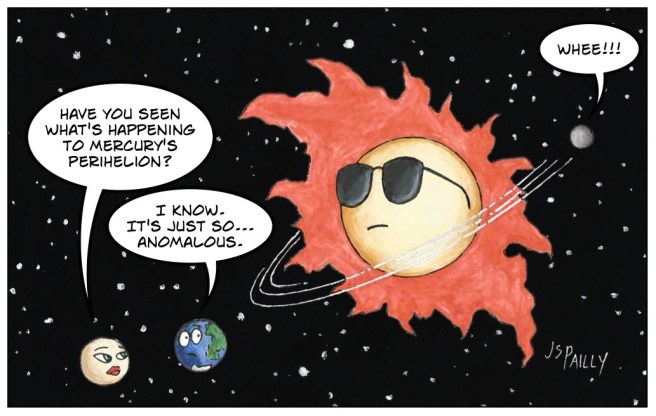
If you’re anything like me, you’ve probably looked at planetary orbits and asked yourself: why does Mercury’s perihelion precess so anomalously? That simple, straightforward question is the subject of this week’s edition of Sciency Words.

Sciency Words is a special series here on Planet Pailly where we take a look at a new and interesting scientific term so we can all expand our scientific vocabularies together. Today’s term is:

THE ANOMALOUS PRECESSION OF THE PERIHELION OF MERCURY

I know, it’s a bit of a mouthful, but trust me… this anomalous precession thing is pretty cool.

Gravity According to Newton

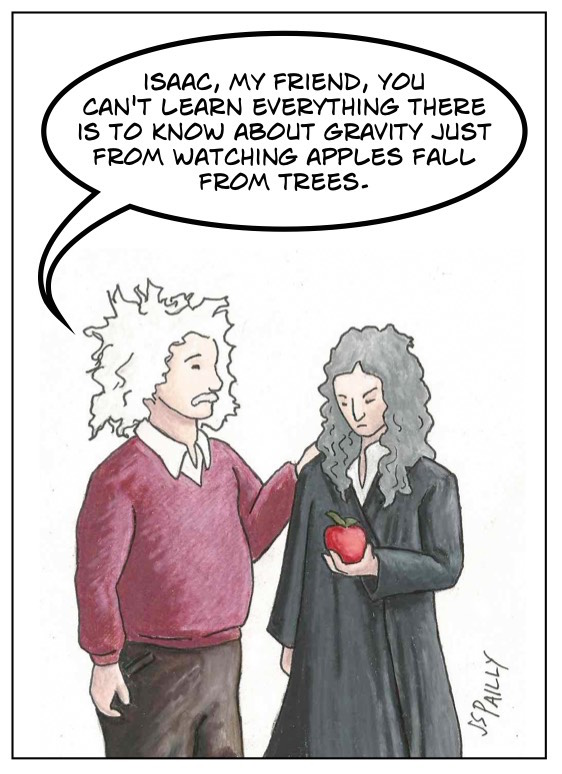
Back in the 17th Century, Isaac Newton found a mathematical way to describe gravity, and his mathematical description worked for everything from falling apples to the orbits of all the planets. Well, all the planets except Mercury.

Mercury’s perihelion (the point where Mercury is as close to the Sun as it gets) moves.  That in and of itself isn’t so strange, but the perihelion moves a tiny bit faster than it should according to Newton.
Mercury’s perihelion (the point where Mercury is as close to the Sun as it gets) moves. That in and of itself isn’t so strange, but the perihelion moves a tiny bit faster than it should according to Newton.

The mystery of Mercury’s orbit (or the “anomalous precession of the perihelion of Mercury,” to use the technical lingo) baffled scientists for centuries. That is until Albert Einstein came along.

Gravity According to Einstein

Einstein’s theory of general relativity postulates that space and time are not separate entities but two aspects of what physicists now call space-time. General relativity predicts that the force of gravity causes space-time to bend or warp.

Needless to say, the Sun has a lot of gravity. Turns out that the warping of space-time around the Sun precisely explains Mercury’s weird orbit. In fact, every planet experiences some degree of this anomalous perihelion thing. It’s just that, because Mercury is so much closer to the Sun, the warping effect is significantly more noticeable.

Fe12 Time Warp

This is perhaps the planet Mercury’s greatest contribution to science. The anomalous precession of Mercury’s perihelion provided one of the earliest proofs that general relativity—and all the wibbly-wobbly, timey-wimey stuff that comes with it—is not just science fiction.

Fe12 Albert and Isaac

Links

The 200-Year-Old Mystery of Mercury’s Orbit—Solved! from io9.

The Mysterious Orbit of Mercury from The Great Courses.

Accounting for General Relativity at Mercury from The Planetary Society.