Sciency Words: Planetary Protection

Sciency Words PHYS copy

Today’s post is part of a special series here on Planet Pailly called Sciency Words. Each week, we take a closer look at an interesting science or science-related term to help us all expand our scientific vocabularies together. Today’s word is:

PLANETARY PROTECTION

I swear this isn’t science fiction. The Office of Planetary Protection is a real department at NASA which follows the guidelines set by COSPAR, an international council with jurisdiction over the safe and responsible exploration of space.

The three core tenets of planetary protection are:

  • Don’t contaminate other worlds (we don’t want to harm alien life, if it exists).
  • Seriously, don’t contaminate other worlds (it would suck if the “alien life” we discover on Mars turns out to be E. coli).
  • While you’re at it, don’t contaminate Earth either (have you seen the Andromeda Strain?).

Under COSPAR rules, different mission categories require different levels of planetary protection. Categories I, II, and III require only minimal precautions. Nobody cares if we contaminate Venus. Nothing lives on Venus (probably). Category VI covers missions on the surfaces of worlds that could theoretically support life, and category V is for sample return missions that could theoretically bring alien organisms back to Earth.

Until recently, planetary protection has been a fairly esoteric concern. But now we know there’s water on Mars, and scientists really, really want to get a closer look at that!
Ja07 Curiosity on Mars 1

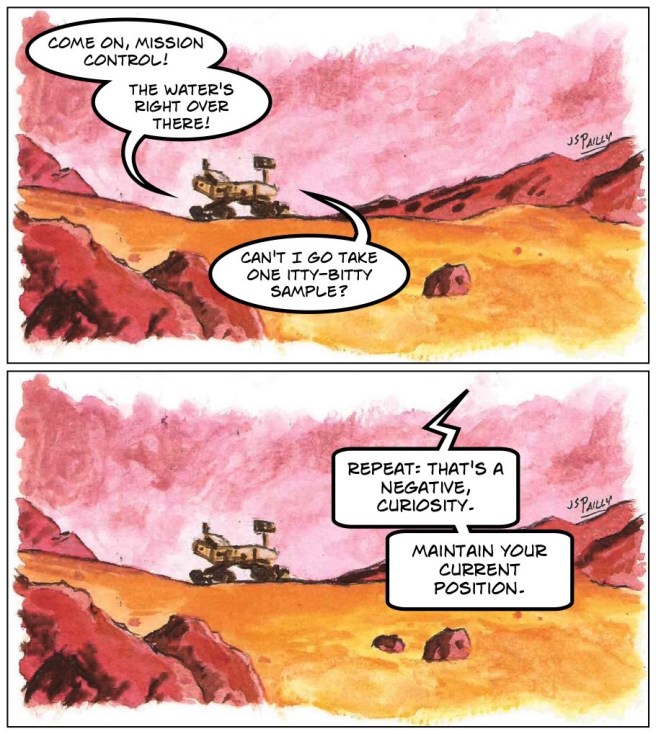
The Curiosity rover is currently located near a potential recurring slope line (RSL) site, meaning it’s only a few kilometers from what appears to be actively flowing water. But NASA won’t allow Curiosity to investigate.

First off, I should mention there is a logistical concern. Remember the slope part of recurring slope linea. The slope may be too steep for Curiosity to climb.

But the bigger issue is planetary protection (I mean, we could let Curiosity at least try to climb that hill). Under current planetary protection rules, the exploration of an RSL zone is a category IV mission. Specifically, it’s a category IVc. Curiosity is only rated for category IVb, because at the time of launch no one knew there was water on the surface of Mars. So there is a chance—a remote chance, but a chance nonetheless—that it is carrying live bacteria from Earth.

In my opinion, Curiosity should be allowed to investigate the RSL site anyway. It would be a miracle if any microorganism from Earth could survive on Mars. There’s too much radiation, and the water is brimming with toxic perchlorate salts. And the idea that organisms from cushy, comfortable Earth might outcompete native Martian life forms—life forms that are perfectly adapted to the harsh environment found on Mars—sounds 100% preposterous to me.

Ja07 Curiosity on Mars 2

At the same time, I know any evidence of life Curiosity might find would be justifiably suspect. We could never rule out the possibility of a contaminated sample.

So what do you think? Should Curiosity keep its distance from potential RSLs, or are COSPAR and the Office of Planetary Protection being over-precautious?

Links

The Office of Planetary Protection (official website).

COSPAR Planetary Protection Policy from COSPAR and the IAU.

Water on Mars: NASA Faces Contamination Dilemma over Future Investigations from The Guardian.

Sciency Words: Recurring Slope Linea (RSL)

Sciency Words MATH

Today’s post is part of a special series here on Planet Pailly called Sciency Words. Each week, we take a closer look at an interesting science or science-related term to help us all expand our scientific vocabularies together. Today’s word is:

RECURRING SLOPE LINEA

By now, I’m sure you’ve heard the news. In fact, this is kind of old news. There’s water on Mars. Liquid water. On the planet’s surface. It was discovered through spectral analysis of something called a recurring slope linea or RSL (plural: recurring slope lineae or RSLs).

I suppose recurring slope linea is really three words, so lets examine each word individually:

  • Recurring: these things go away and come back, apparently due to the changing of the Martian seasons.
  • Slope: they appear on sloped terrain, usually with inclines between 25º and 40º.
  • Linea: this is a fancy Latin word meaning straight line. In both geology and astronomy, lineae are lines on the surfaces of planets or moons, like the criss-crossing pattern of lines on Europa.

So RSLs are straight lines, only a few feet wide but often many miles long, that appear and disappear on sloped surfaces on Mars in correlation with seasonal temperature changes. It seems Mars has an embarrassing problem. The Red Planet just can’t keep itself from…

Ja04 Mars Interrupts

Anyway, this raises a big question, something for scientists and science fiction writers alike to ponder. Where is all that water coming from?

The obvious answer is that RSLs are just the tip of the iceberg (pun intended). Vast quantities of water must be trapped beneath the planet’s surface. Much of this water—though perhaps not all of it—is frozen, and during warmer seasons the top most layer of ice starts melting.

As much as I like that explanation and what it implies about Mars’s habitability, there’s a problem. If RSL water is coming from underground, we should expect it to first appear at lower elevations. Instead, RSLs tend to originate uphill and slowly trickle downward.

An alternative explanation is that the water has an atmospheric origin. Perchlorate salts are common in Martian soil, and these salts have a way of sucking water vapor out of the air.  While this would mean that water is present uphill, downhill, and everywhere in between, significant water flow might only be noticeable on sloped surfaces.

But there’s a problem with that explanation too. I mean, have you seen Mars? Do you really think the Martian atmosphere contains that much water vapor? It seems unlikely, but some scientists say it’s not completely impossible.

So we’re left with an enigma. We now know Mars has liquid water, at least seasonally. But where the heck does it come from?

Correction: I previously stated that water accumulates in Martian soil due to the condensation of atmospheric water vapor into frost, overlooking the role perchlorate salts play.  Condensation is not currently believed to be an important factor in the formation of RSLs.

Sciency Words: Solar Wind

Sciency Words MATH

Today’s post is part of a special series here on Planet Pailly called Sciency Words. Each week, we take a closer look at an interesting science or science-related term to help us all expand our scientific vocabularies together. Today’s word is:

SOLAR WIND

The Sun produces more than just sunlight. In addition to boring, electrically neutral photons of various wavelengths, the Sun also unleashes a near constant onslaught of electrically charged particles that wreak havoc upon the Solar System.

These charged particles are collectively known as the solar wind, and they come in two groups: slow and fast. The slow solar wind originates mainly from the Sun’s equator and travels at a leisurely 400 kilometers per second. The fast solar wind moves at almost twice that speed. It comes from coronal holes (low density regions of the corona) which tend to form near the Sun’s poles.

Both types of solar wind exert a slight pressure on everything they touch, from planets and moons to comets and asteroids. This is a slight pressure, but over long stretches of time it’s enough to nudge asteroids off course, clear dust and debris from the inner Solar System, and strip away entire planetary atmospheres.

Luckily for us, Earth can protect itself. Remember: the solar wind is composed of electrically charged particles, and Earth has a global magnetic field. As a result, the solar wind cannot blast Earth directly. For the most part, the magnetic field either repels solar wind particles away or directs them toward Earth’s poles (where the particles trigger auroras).

That’s good news for us humans, but don’t relax yet. The solar wind varies in intensity, turning from a gentle breeze into explosive solar storms.

Ja03 Ejecta

Earth’s magnetic field still protects our planet during these storms, but not our technology. We learned this the hard way in 1859 when a huge coronal mass ejection struck Earth head on. It was too much, and Earth’s magnetic field sort of freaked out, overloading the global network of telegraph wires. If this happened again today, with our fancy Internet and power grids and satellites, it would… actually, no one really knows what would happen.

Also, the solar wind is a form of radiation, composed primarily of broken pieces of hydrogen and helium atoms. The crew of the International Space Station are still protected (somewhat) by Earth’s magnetic field, and the Apollo Missions to the Moon were brief enough to keep total radiation exposure for astronauts fairly low.

But the future of human space exploration, both in reality and in science fiction, very much depends on this question: how do we protect ourselves from the solar wind?

Sciency Words: Planet X

Sciency Words PHYS copy

Today’s post is part of a special series here on Planet Pailly called Sciency Words. Each week, we take a closer look at an interesting science or science-related term to help us all expand our scientific vocabularies together. Today’s word is:

PLANET X

Planet X is perhaps the most abused term in modern astronomy. The name has been coopted by astrologers, conspiracy theorists, and on occasion science fiction writers.

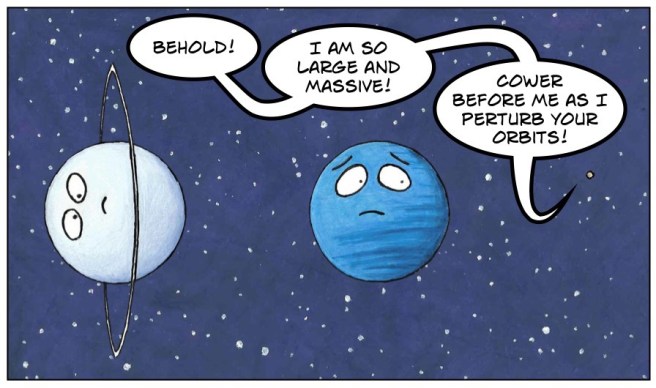
The name originated with Percival Lowell, better known as that guy who thought he saw canals on Mars. Based on apparent inconsistencies in the orbits of Uranus and Neptune, Lowell predicted that a ninth planet must exist: something massive enough that its gravity would perturb Uranus and Neptune’s orbits.

With the discovery of Pluto in the 1930’s, Lowell’s Planet X hypothesis seemed to be confirmed.

Dc08 Perturbing Orbits

Later, it became apparent that Pluto was tiny. In fact, it looked like Pluto was barely large enough to be a planet at all.

Dc08 Orbits Unperturbed

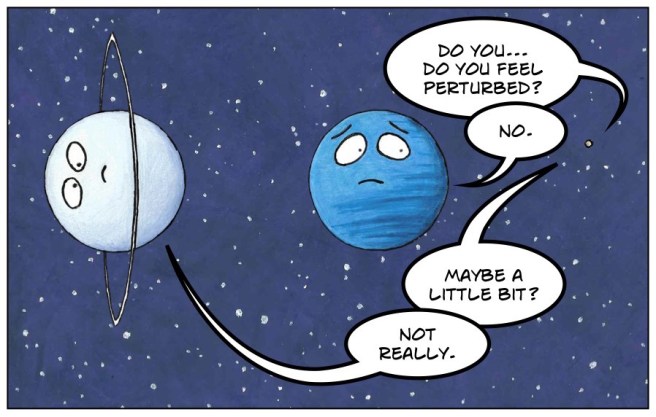
Then in the late 1980’s and early 1990’s, Voyager 2 revealed that we had miscalculated the mass of Neptune. Uranus and Neptune were exactly where they should have been all along. It was our math that was faulty.

The original Planet X hypothesis is now thoroughly defunct, just like that whole Martian canals thing. However, the term is still used as a placeholder name for any hypothetical as-yet-undiscovered planet hiding in the outer Solar System.

Dc08 Planet X

The term also remains annoyingly popular among conspiracy theorists.

P.S.: Planet X discovery announcements seem to pop up every few months. Just last week, astronomers announced the possible discovery of a Planet X and a Planet Y. Maybe this time it’s for real, but based on past experiences I’m guessing it’s not. Everyone stay skeptical and don’t get caught up in the hype.

* * *

Today’s post is part of Pluto/Kuiper belt month for the 2015 Mission to the Solar System. Click here to learn more about this series.

Sciency Words: Binary Planets

Sciency Words BIO copy

Today’s post is part of a special series here on Planet Pailly called Sciency Words. Each week, we take a closer look at an interesting science or science-related term to help us all expand our scientific vocabularies together. Today’s word is:

BINARY PLANET

If Pluto isn’t a planet, what is it? In 2006, the International Astronomy Union reclassified Pluto as a dwarf planet, but they considered other options as well. One idea was to classify Pluto and its largest moon Charon as binary planets.

Dc05 Binary Planets
Bonus points to anyone who can translate this.

The term “binary planets” comes by analogy with the term “binary stars,” which are stars that orbit each other. Proposed technical definitions of binary planets include:

  • A pair of planetary bodies that orbit a point located somewhere between them (it’s not clear how close to the middle that point needs to be).
  • A pair of planetary bodies co-orbiting a star that have close to the same mass (it’s not clear how similar their masses have to be).

Isaac Asimov, the grandmaster of science fiction and one of the greatest science communicators of his day, proposed his own definition for binary planets, or rather double planets, as he called them. Asimov’s definition was based on the gravitational attraction each planet had for the other.

In his books on science, Asimov applied the term double planet not only to Pluto and Charon but also to Earth and the Moon. After all, the Moon does exert a pretty strong gravitational pull on the Earth, arguably comparable to the gravitational pull the Earth exerts on the Moon.

Pluto and Charon have such an unusual relationship with each other that modern scientific literature often still calls them binary planets, even though the I.A.U. has rejected that terminology. Occasionally, the Earth/Moon system is also referred to this way.

The existence of two binary or almost binary planet systems in our own Solar System suggests that we may find other binary worlds orbiting distant stars. Binary habitable planets may even be possible. As this article from Discovery News suggests, civilizations on one or both planets might end up in “a fevered space race that would dwarf our space race of the 1960’s.”

At the very least, such a setting could offer loads of potential for a science fiction story.

* * *

Today’s post is part of Pluto/Kuiper belt month for the 2015 Mission to the Solar System. Click here to learn more about this series.

Sciency Words: Ring Arcs

Sciency Words PHYS copy

Today’s post is part of a special series here on Planet Pailly called Sciency Words. Each week, we take a closer look at an interesting science or science-related term to help us all expand our scientific vocabularies together. Today’s word is:

RING ARCS

Something’s wrong with Neptune’s rings.

Nv11 Neptune's Arcs

Neptune has five rings, all named after astronomers or scientists associated with significant Neptune-related discoveries. They are (in order of increasing distance from Neptune):

  • Galle: named after the guy who discovered Neptune, sort of. He had help from…
  • Le Verrier: named after the guy who calculated Neptune’s exact position, allowing Galle to “discover” it.
  • Lassell: named after the discoverer of Triton, Neptune’s largest moon.
  • Arago: named after the teacher who encouraged Le Verrier in his calculations and helped defend Le Verrier in a dispute with…
  • Adams: named after another person who calculated Neptune’s position before its discovery and started a fuss with Le Verrier over who deserved credit.

There was plenty of drama surrounding the discovery of Neptune, and that has been preserved in the names of the rings that also surround the planet.

Neptune has an unnamed sixth “ring,” if we can be generous enough to call it a ring, located between Arago and Adams. A small moon named Galatea also orbits within that gap. This unnamed ring doesn’t circle all the way around the planet, so it is better described as an “arc.”

Furthermore, a short segment of the outermost ring (Adams) is also broken up into several small arcs. These arcs were originally named Liberty, Equality, and Fraternity (bonus points to anyone who can tell me what the planet Neptune has to do with the French Revolution).

Later, two more arcs were found in the Adams ring, so the list became (in order):

  • Courage: the faintest arc.
  • Liberty: often described as the “leading arc,” even though Courage orbits ahead of it.
  • Equality 1 and Equality 2: the Equalities are so close together that they’re almost a single arc.
  • Fraternity: brings up the rear and is the largest and brightest of Neptune’s arcs.

The existence of these arcs doesn’t make a whole lot of sense. Ring particles should spread out the fill the gaps within a matter of months, yet the arcs have remained stable since their discovery in the 1980’s.

An orbital resonance with Galatea is almost certainly involved, but mathematical models of Galatea and the Adams arcs don’t always match with observations. Neptune may have an additional as-yet-undiscovered moon near its rings, or perhaps some other unknown factor is at work.

Probably aliens.

P.S.: Neptune isn’t the only planet with arcs in its rings. Saturn has them too. So Neptune: you don’t have anything to feel embarrassed about.

Links

Neptune’s Rings and “Ring Arcs” from JPL’s Voyager Mission webpage.

Rings of Neptune from Universe Today.

Stability of Neptune’s Ring Arcs in Question from Letters to Nature.

* * *

Today’s post is part of Neptune month for the 2015 Mission to the Solar System. Click here to learn more about this series.

Sciency Words: Centaur

Sciency Words MATH

Today’s post is part of a special series here on Planet Pailly called Sciency Words. Each week, we take a closer look at an interesting science or science-related term to help us all expand our scientific vocabularies together. Today’s word is:

CENTAUR

When it comes to large, rocky objects drifting through space, naming conventions can get tricky. Many are called asteroids. Others go by stranger names. Some of these objects are called centaurs.

Nv08 Centaurs

Eh… no. It has nothing to do with horses, although these objects are sort of half one thing and half another. Most if not all centaurs could be classified as both asteroids and comets.

One definition of centaur is an object orbiting the Sun between the orbits of Jupiter and Neptune. More technical definitions involve an object’s semi-major axis, relative to the semi-major axes of Jupiter and Neptune, and non-resonant (i.e.: unstable) orbital periods. But I think a better way to describe centaurs is this: they are objects in a state of transition.

It is believed that most centaurs used to be Kuiper belt objects or objects from the scattered disk: basically, they were those large, icy things hanging out beyond Neptune. Due to gravitational interactions with Neptune and other gas giants, these objects have been pulled into increasingly eccentric (non-circular) orbits.

Eventually, most of these objects will transform into comets, with orbital paths that cut through the inner Solar System and bring them within melting distance of the Sun (allowing them to form cometary tails).

The Interanational Astronomy Union (I.A.U.) originally wanted to name all centaurs after actual centaurs from Greek mythology. However, some have been named after other hybrid or shape-shifting creatures, which I think is perfectly appropriate. Examples include Typhon (a snake or dragon hybrid), Ceto (a sea monster goddess), and Narcissus (a man who transformed into a flower).

In the future, centaurs could conceivably be named after the minotaur, the sphinx, or perhaps even Dracula. If the I.A.U. wants to have some fun, they could also use names like Ariel from The Little Mermaid, Constable Odo from Star Trek: Deep Space IX, or any of the Animagus characters from Harry Potter.

In fact, throughout fiction and mythology, there are plenty of hybrids and shape-shifters to chose from. So what names do you think the I.A.U. should give the next centaur asteroids?

Links

Centaurs: Cross-Dressing Comets That Go as Asteroids from Discovery News.

Centaur (minor planet) from Wikipedia.

JPL Small-Body Database Search Engine: List of Centaurs from JPL Solar System Dynamics.

Sciency Words: Cantaloupe Terrain

Sciency Words PHYS copy

Today’s post is part of a special series here on Planet Pailly called Sciency Words. Each week, we take a closer look at an interesting science or science-related term to help us all expand our scientific vocabularies together. Today’s word is:

CANTALOUPE TERRAIN

This is a cantaloupe.

Nv05 Not Actually a Cantaloupe

And this is Triton, Neptune’s largest moon.

Nv05 Not Actually Triton

Wait, I think I got those mixed up…

In 1989, Voyager 2 became the first (and so far the only) spacecraft to visit Triton, and it sent back some weird pictures of Triton’s surface. Pictures like this one:

Nv05 Cantaloupe Terrain

This heavily dimpled surface topography, which bears an uncanny resemblance to the skin of a cantaloupe, is unique to Triton. It may have formed due to a geologic process called diapirism, whereby blobs of warm material (called diapirs) force their way upward through layers of solid rock.

We know this process occurs on Earth and possibly a few other places in the Solar System. However, diapirism does not generally produce a cantaloupe-like appearance. That only happens on Triton, and no one’s entirely sure why.

So research continues on what scientists have officially named “cantaloupe terrain.”

Nv05 Cantaloupe Terrain vs Chaos Terrain

Today’s post is part of Neptune month for the 2015 Mission to the Solar System. Click here to learn more about this series.

And click here to find out more about Europa’s chaos terrain.

Sciency Words: Flagship Mission

Sciency Words BIO copy

Today’s post is part of a special series here on Planet Pailly called Sciency Words. Each week, we take a closer look at an interesting science or science-related term to help us all expand our scientific vocabularies together. Today’s word is:

FLAGSHIP MISSION

There is a growing need among planetary scientists to study an ice giant up close. We keep discovering ice giant size planets orbiting distant stars, but we know next to nothing about the two ice giants in our own Solar System: Uranus and Neptune.

Nv03 Uranus and Neptune

To get to know these two planets better, NASA will have to launch a robotic mission of some kind. But which kind? There are three mission classes, defined primarily by their price tags:

  • Discovery Missions: Proposals for discovery-class missions are submitted to NASA and go through a highly competitive selection process. Approved missions must cost less than $450 million (a real bargain! Well, for NASA at least). Examples include the Mars Pathfinder Mission, the MESSENGER mission to Mercury, and the Kepler Space Telescope.
  • New Frontiers Missions: Like discovery missions, new frontiers missions go through a highly competitive selection process. Total costs (not including the launch vehicle) are capped at $1 billion. Examples include the New Horizons Mission to Pluto and the Juno Mission to Jupiter, due to arrive in 2016.
  • Flagship Missions: Unlike the other two mission classes, there is no regular submissions process for a flagship mission. Instead, NASA develops these missions internally, with costs ranging between $2 and $4 billion. NASA tends to launch only one flagship mission per decade. Examples include the Curiosity rover on Mars, the Cassini spacecraft orbiting Saturn, and the Voyager 1 and 2 probes that are currently exploring the very edges of the Solar System.

In relation to the ice giants, everyone seems to agree that a discovery-class mission could never reach Uranus or Neptune. A new frontiers mission could work, especially if it’s just a flyby mission like the recent New Horizons flyby of Pluto.

But to really get up close and personal with an ice giant, we need to send an orbiter. That will be expensive, and it will require NASA to commit to a flagship mission.

Upcoming flagship missions will focus on Mars (another Curiosity style rover) and Europa (potential home to alien fish). So despite the growing need among planetary scientists to study an ice giant up close, there probably won’t be a Uranus or Neptune orbiter any time soon.

Discovering Uranus’s Rings (Sciency Words: Occultation)

Sciency Words MATH

Today’s post is part of a special series here on Planet Pailly called Sciency Words. Each week, we take a closer look at an interesting science or science-related term to help us all expand our scientific vocabularies together. Today’s word is:

OCCULTATION

You know that thing when the Moon passes in front of the Sun, completely blocking the Sun from our view here on Earth. That specific event, known as a solar eclipse, is an example of a more general phenomenon called an occultation.

The term is related to the more vernacular word “occult” in the sense that they both refer to things that are hidden. When a planet, moon, or other celestial body passes in front of a distant star, for example, the star is “occulted” in the sense that it is briefly hidden from sight.

Occultations are a rare and wonderful cosmic coincidence, and they also provide astronomers with an incredible opportunity. Whenever an occultation is predicted to occur, a great many powerful telescopes all across the globe swivel around to watch.

And sometimes amazing discoveries are made.

In 1977, the planet Uranus occulted a star with the unimaginative name of SAO 158687. After setting up their telescopes, astronomers presumably got their popcorn ready and waited to see what would happen. They were hoping some of the occulted starlight would pass through Uranus’s atmosphere, revealing the atmosphere’s structure and chemical composition.

Surprisingly, the show started early and ended late. SAO 158687 dimmed exactly five times before the occultation and exactly five times afterward. This provided the first evidence that Uranus has rings. At least five of them (we now know of thirteen Uranian rings).

And it’s a good thing we discovered those rings too. Given Uranus’s otherwise bland appearance, how else could I depict the planet’s sideways orientation without the help of those sideways oriented rings?

Oc09 Uranus Without Rings

P.S.: On a personal note, I’ve been feeling a little under the weather lately, which is why this edition of Sciency Words is a day late, and I want to apologize in advance if I don’t respond to comments as quickly as usual.