Sciency Words: Shruggie

Sciency Words BIO copy

Today’s post is part of a special series here on Planet Pailly called Sciency Words. Each week, we take a closer look at an interesting science or science-related term to help us all expand our scientific vocabularies together. Today’s term is:

SHRUGGIE

We all know what quacks are. They’re people trying to sell you pseudoscientific garbage that will benefit your health, beauty, intelligence, sexual prowess, or whatever. We should all be on guard against quackery.

But I recently discovered another term, a term which comes to us courtesy of Val Jones at Science-Based Medicine: shruggies. I’m not sure if this term has really spread beyond the Science-Based Medicine website, but I’m definitely adding it to my vocabulary.

Shruggies are people who, when presented with pseudoscience, just shrug. Bold, unrealistic claims? Shrug. Lack of supporting evidence? Shrug. Science… pseudoscience… what’s the difference? It’s not worth arguing about.

I recently saw an example of this on television, on one of those shows where they give out free medical advise. They were talking about leeches. Yes, leeches. Apparently Demi Moore has been using them as part of her beauty regimen, and gosh doesn’t she look young and beautiful?

Of course, these aren’t just any old leeches from your local swamp. These are “medically trained” leeches (Demi Moore’s words, not mine). So if your blood is full of toxins, if your body is full of negative energy, you can turn to Mr. Leech to suck it all out.

Jn10 Dr Leech

The show’s hosts—who are supposedly real doctors—just smiled and made jokes. One of them decided to try it for himself and put a leech on his hand.

They did not endorse this leech therapy thing, but they didn’t say or do anything to discredit it either. Basically, they shrugged. And by shrugging, they sent a clear message to their viewers at home: if you want to look young and beautiful like Demi Moore, maybe leeches are worth trying.

So beware of shruggies. They’re as bad as quacks. Maybe worse.

P.S.: I should mention that the F.D.A. has approved the use of leeches for medical purposes. Apparently they can help treat certain kinds of blood clots that can be difficult to treat using other methods. I guess this is the kernel of truth at the center of this leech therapy nonsense.

Sciency Words: Equilibrioception

Sciency Words PHYS copy

Today’s post is part of a special series here on Planet Pailly called Sciency Words. Each week, we take a closer look at an interesting science or science-related term to help us all expand our scientific vocabularies together. Today’s term is:

EQUILIBRIOCEPTION

The best writing engages all the senses. That’s worthwhile advise most writers will get at some point in their careers, but how many senses do we humans have?

Thousands of years ago, Aristotle concluded that we have five senses: sight, hearing, taste, smell, and touch. That seems reasonable enough, and five continues to be the traditional number of senses. But depending on whom you ask, you might get a different answer.

Equilibrioception is a sense we rarely have to think about, unless something goes wrong with it. It’s governed by the vestibular system, which is located in your inner ear.

Basically, equilibrioception is your perception of up and down. It’s your ability to orient yourself in relation to gravity so that you can keep your balance while standing or walking.

If you’re writing science fiction—especially hard Sci-Fi—this is a sixth sense you may want to think about (telepathy just got bumped to seventh sense!). The experience of zero-G, or fractional Gs, or Gs greater than one, could really screw with your characters’ heads.

Jn03 Which Way is Up

Even experienced astronauts are known to have equilibrioception-related problems from time to time.

As for artificial gravity, it might “feel” a bit off too. If you’re simulating gravity by rotating your spaceship, as seen in movies like 2001: A Space Odyssey, you might experience a gravity-like pull that is skewed slightly relative to the floor. Or your feet might experience slightly more Gs than your head (especially on smaller spacecraft).

So science fiction writers, remember to engage all the senses in your writing, even senses like equilibrioception that we don’t normally think about. And if you manage to give your readers a bit of vertigo, you’ve done your job well.

Links

How to Pronounce Equilibrioception

Humans Have a Lot More than Five Senses from Today I Found Out

You Don’t Actually Have Five Senses from Modern Notion.

Sciency Words: Pixie

Sciency Words BIO copy

Today’s post is part of a special series here on Planet Pailly called Sciency Words. Each week, we take a closer look at an interesting science or science-related term to help us all expand our scientific vocabularies together. Today’s term is:

PIXIE

The Future

It is the year 2217. The mining vessel Belvedere approaches a large, rocky body in the outer Solar System. The object is dark in color, barely visible against the inky blackness of space. It has every appearance of being a carbonaceous asteroid, no doubt rich in volatiles. It may even contain that most precious of substances in space: water.

The crew of the Belvedere stand to make a substantial profit, but the science officer reports that she’s getting a lot of strange readings. The asteroid may not be what it seems. “I recommend keeping our distance,” she says.

The Present

“Pixies” are part of the whole commercialization of space thing that’s going on right now. They’re made by a company called Asteroid Initiatives LLC, and they’re intended for use in asteroid prospecting and, ultimately, asteroid mining.

Basically, pixies are a new kind of space probe. As you might guess from the name, they’re really small. They’re sometimes referred to as femto-spacecraft, though they’re not actually femto-scale (that would make them smaller than atoms).

In terms of size, they’re often compared to credit cards, cell phones, or TV remote controls. In other words, a pixie spacecraft could fit in the palm of your hand.

Pixies may be going on their first mission soon. They’re under consideration to be part of the AIDA mission to the asteroid Didymos and its moon, Didymoon. If approved, a swarm of forty pixies will either surround Didymoon or land on its surface.

Granted, pixies are too small to carry much sensor equipment, but there will be forty of them. That’s forty extra data feeds, forty extra points of view, forty extra perspectives on how Didymoon responds during AIDA’s impact experiments. That’s a lot of additional information without putting any expensive hardware at risk.

The Future

The captain of the Belvedere steeples his fingers. He can’t pass up the opportunity to mine such a large carbonaceous asteroid, but if his science officer is right… if there’s any danger….

On the view-screen, the large, rocky object drifts through space. The captain comes to a decision. There’s a way to get more data without putting the ship at risk.

The captain issues the order: “Release the pixies!”

Sciency Words: The K-T Event

Sciency Words MATH

Today’s post is part of a special series here on Planet Pailly called Sciency Words. Each week, we take a closer look at an interesting science or science-related term to help us all expand our scientific vocabularies together. Today’s term is:

THE K-T EVENT

You already know this story. It was 65 million years ago. There were dinosaurs, there was an asteroid…

It’s easily the most famous asteroid impact in Earth’s history, and it’s called the K-T Event, or sometimes the K-Pg Event.

In geology shorthand, the letters stand for:

  • K: the Cretaceous period, which is spelled with a K in German. This was the last period of geological history in which dinosaurs roamed the Earth.
  • T: the Tertiary period, which immediately followed the Cretaceous. According to the International Commission on Stratigraphy (ICS), we’re not supposed to use this name anymore, but people still do. It’s sort of like how some people keep calling Pluto a planet, no matter what the International Astronomy Union (IAU) says.
  • Pg: the Paleogene period, which is the period immediately following the Cretaceous according to the ICS’s new list of geological periods. Please note, the Tertiary and Paleogene are not really interchangeable terms. They have the same starting point, but different end points.

Geologists and paleontologists puzzled for decades over a layer of clay separating Cretaceous and Tertiary (or Paleogene) rock. They called it the K-T boundary. There were several competing hypotheses about what might have caused this boundary and how it related to the mass extinction event that killed off the dinosaurs.

Then in 1980, a paper came out entitled “Extraterrestrial Cause for the Cretaceous-Tertiary Extinction.” This paper reported the discovery that the K-T boundary contained abnormally high levels of the element iridium.

Platinum group metals like iridium are extremely rare on Earth (except in the planet’s core) but common in asteroids. So whenever you find lots of iridium in Earth’s crust, you can justifiably assume an asteroid put it there.

The most likely scenario is that a large asteroid, about 10 km in diameter, smashed into Earth, flinging dust and debris high into Earth’s atmosphere. Enough to block out the sun worldwide for several years. This global dust cloud would have included plenty of material from the asteroid itself, which would have been partially vaporized by the heat of the impact.

A major problem with the original 1980 paper was that, at the time, no known impact crater of the appropriate age was sufficiently large. But of course, that was back in 1980. The crater has since been found in the Yucatan Peninsula, and now just about everybody knows the story of the K-T Event (even if they don’t know it’s called that).

P.S.: The K-T Event is not to be confused with the Katie Event. You know, that time your BFF Katie had waaaaay too much to drink and threw a temper tantrum of apocalyptic proportions.

Addendum: While there does seem to be general, widespread consensus that the K-T asteroid impact either caused the extinction of the dinosaurs or contributed significantly to their demise, there is not universal agreement. As Planetary Defense Commander notes in the comments, there are other possibilities worth considering.

Sciency Words: Didymoon

Sciency Words PHYS copy

Today’s post is part of a special series here on Planet Pailly called Sciency Words. Each week, we take a closer look at an interesting science or science-related term to help us all expand our scientific vocabularies together. Today’s term is:

DIDYMOON

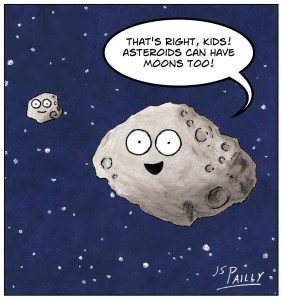
Let it not be said that scientists don’t have a sense of humor. When they discovered that the asteroid 65803 Didymos has its own moon, they named that moon Didymoon.

My06 Didymoon 1

Yes, asteroids can have their own moons, but we knew that for many years before the discovery of Didymoon. The important thing you need to know is that we humans are planning to use Didymoon for target practice.

My06 Didymoon 2

Multiple space agencies around the world, including NASA, are collaborating on a mission called the Asteroid Impact and Deflection Assessment mission (AIDA). Didymos and Didymoon will pass near Earth in October of 2022. As they approach, AIDA will launch, and it will try to hit Didymoon really, really hard to see how much we can shift its orbit.

AIDA is a crucial test. Are we capable of changing the orbits of objects in space? Can we protect our planet from incoming asteroids and comets?

My06 Didymoon 3

Didymos and Didymoon are correct. They’re not like the asteroid from the K-T Event, which wiped out the dinosaurs, or the object from the Tunguska Event, which leveled an astonishing number of trees.

But if we can adjust Didymoon’s orbit around Didymos, we’ll be better prepared to adjust the trajectories of other asteroids that might be heading our way.

Sciency Words: The Tunguska Event

Sciency Words PHYS copy

Today’s post is part of a special series here on Planet Pailly called Sciency Words. Each week, we take a closer look at an interesting science or science-related term to help us all expand our scientific vocabularies together. Today’s term is:

THE TUNGUSKA EVENT

June 30, 1908, was a bad day to be a tree. At least, it was a bad day for a heck of a lot of trees in the middle of nowhere, Russia.

My03 Tunguska Event

Something—there’s debate over what exactly is was—fell from space that day. It didn’t make it to the ground. Instead, it exploded midair above the Tunguska River.

According to human eyewitnesses, who were many miles away, the sky appeared to be split in two by fire. They heard a series of loud booms. The ground shook, and there was a sudden and intensely hot burst of wind so strong it apparently knocked people off their feet.

According to tree eyewitnesses… actually, we can’t ask the trees what they saw. They died. About 2,000 square kilometers (almost 800 square miles) of forest were scorched and flattened.

Scientific debate continues over what caused the Tunguska Event. It could have been an asteroid; however, asteroid debris can usually be identified by the presence of certain rare metals, such as iridium and osmium. These metals have not been found in the Tunguska region, at least not in quantities that would be atypical for Earth.

Another possibility (which makes the most sense to me) is that is was a comet. Comets are composed of lighter, more volatile chemicals like water. So when the Tunguska comet exploded, it would have been completely vaporized, leaving no debris.

The absurdly huge asteroid that killed the dinosaurs gets a lot of attention in popular culture, but asteroids (and comets) don’t have to be mass-extinction-sized to cause considerable damage. If the Tunguska Event had been the New York Event, there would be no more New York. And if something that big fell over the ocean, the resulting tsunamis could obliterate hundreds of miles of nearby coastlines.

Much like the Carrington Event of 1859, the Tunguska Event serves as a warning. Space is dangerous. Space is deadly. Earth can’t protect us from everything.

Sciency Words: Panspermia

Sciency Words BIO copy

Today’s post is part of a special series here on Planet Pailly called Sciency Words. Each week, we take a closer look at an interesting science or science-related term to help us all expand our scientific vocabularies together. Today’s term is:

PANSPERMIA

What if bacteria have their own space program? What if microorganisms can travel from planet to planet all by themselves?

Ap13 Panspermia Adventures Part 1

Admittedly, this bacterial space program is a poor man’s way to explore the universe. Single-celled astronauts don’t know when they’ll be launched into space, nor can they predict where they’ll be going. There are no rocket ships. There’s no mission control.

And if you think a lot of human astronauts have died in the name of space exploration, the fatality rate for bacterial astronauts is way, way higher.

Ap13 Panspermia Adventures Part 2

Panspermia comes from the Greek words for “all” and “seeds.” It can be loosely translated as “seeds in all places” or “seeds everywhere.” As a scientific concept, panspermia hypothesizes that microorganisms can hop from one world to another via asteroid impacts.

There’s very little proof for panspermia, but scientists have gathered plenty of circumstantial evidence.

  • Many asteroids (especially C-type asteroids) contain water and amino acids. It’s not much, but very simple organisms might be able to eek out an existence there.
  • Life didn’t appear on Earth until after an event known as the late heavy bombardment, when loads of asteroids pummeled our planet. Mars and Venus, the moons of Jupiter and Saturn… they all got pummeled too. Life could have been seeded across the whole Solar System at that time.
  • The earliest fossilized microbes on Earth appear to have already developed a certain degree of complexity. Maybe they evolved this complexity before coming to Earth.
  • Tardigrades have become famous for their ability to survive in space, but a surprising number of other microorganisms can survive in space too. Some apparently grow better up there than they do here. Why are these life forms are so well adapted to space? Maybe it’s because they’re from space.
  • Plenty of meteorites found here on Earth originate from other places in the Solar System, and there’s good reason to suspect that Earth rocks have made it to other planets too. Any of these rocks could have had microscopic passengers aboard.

So how seriously should we take the panspermia hypothesis? Even if we accept the possibility that bacteria could travel between worlds, that doesn’t mean they do or that such things are common occurrences.

But as a science fiction writer who’s in the middle of world-building for a new story, I think panspermia is a great place to start. If I decide panspermia is true, I can have a universe where life is everywhere—and perhaps where all life is genetically similar in some respects. If I decide panspermia is false (within my fictional reality), I’ll have a universe where life is rare, separated by strange and wildly dissimilar genetic structures.

Both options offer intriguing storytelling opportunities. Which to choose? Which to choose….

Links

Panspermia: A Promising Field of Research from the 2010 Astrobiology Science Conference.

Tiny Animals Survive Exposure to Space from ESA.

Bacteria in Space! from Scientific American.

The Continuing Controversy of the Mars Meteorite from Astrobiology Magazine.

Earth and Mars Could Share a Life History from Mars Daily.

Sciency Words: Z-Series Spacesuits

Sciency Words PHYS copy

Today’s post is part of a special series here on Planet Pailly called Sciency Words. Each week, we take a closer look at an interesting science or science-related term to help us all expand our scientific vocabularies together. Today’s term is:

Z-SERIES SPACESUITS

What is a spacesuit? Is it a garment? Is it a type of apparel that you wear in space? Or is a spacesuit actually a kind of minimalistic, human-shaped spacecraft?

Last week, we took a look at a new spacesuit concept that’s definitely more of a garment. A tight-fitting, super sexy kind of garment. Today, we’re turning our attention to something that follows the human-shaped spacecraft philosophy of spacesuit design.

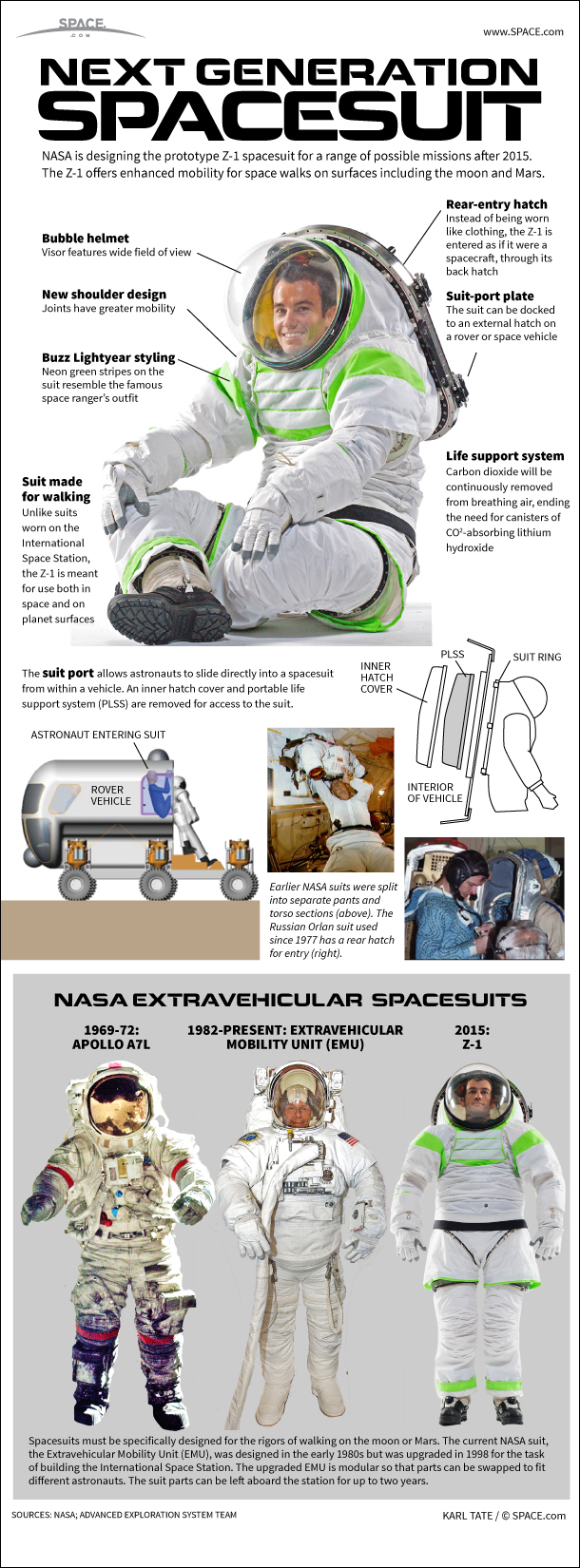
This is NASA’s experimental Z-1 spacesuit: a big, bulky spacesuit that’s sort of reminiscent of Buzz Lightyear.

Ap10 Z-1 Spacesuit

The Z-1 is made from “soft” materials, which weigh less than the “hard” materials of current spacesuits and allow astronauts a greater range of motion. On the downside, soft suits are less durable and provide less protection.

After the Z-1, NASA’s next experimental suit was named the Z-2. This time, rather than borrowing color schemes from Toy Story, NASA went with something from Tron.

Ap10 Z-2 Spacesuit

For the Z-2, NASA went back to hard materials, at least for the torso. They also added electro-luminescent panels, because they look cool. I mean, because they improve visibility in dark environments. It’s dark in space, you know. Looking cool is just a bonus.

While the Z-1 and Z-2 have many differences, there is one design feature they have in common. Notice the body shapes of these suits. Notice that they both look sort of top-heavy. There’s a reason for that.

The Z-series spacesuits aren’t clothes. You don’t put them on like clothes. Instead, you climb in through an entry hatch in the back, which extends up over the shoulders to make room for your head. I have to admit, this does sound a whole lot more convenient than all that mechanical counter pressure stuff from last week. Just climb in, close the hatch behind you, and you’re good to go (well, I’m sure there’s still life support and pressurization stuff to do, but you’re basically good to go).

Both the Z-1 and Z-2 are prototypes. Neither has been sent to space, and I’m under the impression they never will be. Instead, they’re being tested here on Earth using vacuum chambers and such. But maybe someday, thanks to the Z-series suits, astronauts on the Moon or Mars will have the convenience of hatch-back spacesuit entry.

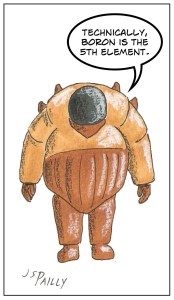
And by the way, if anyone at NASA is reading this, here’s my proposal for the Z-3. It’s inspired by The Fifth Element.

Ap10 Z-3 Spacesuit

So the next time you’re heading to space, what kind of spacesuit do you want? Do you want to wear a garment-like mechanical counter pressure suit, or would you prefer the convenience of something like the Z-series?

Links

Z-1 Next Generation Spacesuit (Infographic) from Space.com.

NASA’s Futuristic Z-2 Spacesuit: How It Works (Infographic) from Space.com.

The Z-1 from NASA.gov.

NASA’s Next Prototype Spacesuit Has a Brand New Look, and It’s All Thanks to You from NASA.gov.

Super Sexy Spacesuits (Sciency Words: Mechanical Counter Pressure)

Sciency Words MATH

Today’s post is part of a special series here on Planet Pailly called Sciency Words. Each week, we take a closer look at an interesting science or science-related term to help us all expand our scientific vocabularies together. Today’s term is:

MECHANICAL COUNTER PRESSURE

Turns out the costume designers of many classic, B-movie Sci-Fi flicks may have been on to something. Space adventurers of tomorrow may actually end up wearing snug, form-fitting spacesuits. For legitimate, practical reasons (not just fan service!).

Ap07 Super Sexy Space Suits

Spacesuits need to accomplish several things: provide breathable air, regulate your body temperature, keep you pressurized…. For that last part, current space suit designs rely on air pressure. Essentially, spacesuits are human-shaped balloons filled with enough air to replicate atmospheric pressure.

In the future, spacesuits might be made of a web of “coils.” When activated (using an electrical current, perhaps) these coils would contract, morphing around all the curves and contours of your body, physically compressing you with enough pressure to simulate atmospheric pressure.

This process of being squeezed and compressed by your spacesuit is known as “mechanical counter pressure.” Parts of a mechanical counter pressure spacesuit will still have to be pressurized: the helmet, for obvious reasons, but also the gloves and boots. Mechanical counter pressure could severely damage the fine bones of the fingers, wrists, ankles, and toes.

So why would you want to wear a mechanical counter pressure suit?

  • Because your spacesuit would weigh a whole lot less.
  • Because your spacesuit would be a lot less bulky, giving you a wider range of motion while working in space.
  • Because if your spacesuit is punctured or torn, you won’t depressurize. The coils will remain contracted.
  • Because you want to look good for all the alien hunks/babes you’ll be meeting in space.

Unfortunately, mechanical counter pressure suits are still very much on the drawing board. The biggest problem seems to be getting the coils to contract and stay contracted without a continuous electric current running through them. There’s not much risk of getting electrocuted by your suit, but the continuous current would eventually make your suit hot. Very hot.

So NASA’s next generation of spacesuits will probably go in a different and less sexy direction. We’ll talk more about that next week.

P.S.: Just to clarify, when I say your spacesuit would get very hot, I’m not referring to the sexy kind of hot.

Links

Shrink-Wrapping Spacesuits from MIT News.

Futuristic Skintight Spacesuit May Shrink-Wrap Astronauts from Space.com.

Future Spandex from TV Tropes.

Sciency Words: Decouple

Sciency Words BIO copy

Today’s post is part of a special series here on Planet Pailly called Sciency Words. Each week, we take a closer look at an interesting science or science-related term to help us all expand our scientific vocabularies together. Today’s term is:

DECOUPLE

After years of speculation, last September we finally learned the truth. Enceladus, one of Saturn’s moons, has a decoupled crust.

Ap04 Enceladus Decoupled

Sorry, Enceladus. I meant no offense. In fact, having a decoupled crust might be a good thing.

We’ve known for some time now that there is liquid water somewhere beneath Enceladus’s surface. Some of that water periodically spurts out of geysers located near the moon’s south pole. You can see this happening in the totally legit Hubble image of Enceladus above.

The big question: how much liquid water is there? Are we talking about a modest subsurface lake near the south pole…

Ap04 Enceladus Subsurface Lake

… or does Enceladus have a vast global ocean hidden beneath its surface? You know, the kind of environment that might support life.

Ap04 Enceladus Subsurface Ocean

By carefully observing Enceladus as it orbits Saturn, astronomers noticed that the moon appears to wobble more than it should. The best explanation for this: the moon’s crust is not attached to anything solid. It floats freely atop a layer of liquid. Enceladus’s crust is—to use the technical term—decoupled from the moon’s rocky interior.

That’s pretty compelling evidence for a global subsurface ocean, and while it doesn’t prove that Enceladus supports life, it does make the possibility a whole lot more likely.

Or does it? Let me check on that for Monday’s post.

* * *

Alternative definition of decouple: to remove any couples from a party or similar social event, leaving all the single gents and ladies free to mingle.