Mercury A to Z: Five

Hello, friends!  Welcome back to the A to Z Challenge.  For this year’s challenge, my theme is the planet Mercury, and in today’s post F is for:

FIVE

Today’s post is really an important life lesson: you can’t always trust your own eyes.  Your eyes will play tricks on you, and they may cause you to make some pretty embarrassing mistakes.  Back in the late 1800’s, Italian astronomer Giovanni Schiaparelli’s eyes played a trick on him, causing him to miscalculate Mercury’s rotation rate.

We touched on this briefly in a previous post.  Based on telescopic observations of Mercury, Schiaparelli determined that Mercury has a rotation rate of approximately 88 Earth days.  This matches nicely with Mercury’s orbital period, which is also about 88 Earth days long.  If Schiaparelli’s calculations were correct, this would mean that Mercury is tidally locked to the Sun.  The same thing happened to Earth’s Moon.  The Moon’s rotation rate and orbital period are both approximately 27 Earth days long, which is why the same side of the Moon always faces toward the Earth.

But Schiaparelli’s calculations were not correct.  We now know that Mercury’s true rotation rate is about 59 Earth days, not 88.  So how did Schiaparelli, an otherwise highly competent and highly accomplished astronomer, get this so wrong?  It’s because when he started his observing campaign of Mercury, he noticed a pattern of splotches on Mercury’s surface that kind of looked like the number five.  And as he continued his observations, he kept seeing this splotchy five shape on Mercury’s surface.

The thing is, if you stare long enough and hard enough at the surface of Mercury, you can probably find the number five in several different places.  I’d normally include one of my own drawings here, but in this case I think you really need to see an actual map of Mercury.
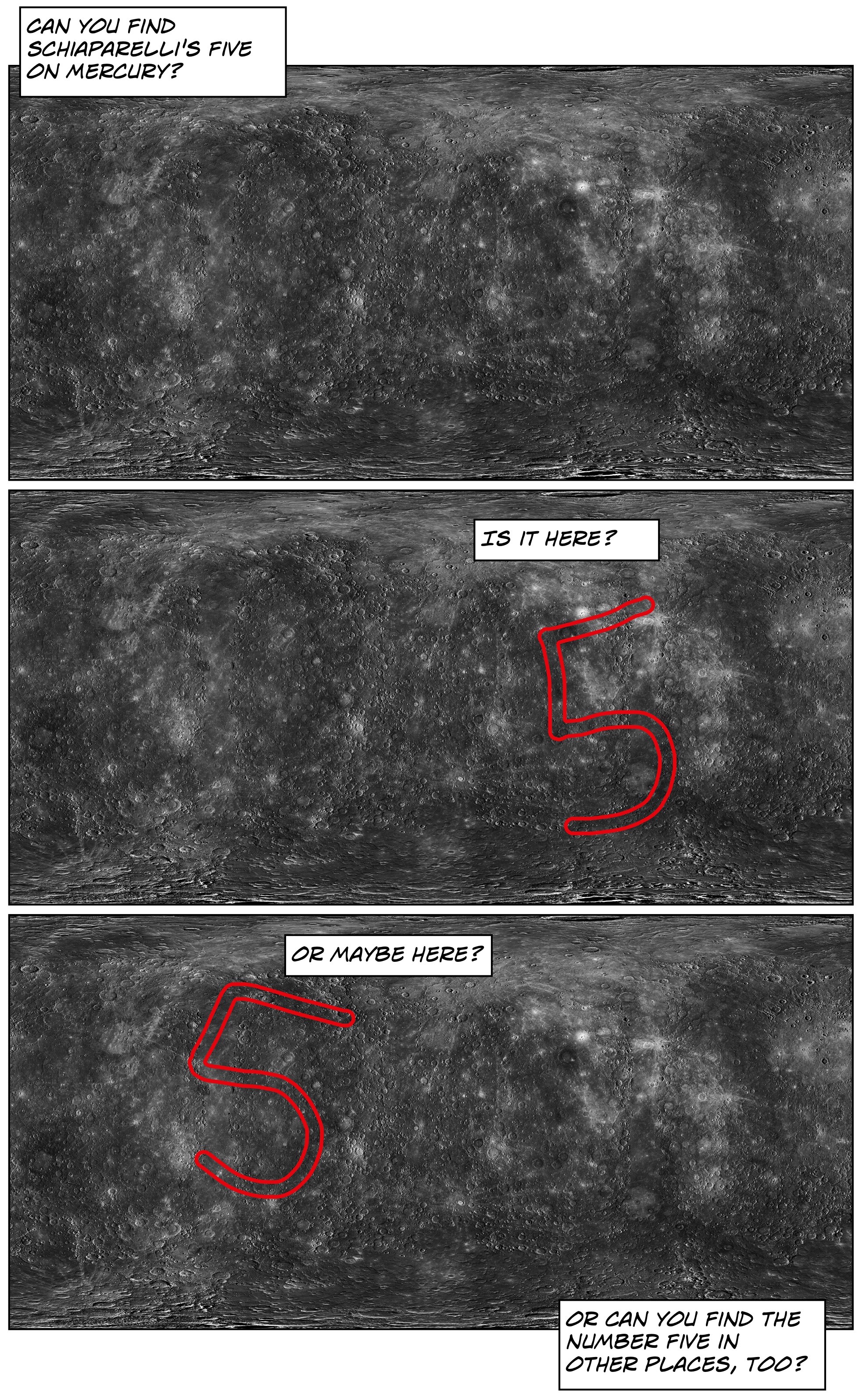
Map of the surface of Mercury, reproduced three times, with outlines showing locations where Giovanni Schiaparelli's figure of five might be.
Original map from NASA, public domain image.

A bit of confirmation bias was probably at work.  After seeing a five on Mercury the first few times he looked, Schiaparelli had an expectation.  He expected to see the five again, and every time he did find a five on Mercury, Schiaparelli assumed it was the same five.  To make matters worse, Schiaparelli also thought he could see clouds on Mercury, so whenever he saw only part of a five, he could easily deceive himself into assuming the rest of the five must be hidden under cloud cover.

As a result, Schiaparelli calculated Mercury’s rotation rate based on faulty observations, and he got a result that triggered a second case of confirmation bias.  Just as the Moon is very close to the Earth, Mercury is very close to the Sun, so it made sense—it fit well with Schiaparelli’s expectations—that Mercury rotation rate would match its orbital period.  It made sense, in Schiaparelli’s mind, for Mercury to be tidally locked to the Sun.

To be fair to Schiaparelli, another astronomer had previously tried to calculate Mercury’s rotation rate and gotten an answer of 24 hours (the same as Earth’s rotation rate).  So while Schiaparelli was wrong, he was, at least, less wrong than the last guy.  And that’s often the way science advances.  Science isn’t always right, but it keeps becoming less and less wrong than it was before.

WANT TO LEARN MORE?

Here’s an article from Astronomy.com about Schiaparelli’s five, and some of the other shapes he thought he saw on Mercury’s surface.

And regarding that point I made at the end, about science being less and less wrong than it was before, here’s a famous article by Isaac Asimov called “The Relativity of Wrong.”  It’s a must read for anyone who has even a passing interest in how science works.

Mercury A to Z: Exosphere

Hello, friends!  Welcome back to this year’s A to Z Challenge.  My theme for this year’s challenge is the planet Mercury, and in today’s post E is for:

EXOSPHERE

When I was preparing for this A to Z series on Mercury, a friend and I were joking that I should do “atmosphere” for the letter A.  The body of the post would simply say: “There isn’t one.”  And that would be the end of it.  But that wouldn’t be 100% true, and it wouldn’t be fair to poor, little Mercury.  Mercury does, in fact, have an atmosphere.  An extremely thin atmosphere, so thin it’s almost nonexistent.  But it is not entirely nonexistent.

Scientists usually refer to Mercury’s atmosphere as an “exosphere” to help distinguish it the thicker, heavier air layer that the word atmosphere traditionally implies.  Mercury’s exosphere is made of a little hydrogen, a little helium… there’s a little oxygen and a little sodium… a little potassium… a little calcium… there’s a little of a lot of different things, which adds up to not very much.

The hydrogen and helium presumably come from the Sun.  As the solar wind washes over the planet, hydrogen and helium atoms get tangled up in Mercury’s magnetic field and end up being incorporated (temporarily) into Mercury’s exosphere.  Some of the helium may also come from the radioactive decay of elements like uranium in Mercury’s crust.  As for the oxygen, sodium, and everything else, that stuff probably outgasses from the planet’s interior.  When Mercury formed, certain gases were trapped inside, and those gases have been very slowly leaking out of the planet ever since.  This outgassing process may help explain why Mercury appears to be shrinking (but we’ll talk about that in a future post).

But any gas you might find in Mercury’s exosphere is only there temporarily.  Mercury’s low gravity, plus the intense heat of the Sun, plus the constant pressure of the solar wind “blowing” on the planet, mean that Mercury’s exosphere is constantly blowing off into space.  Just as quickly as Mercury can gain a few atoms worth of atmosphere, he’ll lose them again.  In fact, as you can see in the totally legit Hubble image below, Mercury has a very faint comet-like tail of atmospheric gases, billowing off into space.

Cartoon image of Mercury, singing "You Take My Breath Away" to the Sun, while Mercury's atmospheric gasses blow off into space as a comet-like tail.

Just kidding.  That’s not really a Hubble image.  The Hubble Space Telescope has never observed Mercury.  Due to Mercury’s proximity to the Sun, trying to image Mercury would run the risk of burning out Hubble’s optics.  Some other space telescope must have taken that picture.

WANT TO LEARN MORE?

Today, I want to recommend a book simply titled Mercury, by William Sheehan.  It’s part of a series of books on the Solar System called Kosmos.  I’ve read a few of these Kosmos books now, and they are all wonderful.  Finding a book about one specific planet can be difficult (unless that planet is Mars), so if there’s a specific planet you want to learn more about, I highly recommend checking out the Kosmos series.

Also, if you want to see a for real picture (a for real for real picture) of Mercury’s comet-like tail, click here.

Mercury A to Z: Density

Hello, friends!  For this year’s A to Z Challenge, my theme is the planet Mercury.  Mercury may not be the most exciting planet in the Solar System, but he’s interesting in his own way, and I think he deserves a little more love and attention than he usually gets.  In today’s post, D is for:

DENSITY

In recent years, astronomers have discovered literally thousands of exoplanets (planets orbiting stars other than our Sun).  Every once in a while, one of these newly discovered exoplanets will be described as “Mercury-like.”  Now what do you think makes a planet “Mercury-like” in the minds of exoplanet hunters?  Are Mercury-like exoplanets small?  No, not necessarily.  Are they very close to their suns?  Again, not necessarily.  The most Mercury-like quality of a Mercury-like exoplanet is its density.  Mercury is an abnormally dense planet, due to the fact that Mercury has an abnormally large core.

Mercury’s core takes up roughly 85% of the planet’s internal volume.  For the sake of comparison, Earth’s core constitutes only 17% of Earth’s total volume.  For this reason, I sometimes like to call Mercury the avocado planet, because much like the seed inside an avocado, the core of Mercury is shockingly large.

The most likely explanation is that Mercury started out as a much larger planet, perhaps even an Earth-sized planet.  But then, in the very early days of the Solar System, young Mercury collided with another planetary body (in case anyone’s wondering, this would have happened long before the collision that created Caloris Basin).  Most of Mercury was destroyed.  Most of the debris from the collision probably fell into the Sun.  All that’s left today is the planet’s original iron core, buried under a relatively thin skin of rocky material.

So modern day Mercury is almost entirely made of iron, an extremely dense metal—which explains why Mercury is such an extremely dense planet.  The second densest planet in the Solar System, after Earth.

Now I have to level with you: I thought this was going to be one of the easier blog posts to write for this A to Z series, because I thought I already knew basically everything I needed to know about this topic.  But apparently there’s been some new research since the last time I read up about Mercury’s density and internal structure.

Decades ago, scientists assumed that Mercury’s core would be solid.  A planet as small as Mercury surely would have lost all his internal heat by now.  However, Mercury does have a magnetic field.  Planetary magnetic fields are usually caused by liquid metal sloshing around in a planet’s interior; ergo, Mercury must have a liquid core after all.  Right?

But apparently a few years ago (and this is the part I only learned about a few days ago), scientists were looking over gravity data from NASA’s MESSENGER Mission and realized that Mercury’s core cannot be entirely liquid.  Mercury’s core must be part liquid, to explain the magnetic field, but also part solid to explain MESSENGER’s gravity measurements.  So scientists now believe Mercury has a solid inner core surrounded by a liquid outer core.

So that’s a new thing that I have learned, and now it is a thing that you have learned, too.

WANT TO LEARN MORE?

I’m going to recommend this article from EarthSky.org, explaining (in layperson’s terms) how scientists determined that Mercury must have this part liquid/part solid core.

And for anyone interested in the original research, here’s a link to the original research paper about Mercury’s liquid/solid core (I haven’t had a chance to read that paper yet, but I’m looking forward to doing so soon).

I also want to mention this article from ScienceNews.org, which briefly discusses one of those Mercury-like exoplanets I was talking about in the beginning of this post.  In fact, the exoplanet K2-229b is so Mercury-like that scientists have nicknamed it “Freddy” (get it?—because of the singer Freddy Mercury!).

Mercury A to Z: Caloris Basin

Hello, friends!  For this year’s A to Z Challenge, we’re exploring the planet Mercury.  In today’s post, C is for:

CALORIS BASIN

It seems like just about every planet has its thing.  Saturn has her rings.  Jupiter has his Great Red Spot.  Mars has both Olympus Mons and Valles Marineris, the largest volcano and the largest canyon, respectively, in the entire Solar System.  And as for Mercury, Mercury has Caloris Basin, an absurdly large crater in Mercury’s northern hemisphere.

So how did Mercury end up with such a big crater?

Based on what science currently knows about the history of the Solar System in general, and the history of Mercury in particular, Caloris Basin most likely formed during an event known as the Late Heavy Bombardment.

About four billion years ago, the Solar System looked a little different than it does today.  The gas giants (Jupiter, Saturn, Uranus, and Neptune) were engaged in these gravitational tug-of-wars with each other, pulling each other into new orbits, swapping places with each other, and generally causing chaos in the outer Solar System—and generally making a mess of the inner Solar System, too.  All those gravitational tug-of-wars in the outer Solar System sent tons and tons and tons of stray asteroids hurtling toward the inner Solar System.  All the inner planets (Mercury, Venus, Earth, and Mars) took a beating.  Earth’s Moon took a beating, too.

A particularly large asteroid must have slammed into Mercury near the end of the Late Heavy Bombardment.  We know this must have been near the end of the Late Heavy Bombardment because Caloris Basin has only a few smaller, younger-looking craters inside it, while the surrounding terrain is thoroughly peppered with older-looking craters.  That impact must have been a truly Earth-shattering Mercury-shattering event, sending ripples and shockwaves all the way around the planet, leaving geological marks that can still be seen to this day.

Caloris Basin was discovered in 1974 by NASA’s Mariner 10 space probe.  At the time of the discovery, Caloris Basin was only half in daylight, so the full size of the crater was unknown.  You may recall from yesterday’s post that Mariner 10 visited Mercury three times, but due to an unfortunate coincidence of orbital mechanics, Caloris Basin was only half in daylight every single time Mariner 10 showed up.  And it was always the same half of Caloris Basin, too.  So the full size of the crater remained uncertain until the 2010’s, when the MESSENGER Mission entered orbit of Mercury and finally imaged the entire crater in full daylight.

Based on Mariner 10’s data, scientists originally guessed that Caloris Basin was 1300 km (810 miles) in diameter, making it larger than Texas.  MESSENGER revealed that its actually 1550 km (960 miles) in diameter, making it even more larger than Texas.

WANT TO LEARN MORE?

Here’s an article from Astronomy.com, going into a little more detail about how Caloris Basin formed and what we currently know about it.

And here’s an article from Wondrium about the Late Heavy Bombardment, how it happened, and how we know about it.

Also, I thought I read somewhere that Caloris Basin was the largest impact basin in the Solar System, and an early draft of this blog post included that detail.  But that’s not true.  Apparently the largest impact basin in the Solar System is Utopia Planitia on Mars.  For anyone interested, here’s a Wikipedia page listing all the largest craters known to exist in the Solar System.

Mercury A to Z: BepiColombo

Hello, friends!  Welcome to the second posting of this year’s A to Z Challenge!  My theme this year is the planet Mercury, and in today’s A to Z post, the letter B is for:

BEPICOLOMBO

Mercury is a pretty lonely planet.  Only two spacecraft have ever come to visit: NASA’s Mariner 10 space probe, which conducted a series of flybys in the 1970’s, and NASA’s MESSENGER Mission, which orbited Mercury for several years in the 2010’s.  But don’t feel too bad.  Soon, Mercury will be welcoming not one but two new guests, thanks to a joint mission by the European and Japanese space agencies.  And that name of that mission?  BepiColombo.

But first, a little history lesson.  Back in the late 1800’s, Italian astronomer Giovanni Schiaparelli determined that Mercury’s rotation rate (the time it takes for Mercury to spin on its axis) equals approximately 88 Earth days, or exactly one Mercurian year.  Unfortunately, Schiaparelli’s calculations were way off (we’ll talk about that more in a future post), and it took another Italian scientist, named Giuseppe “Bepi” Colombo, to fix Schiaparelli’s mistake.

In the 1960’s, thanks to new RADAR observations of Mercury, astronomers discovered that Mercury’s true rotation rate is approximately 59 Earth days, or precisely two-thirds of a Mercurian year.  And I do mean precisely two-thirds of a Mercurian year.  Odd coincidence, right?  Don’t worry.  We’ll talk about that more in future posts, too.  For now, all you need to know is that Giuseppe Colombo was the lead author on a paper that explained how Mercury could have gotten itself into this rather curious predicament.

The history lesson’s not over yet!  In the 1970’s, NASA was planning their first mission to Mercury, a mission known as Mariner 10.  But getting to Mercury isn’t easy.  Mercury is very small, and the Sun is very big.  The orbital mechanics of approaching such a small object in space, so close to such a big object, are really complicated.  NASA scientists thought the best they could do was aim carefully and do one quick flyby of Mercury.  But NASA was wrong, and once again, Giuseppe Colombo stepped in to correct the mistake.

Colombo showed NASA an alternative flight trajectory, involving a never-tried-before gravity assist maneuver near Venus, which would cause Mariner 10 to fly past Mercury, circle around the Sun, then fly past Mercury again… and again!  Thanks to Colombo’s orbital calculations, Mariner 10 was able to do three flybys of Mercury for the price of one.

Fast forward to modern times.  When ESA (the European Space Agency) and JAXA (the Japanese Aerospace eXploration Agency) decided to team up for a Mercury mission, they had no trouble picking a name.  In honor of Colombo’s outstanding contributions to the study and exploration of Mercury, the mission was officially named BepiColombo (one word, no space or hyphen—I’m not sure why it’s like that, but it’s one word).

BepiColombo is already in space, on route to Mercury.  When it arrives in 2025, it will separate into two spacecraft: the Mercury Planetary Orbiter (M.P.O.), built by Europe, and the Mercury Magnetospheric Orbiter (M.M.O.), built by Japan.  Together, these two spacecraft will follow up on some of the lingering mysteries about Mercury (i.e., other stuff that we’ll talk about in future posts).

WANT TO LEARN MORE?

I’m going to recommend this article from Univere Today, entitled “Who was Giuseppe “Bepi” Colombo and Why Does He Have a Spacecraft Named After Him?”

I’m also going to recommend this article from the Planetary Society, entitled “BepiColombo, Studying How Mercury Formed.”

And for those of you who enjoy reading scientific papers for fun, like I do, here is Giuseppe Colombo’s original research paper from 1965, explaining how Mercury’s rotation rate ended up being precisely two-thirds of a Mercurian year.

Mercury A to Z: Amorphous Ice

Hello, friends!  Welcome to my very first post for this year’s A to Z Challenge.  You don’t know what the A to Z Challenge is?  That’s okay.  You can click here if you want to learn more.  My theme for this year’s challenge is the planet Mercury, and in today’s post the letter A is for:

AMORPHOUS ICE

It gets really hot on Mercury.  You probably knew that already.  Mercury is, after all, the planet closest to the Sun.  But it may surprise you to learn that it also gets really cold on Mercury.  Extremely cold.  Like, we’re talking spit-goes-clink levels of cold.

Much like the Moon, Mercury has virtually no atmosphere.  That means there’s no atmospheric convection to transfer heat from the dayside of Mercury to the nightside.  Atmospheres can also act as a sort of blanket to keep a planet’s surface warm during the night.  But again, Mercury has virtually no atmosphere.  No blanket effect.  All the heat Mercury’s surface soaks up during the long Mercurian day is lost during the equally long Mercurian night.  As a result, the nightside of Mercury is one of the absolute coldest places in the entire Solar System.

Now, imagine if there were a place on Mercury where it is always night and never day.  Places like that exist at the bottoms of deep, dark craters clustered around Mercury’s north and south poles.  Shielded by crater rims and tall crater walls, the bottoms of those polar craters are cloaked in eternal darkness, and they are eternally cold.  Anything that happens to fall into one of those craters would freeze solid and could stay frozen for millions or even billions of years.

Back in the 1990’s, scientists began to suspect that those deep, dark craters around Mercury’s poles might be full of water (frozen water, obviously, but still… water).  And then in the 2010’s, NASA’s MESSENGER space probe took a closer look and confirmed it.  There is, in fact, water (in ice form) on Mercury.  Water on Mercury, of all places!

But I remind you again, the bottoms of Mercury’s polar craters are obscenely and stupidly cold.  Too cold for water to freeze the way it freezes on Earth.  On a molecular scale, the ice we find here on Earth has a neat and orderly crystalline structure.  Scientists call our Earthly kind of ice “ice Ih” or “hexagonal ice,” because the water molecules fit together in a hexagon pattern.  But the ice on Mercury is more likely to be what scientists call “amorphous ice.”

Amorphous ice is what happens when water freezes so fast that the water molecules don’t have time to arrange themselves in any sort of crystalline structure.  On a molecular scale, the water molecules are scattered haphazardly about.  No hexagons.  No patterns or shapes.  The ice is structurally shapeless—a.k.a., amorphous.  This doesn’t occur often here on Earth, except in certain astrophysics laboratories, but amorphous ice is extremely common out in space.

Comets and asteroids?  Whatever water they have is, partially or wholly, in the form of amorphous ice.  The surfaces of Europa, Ganymede, and the other icy moons of the outer Solar System?  They may be partially composed of amorphous ice.  And the ice inside those polar craters on Mercury (and similar polar craters on the Moon)?  You can bet on that being amorphous ice, too.

WANT TO LEARN MORE?

Water can freeze in so many different ways, with so many different crystalline and non-crystalline structures.  Here’s a brief video from Sci-Show about all the different kinds of ice scientists currently know about.

I also want to recommend this article from ZME Science, briefly summarizing the history of how water ended up on Mercury, how scientists on Earth first detected it, and how the MESSENGER mission later confirmed it.

Lastly, this is a far more technical source than the other two, but this paper on amorphous ice in the Solar System is the best source I could find stating, explicitly, that the ice on Mercury is probably amorphous ice. 

A to Z Challenge Theme Reveal

Hello, friends!

Do you have a favorite planet?  Each planet of the Solar System is beautiful in its own way, and weird in its own way, and dangerous in its own way.  It’s almost like each planet has its own distinct personality.  When you start learning about the planets, it’s hard to not pick a favorite.  My own favorite is Venus, but that’s not what I want to talk about today.  Today, I’m announcing my theme for this year’s A to Z Challenge, and that theme will be:

THE PLANET MERCURY

For those of you who don’t know, the A to Z Challenge is a month long blogging event.  Throughout the month of April, participants write twenty-six blog posts (starting with A, ending with Z) on a topic of their choice.  In previous years, I’ve used the A to Z Challenge as a platform to talk about scientific terminology, the search for alien life, and humanity’s future as a spacefaring species.  If you want to learn more about the A to Z Challenge, and if you’re interested in signing up yourself, please click here.

Now you may be wondering about the theme I picked this year.  Out of all space/science topics I could cover for an A to Z series, why the heck would I pick Mercury?  Mercury is not Mars, or Saturn, or Pluto.  Mercury is not a super exciting place.  There’s virtually no atmosphere.  There are absolutely no signs of life.  And if you’re thinking about future human habitats in space, Mercury may be the least appealing piece of real estate in the entire Solar System.

Observing Mercury with a telescope is inconvenient, due to Mercury’s proximity to the Sun.  Reaching Mercury with a spacecraft is also inconvenient, again due to the planet’s proximity to the Sun.  And what does all the inconvenience of observing Mercury or traveling to Mercury get you?  A grey rock.  There are a bunch of craters.  It gets really hot during the day, due (yet again) to the proximity of the Sun.  And there’s not a whole lot else worth saying about Mercury, right?

Wrong.  By the end of this year’s A to Z Challenge, I do not expect to change your mind about whatever your favorite planet happens to be.  My favorite planet will still be Venus.  But I do hope you’ll come to appreciate Mercury for what he truly is: a humble grey rock, with a few weird quirks, and a surprisingly big heart (by which I mean a surprisingly big planetary core–for such a small planet, Mercury has an enormous core!).

P.S.: I will be taking the rest of March off from regular blogging.  I’m still picking up the pieces after a recent family emergency, and I’ve decided that whatever free time I do have for blogging should go to preparing for this A to Z series.  So I’ll see you all on April 1st, when “A” will be for “amorphous ice.”

Sciency Words: The Gartner Hype Cycle

Hello, friends!  Welcome back to Sciency Words, a special series here on Planet Pailly where we talk about the definitions and etymologies of science or science related terms.  Today, we’re talking about:

THE GARTNER HYPE CYCLE

In my last blog post, I shared my thoughts about A.I. generated art.  It’s a new technology.  There’s a lot of hype about this new technology right now, and my suspicion is that A.I. art is getting a little more hype than it really deserves.  I feel that way, in part, because of something called the Gartner hype cycle.

Definition of the Gartner hype cycle: The Gartner hype cycle is a curvy line on a graph that purportedly models how the hype for a newly introduced technology changes over time.  First, the hype will go up—way up.  Then the hype will plummet down.  In the final phases of the cycle, hype will go slightly up again, before leveling off.

Etymology of the Gartner hype cycle: The idea that new technologies experience a “hype cycle” was first introduced in 1995 by tech analyst Jackie Fenn.  She worked for a tech consulting firm called Gartner Inc., which continues to use hype cycle charts in presentations about new and emerging technologies.

As Gartner Inc. describes it on their website, the Gartner hype cycle has five distinct phases:

Innovation Trigger: A new technology is introduced.  Hype starts to grow (and grow and grow).

Peak of Inflated Expectations: The hype surrounding this new technology gets blown way out of proportion.  Media reports make it sound like almost all the world’s problems could be solved by this new technology.  Investors on Wall Street start screaming “Buy! Buy! Buy!”

Trough of Disillusionment: The hype bubble bursts.  It becomes clear that this new technology cannot solve all the world’s problems, and those Wall Street people start screaming “Sell! Sell! Sell!” 

Slope of Enlightenment: While the new technology can’t solve all of the world’s problems, it turns out that it can solve some problems.  Interest and investment in the new technology starts to build again, based on more realistic expectations.

Plateau of Productivity: The new technology becomes normalized after finding its proper niche in society.

There are at least three major criticisms of this concept.  First, the word “cycle” is misleading.  It implies that this process is cyclical when it clearly isn’t.  Second, this concept is not good science.  How do you measure something like hype, scientifically speaking?  And third, the Gartner cycle would have you believe that every new technology will eventually find its niche.  There’s no guarantee of that.  Sometimes a new technology simply fails.  It falls into that “trough of disillusionment” and never comes back.

Despite those valid criticisms, I do think the Gartner cycle can be a helpful first approximation of what might (might!) happen with a newly introduced technology.  The cycle may not be good science.  It may not make exact predictions, and it can’t guarantee anything.  But the general idea that the hype for a new technology will go way up, then go way down, and then settle somewhere in the middle… that does seem to happen, more often than not.  There’s enough truthiness to the Gartner cycle that it’s influenced my own thinking about A.I. art, as well as my thinking on topics like cryptocurrency, commercial space flight, self-driving cars, and a bunch of other things.

And the Gartner cycle is something I’m starting to think about in my Sci-Fi writing as well.  What might happen when we invent antigravity technology?  Faster-than-light travel?  Time machines?  Would those technologies experience something like the Gartner hype cycle?  Maybe.  Or maybe not.

Again, there are no guarantees with this one. In my mind, the Gartner cycle is a useful first approximation of what might happen. Nothing more.

WANT TO LEARN MORE?

I first heard about the Gartner cycle in a video by Wendover Productions, which uses drone delivery services as an example of the Gartner hype cycle in action.  Click here to watch.

Sciency Words: Coronium

Hello, friends!  Welcome to Sciency Words, a special series here on Planet Pailly where we take a closer look at the definitions and etymologies of scientific terms.  Today on Sciency Words, we’re talking about the word:

CORONIUM

Here on Sciency Words, we usually talk about scientific terms that are relevant and useful in modern science, but sometimes I like to draw attention to scientific terms that didn’t make it.  I think it can be helpful to learn about how and why words drop out of the scientific lexicon.  So today, we’re going to talk about coronium, a chemical element that we now know does not exist.

Definition of coronium: A chemical element that scientists in the late 19th and early 20th Centuries thought existed based on a mysterious green emission line detected in the Sun’s corona.  At least one very prominent scientist (Dmitri Mendeleev) believed coronium to be an element lighter than hydrogen, with chemical properties similar to helium and argon.

Etymology of coronium: In 1869, American astronomers Charles Augustus Young and William Harkness independently detected a green emission line in the Sun’s corona during a solar eclipse.  In 1887, Professor A. Grünwald proposed the name “coronium” for whatever chemical substance caused that green emission line.  Since this unknown substance was first detected in the Sun’s corona, coronium seemed like an obvious name.

The “discovery” of coronium came right on the heels of the discovery of helium, and the story of these discoveries was eerily similar.  Scientists observe a solar eclipse.  A strange, new emission line appears in Sun’s spectrum, as measured using a spectroscope.  This emission line is (or seems to be) the first evidence of a newly discovered chemical element.

Dmitri Mendeleev was initially skeptical about both helium and coronium, because he couldn’t find places for them in his periodic table of the elements.  Toward the end of his life, however, Mendeleev tried to shoehorn these elements, along with several others, into his theories by adding a “group zero” to the periodic table.  Each group zero element is lighter than the group one element it sits next to—for example, argon is lighter than potassium, neon is lighter than sodium, helium is lighter than lithium… and coronium ended up sitting next to hydrogen, indicating that coronium is an element lighter than hydrogen.

Mendeleev was a smart man, but he was wrong about group zero.  After some reshuffling of the periodic table, most of the group zero elements were moved to group eighteen (a.k.a. “the noble gases”), and in the end, it turned out there really was no place for coronium.  No element lighter than hydrogen exists.

So what caused that anomalous green emission line in the Sun’s spectrum?  Turned out it was iron.  In the 1930’s, German and Swedish astronomers Walter Grotian and Bengt Edlén discovered that a form of super-hot, super-ionized iron gives off an emission line at 530.3 nm—an exact match with the 530.3 nm green emission line found in the solar corona.  Without the power of the Sun (or the power of modern laboratory equipment), iron doesn’t get hot enough or ionized enough to reveal that part of its spectrum.  As a result, scientists in the late 1800’s couldn’t have known what that strange, green emission line was.

Coronium is a Sciency Word of the past, from a time when the spectroscope was a relatively new scientific instrument and the periodic table was still a work in progress.  We no longer need to imagine there’s an exotic chemical element found only in the Sun’s corona, not when super-ionized iron explains that green emission line in the Sun’s spectrum just as well.

WANT TO LEARN MORE?

Here’s an interesting article about Dmitri Mendeleev and his mistakes, including his mistakes about coronium and the “group zero” elements.  For anyone involved in science education, this article makes a compelling case about why teaching the history of science is so important, with an emphasis on showing how scientists don’t always get it right on the first try.

I also want to recommend this book, simply titled The Sun.  It is full of cool and useful space facts that I had never read about before anywhere else (including the false discovery of coronium).  The Sun is part of a series called Kosmos, and I highly, highly, highly recommend this series to anyone who loves space.

And lastly, here’s a link to A. Grünwald’s 1887 paper where he first proposed the name “coronium” for a “hitherto unknown corona-substance.”

Sciency Words: Antitail

Hello, friends!  Welcome to Sciency Words, a special series here on Planet Pailly where we talk about the definitions and etymologies of scientific terms.  In today’s Sciency Words post, we’re talking about the word:

ANTITAIL

Did you see the comet?  Pretty much everyone I know has been asking me that question lately.  Comet C/2022 E3 (ZTF) had a wild ride these last few weeks.  First, she started glowing a lot brighter and a lot greener than expected, leading to some people calling her “the green comet.”  Then, due to some intense solar activity, a gap formed in one of the green comet’s two tails.  Shortly thereafter, almost as if the comet were trying to compensate for the damage to one tail, an apparent third tail became visible to observers here on Earth.  This apparent third tail is what astronomers call an antitail.

Definition of antitail: Comets typically have two tails: a dust tail and an ion tail.  These tails are supposed to point away from the Sun.  They’re caused by the solar wind sweeping gas, dust, and other lightweight material away from the comet and off into space.  An antitail is an apparent third tail pointing toward the Sun.  At least antitails look like they’re pointing toward the Sun, but this is actually an optical illusion.

Etymology of antitail: The prefix “anti-” can mean several things.  In this context, it means “opposite,” because antitails point (or look like they point) in a direction opposite to the direction cometary tails are supposed to point.  Based on my research, I believe this term was first introduced in the late 1950’s, following the appearance of comet Arend-Roland.

Okay, I’m going out on a bit of a limb claiming that the term was introduced in the 1950’s.  I cannot find any sources explicitly stating that, but almost every source I looked at seems to agree that Comet Arend-Roland had the most famous and noteworthy antitail in the history of antitails.  In 1957, Arend-Roland developed a large and protruding “sunward spike.”  In photos (like this one or this one), the comet reminds me a little of a narwhal.

Arend-Roland cannot possibly be the first comet ever observed to have an antitail, but it does seem to be the most spectacular and most widely studied antitail in recorded history.  Crucially, I was unable to find any sources mentioning cometary antitails prior to 1957.  Ergo, I think I’m right that the term was first introduced around that time, in reference to that particular comet.  But I could be wrong, and if anyone knows more about this topic than I do, please do share in the comments below.

Regardless of how much of a first Arend-Roland’s antitail really was to the scientific community at the time, it was not much of a mystery.  Within a matter of months, scientists were able to offer explanations, like this explanation published in Nature:

No extraordinary physical theory appears necessary to account for the growth of the sunward tail […]  The sunward tail must almost certainly have resulted from the concentration of cometary debris over an area in the orbital plane.  Seen at moderate angels to the plane, the material possessed too low a surface brightness to be easily observed, but seen edge-on it presented a concentrated line of considerable intensity.

So several things have to happen in order for us Earth-based observers to see an antitail.  First, a comet needs to shed some debris that’s too big and heavy to be swept off by the solar wind.  This extra debris will accumulate along the comet’s orbital path, rather than billowing off in a direction pointing away from the Sun.  Second, Earth has to be in just the right place at just the right time to see this debris field “edge-on.”  Otherwise, the light reflecting off the debris will be too diffuse for us to see.  And third, this has to happen at a time when the comet’s tails don’t overlap with the debris field (i.e., the debris and the tails have to be pointing in opposite directions, as seen from Earth).  Otherwise, the glow of the tails will obscure the light reflecting off the debris.

Last week, I was lucky enough to see the comet, but I didn’t see her bright green color (she was a hazy grey in my telescope), and I certainly didn’t get a chance to see the antitail.  I’m pretty sure I was a few days too late for that, and besides, there’s too much light pollution where I live to see faint details like that.

Still, I consider it a great joy and privilege that I got to see as much of the comet as I did.  And for all the cool sciency stuff I couldn’t see for myself, I can always turn to my research if I want to learn more.

WANT TO LEARN MORE?

Here’s the 1957 report from Nature that I quoted above, explaining what “must almost certainly” have caused Arend-Roland’s “sunward tail.”

And here’s a more recent article about Arend-Roland, reviewing the comet’s discovery, observation history, and the appearance of his antitail.

Lastly, here’s an article from Live Science about the recent “green comet” and her antitail.