Sciency Words: Coatlicue

Today’s post is part of a special series here on Planet Pailly called Sciency Words.  Each week, we take a closer look at an interesting science or science-related term to help us expand our scientific vocabularies together. Today’s term is:

COATLICUE

You may recall the famous words of Carl Sagan: “We’re made of star stuff.”  Turns out we’re not made of just any old star stuff.  No, a great deal of our stuff came from one star in particular, a giant star named Coatlicue that went supernova about 4.5 billion years ago.

I first saw this name in a recent article from Scientific American called “The New Biography of the Sun,” which in turn referenced a paper from the journal Astronomy & Astrophysics titled “Solar System Genealogy Revealed by Extinct Short-Lived Radionuclides in Meteorites.”

In short, certain radioactive isotopes found in our Solar System can be thought of as our Solar System’s D.N.A.  The authors of that “Solar System Geneaology” paper used some of those isotopes (most notably aluminum-26) to try to reconstruct our Sun’s family tree and give us some idea about what the Sun’s “mother” must have been like.

Coatlicue would have been a giant star, approximately 30 times as massive as our Sun, ensconced within a giant molecular cloud along with other giant star siblings.  This is sort of like what we see today with the stars of the Trapezium inside the Orion Nebula.

About 4.5 billion years ago, Coatlicue went supernova.  The explosion accomplished two things: it seeded the surrounding molecular clouds with heavy elements (like aluminum-26) and, because of the force of the explosion, caused those molecular clouds to compress, triggering new star formation.

I have to confess that I feel like there’s a lot of guesswork and speculation going on here about how, specifically, Coatlicue died and how, specifically, the Sun and its planets were born.  But the general idea that the death of one star triggers the formation of others is consistent with what we already know about star formation, so it makes sense to me that something like this must have happened for our own Solar System.

As for the name Coatlicue (which I believe is pronounced Kwat-LEE-kway), that comes from Aztec mythology.  Coatlicue was the mother of the Sun.  So that makes sense.  In the myth, Coatlicue was also the mother of the stars, which actually sort of matches up with the science too.  That supernova explosion 4.5 billion years ago would have triggered the formation of other stars—perhaps several hundred of them—in addition to our own Sun.

I didn’t see this in either Scientific American or that “Solar System Genealogy” paper, but I’d like to believe Coatlicue might not have been totally destroyed in that supernova.  Perhaps some remnant is still out there, living on as a neutron star or a black hole or something.  If so, I doubt we’ll ever find it, but if I know anything about mothers, I’m sure our Sun still hears from Coatlicue every now and then.

Sciency Words: Thiea

Today’s post is part of a special series here on Planet Pailly called Sciency Words.  Each week, we take a closer look at an interesting science or science-related term to help us expand our scientific vocabularies together. Today’s term is:

THEIA

When I wrote about the Nice model, I said it does a nice job (pun intended!) of explaining how the planets of the Outer Solar System started out, and how they ended up where they are today.  But what about the Inner Solar System?  Well, it turns out we may have started with a few more planets than we have today, and one of those hypothetical early planets has been named Theia.

Technically speaking, Theia wouldn’t have been a planet (not according to the I.A.U. definition), but it was definitely planet-sized, perhaps as large as modern day Mars.  But Theia had to share its orbit with another planet that wasn’t technically a planet (yet): Earth.

Theia got stuck near one of Earth’s Lagrange points, about 60 degrees ahead of Earth in Earth’s almost circular orbital path.  There’s some weird gravitational voodoo going on at these Lagrange points, and so this arrangement of Earth and Theia could theortically have remained stable long term.

Except Jupiter and/or Venus disrupted the gravitational balance, pulling Theia a little this way, a little that way, nudging Theia away Earth’s Lagrange point and closer to Earth itself, until one day….

I would call this the worst disaster in Earth’s history, except this collision was sort of the moment when Earth (as we know it) really began.  I gather there’s still a lot of disagreement about the details, like whether this was a head-on collision or more of a glancing blow, but the two really important things to know are:

  • Theia knocked a large amount of Earth debris into space. That debris eventually coalesced to form our Moon.
  • Most of Theia is probably still here.Theia has become part of Earth, and the bulk of Theia may have would up becoming Earth’s core.

This idea that early Earth suffered a cataclysmic collision with another planetary body has been credited to a lot of different people, but it first appeared in the scientific literature in this paper from 1975.  The name Theia wasn’t introduced until much later, in this paper from 2000.

In Greek mythology, Theia was the Titaness who gave birth to the Moon.  That checks out. The name definitely seems appropriate.  In the myth, Theia also gave birth to the Sun.  That part doesn’t match up with the science so well.

But not to worry!  In next week’s episode of Sciency Words, we’ll meet the Sun’s real mother.

Sciency Words: Degeneracies

Today’s post is part of a special series here on Planet Pailly called Sciency Words.  Each week, we take a closer look at an interesting science or science-related term to help us expand our scientific vocabularies together. Today’s term is:

DEGENERACIES

Okay, I have to be honest with you: I really don’t understand what this term means.  It’s a statistics thing, and it gets really mathy.  But since I came across this term in a paper about the TRAPPIST-1 planets, I felt I should try to get some sense of what a degeneracy is.  What I learned, at least in relation to planets, was interesting enough that I thought it was worth sharing with you.

Imagine we’re playing a game of “Guess Who?”  You know my person has red hair, but you still don’t know my person’s age or gender, you don’t know if my person is wearing glasses, or if my person has freckles.  That one datapoint—my person has red hair—eliminates a lot of possibilities from the board, but there are still plenty of possibilities left over.

Those left over possibilities can be refered to as degeneracies (if I’m understanding the proper usage of this term).  In that paper on the TRAPPIST-1 planets, it says: “The derivation of a planetary composition from only its mass and radius is a notoriously difficult exercise because of the many degeneracies that exist.”

In other words, if you’re playing “Guess Who?” with planets, knowing a planet’s mass and volume (and thus being able to calculate its density) still leaves you with a whole lot you don’t know about that planet.

This reminds me a lot of the Earth Similarity Index and the problems with using that system to identify Earth-like planets. Venus, for example, scores rather highly on the E.S.I. because its mass and volume are so similar to Earth’s, but Venus is not at all Earth-like in the sense that most people mean when they talk about Earth-like planets.

I’d say I plan to study this concept more, but I think I’m done for now.  I tried to read this paper from 2010 which seems to have introduced the subject of degeneracies to planetary science and warned that they’d be a real problem in the study of exoplanets.  But after attempting to slog my way through that paper, I think I’ve had enough mathy stuff for a while.

Sciency Words: Nice Model

Today’s post is part of a special series here on Planet Pailly called Sciency Words.  Each week, we take a closer look at an interesting science or science-related term to help us expand our scientific vocabularies together.  Today’s term is:

NICE MODEL

I recently assembled Lego’s Saturn V rocket set, and I have to say it’s a really nice model.  It even has these little orange pieces to represent the floaty things for when the Apollo capsule returns to Earth and splashes down in the ocean. That, I thought, was a really nice touch!

But as nice as that Lego model is, that’s not the model we’re talking about today.  Nope, today we’re talking about the Nice model, with a capital N.

In May of 2005, three papers were published in the journal Nature which did a nice job explaining some of the big mysteries of our Solar System.

  • First (in order of page number) was a paper on the anomalous orbital eccentricities and inclinations of the four gas giant planets.
  • Next came a paper on the Trojan asteroids which hang out around Jupiter’s Lagrange points, 60º ahead and 60º behind Jupiter in its orbital path.
  • And lastly, there was a paper on the Late Heavy Bombardment, a period of time when the Moon (and also the four inner planets) got pummeled with asteroids.

All three of these papers share a common idea: that the four gas giants of our Solar System must have started out much closer together, with a broad disk of rocky and icy debris beyond them, like a super-sized Kuiper belt.  Then, approximately 700 million years after their initial formation, three of those gas giants (Saturn, Uranus, and Neptune) started drifting farther and farther away from the Sun and away from each other.

Jupiter seems to have drifted slightly closer to the Sun, but stopped short of entering and demolishing the inner Solar System thanks to a last minute gravitational interaction with Saturn (thanks, Saturn!).

As the gas giants spread out, they threw that super Kuiper belt into chaos.  Some of that rocky and icy debris was hurled toward the inner planets, causing the Late Heavy Bombardment.  Some of the debris got stuck around Jupiter’s Lagrange points, becoming the Trojan asteroids.  And with so many complicated gravitational interactions happening at once, it’s no wonder the four gas giants ended up with some anomalies in their orbital paths.

This one idea—that the gas giants drifted apart after they formed—does a pretty nice job explaining three of the biggest mysteries about our Solar System.  But sadly, that’s not why it’s called the Nice model.  The name actually isn’t pronounced like the English word “nice” but rather like the French city of Nice (which rhymes with geese or fleece).  That’s because the model was originally formulated at an observatory in Nice, France.

Unfortunately, I didn’t find that out until I’d already sprinkled a bunch of nice puns into this post, and I don’t feel like taking them out.

Sciency Words: Voorwerp

Today’s post is part of a special series here on Planet Pailly called Sciency Words.  Each week, we take a closer look at an interesting science or science-related term to help us expand our scientific vocabularies together. Today’s term is:

VOORWERP

In 2007, Dutch schoolteacher and citizen scientist Hanny van Arkel was participating in the Galaxy Zoo project.  She was sorting through photos of galaxies (there are so many galaxies out there, scientists need help sorting through them all) when she came upon the image of a weird, green, blob-like object.

This mysterious object came to be known as Hanny’s Voorwerp, because voorwerp is the Dutch word for object.

Image courtesy of Wikipedia.

It’s hypothesized that the spiral galaxy in the upper part of the image had a quasar flare up at some point.  The resulting super accelerated jets of radiation must have hit a giant dust cloud, which we now see glowing green.

The quasar has since stopped, or at least calmed down for now, but that distinctive green glow can persist for tens of thousands of years. The color is almost certainly caused by ionized oxygen atoms.

Hanny’s Voorwerp is enormous, roughly the same size as our own Milky Way Galaxy.  We now know of several other glowing green blobs hanging around other suspected former quasers.  This paper identifies nineteen of them, and this collage from Wikipedia shows eight.

Image courtesy of Wikipedia.

These are commonly known as voorwerpjes. I have to admit I don’t know anything about Dutch (my linguistic education focused on Latin and Greek), but according to Wiktionary.org the j-part creates a diminutive form.  So Hanny’s Voorwerp is the big “object” and the others are like cute, little “objectlings.”  Well, little on the astronomical scale, at least.

Future research on Hanny’s Voorwerp and those voorwerpjes may tell us more about how quasar activity fluctuates over time. Also, it seems that getting zapped by a quasar may have triggered star formation inside Hanny’s Voorwerp. So we may be witnessing the very, very earliest beginnings of a brand new galaxy.

Sciency Words: Ultima Thule

Today’s post is part of a special series here on Planet Pailly called Sciency Words.  Each week, we take a closer look at an interesting science or science-related term to help us expand our scientific vocabularies together. Today’s term is:

ULTIMA THULE

It just so happens that the New Horizons space probe, which flew by Pluto in 2015, will pass near another Kuiper Belt Object at the start of 2019—on New Year’s Day, in fact!  And that Kuiper Belt Object is called Ultima Thule (pronounced thoo-lee).

I first heard this name on a podcast called Are We There Yet? (click here, it’s about 20 minutes long), and I was initially confused.  I had thought New Horizons was heading toward an object named MU69; what the heck in an Ultima Thule?  Turns out they’re one in the same.  “(486958) 2014 MU69” is the official name approved by our old friends, the International Astronomy Union (I.A.U.), but NASA recently held a contest to see if the public could come up with something better.

The New Horizons mission team selected “Ultima Thule” as the winner, making it the official unofficial name, if that makes sense. And it’s a good name, a name with a long history going back to medieval times.  Thule was the name for a mythical island that was said to be as far north as you could possibly go, somewhere right at the edge of the world as Mankind knew it.  So Ultima Thule was an even more mythical land somewhere beyond that, beyond the limits of the known world!

The metaphor, I think, is that Pluto is Thule: the most distant planet (sort of) in the Solar System, and now we’re going to a place even farther than that.  Ultima Thule will be the most distant object ever visited by one of our space probes, and it will stretch the boundaries of human knowledge.  So yeah, the name seems appropriate.

But it’s interesting to me that NASA and the New Horizons mission seem to have picked this name without consulting with the I.A.U. first. They’ve done this sort of thing before, assigning a whole bunch of names to surface features on Pluto, and putting those names into official, scientific documents without asking for the I.A.U.’s permission first.  This reportedly annoyed the I.A.U.  And some of the scientists from New Horizons are still fighting to get Pluto’s planet status back, which I’m sure also annoys the I.A.U.

According to this press release from NASA, the New Horizons mission will submit an official naming proposal to the I.A.U. after the New Year’s Day flyby, once they know exactly what it is they’re naming. I’m guessing the I.A.U. will accept Ultima Thule, but if there does end up being a bit of a spat over this between the I.A.U. and New Horizons team, it wouldn’t surprise me.

Correction: I spent much of New Year’s Eve watching NASA TV, and everyone there pronounced the name as Ultima Too-lee rather than Thoo-lee. So I guess that’s how you say it.

Sciency Words: Steve

Today’s post is part of a special series here on Planet Pailly called Sciency Words.  Each week, we take a closer look at an interesting science or science-related term to help us expand our scientific vocabularies together. Today’s term is:

STEVE

In 2014, photographer, citizen scientist, and weather enthusiast Chris Ratzlaff was out looking for the aurora borealis when he saw something weird in the sky.  Something that looked like an aurora but could not possibly be an aurora.

For one thing, it was in the wrong part of the sky.  It was too far south, well outside the auroral oval, the region encircling the pole where, on any given night, aurorae are predicted to occur.

And for another thing, this mysterious something was the wrong color.  It was purple. Now I was a bit confused about this part at first, because I thought purple was one of the normal colors in an aurora (along with green).  But aurora purple is more of a reddish or magenta-ish purple, whereas this new phenomenon was a true purple.  A purplish purple, so to speak.

According to this interview with Canadian Geographic, Chris shared pictures of the whatever-it-was on a Facebook group called Alberta Aurora Chasers.  Other members of the group then went out and got more photos.  Hundreds of photos.  And time-lapse sequences.

But still, nobody knew what this purple thing was.  An early guess that it was something called a proton arc got shot down by an expert, at which point Chris wrote “[…] until we know what it is, let’s call it Steve.”  This was a reference to the DreamWorks Animated film Over the Hedge.

In the film, a group of animals are confused and alarmed by the appearance of a neatly-trimmed hedge.  One of the animals says, “I would be a lot less afraid of it if I just knew what it was called,” to which another animal replies, “Let’s call it Steve!”


This bit about being less afraid of a thing simply because you know its name is, in my view, a profoundly true statement about the power of language.  But I digress.

According to this research paper from Science Advances, we now know, thanks to all those photos and time lapses from the ground, combined with satellite observations from orbit, what “Steve” is.  Or at least we know that it’s associated with another phenomenon called an S.A.I.D. (SubAuroral Ion Drift). Thanks to Steve, we now have a new way to observe and study S.A.I.D.s and learn more about the interaction between the solar wind and Earth’s magnetic field.

As such, Steve has been assigned a more proper-sounding scientific name: Strong Thermal Emission Velocity Enhancement (or S.T.E.V.E. for short).

Sciency Words: Encephalization

Today’s post is part of a special series here on Planet Pailly called Sciency Words.  Each week, we take a closer look at an interesting science or science-related term to help us expand our scientific vocabularies together. Today’s term is:

ENCEPHALIZATION

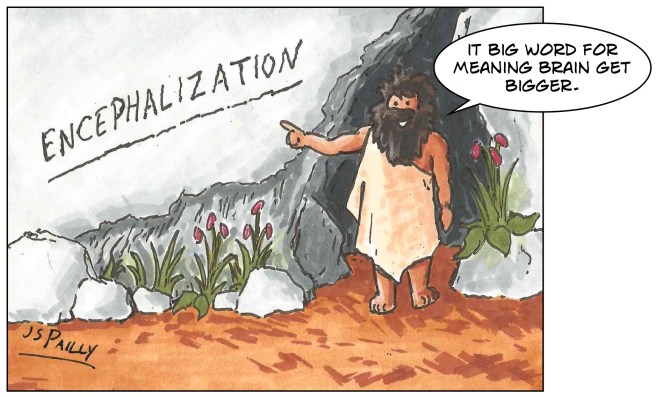
I’m going to let my friend Og the Caveman handle the definition of this term.  Og?

Thanks, Og!

The process of encephalization was rather important to humans of Og’s time.  The term refers specifically to the gradual, somewhat clumsy evolutionary process whereby an organism’s brain becomes larger over time.  The word itself derives from the Greek word for brain, which in Greek appears to be a compound word (en+ kephale) meaning “in the head.”

My first encounter with this term was in a recent issue of Scientific American, in an article about the social behavior of whales and dolphins.  According to the article, brain size can be correlated to social behavior.  Animals that have evolved larger brains (relative to overall body mass) tend to have more complex social interactions with each other and also tend to live in larger social groups.  This seems to be true for both primate and cetacean species.

Now it seems pretty clear to me that the word encephalization is intended only to describe the gradual process of brains growing larger over time, over the course of many, many generations of evolution.  It would be totally inappropriate, therefore, to use the term as part of the origin story of some brainiac super villain… to write about an “encephalization machine” that went haywire during a top secret government experiment.

Nope.  It would be woefully inappropriate to use the word in that way.

P.S.: Though if some hack of a Sci-Fi writer were to do that, don’t be surprised if the encephalized brainiac super villain teams up with that Mars rover NASA reprogrammed for science autonomy.

Sciency Words: Dinosaur

Today’s post is part of a special series here on Planet Pailly called Sciency Words.  Each week, we take a closer look at an interesting science or science-related term to help us expand our scientific vocabularies together. Today’s term is:

DINOSAUR

I did a Sciency Words post on the word dinosaur before, when I participated in last year’s A to Z Challenge, but I never felt satisfied with that post.  For one thing, I missed a golden opportunity to tell you one of the coolest sciency things I’ve learned: dinosaurs are not extinct.

Or rather, to be more technical about it, dinosaurs are or are not extinct depending on how you define the word dinosaur.  You see we have two different systems for classifying life: the traditional Linnaean system and an alternative system called cladistics.

In 1735, Swedish botanist Carl Linnaeus published his book Systema Naturae, introducing the world to his system of binomial nomenclature.  All of a sudden, we humans became Homo sapiens, our cats became Felis catus, and so forth.  But under Linnaeus’s system, plants and animals (and also minerals) had to be classified purely according to their physical characteristics, not their evolutionary heritage.  Darwin’s On the Origin of Species wouldn’t be published for another 124 years.

Then in the 1950’s, German entomologist Willi Hennig introduced a new and improved system which he called phylogenetic systematics, but which has since been renamed cladistics.  A “clade,” in cladistics, is a group of animals that share a common ancestor, and if one animal is part of any given clade, then all of that animal’s descendents are part of that clade too, according to Hennig’s system.

Both of these systems are still in use today.  As this article from Ask a Biologist explains, “[Claudistics] is useful for understanding the relationships between animals, while the Linnaean system is more useful for understanding how animals live.”

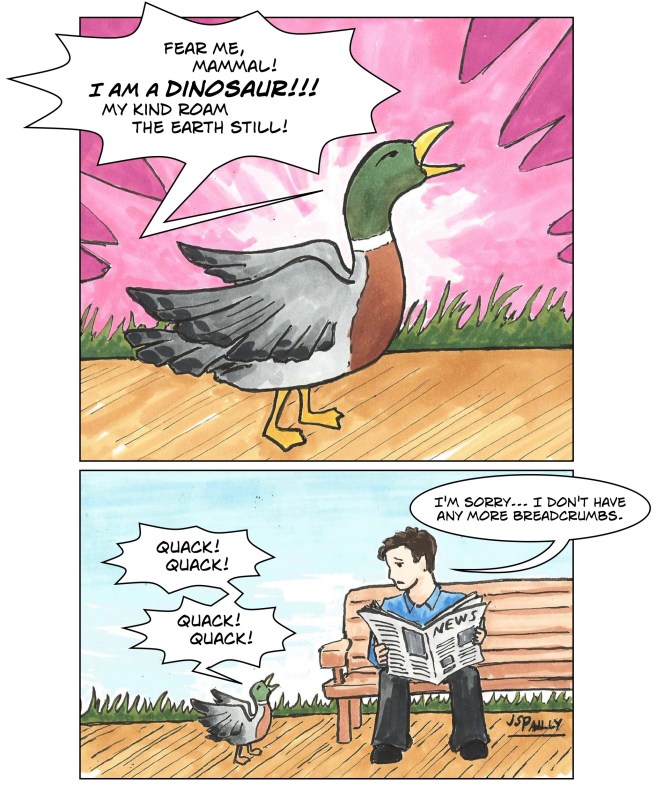
So because birds evolved from dinosaurs, birds are dinosaurs, claudistically speaking.  Birds are like a subcategory of dinosaur.  And thus the dinosaurs are still here, strutting and flapping about on this planet.

Sciency Words: Clean Meat

Today’s post is part of a special series here on Planet Pailly called Sciency Words.  Each week, we take a closer look at an interesting science or science-related term to help us expand our scientific vocabularies together. Today’s term is:

CLEAN MEAT

There’s a newspaper clipping that’s been circulating around the Internet for a while.  It says:

To all you hunters who kill animals for food, shame on you; you ought to go to the store and buy the meat that’s made there, where no animals were harmed.

This is a stupid quote, purportedly made by a very stupid person (though I’m of the opinion that this was always meant as a joke, because nobody could be that stupid, could they?).  But maybe at some point in the future, thanks to advancements in cloning technology, we really will be able to make meat without harming animals.

Researchers are already working on the idea.  They call it “clean meat.”  What’s clean about it?  Well, because it’s grown from animal cells in controlled, laboratory-like conditions, clean meat is far less likely to pick up bacterial contaminants. Also large-scale production of clean meat would have less of an environmental impact than traditional animal farming, making it cleaner for the environment.

Personally, I’d be happy to eat clean meat.  I’d feel a lot cleaner, morally speaking, if I knew no animals had to suffer to make my delicious cheeseburger.  But there seems to be a lot of concern among the scientific community about whether or not the general public would be willing to eat this stuff.  According to this brief article from International Social Science Research, the key will be making sure the public is well educated about clean meat, especially the health benefits, before the product hits the market.

P.S.: Special thanks to Patrick Walts for cluing me in about this in response to one of my dining on Mars posts.  If clean meat works out here on Earth, it will certainly make it a lot easier to feed a growing colony on Mars, or on any other world for that matter.