Sciency Words: The Torino Scale

Sciency Words: (proper noun) a special series here on Planet Pailly focusing on the definitions and etymologies of science or science-related terms.  Today’s Sciency Word is:

THE TORINO SCALE

Are you worried about an asteroid or comet smashing into Earth and annihilating human civilization?  Well, you should be worried about that a little bit.  But only a little bit.  Let me tell you about the Torino Scale, and while that won’t put all your fears to rest, it may help put things in perspective.

In the late 1990’s, M.I.T. Professor Richard Binzel came up with a system which he initially called the Near Earth Object Hazard Index.  In 1999, Binzel presented his system to a conference on Near Earth Objects (N.E.O.s) in Torino, Italy.

People at that conference loved Binzel’s idea and voted that the system should be adopted by the scientific community at large. They also voted to rename Binzel’s system the Torino Scale.

The Torino Scale asks two questions about any given N.E.O.: how likely is it to hit us, and how much destructive energy would be released if it did?  Taking those two factors into consideration, the Torino Scale then produces a score between zero and ten.  Zero means we have nothing to worry about.  Ten means “WE’RE ALL GONNA DIE!!!  AAAHHHHHH!!!” as the experts would say.

According to Wikipedia, the comet that caused the Tunguska Event would have probably scored an eight, and the asteroid that caused the K-T Event (the event widely believed to have killed off the dinosaurs) would have scored a ten.  Wikipedia also tells me that the 2013 Chelyabinsk meteor would have scored a zero, because while that particular N.E.O. was definitely on a collision course with Earth, it’s destructive energy was relatively low (I wonder if the residents of Chelyabinsk, Russia, agree with that assessment).

As of this writing, there are no known N.E.O.s that score higher than zero on the Torino Scale, as least not according to this website from NASA’s Jet Propulsion Laboratory.  It is possible for an N.E.O.’s threat level to change as we learn more about it.  As explained in this article from NASA:

The change will result from improved measurements of the object’s orbit showing, most likely in all cases, that the object will indeed miss the Earth. Thus, the most likely outcome for a newly discovered object is that it will ultimately be re-assigned to category zero.

Sooner or later, another eight, nine, or ten on the Torino Scale will come along.  Fives, sixes, and sevens could also be bad news for us.  But for now, at least within the next one hundred years, it sounds like we probably don’t have too much to worry about.

Probably.
Sciency Words: The Rio Scale

Sciency Words: (proper noun) a special series here on Planet Pailly focusing on the definitions and etymologies of science or science-related terms.  Today’s Sciency Word is:

THE RIO SCALE

The Rio Scale is a classification system used by SETI scientists.  Let’s say someone’s detected possible evidence of an alien intelligence.  How significant is this discovery?  How seriously should we take that news?  The Rio Scale is a tool to help answer those questions.

The Rio Scale was created in the year 2000 at the International Astronomical Congress, which was held that year in Rio de Janerio. Mathematically speaking, the Rio Scale is expressed as:

(Q1 + Q2 + Q3) * ∂

You have to look through a chart in order to plug numbers into those variables.  I’m not going to reproduce that whole chart here, but if you’re interested here’s a Rio Scale calculator where you can learn more.

The quick version is that Q1 is the “what” of what we’ve discovered.  Q2 represents how we discovered it, and Q3 represents how far away from Earth it is.  So as an example, let’s say aliens are transmitting a message straight at Earth.  Let’s say the message was detected by a radio telescope and confirmed by subsequent SETI observations.  And let’s say the message is coming from Proxima Centauri, the star nearest to our own Sun.  This scenario would score very well on the Rio Scale.

As another example, let’s say we find some anomalous infrared radiation, the possible heat signature of an alien megastructure. Let’s say this was found in archival data from the 1970’s.  And let’s say this anomalous radiation came from the Triangulum Galaxy. This scenario would score rather poorly on the Rio Scale.

Lastly, before I forget, let’s talk about ∂.  That variable is a credibility factor. If information about a possible extraterrestrial signal is presented in a peer-reviewed scientific journal, ∂ will be a fairly high number.  If it’s just a press release, ∂ will be lower.  And if the information is coming from some weirdo on the Internet, ∂ equals zero.

Given the chance, I’m sure SETI scientists would like to follow up on every possible detection of extraterrestrial intelligence.  But SETI research does not have infinite resources.

In my opinion, the Rio Scale doesn’t sound like the most scientifically objective system; however, I imagine it does help when comparing and contrasting different possible discoveries.  That way, given the limited resources available to them, SETI scientists can better judge which detections are worth further investigation and which can probably be ignored.

Sciency Words: Euphotic Zones

Sciency Words: (proper noun) a special series here on Planet Pailly focusing on the definitions and etymologies of science or science-related terms.  Today’s Sciency Word is:

EUPHOTIC ZONES

Based on what Google ngrams has to tell me, it looks like “euphotic” and “euphotic zone” entered the English lexicon right at the start of the 20th Century, then really caught on circa 1940.

The word euphotic is a combination of Greek words and means something like “good lighting” or “well lit.”  In the field of marine biology, the euphotic zone refers to the topmost layer of the ocean, or any body of water, where there’s still enough sunlight for photosynthesis to occur.

My first encounter with this term was in this paper by astrophysicists Carl Sagan and Edwin Salpeter.  Sagan and Salpeter sort of co-opted this term from marine biologists and applied it to the layer of Jupiter’s atmosphere where—hypothetically speaking—Jupiterian life might exist.

I don’t see any reason why the term could not also by used for other planets as well.  There’s a euphotic zone just above the cloud tops of Venus.  The same could be said about Saturn or Uranus.  Or maybe if the ice is thin enough, we may find euphotic zones right beneath the surfaces of Europa or Enceladus.

Of course just because a planet has a euphotic zone, that doesn’t mean photosynthetic organisms are living there.  And also there are plenty of ecosystems here on Earth that do not depend on photosynthesis and that don’t exist anywhere near a euphotic zone.

Still, I’m very glad to have picked up this term.  The concept of euphotic zones can be very helpful in any discussion of where alien life may or may not be hiding.

Sciency Words: Sinkers, Floaters, and Hunters

Sciency Words: (proper noun) a special series here on Planet Pailly focusing on the definitions and etymologies of science or science-related terms.  Today’s Sciency Word is:

SINKERS, FLOATERS, and HUNTERS

In the 1970’s, Carl Sagan and fellow astrophysicist Edwin Salpeter were curious about the orangey-red coloration seen on certain parts of Jupiter.  That sort of orangey-red color is frequently associated with organic chemistry (see my post on tholin).

So in this 1976 technical report for NASA, Sagan and Salpeter hypothesize that we really are seeing organic compounds in Jupiter’s atmosphere.  They then go on to imagine what kind of life might develop on a planet like Jupiter.  As a frame of reference, they start by describing one specific example of life here on Earth:

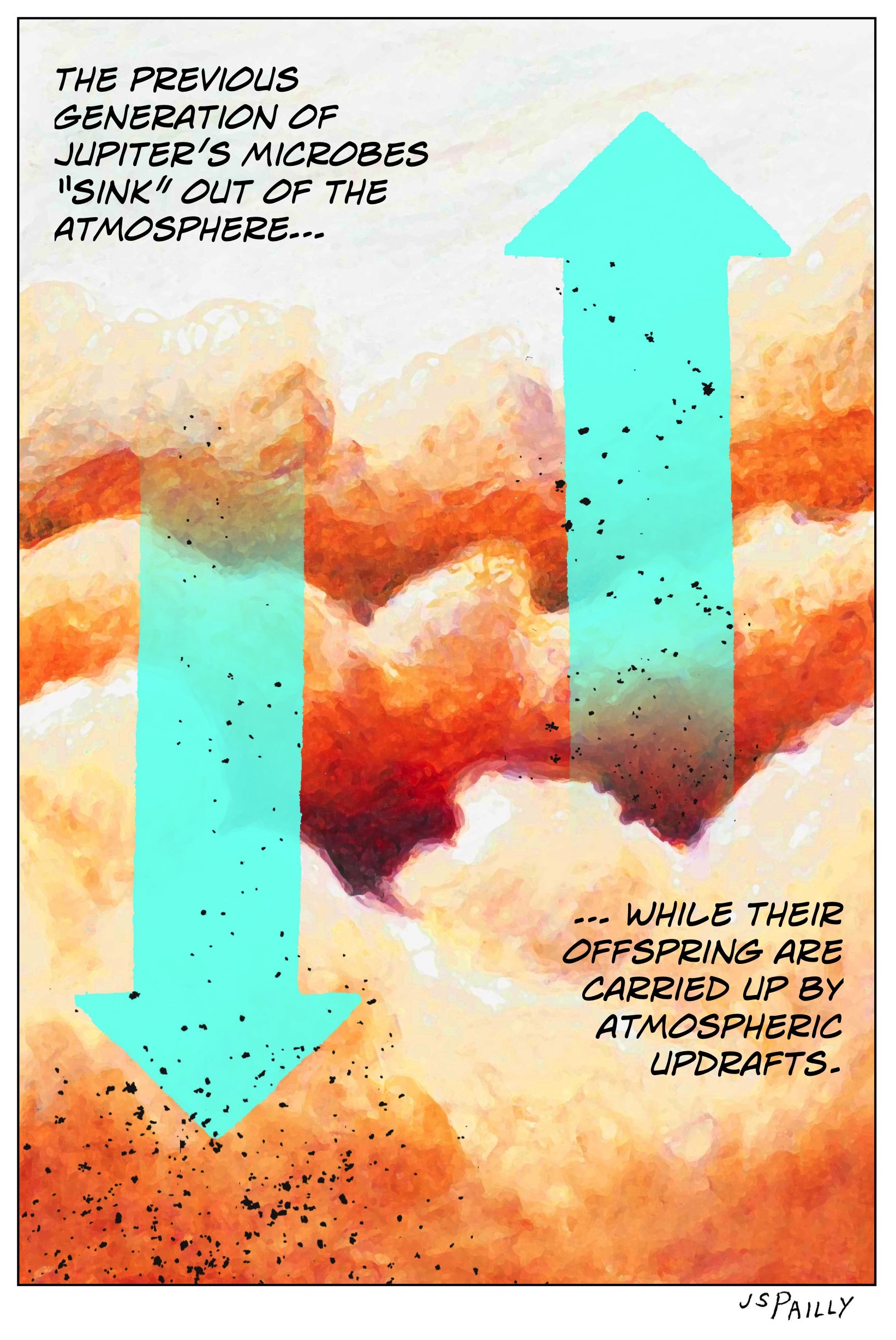
The best analogy seems to be the surface of the sea.  Oceanic phytoplankton inhabit a euphotic zone near the ocean surface where photosynthesis is possible.  They are slightly denser than seawater and passively sink out of the euphotic zone and die.  But such organisms reproduce as they sink, return some daughter cells to the euphotic zone through turbulent mixing, and in this way maintain a steady state population.

So if microorganisms exist on Jupiter, perhaps they follow a similar lifecycle.

Sagan and Salpeter name these hypothetical microorganisms “sinkers,” since sinking is pretty much the defining characteristic of their lifecycles.  But if these sinkers really do exist, then Jupiter may be able to support other, more complex forms of life as well.

Sagan and Salpeter go on to describe “floaters.” Floaters would be giant organisms, perhaps several kilometers in radius.  In order to remain buoyant, they’d have to have very thin skin and be filled with a lifting gas like hydrogen.  Floaters would drift aimlessly through the skies of Jupiter, feeding on the rising and falling swarms of sinkers.

And then there would be “hunters,” as Sagan and Salpeter call them, though that term may be misleading.  Hunters would be able to maneuver deliberately through the air, “hunting” for other organisms.  But these hunters would not eat their prey, at least not in the way we understand eating.  Instead, through a process called “coalescence,” the hunter and the hunted would merge together as one giant super-organism.

Personally, I think Sagan and Salpeter let their imaginations run a little too wild in this paper.  Could life exist on Jupiter?  Sure.  The universe is full of possibilities.  Can we predict with any specificity what life on Jupiter would be like?  I doubt it.

Still, the Jovian ecosystem that Sagan and Salpeter described seems plausible enough.  For the purposes of science fiction, it deserves some attention, and it inspired the short story I posted on Monday.  However, if you haven’t read that story yet, I have to confess (spoiler warning): it turns out the planet in that story is not Jupiter.

Sciency Words: Ice

Sciency Words: (proper noun) a special series here on Planet Pailly focusing on the definitions and etymologies of science or science-related terms.  Today’s Sciency Word is:

ICE

I have a friend who teases me whenever I use the word ice. This is because, depending on what we’re talking about, I can’t just say “ice.”  As soon as the conversation turns to space stuff (as it often does when I’m around, for some reason), I feel the need to say “water ice.” I feel the need—no, the compulsion to specify that I mean the frozen form of water, as opposed to the frozen form of something else.

In more normal, down-to-earth sorts of conversation, I don’t feel that same compulsion.  Water ice is the only kind of ice we’re likely to encounter here on Earth. On rare occasions, if you’re at a science fair, or maybe a Halloween party, you might encounter carbon dioxide ice (a.k.a. dry ice).  But that’s a very rare special case.

However, as soon as we start talking about other planets and moons, or comets and asteroids, the word ice takes on a much broader meaning. In these more cosmic conversations, you really do need to be specific about which ice you’re talking about. To quote from a recent issue of The Planetary Report:

In the strictest definition, ice is the solid form of water.  However, planetary astronomers often use “ice” to refer to the solid form of any condensable molecule.

Beyond Earth, and especially in the outer Solar System, we find all sorts of crazy ices, like ammonia ice, methane ice, or nitrogen ice.  Along with the water ice and CO2 ice we Earthlings are more familiar with, these ices make up the hard crusts of many planetary bodies, like Titan or Pluto.

We also find ice crystals (of various types) forming in the clouds of planets like Uranus and Neptune.  In fact, Uranus and Neptune are often called “ice giants” in large part because of all those weird ices found in their atmospheres.

Starting next week, I’m planning to take a much closer look at those ice giant planets.  I expect my research to turn up plenty of questions, but very few answers.  Uranus and Neptune are, at this point, the least well explored planets in the Solar System.

So stay tuned!

P.S.: I want to start referring to all forms of igneous rock as “magma ice.”  After all, what is igneous rock but frozen magma?  I can’t think of any good reason why the term “magma ice” shouldn’t apply.

Sciency Words: Eustress vs. Distress

Sciency Words: (proper noun) a special series here on Planet Pailly focusing on the definitions and etymologies of science or science-related terms.  Today’s Sciency Word is:

EUSTRESS vs. DISTRESS

So I’ve been dealing with more stress than usual this past week, but maybe that’s not such a bad thing.  Like cholesterol, there can be good stress and bad stress.

When I started researching this topic, I was surprised to learn that the whole concept of stress, in the psychological sense of the word, is a relatively modern development.  According to the American Institute of Stress, Hungarian-American endocrinologist Hans Selye gets credit for coining the term in 1936.

Selye defined stress as “the non-specific response of the body to any demand for change.”  Selye seems to have gone to great lengths to emphasize that stress is not an inherently bad thing.  As stated in this paper on stress in video games:

Medical anthropologists and others commonly frame stress as negative and connected to poor mental and physical health.  However, Selye (1975) pointed out that stress itself is adrenaline- and/or cortisol-fueled arousal, relatively neutral in character, but rendered by context either pleasurable eustress or painful distress.

Selye gets credit for coining those words as well: eustress and distress.  In this context, the Greek prefixes “eu-” and “dis-” simply mean “good” and “bad,” respectively.

Research and discussion of eustress and distress typically focuses on productivity in the workplace, but I think research related to video games does a better job illustrating the concept.  To quote once more from that stress in video games paper, “Without some degree of stress, there is no fun, a point that both anthropologists and game developers understand well.”

But as the paper goes on to demonstrate, certain hardcore gamers—those who “game too hard and too long”—tend to transition at some point from eustress to distress.  Basically, so long as you feel like you’re “up to the challenge,” whatever that challenge might be, you’re probably experiencing eustress.  But if you start to feel overwhelmed, that’s distress.

The point at which eustress turns into distress is, of course, different for each of us, and it varies from one activity to another.  It may even vary from day to day.  Something that you found eustressful yesterday might suddenly feel distressful today, or vice versa.

As for my own stress this past week, there may have been a little too much distress going on.  But that’s over now, and I’m looking forward to a highly eustressful weekend!

Sciency Words: Schrödinger’s Cat

Sciency Words: (proper noun) a special series here on Planet Pailly focusing on the definitions and etymologies of science or science-related terms.  Today’s Sciency Word is:

SCHRÖDINGER’S CAT

Quantum physics has a mascot: a cat.  Specifically, it’s a cat that is somehow, almost magically, both dead and alive at the same time.  Does that sound weird?  Confusing?  It should.  This simultaneously living and dead cat has come to represent everything that makes quantum physics such a weird and confusing subject.

I’m not going to go into the details of how quantum mechanics works because A) I don’t have the math skills to do that properly and B) even if I did, it’s way too big a topic to cover in one blog post.  For the purposes of a Sciency Words post, it’s enough for you to know this: based on a strict interpretation of quantum mechanics, you would be forced to conclude that nothing is real unless it is being observed.

If you find that hard to accept, you’re not alone.  Many of the scientists who came up with quantum mechanics couldn’t accept it.  In 1935, German physicist Erwin Schrödinger—a man who’d received a Nobel Prize for his contributions to quantum theory—had had enough, and he published this article titled “The Present Situation in Quantum Mechanics.”

Don’t let that stolid title fool you.  Schrödinger was mad.  I’d characterize his article as an angry rant about everything wrong with quantum mechanics, or at least everything that was wrong with the strict interpretation of quantum mechanics.  That strict interpretation was becoming increasingly popular among Schrödinger’s colleagues, and it remains very popular among physicists today.

It was in the middle of this angry rant that Schrödinger first presented his now famous cat-in-a-box paradox.  Schrödinger first describes a killing contraption worthy of a James Bond villain.  A radioactive isotope is placed in a box.  A Geiger counter is rigged to trigger a hammer, which will smash a flask of hydrocyanic acid if the Geiger counter detects radioactive decay.  Lastly, a cat is placed in the box.  The box is sealed up so that no one can observe what’s happening inside, and it’s left undisturbed for one hour.

There’s a fifty-fifty chance that that radioactive isotope will decay before the hour is up.  Therefore, there’s a fifty-fifty chance that the cat will die.  So until we open the box and make an observation, a strict interpretation of quantum mechanics would have us believe the isotope simultaneously has and has not decayed.  The Geiger counter simultaneously has and has not gone off, and the cat simultaneously is and is not dead.

Schrödinger’s cat was meant to demonstrate that a strict interpretation of quantum mechanics leads to nonsensical conclusions. “The rejection of realism has logical consequences,” Schrödinger warns us.

No one has ever tried this experiment with an actual cat (I hope), but according to this article from Quanta Magazine, the Schrödinger’s cat phenomenon can and does happen in real life.  Quantum mechanics is weird.  It’s confusing.  It defies common sense.  But as author John Gribbin writes in his cleverly titled book In Search of Schrödinger’s Cat:

Common sense has already been tested as a guide to quantum reality and been found wanting.  The one sure thing we know about the quantum world is not to trust our common sense and only believe things we can see directly or detect unambiguously with our instruments.

A to Z Reflections

You don’t really understand something until you can explain it to somebody else.  There are lots and lots of quotes out there to that effect, sometimes attributed (or misattributed) to Einstein, sometimes attributed (or misattributed) to other great scientists.  Regardless of where all those quotes really came from, that sentiment has long been the guiding philosophy of this blog.

For this year’s A to Z Challenge, my theme was the scientific search for alien life.  Obviously I’ve written about that topic before, many times over, but I still felt a bit shaky in my knowledge.  So I wanted to dive deep into the science of astrobiology and the closely related field of SETI.  I wanted to double check the things I thought I already knew, and of course I wanted to add to that knowledge.

Writing those 26 blog posts was the final step, the final test. Have I learned this stuff well enough to explain it clearly and concisely?  I suppose only you, dear reader, can be the judge of that. But based on the responses I’ve gotten so far and the conversations I’ve been having with people in the comments, I feel like I must’ve done a decent enough job.

With this year’s A to Z Challenge now behind me, I certainly feel more confident talking about astrobiology and SETI than I did before. More importantly, I feel a whole lot more comfortable incorporating what I’ve learned into my science fiction. After all, I started this blog with one purpose in mind: to force myself to do the kind of research that, in my opinion, a science fiction writer ought to do.

If any of you came away from my A to Z series feeling like you learned something, or even if you just have a newfound sense of wonder for the stars—for all the things that might be out there in the cosmos—I consider that a bonus.  Thank you for reading, and thank you especially to those of you who commented.

On Monday, I’ll be back to my regular blogging schedule.

Sciency Words A to Z: The Zero-One-Infinity Rule

Welcome to a special A to Z Challenge edition of Sciency Words!  Sciency Words is an ongoing series here on Planet Pailly about the definitions and etymologies of science or science-related terms.  In today’s post, Z is for:

THE ZERO-ONE-INFINITY RULE

All month, we’ve been talking about astrobiology, SETI, and the possibility that we are not alone in the universe.  I’d like to end this series with a prediction for the future, and conveniently my prediction is related to a Z-word: the zero-one-infinity rule.

The zero-one-infinity rule was originally created by Dutch computer scientist Willem Louis Van Der Poel.  For the purposes of computer programming, the rule has to do with how many times a user is allowed to do a thing (whatever that thing might be).

It makes sense for a user to never be allowed to do a certain thing (zero), or it makes sense for a user to do a thing only once (one).  But if you’re going to allow a user to do a thing more than once, you may as well let the user do that thing as many times as the user wants.  As a rule of thumb, the zero-one-infinity rule means there’s no reason to impose arbitrary limits on what users can do.

The zero-one-infinity rule has been adapted to many other scientific fields, including the field of astrobiology.  How many places can life exist in the universe?

  • Zero: the universe might not allow life to exist at all.  Of course we already know this isn’t  true, otherwise we wouldn’t be here.
  • One: the universe might only allow life to develop once.  In this view, Earth is a crazy exception, a one-time fluke in a universe that otherwise does not allow life to exist.
  • Infinity: the universe allows life to exist anywhere and everywhere it can.  Life might still be rare in this view, but there are no arbitrary limits imposed on life.

I remember in the 80’s and early 90’s there were a lot of people (including one of my science teachers) who honestly believed our Solar System might be unique.  No other star except our Sun was known to have planets. Maybe that was because there were no other stars with planets.  In short, our Solar System was a “one” in the zero-one-infinity rule.

Then in 1992, astronomers announced the discovery of the first known exoplanets—planets orbiting a star other than our Sun. At the time, we still had no idea just how many exoplanets we might find, but if the universe had allowed two solar systems to form, why not three?  Why not a dozen, or a thousand, or a million?  As soon as the case for “one” crumbled, the possibilities were suddenly limitless.

I predict the same thing will happen when we finally discover alien life.  Maybe it will be microorganisms on Mars, or sea monsters on Europa, or ham radio enthusiasts in the constellation Sagittarius.  It won’t matter which kind of life we find, specifically. Any alien life will do.

In this special edition of Time Magazine, there’s a brief mention of the zero-one-infinity rule.  In that article, NASA scientist Chris McKay sums up the whole field of astrobiology by saying, “So what we’re searching for is two.”  Because once we know that life developed on not one but two worlds… why not three?  Why not a dozen, or a million?  The possibilities will be truly limitless.

Sciency Words A to Z: Young Surface

Welcome to a special A to Z Challenge edition of Sciency Words!  Sciency Words is an ongoing series here on Planet Pailly about the definitions and etymologies of science or science-related terms.  In today’s post, Y is for:

YOUNG SURFACE

Imagine a nice, smooth, clean sheet of asphalt: a parking lot, maybe, with no cracks or potholes or blemishes of any kind.  Just looking at it, you would know, with a reasonable degree of certainty, that this asphalt had been laid down recently. It’s new.  It is, in effect, a young surface.

In much the same way, planetary scientists can look at the surface of a planet or moon and infer, with a reasonable degree of certainty, how young or old that surface must be.  Look at the Moon or Mercury; they’re covered in craters, showing that their surfaces must be very, very old.  Or look at Mars, where some regions are more heavily cratered than others, implying (intriguingly) that some surfaces are relatively old and some are relatively young.

And then there’s Europa, one of Jupiter’s moons. Europa may be covered in weird, orangey-red cracks, and it may have a few other orangey-red blemishes, but overall it’s surprisingly smooth, and there are very few craters.  This makes Europa look a whole lot younger than it actually is.  In fact, Europa is said to have the youngest-looking surface in the whole Solar System.

Europa’s surface is made of ice, specifically water ice.  This is not so uncommon for a moon in the outer Solar System.  It’s so cold out there that water behaves like a kind of rock.

But unlike most other icy moons, Europa must be doing something to get rid of old, crater-y surface ice and replace it with new, clean, smooth ice.  And once you really start thinking of water as a kind of rock, you might be able to guess what Europa’s doing.  As stated in this paper from Nature Geoscience: “[…] Europa may be the only Solar System body other than Earth to exhibit a system of plate tectonics.”

Except unlike Earth’s techtonic plates, which float atop a layer of magma (liquid rock), Europa’s plates would be floating atop “magma” that is actually liquid water—twice as much liquid water as we have here on Earth, according to some calculations.

And while liquid water may or may not be necessary for life, we do have good reason to suspect that any place that has liquid water might also have life.  Personally, based on everything else I’ve learned about Europa, I’d be more surprised if we didn’t find something living there.

Next time on Sciency Words A to Z, I have a prediction for the future.