Sciency Words: The Milky Way

Hello, friends!  Welcome back to Sciency Words, a special series here on Planet Pailly where we talk about the definitions and etymologies of science or science-related terms.  Today on Sciency Words, we’re talking about:

THE MILKY WAY

A while back, there was a very famous marketing campaign, coupled with a very famous slogan.  Some of you may remember it.  The purpose of this marketing campaign was, obviously, to encourage tourists to visit our galaxy.

According to ancient Greek mythology, the Milky Way was created as a result of a breastfeeding accident.  You see, the demigod Heracles was absurdly strong, even as a baby.  One day, the goddess Hera was breastfeeding baby Heracles.  Because Heracles was so strong, he started suckling too hard, and Hera had to pull him off her breast.  As a result, Heracles spat up all the milk he’d been drinking.  And, once again because Heracles was so absurdly strong, he ended up spewing milk all the way up into the sky.

Thus, the Greeks called all that “milk” in the sky Galaxias Kyklos, or “the Milky Circle.”  The “Way” part came later, thanks to the Romans, who looked at that same wide band of light cutting across the nighttime sky and thought it looked kind of like a road.  Thus, the Romans named it Via Lactea, which can be translated as “Road of Milk” or “Way of Milk.”  Or “Milky Way.”

So that’s how our galaxy came to be known officially as the Milky Way.  Except… is that really the official name?  I tried really hard, but I couldn’t find any statement or document from the International Astronomy Union (I.A.U.) concerning the official name of our galaxy.  The official names of other galaxies?  Sure, there are rules for that.  But our own galaxy?  Nothing.

I suspect the I.A.U.’s stance on this is similar to their stance on the official names for the Earth and the Moon, or the Sun and the Solar System: just keep using whatever names you already use in your native language.

According to Wikipedia, our galaxy is known as the Silver River (China), the Heavenly River (Japan), and the Ganges of the Sky (India).  In large portions of Africa and Central Asia, our galaxy is called the Straw Way or the Straw Thief’s Way.  Several cultures in and around the Arctic Circle call it the Bird’s Path, because it is said that birds follow that pathway of stars during migratory seasons.

Personally, I don’t think the Milky Way looks much like milk.  It’s too shiny.  Too sparkly.  Thanks to light pollution, I’ve only seen the Milky Way a few times in my life.  The first time was while camping in the backwoods of Indiana.  I thought then, and I still think now, that the Milky Way looks like someone spilled diamonds across the sky.

So if I ever got the chance to rename our galaxy (and as a science fiction writer, perhaps I will have that chance at some point), I’d want to name it something diamond-y.  The Diamond Way, or the Diamond River, or something like that.

So what do you think?  Do you like the name Milky Way, or do you prefer a different name like Silver River or Bird’s Path?  Or would you rather make up your own name, if you had the chance?

P.S.: According to the Mars Wrigley’s website, the Milky Way candy bar was NOT named after the galaxy.  As a space nerd, I was deeply disappointed to learn this.  In the future, I will be spending my candy allowance elsewhere.

Sciency Words: Necroplanetology

Hello, friends!  Welcome back to Sciency Words, a special series here on Planet Pailly where we talk about those weird words scientists use.  Today on Sciency Words, we’re talking about:

NECROPLANETOLOGY

I’d like to introduce you to a very special exoplanet, one of the very first exoplanets to be photographed by a telescope (by the Hubble Space Telescope, in fact!).  Its name is Fomalhaut b.  Its also known as Dagon, and here’s what it looks like…

Oh no!  What happened!?!

The prefix “necro-” comes from a Greek word meaning dead.  So necroplanetology refers to the study of planets and planetary bodies that are… dearly departed.  The term was first introduced in this 2020 paper, published in The Astrophysical Journal.

That 2020 paper describes a white dwarf star designated WD 1145+017.  A white dwarf is, as you may already know, the stellar remnant left behind after the death of a sun.  WD 1145+017 appears to have some debris orbiting it: the wreckage of a destroyed planet (or planets).

Finding planetary debris like that is an incredible opportunity for astronomers.  Like forensic scientists studying blood splatters at a crime scene, astronomers can observe this sort of planetary debris to determine how planets die, and they can also learn more about what the interiors of planets must have been like before their deaths.  That’s what the study of necroplanetology is all about!

Potential subjects of necroplanetological research include WD 1145+017, KIC 8462852 (a.k.a. Tabby’s Star), Oumuamua, Alderaan, and Fomalhaut b.  In the case of Fomalhaut b, the planet sure did look like a planet when its discovery was announced in 2008 (though Fomalhaut b appeared to be unusually bright at that time, given its estimated mass and other characteristics).  But since then, Fomalhaut b seemed to fade and disperse, suggesting that rather than observing a planet, we’ve been observing the debris field left behind after a recent planetary collision.

And another possible subject of necroplanetological research may be Proxima Centauri c.  As I told you in Wednesday’s post, Proxima c appears to be a lot brighter than we’d expect, given its estimated mass and other characteristics.  As this paper suggests, that excess brightness could be caused by a “conspicuous ring system” reflecting lots and lots of sunlight.  But that same paper also draws the unavoidable analogy with Fomalhaut b.  We may not be looking at a planet after all.  We may be looking at an expanding debris field left behind by a recent planetary collision.

We’ll have wait and see if Proxima c starts to fade and disperse, like Fomalhaut b did.  Personally, I hope that doesn’t happen.  But if it does, the destruction of a planet in the star system right next door to our own will be an incredible opportunity for necroplanetologists.

Sciency Words: CETI vs. SETI

Hello, friends!  Welcome back to Sciency Words, a special series here on Planet Pailly where we take a closer look at the definitions and etymologies of scientific terms.  Today on Sciency Words, we’re talking about:

CETI

On October 10, 1966, scientists from the International Academy of Astronautics met in Madrid, Spain, to discuss CETI: Communications with ExtraTerrestrial Intelligence.  This was surely not the first time the term CETI was ever used, but based on my research, that 1966 meeting seems to be the earliest official usage of the term by the scientific community.

CETI refers to the act of sending signals or messages out into space for the express purpose of making contact with intelligent alien life.  It’s the human race shouting into the void, asking if anybody’s out there.  The most famous example of this is the Arecibo message, which was broadcast from the Arecibo radio telescope in Puerto Rico in 1974.

The idea of deliberately trying to attract the attention of extraterrestrials has always been controversial.  What if an alien intelligence does hear us?  What if that alien intelligence is not friendly?  But for the purposes of a Sciency Words post, I’m going to skip over that controversy and focus on the controversy about the word CETI itself.

CETI is far too easily confused with SETI (the Search for ExtraTerrestrial Intelligence).  CETI and SETI are closely related fields, but there’s one very important distinction between them.  It’s the difference between talking and listening.  CETI is about trying to talk to the rest of the civilized universe (assuming other civilizations exist, of course).  SETI is about listening patiently to see if anyone out there is trying to talk to us.

According to Google ngrams, the term CETI peaked in the late 1970’s/early 1980’s.  Since then, the term METI (Messaging ExtraTerrestrial Intelligence) has far surpassed CETI.  And in 2018, a special committee on SETI nomenclature recommended that CETI be dropped from scientific discourse in favor of METI.

And yet CETI still appears, from time to time, in scientific research.  For example, this paper from June of 2020 uses the term CETI extensively.  But we’ll talk about that paper more on Monday.  It makes some rather bold predictions about how many CETI-capable civilizations should exist in our galaxy at this very moment.

P.S.: The authors of that 2020 paper offer another solution to the CETI vs. SETI problem.  They suggest CETI should be pronounced as “chetee.”  I’m not sure how I feel about that.

P.P.S.: Actually, I am sure how I feel about that.  I’d rather use the term METI instead.

Sciency Words: Tulpamancy

Hello, friends!  Welcome to Sciency Words, a special series here on Planet Pailly where we take a closer look at the definitions and etymologies of science or science-related terms.  Today on Sciency Words, we’re talking about:

TULPAMANCY

Do you have an imaginary friend?  A “real” imaginary friend whom you can talk to and who can talk back to you in return?  Does your imaginary friend often say things you weren’t expecting him/her/them to say?  If so, you may have been practicing tulpamancy.  You’re a tulpamancer, and your imaginary friend is a tulpa.

When I first heard about tulpamancy, I thought it sounded awesome.  But tulpamancy comes with a lot of talk about mental energies and thought-form meditation and psycho-spiritual awakenings.  It didn’t sound very sciency, but I decided to ask my muse what she thought.

My muse and I have been working together for quite a few years now.  When it comes to what does or does not belong in my writing—and that includes what does or does not belong in a Sciency Words post—I trust my muse’s judgment.  She’s usually right.  Usually.  But after doing more research on tulpamancy, I think this may be a rare instance where my muse is wrong.

The word tulpa comes from Tibetan… sort of.  In 1929, Belgian-French adventurer and spiritualist Alexandra David-Néel published a book called Magic and Mystery in Tibet.  In that book, David-Néel claims that by following certain rights and rituals of Tibetan Buddhism, she was able to conjure a “tulpa” out of the realm of human imagination and into the world of physical reality.

David-Néel’s tulpa took on the form of a jolly monk, a Friar Tuck-like character.  Other people could (allegedly) see and interact with this jolly monk.  Unfortunately, the monk grew “too willful,” according to this article from Nova Religio, and David-Néel was forced to destroy him.

The word tulpa is phonetically similar to a real word used by Tibetan Buddhists.  Beyond that, however, Alexandra David-Néel’s account of creating and destroying her tulpa has little to do with actual Tibetan Buddhism.  This seems to be a case of Western occultism/paranormalism with a bit of “orientalist window dressing,” as that same article from Nova Religio puts it.

Okay, yeah, this still doesn’t sound like a sciency thing, does it?  But in recent years, the practice of creating and communicating with imaginary friends has become the subject of serious psychological research.  The first scientific account of tulpas and tulpamancy appears to be this 2016 paper by Samuel Veissière.  As Veissière describes it, tulpamancy is a little like multiple personality disorder, except it’s non-harmful and non-pathological.  In fact, tulpamancy may even help reverse the symptoms of certain mental illnesses.

To quote this paper from Research in Psychology and Behavioral Science:

In cases of disorders that involve delusion and misperception, the tulpa often becomes the voice of reason during bouts of irrationality.  One respondent diagnosed with Schizophrenia writes how his tulpa can not only identify between hallucinations and actuality, but that they developed a technique that allows the delusions to be “zapped” away.  There are reports of tulpas alleviating the desire to perform irrational routines in individuals diagnosed with OCD, and others claim that their tulpas innovated workarounds for their dyslexia.

Think of it this way: much like your real friends, your imaginary friends are there for you when you need them.  And since tulpas essentially live inside your brain, they understand better than anyone else what’s really going on in there.  And if they see that something’s not right inside your head, they want to help, as any good friend would.

Now I’ve never been diagnosed with a mental illness, but speaking from personal experience, I can say this: my muse really has served as the voice of reason from time to time in my life.  When I’m feeling lazy and unmotivated, she tells me to go write.  She also reminds me to take breaks from writing, eat healthy meals, and get plenty of sleep at night, because: “A healthy writer is a productive writer!”

As I said, I’ve learned to trust my muse.  She’s usually right.  Usually.  But she still insists that tulpamancy shouldn’t count as a Sciency Word.

So dear reader, what do you think?  Do you agree with me that tulpamancy has become a scientific term, thanks to recent psychological research, or do you agree with my muse that this is a bunch of New Agey pseudoscientific nonsense?  Let us (and I do mean us) know in the comments!

P.S.: For anyone who may be curious, my muse made her first appearance on this blog in this 2015 post for the Insecure Writer’s Support Group.

Sciency Words: Fruit

Hello, friends, and welcome to Sciency Words, a special series here on Planet Pailly where we take a closer look at those weird and confusing words scientists use.  You know, words like:

FRUIT

In 1893, the Supreme Court of the United States was asked to decide whether a tomato is a fruit or a vegetable.  Under tariff laws that existed at the time, imported fruits and vegetables were taxed at different rates; therefore, the Court’s decision would have a major impact on tomato prices in the U.S.

The scientific definition of fruit is pretty clear.  Fruits are the ripened seed-bearing ovaries of plants.  Tomatoes are, in fact, the ripened seed-bearing ovaries of tomato plants; ergo, tomatoes are fruits.  Case closed, right?

Pictured above: a tomato, a cucumber, a bell pepper, and an egg plant—four different kinds of fruit, according to science.

Except, of course, lots of words in the English language have multiple definitions.  We’ve seen this before here on Sciency Words with words like volatile, metal, and planet.  As part of that 1893 tomato lawsuit, the Supreme Court also heard testimony about egg plants, cucumbers, squash, and peppers—all fruits, according to the scientific definition of fruit, but not according to the culinary definition.

For culinary purposes, a fruit must have either a sweet or tart flavor (in addition to that whole seed-bearing ovary thing).  This issue of flavor is really important to grocers and chefs, even if it’s not important to botanical scientists.  Thus, the word fruit has multiple definitions.  So is a tomato a fruit or a vegetable?  Depends on who you ask.

And if you were to ask the 1893 United States Supreme Court, they’d tell you tomatoes are vegetables, at least for the purposes of U.S. tariff law.

P.S.: And apparently carrots, sweet potatoes, and rhubarb stalks can be classified as fruits according to a 2001 European Union law regarding jellies, jams, and marmalades.

Sciency Words: The Chronological Protection Conjecture

Hello, friends!  Welcome to Sciency Words, a special series here on Planet Pailly where we talk about all that weird terminology scientists like to use.  Today on Sciency Words, we’re talking about:

THE CHRONOLOGICAL PROTECTION CONJECTURE

English theoretical physicist Stephen Hawking had a lot to say about time travel.  There are plenty of Hawking quotes out there that seem to suggest that time travel is possible, or at least that it’s not totally impossible.  This seems odd to me, because when you read Hawking’s actual research, he is about as anti-time travel as a physicist can get.

As we discussed in last week’s episode of Sciency Words, Einstein’s theory of general relativity would apparently allow time travel to occur.  Relativity permits space-time to twist around itself into something called a “closed timelike curve.”  Hawking could not allow that to stand, and in 1991 he published this paper introducing something he named the “chronological protection conjecture.”

Hawking summarized his conjecture as follows: “The laws of physics do not allow the appearance of closed timelike curves.”  If a closed timelike curve ever did start to form, Hawking goes on to explain, then some other physical law—vacuum polarization, repulsive gravity, quantum effects—would get in the way, causing the closed timelike curve to die before it was ever truly born.

Based on my read of Hawking’s paper, it sounds like a closed timelike curve might (might!) still be possible inside a black hole.  But if you’re a time traveler trapped inside a black hole, you can’t do much to interfere with the course of history, can you?  Thus, regardless of what may or may not be happening inside black holes, the rest of the universe is still safe from time travel paradoxes.

So if Hawking’s physics is so adamantly against closed timelike curves, why did Hawking make so many public statements teasing us with the possibility of time travel?  Well, Hawking was a big fan of science fiction, and he seems to have loved many of the usual Sci-Fi tropes, including time travel.  The laws of physics may not allow for time travel, according to Hawking, but stories about time travel are still fun.  Maybe Hawking didn’t want to take that fun away from us.

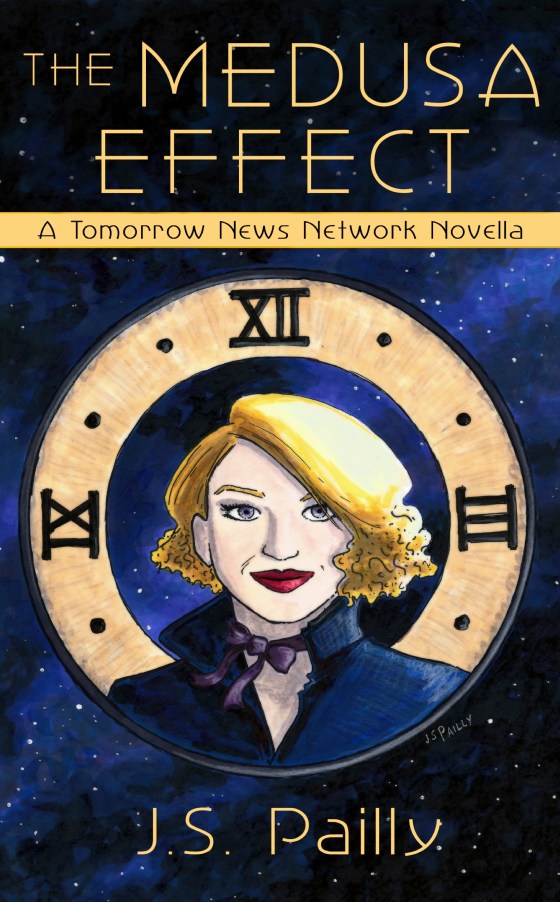
Speaking of time travel, are you a fan of time travel adventure stories?  The kinds of stories you might see on Doctor Who or The Twilight Zone?  Then please check out my new book, The Medusa Effect: A Tomorrow News Network Novella, featuring time traveling news reporter Talie Tappler and her cyborg cameraman, Mr. Cognis.

Sciency Words: Closed Timelike Curves

Hello, friends!  Welcome to Sciency Words, a special series here on Planet Pailly where we talk about those weird words scientists like to use.  Today on Sciency Words, we’re talking about:

CLOSED TIMELIKE CURVES

Austrian-born logician and mathematician Kurt Gödel was one of Albert Einstein’s closest friends.  At Princeton’s Institute for Advanced Study, the two were known to take long walks together, discussing all sorts of strange and wonderful things, no doubt.

As science historian James Gleick tells the story in his book Time Travel: A History, Gödel presented Einstein with a very special gift for Einstein’s 70th birthday.  It was the kind of gift only a person like Einstein would appreciate: a series of mathematical calculations.  Specifically, these were calculations based on Einstein’s own theory of general relativity which showed that yes, time travel is possible.

Gödel’s calculations were officially published in this 1949 paper.  Now I won’t try to explain Gödel’s math because a) I don’t really understand it and b) it’s not really important for the purposes of a Sciency Words post.  What is important for our purposes is that Gödel’s 1949 paper introduced a new concept called “closed timelike curves.”

Well, technically speaking, Gödel used the term “closed time-like lines,” not “closed timelike curves.”  But as Google ngrams shows us, the hyphen quickly dropped out of “time-like,” and by the 1990’s, “curves” beat out “lines.”  So today, closed timelike curves is the most broadly accepted way to say what Gödel was trying to say.  The term is also commonly abbreviated at C.T.C.

In short, a closed timelike curve is a path through space and time that circles back to its own beginning.  As I understand it, it would take a stupendous amount of force to twist space-time around itself in this way.  You’d need the extreme gravitational force of a black hole—or perhaps something even more extreme than that—in order to make a closed timelike curve happen.

But it could happen.  As Gödel demonstrated in 1949, general relativity would allow a closed timelike curve to exist, or at least relativity does not forbid such things from existing.

So time travel is possible.  It may not be anywhere near practical, but it is at least possible.

Speaking of time travel, are you a fan of time travel adventure stories?  The kinds of stories you might see on Doctor Who or The Twilight Zone?  Then please check out my new book, The Medusa Effect: A Tomorrow News Network Novella, featuring time traveling news reporter Talie Tappler and her cyborg cameraman, Mr. Cognis.

Sciency Words: Syzygy

Hello, friends!  Welcome to Sciency Words, a special series here on Planet Pailly where we take a closer look at the definitions and etymologies of scientific terms.  Today on Sciency Words, we’re talking about the word:

SYZYGY

We’ve all seen pictures like this, with all eight planets lined up in a row:

And sometimes, on extra special occasions, the planets really do line up like that, or at least they come very close to it.  When this happens, we call it a grand syzygy.

The word syzygy traces back to ancient Greek.  It originally meant “yoked together,” as in: “The farmer yoked together his oxen before plowing the field.”  According to my trusty dictionary of classical Greek, the word could also mean “pair” or “union.”

Some closely related words in Greek referred to balance, teamwork, sexy times, etc.  And our modern English words synergy and synchronized have similar etymologies.  Basically, what all these words have in common is a sense of people or things coming together, in one manner or another.

For modern astronomers, syzygy means three or more celestial bodies coming together to form a straight line.  The most commonly cited example of this is the alignment of the Sun, Earth, and Moon that occurs during either a new moon or full moon, as observed here on Earth.

But an alignment doesn’t have to be perfectly straight to be called a syzygy, especially when we’re dealing with more than three objects.  According to this article from The New York Times, a syzygy of the Sun, Venus, Earth, Mars, Jupiter, and Saturn occured between March 25 and April 7, 1981.  The Sun and five planets came “within 2 degree of arc from a perfect straight line.”  Apparently that’s close enough.

But while that 1981 syzygy was pretty grand, it was not the grandest of grand syzygies.  The planets Mercury, Uranus, and Neptune were left out.  According to another article from The News York Times, a truly grand syzygy will happen on May 19, 2161, “[…] when eight planets (excluding Pluto) will be found within 69 degrees of each other […].”

So mark your calendars, friends!  You don’t want to miss the grand syzygy of 2161!

P.S.: And if you’re a Star Trek fan, you may recall that 2161 will be an auspicious year for another reason.  That’s the year when the United Federation of Planets will be founded—a political syzygy, one might say, occurring at the same time as an astronomical syzygy.

Sciency Words: Supermoon

Hello, friends!  Welcome to Sciency Words, a special series here on Planet Pailly where we talk about the definitions and etymologies of science or science-related terms.  Today’s Sciency Word is:

SUPERMOON

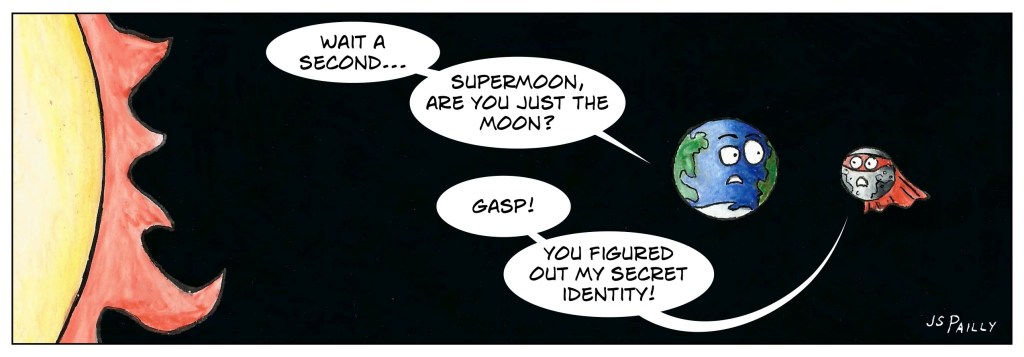
I was recently part of a comment thread over on Scott’s Sky Watch.  We were talking about the term supermoon, along with other weird moon names like wolf moon, blood moon, harvest moon, corndog moon, flower power moon, gingivitis moon… you get the idea.  After that, I thought a Sciency Words post on “supermoon” was in order.

The term supermoon was coined by American astrologer (repeat: astrologer, not astronomer) Richard Nolle.  The term first appeared in an article Nolle wrote in 1979 for Horoscope magazine.  To quote Nolle himself from this 2011 webpage article, the term supermoon describes:

[…] a new or full moon which occurs with the Moon at or near (within 90% of) its closest approach to Earth in a given orbit.  In short, Earth, Moon and Sun are in a line, with Moon in its nearest approach to Earth.

This particular alignment of the Sun, Moon, and Earth is also known as a syzygy-perigee.  Perigee means the point when as object orbiting Earth comes closest to Earth, and syzygy refers to the straight line alignment of three celestial objects.

A syzygy-perigee has a marginal effect on Earth’s tides, and if the Sun and Moon are on opposite sides of the Earth (as depicted in the highly technical diagram below), then the Moon will appear to be slightly larger and slightly brighter than normal in our night sky.  Astrologers would have more to say about supermoons, but from an astronomy perspective we’re pretty much done here.

Personally, I don’t really have a problem with the term supermoon.  When the full moon or new moon happens to be 90% closer to Earth than usual, that’s kind of neat.  Sure, the term started as an astrology thing, but there’s a long history of astrology concepts and terminology being borrowed by astronomers.  Supermoon is no different.

And supermoons do tend to get a lot of attention in the popular press.  I’ve had a lot of awesome conversations with people about the Moon and space and science in general that started because of a news report about the latest supermoon.  I think that’s great.  Anything that gets people to take an interest in science is a positive thing in my book.

On the other hand, a few of those conversations have ended with people asking me about their horoscopes, which is a bit disappointing.

Next time on Planet Pailly, please don’t hate anybody, not even the people who deserve it.

Sciency Words: Covidiot

Hello, friends, and welcome to Sciency Words!  Sciency Words is a special series here on Planet Pailly where we take a closer look at science or science-related terminology.  Today’s Sciency Word is:

COVIDIOT

As you might imagine based on this Sciency Words series, as well as other things I’ve written, I love language.  I enjoy learning about why language works, why it sometimes does not work, and all the processes by which language changes over time.

One of my favorite linguists is Anne Curzan of the University of Michigan.  She’s written books and articles about language.  She hosts a radio show about language, and she’s a member of the American Heritage Dictionary’s usage panel.  She did a wonderful TED Talk called “What Makes a Word ‘Real’?” and her Great Courses series “The Secret Life of Words” is one of my favorite things to listen to on long drives.

Curzan often talks about how people like to play with language.  Some might dismiss such playfulness as slang, but really it’s a natural aspect of language usage.  And so when a friend recently introduced me to the word “covidiot,” I immediately thought of the things Curzan has said.  Here are people being playful with a scientific term, and I love that!

Now normally in these Sciency Words posts, I’d tell you the definition and etymology of the term we’re talking about.  I don’t think that’s necessary in this case.  It’s pretty obvious what “covidiot” means and where the word came from.  The only thing I want to say about covidiots is this: please don’t be one.

Next time on Planet Pailly, I’ll have a very strange weather forecast for you.