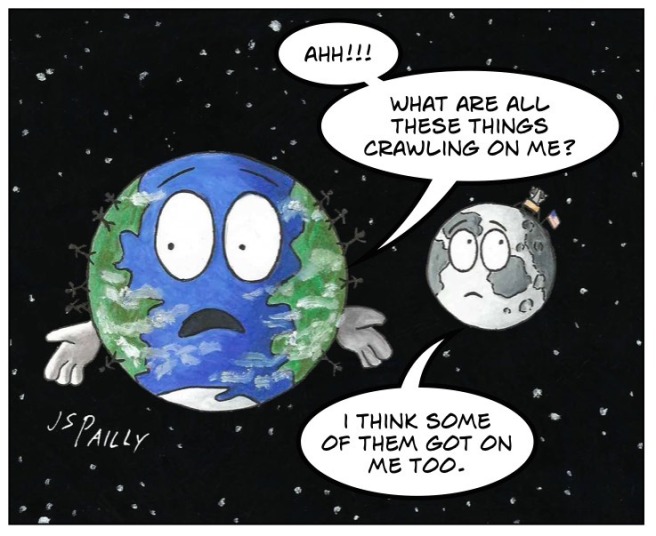
Good News About Climate Change

In a recent post, I suggested a story setting: a future where Earth, ravaged by a runaway greenhouse effect, has transformed into a clone of Venus. Today, I’d like to suggest an alternative: a future where Earth’s climate stabilized, more or less, thanks to the efforts of resourceful human beings.

Of these two possible futures, I think the latter is more believable. I say that partly because I’m an optimist when it comes to human nature, and given recent developments, I think my optimism may be justified.

  • The ozone layer is recovering: in the 1980’s, chlorofluorocarbons (or C.F.C.s) were banned due to their effect on the ozone layer. Now, decades later, the ozone layer is showing the first hints of recovery. Click here for more information.
  • We can have solar power at night: solar power isn’t perfect. Among its many problems is the rather obvious fact that it doesn’t work at night. But new facilities like the Solana Generating Station in Arizona can store excess heat collected from sunlight, and that heat energy can continue generating power for up to six hours after sunset.  Click here for more information.
  • Global Carbon Emissions Flatline: carbon emissions tend to drop only when the economy slumps, but in 2014, for the first time since we started tracking these things, the economy grew without the usual increase in carbon emissions. If this trend continues, maybe we can save the planet and have plenty of money in our bank accounts. Click here for more information.

The situation is far from ideal. Some of the chemicals that replaced C.F.C.s harm the environment in other ways. Solana still struggles with energy production during the winter. Projections still show the planet will warm slightly, even though we’ve curtailed our carbon emissions somewhat.

But we’re making progress. As a global community, we’re making smarter decisions about energy production. I think one of the reasons climate change is such an uncomfortable topic is that most of the time, the situation seems hopeless, but we now have a few good reasons to be optimistic.

Believing a problem can be solved is the first step toward solving it. With climate change, the problem is starting to look solvable. So maybe Earth in the distant, Sci-Fi future won’t look like another Venus after all.

* * *

Today’s post is part of Earth month for the 2015 Mission to the Solar System. Click here for more about this series.

Sciency Words: The Oxygen Catastrophe

Today’s post is part of a special series here on Planet Pailly called Sciency Words. Every Friday, we take a look at a new and interesting scientific term to help us all expand our scientific vocabularies together. Today’s word is:

OXYGEN CATASTROPHE

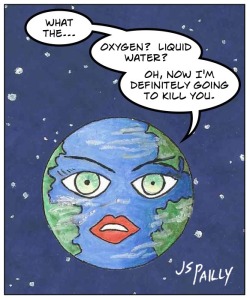
If an extraterrestrial intelligence were to examine Earth from a distance, perhaps analyzing the spectral lines of Earth’s atmosphere, Earth might not seem like the most hospitable of planets. The atmosphere contains one of the most dangerous substances in the known universe: oxygen.

Ap05 Professor Xiggoloplod


Earth Before Oxygen

In the beginning, Earth had an atmosphere composed mainly of carbon dioxide. Life thrived in this environment until someone (I’m looking at you, cyanobacteria) discovered the secret to photosynthesis: the ability to draw energy from sunlight.

Unfortunately, photosynthesis produces oxygen as a byproduct. As the cyanobacteria population boomed, so too did the oxygen content of both the oceans and the atmosphere. This led to Earth’s first mass extinction event: the oxygen catastrophe.

That’s Too Much Oxygen!

Oxygen is a highly reactive gas. It’s so reactive that one of the most common types of chemical reactions—oxidation—is named after it. Oxygen will do just about anything to react with other substances, and it doesn’t care who gets hurt in the process.

Here are some of the ways oxygen harmed Earth’s earliest organisms:

  • Oxygen oxidized minerals in the oceans, robbing microbial life forms of vital nutrients, causing many microbes to starve to death.
  • Oxygen attacked microbes directly, essentially oxidizing them to death.
  • Oxygen sucks at trapping heat, so as atmospheric oxygen levels climbed, global temperatures plummeted. In fact, Earth may have briefly looked a little like the planet Hoth from Star Wars. End result: many microbes froze to death.

And that was the end of life on Earth, or at least it should have been.

Breath Easier Thanks to Aerobic Respiration

Aerobic respiration is a biological process that puts oxygen’s oxidizing tendencies to good use. Through aerobic respiration, glucose molecules (a.k.a. sugar) are disassembled, releasing enormous quantities of energy stored within glucose’s chemical bonds—far more energy than we could get without oxygen’s help.

During the height of the oxygen catastrophe, a handful of clever microbes figured out this aerobic respiration thing. They also developed special enzymes to protect themselves from the ravages of prolonged oxygen exposure. Atmospheric oxygen levels dropped to safer levels, the planet thawed, and a new balance was achieved between respirating and photosynthesizing organisms.

In fact, aerobic respiration has been so successful that it’s hard for us to think of oxygen as a deadly poison. Rather, it’s become a source of life. As for the cyanobacteria that started this whole mess, they’re still here, unrepentant, continuing to spew their oxygen waste all over the place.


So if an extraterrestrial intelligence were to examine Earth from a distance and notice the high oxygen content of the atmosphere, this might not be an obvious sign of life. But oxygen atmospheres don’t just happen. Something has to make them happen, and something has to maintain them over time. That should be enough to at least leave our E.T. friends scratching their heads.

Links

Bacteriapocalypse from Damn Interesting.

Evolution of Aerobic Respiration from the Astrobiology Conference of 2010.

Evolution and Oxygen from Science Online.

How Did Early Bacteria Survive Poisonous Oxygen? from Universe Today.

The Tectonic Theory (It’s Not “Just a Theory”)

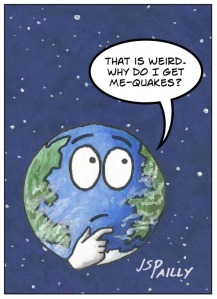
Earth is a weird little planet. I’m not talking about all the oxygen and liquid water. I’m not even talking about life (although that is really weird). You may not have thought about this before, but there’s another thing that makes Earth strange: earthquakes.

Ap04 Me-Quakes

Of all the terrestrial planets and moons in the Solar System, only Earth has active plate tectonics (also, maybe Mars… maybe).

The theory of continental drift was first proposed by Alfred Wegener in the 1910’s with his book entitled The Origin of Continents and Oceans. At the time, the idea was not well received. Though Wegener had plenty of evidence that the continents had moved, he couldn’t explain why. His contemporaries preferred imagining the world as solid and unchanging. They didn’t want to believe continents could move. (Also, it says nothing about continental drift in the Bible.)

A more formal theory of plate tectonics didn’t emerge until the 1960’s, and it has since become the unifying theory of geology. We now know that massive tectonic plates drift about, jostling against each other, pushed and pulled by the rising and sinking of magma in the Earth’s interior.

Where plates meet, they form three types of boundaries:

  • Divergent boundaries: two plates move apart, allowing magma to fill the gaps between them.
  • Convergent boundaries (a.k.a. subduction zones): two plates collide, forcing one plate beneath the other.
  • Transformal boundaries: two plates moving alongside one another scrape against each other. Most earthquake zones, like the San Andreas Fault in California, occur near transformal boundaries.

As we try to understand Earth, especially how life developed and thrived here, we should take note of all of Earth’s weird traits. Water and oxygen are not the only things that make our planet special.

Links

Without Plate Tectonics Life on Earth Might Never Have Gained a Foothold from Daily Galaxy.

Shift Happens: Mars May Have Plate Tectonics from Discovery News.

Sciency Words: Anthropocene

Today’s post is part of a special series here on Planet Pailly called Sciency Words. Every Friday, we take a look at a new and interesting scientific term to help us all expand our scientific vocabularies together. Today’s word is:

ANTHROPOCENE

As recently as 2012, scientists have confirmed there is life on Earth. Do not underestimate the effect life can have on a planet. Do not underestimate the even greater effect of intelligent life.

Ap02 Life on Earth

The term Anthropocene is a fairly new addition to the scientific lexicon. It’s still unclear whether or not the term will stick.

Anthropocene loosely refers to the era of Earth’s geological history when human beings (anthropos is Greek for human) have had the greatest geological impact on the planet.

How have we impacted the geology of our planet? Just think of all the digging we do. Think of all the minerals we’ve extracted from Earth’s crust. Think of how acid rain weathers the landscape or how garbage decomposes (or sometimes doesn’t), changing the makeup of the soil, the atmosphere, the oceans…

Think of all the effects of artificial rather than natural processes: this is the meaning and significance of the Anthropocene epoch.

Of course, the use of this term is not without controversy. Geological epochs are supposed to correspond to rock strata. They’re supposed to have clearly defined boundaries. Where, exactly, is the boundary marking the beginning of the Anthropocene? There isn’t one, yet, because we’re still living in it.

In the future, especially the distant future, the boundaries of the Anthropocene might be very easy to identify. Hundreds or thousands of years from now, the Anthropocene may be a well-established historical and geological fact. Or maybe not.

So do you think characters in a Sci-Fi future would talk about the Anthropocene epoch? If they do, what would they say?

P.S.: Throughout the month of April, as part of the 2015 Mission to the Solar System, we’ll be exploring the planet Earth—in many ways the strangest planet in the Solar System, for reasons you might not expect.

Links

What Is the Anthropocene and Are We in It? from Smithsonian.com.

Generation Anthropocene: Stories About Planetary Change.

The Aphrodiocentric Theory

What is the aphrodiocentric theory? It’s something I made up. It comes from aphrodio-, the scientific prefix meaning Venus, and centric, meaning center, as in center of the universe. We’ve had a geocentric theory and a heliocentric theory, but sadly, there was never an aphrodiocentric theory.

Mr13 Aphrodiocentric
The discovery that Venus orbits the Sun had huge implications for Earth’s place in the cosmos.


In 1610, Galileo began observing Venus through his telescope. At certain times, Venus appeared as a full circle, just like any other planet. But at other times, Venus appeared as a crescent shape or half-circle shape or some other not-quite-a-circle shape.

In other words, Venus as observed from Earth had phases, just like the Moon. After puzzling over these observations, Galileo soon concluded that Venus must orbit the Sun. It’s not much of a leap from there to realize that all the planets, including Earth, orbit the Sun.

If you remember nothing else about Venus, remember this: right from the start, Venus has been teaching us about our own planet. It taught us the folly of our geocentrism, it taught us the dangers of greenhouse gases, and no doubt it will continue to teach us in the future.

This is the final post in my series on Venus. Clearly there is a lot more to say about such a mysterious and chemically active planet, but it is time for us to move on. The 2015 Mission to the Solar System will continue on Friday as we begin our exploration of Earth.

Sciency Words: Venus Syndrome

Today’s post is part of a special series here on Planet Pailly called Sciency Words. Every Friday, we take a look at a new and interesting scientific term to help us all expand our scientific vocabularies together. Today’s word is:

VENUS SYNDROME

On Thursday, we talked about what it would take to terraform Venus. Turning Venus into another Earth is, in short, difficult. So instead, how about we turn Earth into another Venus?

Mr12 Earthly Earth

In the worst-case scenario for climate change, accumulating greenhouse gases in Earth’s atmosphere trigger a runaway greenhouse effect analogous to what happened long ago on Venus. Hence the name “Venus syndrome.”

Here’s how Venus became the charming hellhole we know today:

  • Venus had oceans: Early Venus probably had oceans of liquid water. As the early Sun grew brighter, these oceans warmed up, releasing water vapor. Water vapor, believe it or not, is a greenhouse gas. It’s transparent, so light energy passes straight through; but it traps heat, so once light energy becomes heat energy, it can’t escape.
  • The oceans boiled: The initial temperature change would have been relatively minor, but it created a positive feedback loop. More water vapor trapped more heat, which evaporated more water, which trapped more heat, until the oceans boiled away completely. Then things got worse.
  • The rocks sublimated: The temperature rose to the point that certain carbon-containing rocks sublimated (turned from solids directly into gases). Carbon dioxide took over for water vapor as Venus’s principle greenhouse gas. More CO2 caused more rocks to sublimate, generating more CO2, and… well, you get the idea.
  • The sulfur cycle began: The now ludicrous temperatures also released sulfur compounds into the planet’s atmosphere, providing the key ingredient for Venus’s infamous sulfuric acid clouds.

So could this happen on Earth? Could manmade greenhouse gases initiate a runaway greenhouse effect, ultimately boiling our oceans and sublimating the carbon and sulfur in Earth’s crust?

Mr12 Venus-y Earth

According to the U.N.’s International Panel on Climate Change, human activities have “virtually no chance” of causing Venus syndrome. They’re predicting less dramatic consequences: rising sea levels, mass extinctions, etc. So that’s reassuring, I guess.

The problem is we don’t know the point at which slight changes to Venus’s environment began spiraling out of control. This makes Venus the subject of rather urgent research by both climatologists and planetary scientists.

Venus syndrome is a worst-case scenario, meaning it’s the greatest extreme on a spectrum of possibilities. But that doesn’t mean we can ignore it. The story of humanity’s exodus from a Venus-like Earth needs to be told, perhaps as science fiction, before it has the chance to become science fact.

Links

2009 Assessment Report from the International Panel on Climate Change.

Venus and Mars Hold Priceless Climate-Change Warnings for Earth from The Daily Galaxy.

Could Greenhouse Gases Turn Earth into Venus? (Yes, But Not Anytime Soon) from Mother Jones.

Let’s Fix Venus

Venus wants to kill you.

Mr11 Venus Won't Lie

With its sulfuric acid clouds, dangerously high atmospheric pressure, absurdly high surface temperature, et cetera, et cetera, Venus has more options for killing humans than any other planet in the Solar System. But maybe we can fix that. Maybe we can make Venus more like Earth.

To terraform Venus (or any other planet) we must do two things:

  • Add stuff that we need to survive, like water and oxygen.
  • Remove or mitigate conditions that would harm us.

Most discussions on terraforming seem to overlook that second part, perhaps because the biggest threats to life-as-we-know-it are not always immediately obvious.

Turning Venus into Earth

Converting Venus’s noxious atmosphere of CO2 and sulfuric acid into a friendly oxygen/nitrogen mix will require some creativity. Since I’ve never personally terraformed a planet (yet), I can only guess about the tools required; but my educated guess is that some sort of bioengineered algae would work best.

We’d need something that converts carbon dioxide into oxygen. Algae already do this. We’d need something that can endure prolonged exposure to sulfuric acid and solar radiation. Some species of bacteria can do that. We’d also need something that can survive, at least at first, in a high temperature environment where water is scarce. Again, life on Earth has already shown that this is possible. We just have to design a new species that puts all of these qualities together.

Once our bioengineered algae start gobbling up Venus’s CO2, removing Venus’s primary greenhouse gas, a process of global cooling should begin. Cooler temperatures would disrupt the sulfur cycle, so the sulfuric acid clouds would start disappearing on their own, and traces of water vapor in the upper atmosphere would be able to condense into liquid water.

Admittedly, this liquid water would only result in a few puddles, so we’d still have to transport in more water. Also, I’m not sure how to deal with the atmospheric pressure. But still, we’re off to an amazing start. Unfortunately, Venus has other plans.

Mr11 Terraformed Venus

Turning Venus Back into Venus

I sometimes joke that I want to live on Venus because I’d have so many more hours in my day to get stuff done. From sunrise to sunset, a day on Venus is over 2,800 hours long.

Venus has an abnormally slow rotation. In fact, compared to the rest of the Solar System, Venus is rotating backwards (the only planet weirder than Venus in this regard is Uranus, which rotates sideways).

2,800 hours of daylight can have some peculiar effects on a planet, especially an Earth-like planet. The oceans that our algae worked so hard to create would soon boil. Water vapor would act as a greenhouse gas. The planet’s carbon cycle would come to a grinding halt, allowing CO2 to accumulate in the atmosphere once again, and the rising temperatures would kick start a brand new sulfur cycle.

Without constant efforts by us to maintain cool temperatures on Venus, the planet would rapidly turn back into its old self. In the end, Venus kills you.

Mr11 Venus Warned You

I normally end these posts with links to some of my sources, but today, I want to end with a book recommendation: Venus Revealed by David Grinspoon. Without getting into too much technical detail, Grinspoon covers many key topics related to Venus, including a brief but illuminating section on terraforming. The book is a wealth of knowledge not only on Venus but concerning planetary science in general (although the bits about exoplanets are now out of date).

UPDATE: The length of a day on Venus has been corrected in this post.  According to this article from Universe Today, the time from sunrise to sunset equals 116.75 Earth days (which comes out to 2,802 hours).  I apologize for my previous mistakes, in which I stated a figure of 1,400 hours and, before that, a mere 60 hours.

Sciency Words: Global Resurfacing Event

Sciency Words MATH

Today’s post is part of a special series here on Planet Pailly called Sciency Words. Every Friday, we take a look at a new and interesting scientific term to help us all expand our scientific vocabularies together. Today’s word is:

GLOBAL RESURFACING EVENT

Sometime between 300 and 600 million years ago, Venus experienced what scientists call a global resurfacing event.

Mr09 Makeover

It seems that all of a sudden, in some cataclysmic event, molten hot lava spread all over the planet’s surface, covering up pretty much everything. We know this because Venus’s surface, which has been mapped using radar altimetry, appears to be much younger than the planet itself, free of many of the impact crater blemishes we find on all the other terrestrial worlds in the Solar System.

What caused the global resurfacing event is a topic of heated debate (get it… heated!). Maybe this happened due to a really bad volcano day. Maybe some large object (Venus’s former moon?) collided with the planet. Maybe aliens bombarded Venus with planet crusher missiles… you know, as a warning to the dinosaurs. It’s also possible that Venus goes through periodic resurfacing events.

If this was a one time event, you have to wonder what Venus was like before it got resurfaced. If this is a recurring event, then it could be fun (as a science fiction writer) to speculate about what might happen when the next resurfacing event begins.

Links

Craters on Venus from Universe Today.

Tectonics on Venus from Teach Astronomy.

Colonizing Venus

Mr08 Venus or Bust

No place in the Solar System (except Earth) is exactly welcoming to human life, but Venus’s anti-human hostility reaches a whole other level. Venus will try to kill you eight different ways before you even touch the ground. You’ll never have to worry about the lack of water or oxygen because you’ll already be dead.

And yet, there is serious discussion about colonizing Venus. The trick, it turns out, is to not bother trying to land. Instead, Venusian colonists would live in cities suspended in the upper atmosphere. The oxygen/nitrogen air that we breathe would have sufficient lifting force on Venus to keep our floating cities aloft, so we don’t even need helium or hydrogen balloons.

NASA has even produced this video showing what our first manned mission to Venus might look like. Get ready for space blimps!

The magic number is 55. At an altitude of 55 kilometers above the Venusian surface, the temperature is about the same as a warm summer’s day on Earth, with 90% Earth gravity and atmospheric pressure only a hair above Earth normal. The environment actually sounds pleasant—aside from the hurricane force winds and sulfuric acid clouds.

So could we colonize Venus? Sure. It’s definitely possible, and there may be good scientific reasons for doing it. Just so long as I’m not the one who has to go.

Links

Colonization of Venus, a proposal by Geoffrey A. Landis.

Acid Clouds and Lightning from ESA.

Super-Hurricane-Force Winds on Venus are Getting Stronger from ESA.

Venus and Mother Russia

If you want to land on Mars, the United States can help. The U.S. has a pretty good track record for successfully landing space probes on Mars. But if you’d rather land on Venus, talk to the Russians. They’ll tell you how it’s done.

Mr07 Vodka

In fact, I’d say Russia’s special relationship with Venus began in 1761 when Russian astronomer Mikhail Lomonosov discovered that Venus has its own atmosphere.

In more recent history, Russia’s Venus-related accomplishments include:

  • Venera 1: First spacecraft ever sent to Venus, or any other planet for that matter. Sadly, radio contact was lost before Venera 1 reached its destination.
  • Kosmos 27: Failed in Earth orbit.
  • Zond-1: Failed on route to Venus.
  • Venera 3: First spacecraft to land on Venus. Well, crash land.

Okay, a lot of these missions didn’t go so well, but the Soviet space program can teach us all the value of persistence. And eventually, Russian persistence paid off.

  • Venera 4: Successfully transmitted data from inside Venus’s atmosphere.
  • Venera 7: First successful landing on Venus. Plenty of data transmitted back to Earth.
  • Venera 11 and 12: Observed thunderstorms on Venus.
  • Venera 13: First color photos from the surface of Venus.
  • Vega 1 and 2: First weather balloons deployed to study Venus’s atmosphere.

As an interesting side note, Russia’s Venera 4 entered Venus’s atmosphere at almost the same time that the U.S.’s Mariner 5 was passing by. Despite the tensions of the Cold War, this was just too good an opportunity to pass up. The sharing of data from the two spacecraft was one of the earliest examples of international cooperation in space exploration.

Russia’s next mission to Venus won’t be for a while. The launch of the Venera-D space probe is currently scheduled for 2024.

Links

Russia’s Unmanned Missions to Venus from Russian Space Web.

When the Veneras Challenged Venus’s Hellish Atmosphere from Discovery News.

Soviet Balloon Probes May Have Seen Rain on Venus from Wired.com.