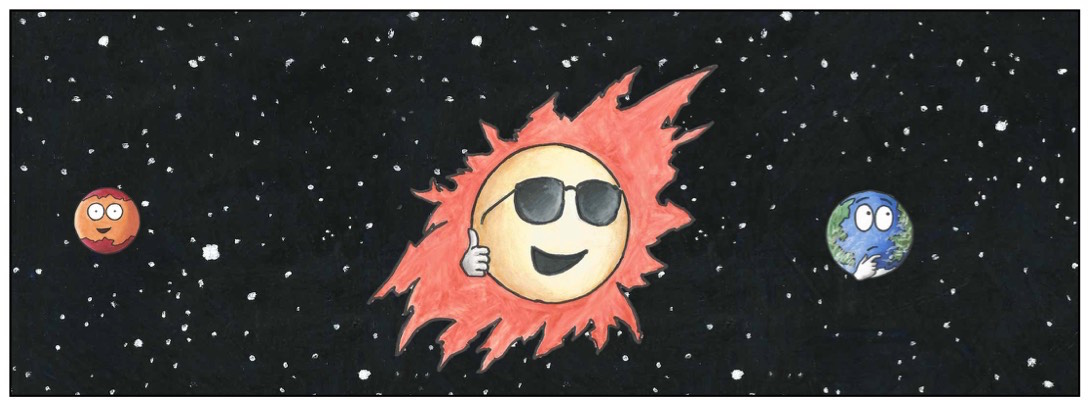
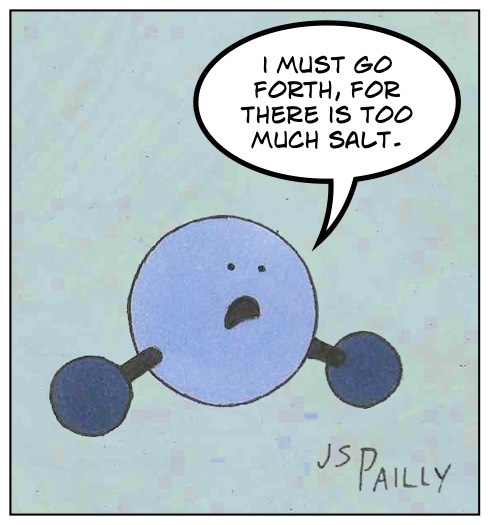
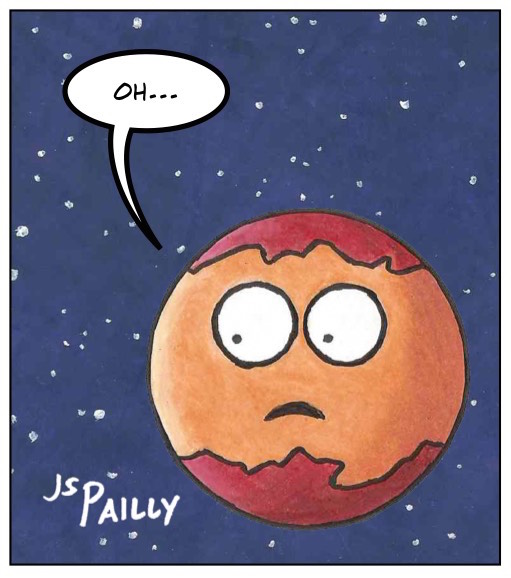
Molecular Monday: Mars’s Hydrogen Peroxide

Welcome to Molecular Mondays! Every other Monday, we examine the atoms and molecules that serve as the building blocks of our universe, both in reality and in science fiction. Today, we turn our attention to:

Hydrogen Peroxide on Mars

The surface of Mars is covered with hydrogen peroxide, a strong oxidizing agent. Here on Earth, we use hydrogen peroxide (chemical formula H2O2) as a disinfectant, among other things.
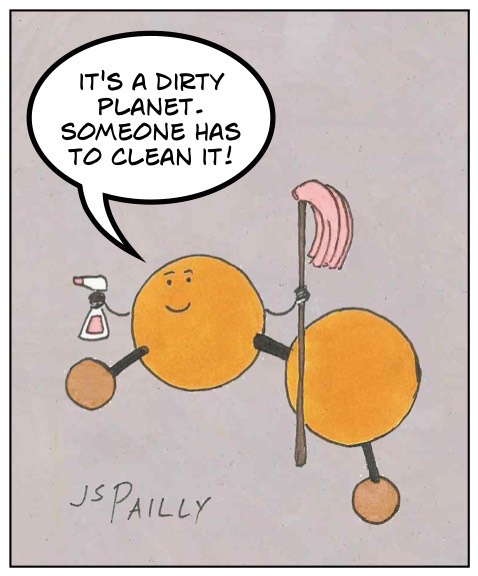
Jn10 H2O2

So I guess that’s it. My hope that one day we’ll discover native Martian organisms is crushed. How could life survive on a planet covered in disinfectant?

The Office of Planetary Protection must be happy.

This could be good news for the Office of Planetary Protection (real thing, not kidding). The O.P.P.’s job is to ensure that NASA doesn’t accidentally contaminate other worlds with microorganisms from Earth.

They don’t worry about contaminating Venus because Venus is self-sterilizing (in many more ways than one). So with all that H2O2 lying around, is Mars a self-sterilizing planet too?

Turns out it isn’t. Researchers found that while microbes from Earth would probably struggle on Mars, enough could survive to cause problems. Despite all that H2O2, we could still contaminate Mars if we’re not careful.

And if Earthly microorganisms can survive, surely native Martians—which would have evolved in this peroxide-rich environment—would be okay as well.

Wait, did you say oxidizing agent?

Long ago, life on Earth was nearly wiped out by a certain oxidizing agent called oxygen. This event is known as the oxygen catastrophe.

Free oxygen can rip chemical bonds apart, to the detriment of most early organisms on Earth. And yet, life adapted. Not only that: life figured out how to take advantage of an otherwise bad situation.

Perhaps a similar story could have occurred on Mars. If Martian life forms exist, maybe they “breathe” hydrogen peroxide as we breathe oxygen, using it to power their bizarre, alien biochemistries.

Some experts would argue that Mars’s hydrogen peroxide is the final proof that life cannot exist anywhere near the planet’s surface. But perhaps, quite to the contrary, hydrogen peroxide might be the very thing that makes Martian life possible.

At the very least, it’s enough to give science fiction writers something to think about.

P.S.: Regular readers of this blog already know that Martians are convinced life cannot exist on Earth. After all, oxygen can be used as a disinfectant. How could life survive on a planet with an atmosphere full of disinfectant?

Sciency Words: Yestersol

Sciency Words MATH

Sciency Words is a special series here on Planet Pailly celebrating the rich and colorful world of science and science-related terminology. Today, we’re looking at the term:

YESTERSOL

In the course of my research, I sometimes stumble upon new words that just make me smile. Sol is the technical term for a Martian day, a period of roughly 24.6 hours. Knowing that, I’m sure you can guess what yestersol means.

The term yestersol was apparently coined during NASA’s Spirit and Opportunity rover missions. Scientists and engineers assigned to those missions had to sync their work schedules to Martian time, screwing up their sleep cycles, eating habits, and no doubt many other aspects of their personal lives. This was necessary because the rovers could only operate during Martian daylight hours.

Additional new terms include “tosol” for today and several versions of tomorrow, such as “nextersol” and “solmorrow.”

In the distant future, Earth time may well be retained as an interplanetary standard, but each colonized world will probably develop its own version of local time, along with playful local terminology like yestersol.

Another timekeeping idea that made me smile appeared in Robert Zubrin’s book The Case for Mars. Zubrin suggests dividing Mars’s 687 day-long (or 669 sol-long) year into twelve months based on the twelve Zodiac constellations. So Martian months may end up having names like Sagittebruary, Leotober, or Cancricember.

These months would be significantly longer than Earth’s, but they could be made to correspond with Martian seasons in a manner similar to Earth’s calendar. Martian colonists may find that convenient. Also, who wouldn’t want their birthday (I mean birthsol) to be something like Sagittebruary the 49th?

When world building in science fiction, it can be tempting to either adhere to the familiar Earth calendar or try to impose some sort of intergalactic standard time on everyone. But it might be more fun (and perhaps more true to life) to think about how different communities spread across space might track time in their own unique ways, using their own colloquialisms like yestersol.

Links

Yestersol from Word Spy.

Martian Language: Where Curiosity Can Take You from A Way with Words.

Workdays Fit for a Martian from the Los Angeles Times.

Long Day at the Office as Scientists Get in Sync with Mars from the Sydney Morning Herald.

* * *

Today’s post is part of Mars month for the 2015 Mission to the Solar System. Click here for more about this series.


Martian Vacation, Part Two (Conjunction-class Missions)

So you’re planning a vacation on Mars and want to know when is the best time to go. This may seem counterintuitive, but you might want to schedule your launch for when Earth and Mars are on opposite sides of the Sun. This is known as a conjunction-class mission.

Keep in mind that any journey to Mars will take months. During that time, the planets will move around in their orbits, with Earth moving slightly faster than Mars (66,000 m.p.h. versus 54,000 m.p.h.). Earth’s orbit is also smaller than Mars’s, so if the two planets were racing, Earth would be lapping Mars on the racetrack quite frequently.

Jn08 Solar Racetrack

In conjunction-class missions, Mars may be on the far side of the Sun at launch, but your spacecraft takes full advantage of Earth’s greater momentum and soon catches up. This gives conjunction-class missions certain benefits over the alternative opposition-class missions (which we covered on Monday):

  • You need a lot less fuel.
  • You get to spend a lot more time on Mars—almost two years! For this reason, conjunction-class missions are also known as long-stay missions.
  • Unlike in opposition-class missions, you don’t have to cut through the Inner Solar System on your way home to Earth. This makes conjunction-class missions far less complicated and, at least on the return leg of your voyage, safer.

The only real downside is that your journey to and from Mars will take longer. Although spending more time in space does raise a few health and safety concerns, almost every serious plan for the long-term exploration and colonization of Mars seems to favor conjunction-class missions.

Personally, if I were going on a Martian vacation, I’d choose a conjunction-class flight. The lower fuel requirements mean lower ticket prices. Having more time to go sightseeing on Mars is an added bonus. I just have to convince my day job to let me take a two-year vacation.

So how would travel to Mars? Would you prefer the faster, marginally safer opposition-class flight or the longer, less expensive conjunction-class?

P.S.: If you want to learn more about opposition- and conjunction-class missions to Mars or about humanity’s future on Mars in general, I highly recommend The Case for Mars by Robert Zubrin. The book lays out the most believable and compelling plan for the exploration and eventual colonization of Mars I’ve ever seen.

* * *

Today’s post is part of Mars month for the 2015 Mission to the Solar System.

Martian Vacation, Part One (Opposition-class Missions)

Planning a vacation to Mars? Wondering when is the best time to go? Here’s one option:

Once every 26 months, while Earth and Mars are on the same side of the Sun, the two planets line up just right for a launch. Although Mars is not necessarily in opposition at this time, it’s close to it, so your flight is known as an opposition-class mission.

Your journey will take several months (exact time estimates vary depending on spaceship design and other mission parameters). Keep in mind that during your voyage, both Earth and Mars continue moving through their orbits. In fact, Earth will rapidly move ahead of you, so you’ll only be able to stay on the surface of Mars for a short time before you have to come home. For this reason, opposition-class missions are also known as short-stay missions.

On your return flight, Earth is still moving away from you, so to catch up, your spacecraft will have to cut through the inner Solar System, swinging in a wide arc around the Sun, possibly utilizing a difficult and dangerous gravity assist maneuver at Venus.

Opposition-class missions aren’t the only way to get to Mars, but they do offer some advantages:

  • You get to Mars faster.
  • You get home faster.
  • Some argue the trip is safer. Since you spend less time in space, you should suffer less radiation exposure and less bone-loss due to zero-gravity.

However, there are some noteworthy disadvantages too:

  • Opposition-class missions require a whole lot of fuel, significantly more than alternative conjunction-class missions.
  • You only get to spend a few weeks on Mars. Depending again on mission parameters, you might get a little over a month.
  • About that safety thing… some argue opposition-class missions aren’t so safe after all because more things can go wrong, especially during your return flight.

I’d guess that the first manned mission to Mars may well be opposition-class. I think humanity might prefer to dip its toe in the water, so to speak, with a short-stay mission.

Subsequent missions (and vacations) will probably be conjunction-class, long-stay missions, for reasons that we’ll examine on Wednesday.

P.S.: It’s difficult to find reliable information about opposition- and conjunction-class missions online, so for further research, I recommend The Case for Mars by Robert Zubrin. Zubrin, a former aerospace engineer for Lockheed Martin and founder of the Mars Society, lays out one of the most believable and compelling plans for Mars exploration and eventual colonization that I’ve ever seen. If you have any interest in going to Mars (or writing science fiction about Martian colonists), you should read Zubrin’s book.

* * *

Today’s post is part of Mars month for the 2015 Mission to the Solar System.

Sciency Words: Opposition and Conjunction

Sciency Words PHYS copy

Sciency Words is a special series here on Planet Pailly celebrating the rich and colorful world of science and science-related terminology. Today, we’re looking at two related terms:

OPPOSITION AND CONJUNCTION

Admit it: you want to go to Mars. Despite all the radiation and sandstorms and saltwater, you still kind of want to do it. But which way is it to Mars? Bonus credit if you can point in the correct direction right now without checking a smartphone app.

Mars, like pretty much everything in space, is a moving target. Sometimes, it’s fairly close to Earth. Other times, it’s all the way on the far side of the Sun. To make life slightly easier, astronomers have special terms to describe the positions of other planets relative to Earth.

Jn06 OppositionOpposition: Earth and Mars, as pictured above, are on the same side of the Sun, almost perfectly lined up. In this situation, Mars is said to be “in opposition.”

Jn06 ConjunctionConjunction: Mars is now on the far side of the Sun, basically as far from Earth as it can get. Mars is now said to be “in conjunction.”

In my mind, these terms would make more sense the other way around. Mars should be in opposition when it’s on the opposite side of the Sun, don’t you think? But I’m guessing this all originates from a more geocentric view of the Solar System. Opposition, therefore, gets its name because the Sun and Mars are on opposite sides of the Earth.

What about Mercury and Venus? Since neither can be on the opposite side of Earth from the Sun, they’re never in opposition. Instead, astronomers use slightly different terms.

Jn06 Superior ConjunctionSuperior Conjunction: Venus, as pictured above, is on the opposite side of the Sun as viewed from Earth. This is called a “superior conjunction.”

Jn06 Inferior ConjunctionInferior Conjunction: Venus is now on the same side of the Sun as Earth. This is an “inferior conjunction.”

Of course, all this terminology can be shifted around if you want to take the perspective of a planet other than Earth. From a Venusian point of view, Earth could be in opposition or conjunction, and Martians could observe Earth to be in superior or inferior conjunction.

Knowing where planets are in relation to each other is critical for interplanetary voyages. Next week, we’ll start planning a Martian vacation, keeping an important question in mind: would you rather travel to Mars when Mars is in opposition or conjunction?

* * *

Today’s post is part of Mars month for the 2015 Mission to the Solar System. Click here for more about this series.

Do You Believe in Martians?

I believe in Martians. The planet Mars was once a wet, warm world like Earth, and it stayed that way for billions of years. That means Mars had ample opportunity to start growing its own organisms, even if things didn’t turn out quite as successfully as they did on Earth.

And while the evidence is not exactly conclusive, there’s plenty of reason to believe that life of some kind did exist and still exists on the Red Planet.

Surviving in Saltwater

On Monday, we looked at Martian water, which some claim is way, way too salty to support life. Meanwhile, here on Earth, scientists have been investigating a creepy, blood-red substance seeping out of Antarctic ice.

Turns out this red substance is produced by large communities of bacteria living beneath the ice. These bacteria have been virtually cut off from the rest of the world for over a million years, surviving in a frigid and super-salty environment almost identical to what hypothetical Martian microbes would have to endure.

Click here to learn more about these Antarctic bacteria.

Debating Over Meteorites

I’m sure we all remember meteorite ALH-84001. That’s the meteorite found in Antarctica that allegedly contained fossilized Martian microbes.

Although the origin of these “fossils” has been called into question, this piece of evidence has not been fully discredited. The scientific debate is ongoing, and additional Martian meteorites have been discovered bearing still more hints of possible biological activity on Mars.

The most recent meteorite, named Tissint, somehow got organic material wedged into cracks and fissures in its surface before traveling to Earth.

Click here for more information about Tissint.

Sniffing Martian Methane

And on the surface of Mars itself, the Curiosity rover has detected several sudden spikes in atmospheric methane, one in late 2013 and another in early 2014. This is mysterious for two reasons: where did all this methane come from, and where did it all go?

Although there are several possible explanations, scientists seem hard-pressed to account for these sudden, dramatic fluctuations of atmospheric methane without involving some sort of native Martian organisms.

Click here for more about methanogenesis on Mars.

Conclusion

Of course, this is all circumstantial evidence. The anomalous methane doesn’t have to come from biological sources, and some experts suspect that the rover itself, which apparently has pressurized methane stored inside it, might simply have sprung a leak. Evidence from Martian meteorites will always be controversial, and discovering bacteria sequestered beneath Antarctic ice is not the same as finding microbes on Mars.

Still, this circumstantial evidence is piling up. It’s enough to convince me that life probably exists on Mars, but what about you? Do you believe in Martians?

* * *

Today’s post is part of Mars month for the 2015 Mission to the Solar System. Click here for more about this series.

Molecular Monday: The Waters of Mars

Welcome to Molecular Mondays! Every other Monday, we examine the atoms and molecules that serve as the building blocks of our universe, both in reality and in science fiction. Today, we turn our attention to:

The Waters of Mars

If you ever find yourself on Mars, do not drink the water. And not just because of a certain episode of Doctor Who.

In real life, the waters of Mars probably won’t transform you into a space zombie, but they still might kill you or at least leave you severely dehydrated. That’s because Martian water is saltwater.

What’s So Dangerous About Saltwater?

Human beings need water. We also need salt. Given those two facts, you’d think drinking saltwater would be great! But introducing all that salt to your system all at once dramatically raises the salinity (salt content) of your blood. You don’t want that.

To lower your blood’s salinity, water molecules will start passing through your cell membranes in a valiant but futile effort to dilute the salt to more acceptable levels.

Jn04 Water Molecule

Ultimately, your body will flush all the excess salt AND excess water out through your urine. In the end, drinking saltwater causes you to lose more water than you gain.

What Do Saltwater Fish Do?

Most organisms here on Earth that live in saltwater environments do so by either actively pumping salt out of their bodies or constantly rehydrating (i.e.: drinking like a fish) to replenish all the water their cells are losing.

What About Life on Mars?

Some scientists here on Earth argue that life cannot exist on Mars because the water is just too salty, both now and in Mars’s past. As a counterpoint, Martian scientists have been quoted saying life couldn’t exist on Earth because the water isn’t salty enough.

P.S.: As you’re probably aware, the freezing point of saltwater is lower than that of regular water. Given how cold Mars is, the high salinity of Martian water is a big part of why Mars has liquid water in the first place.

Links

Mars Perhaps Too Salty for Life from Space.com.

Salt of the Early Earth from Astrobiology Magazine.

Surviving in Salt Water from American Museum of Natural History.

Do Fish Drink Water? from SciShow.

* * *

Today’s post is part of Mars month for the 2015 Mission to the Solar System. Click here for more about this series.

Sciency Words: The Gaia Principle

Sciency Words BIO copy

Today’s post is part of a special series here on Planet Pailly called Sciency Words. Every Friday, we take a look at a new and interesting scientific term to help us all expand our scientific vocabularies together. Today’s term is:

THE GAIA PRINCIPLE

The Gaia principle (named after the Greek word for Earth) has taken on a lot of new agey, pseudo-religious connotations. We hear about life forces, Mother Earth, and the spiritual connection we humans have (or ought to have) with our planet. That’s all very interesting, but let’s set that aside for now.

As a scientific concept, the Gaia principle or Gaia hypothesis is primarily credited to James Lovelock. In the 1960’s and 70’s, while working for NASA, Lovelock wanted to understand why Earth is so tailor-made for life while other planets, especially Mars, are not.

According to Lovelock’s hypothesis, once life takes root on a planet, it fundamentally changes the environment around it. As life evolves, so too does the planet, with the planet’s environment becoming increasingly favorable to life and life becoming increasingly well adapted to the planet’s environment.

Today, all life forms on Earth exist in a symbiotic relationship with each other and with the planet, actively (though unwittingly) maintaining the planet’s life-friendly conditions. It’s almost as though Earth has become a single organisms with countless individual “cells” working to maintain homeostasis.

A strict interpretation of the Gaia principle would tell us that if life fails to alter its environment, if it fails to spread out and establish a vast and complicated planetary biosphere, then it will wither and die.

Jn03 Mars Doesn't Have a Green Thumb

Scientists are currently searching for evidence of life on Mars. Specifically, they’re looking for microbial life eking out an existence, perhaps only in one limited region of the planet.

Whether or not we accept the Gaia principle and how strictly we choose to interpret it has major implications for what we can expect scientists to find on Mars. Because if it’s all or nothing when it comes to life on other planets, as the Gaia principle suggests, then Mars looks pretty darn close to nothing.

So what do you think of the Gaia principle, and how likely do you think it is that we’ll find life on Mars?

* * *

Today’s post is part of Mars month for the 2015 Mission to the Solar System. Click here for more about this series.

Muse Chat: Mars Mission (The Insecure Writer’s Support Group)

InsecureWritersSupportGroup

Today’s post is part of the Insecure Writer’s Support Group, a blog hop hosted by Alex J. Cavanaugh where insecure writers like myself can give each other advice and encouragement. Click here for more information about I.W.S.G. and to see a full list of participating blogs.

Once again, I’m going to turn the floor over to my muse. She has something to say, and maybe it’s something your own muse would like to hear.

* * *

Hello, I’m James’s muse, and welcome to another edition of the Insecure Muse’s Support Group. Because behind every insecure writer is an even more insecure muse.

My writer and I are currently doing research about the planet Mars, and I think Mars exploration serves as a pertinent metaphor for the adventure of publishing. They both sound fun and exciting until you start digging into the details.

  • Essentially, my writer and I are traveling to an unknown world.
  • There’s a lot of conflicting, contradictory information about what that world will be like.
  • We do not know if life is possible in this new world. We might not be able to survive there.
Jn02 Published on Mars
Also, why do I have to wear a spacesuit and you don’t?

I think my writer would rather risk going to Mars than facing the unknowns involved in publishing. And unfortunately, I don’t really know how to help.

Publishing involves money and marketing and something called social media. Basically, it involves a bunch of stuff that’s none of a muse’s business. I know how to inspire, not how to network.

The only thing I can tell my writer right now is that it’s okay to be scared. Leaping into the unknown is scary. But giving up on publishing just because it’s scary would be as disappointing as humanity never going to Mars just because it’s difficult.


Life on Mars: Fact or Wishful Thinking?

As the 2015 Mission to the Solar System continues, we now begin our month-long visit to the planet Mars.

Jn01 Mars Visit #1Well, we’re not literally visiting Mars. I’m just blogging about it.

Jn01 Mars Visit #2Everyone seems to have an opinion about Mars. Does Mars support life? Did Mars support life at some point in its past? Could humans live on Mars at some point in the future?

There’s probably more information available about Mars than any other planet, but most of that information is colored by certain preconceived notions. It’s hard to remain objective about a planet that holds such a prominent place in our collective imaginations.

Many scientists seem to feel strongly that Mars could be friendly to life. Other scientists have the opposite opinion. The debate continues, fueled by tantalizing but often inconclusive clues sent back by our Mars rovers and Mars orbiters.

I for one believe that life once flourished on Mars, and I suspect microbial life of some kind still exists there. I also believe that human colonization of Mars is possible, either using current technology or technology that will be available in the very near future.

But those are only my beliefs. They are my biases as a science enthusiast and science fiction author, and everything I have to say about Mars over the next month will no doubt be colored by my biases. I think it’s important to acknowledge that, both to myself and to you, before we delve into any serious discussion about the Red Planet.

So where do you stand in the ongoing Mars debate? What do you think about the prospects for life on Mars, past, present, and future?