Life on Venus (The Unknown Absorber)

Venus loves keeping secrets. One of the biggest, most frustrating secrets has to do with the planet’s upper atmosphere. Something is absorbing ultraviolet light, and no one can figure out what.

Mr05 Ultraviolet Mystery

A Scientific Explanation

Specific atoms and molecules absorb specific wavelengths of light, producing what’s called an absorption spectrum. Given the prevalence of sulfur compounds in Venus’s atmosphere, it seems like a safe bet that some kind of sulfur containing compound is responsible for this mysterious ultraviolet absorption.

But the absorption spectrum doesn’t match with sulfur dioxide, sulfuric acid, or any other sulfur-based chemical thus far identified on Venus. After decades of observation and research, scientists can’t reach any consensus on what the heck is going on.

A Sci-Fi Explanation

Chlorophyll is a pretty important (and pretty complicated) chemical here on Earth. It’s what makes photosynthesis possible in plants, and therefore it’s what makes life as we know it possible. And it just so happens that chlorophyll’s strongest absorption lines are in the blue part of the spectrum, not far from ultraviolet. Could Venus’s unknown absorber be a sulfur-based, chlorophyll-like chemical?

In other words, could there be something alive on Venus? Could there be some kind of alien algae drifting about in Venus’s sky? Venus’s atmosphere contains a rich mixture of chemicals, including carbon dioxide and water vapor.

Even those thick, fluffy clouds of sulfuric acid might not be dangerous to creatures that evolved to live there. Who knows? Maybe sulfuric acid is highly nutritious if you have the right biochemistry.

And if these cloud algae phosphoresce, as some species of algae do on Earth, that might explain the mystery of Venus’s ashen light.

Final Thoughts

I’m presenting these cloud algae as science fiction, but many well-respected scientists have speculated about this possibility. Even so, this idea is a bit farfetched. Odds are sulfur-based life on Venus is completely impossible.

Mr05 Cloud Algae

Links

Does Alien Life Thrive in Venus’s Mysterious Clouds from Discovery News.

Could There Be Life on Venus? from Venus Dispatches.

Solar System Bodies: Venus from NASA’s Office of Planetary Protection.

Recommended Reading

Venus Revealed: A New Look Below the Clouds of Our Mysterious Twin Planet by David Grinspoon.

Molecular Monday: Venus’s Sulfuric Acid

Welcome to the first official installment of Molecular Mondays, a new series here on Planet Pailly where we take a closer look at the atoms and molecules that make up our universe. Today, we’ll be talking about sulfuric acid, specifically the sulfuric acid that is so disturbingly prevalent in Venus’s upper atmosphere.

Mr04 Melting Spaceship

How to Make Sulfuric Acid

The first step is for sulfur dioxide to pick up an extra oxygen atom, creating sulfur trioxide. Sulfur trioxide then reacts with water, yielding sulfuric acid.

SO2 + O -> SO3

SO3 + H20 -> H2SO4

On Earth, we make sulfuric acid in factories, and it has many scientific and industrial uses. But on Venus, this is happening not in tanks or vats but in the open air, far above the planet’s surface.

Venus’s Sulfur Cycle

Sulfur containing chemicals like sulfur dioxide rise through the air on Venus, possibly originating from Venus’s many volcanoes. These chemicals get zapped by ultraviolet radiation from the Sun, causing sulfur and oxygen atoms to separate and recombine. One possible recombination is sulfur trioxide, which then reacts with traces of water vapor hanging around in Venus’s atmosphere.

Sulfuric acid then condenses into clouds. Sooner or later, the clouds condense further, producing rain: the most horrible rain you could possibly imagine. Fortunately, this sulfuric acid rain never reaches the planet’s surface (not that it matters much because if you’re on the surface of Venus, you’re already dead).

Thermal Dissociation of Sulfuric Acid

Because Venus’s surface temperature approaches 900 degrees Fahrenheit, the sulfuric acid rain begins to evaporate. In fact, the temperature is so high that sulfuric acid molecules break apart in a process called thermal dissociation.

What we’re left with are water vapor and sulfur containing chemicals like sulfur dioxide. The water and sulfur compounds start rising through the atmosphere, and the process begins again, repeating over and over, ensuring that Venus’s atmosphere maintains high levels of corrosive acid… forever.

It’s almost like Venus is being deliberately evil.

Mr04 Evil Venus

Links

Sulfuric Acid from Essential Chemistry Industry Online.

Aerosols and Clouds on Earth and Venus from the University of Colorado, Boulder.

Photolysis of Sulphuric Acid as the Source of Sulphur Oxides in the Mesosphere of Venus from Nature Geoscience.

The Sulfur Cycle on Venus: New Insights from Venus Express from the 2009 Lunar and Planetary Science Conference.

Recommended Reading

Venus Revealed: A New Look Below the Clouds of Our Mysterious Twin Planet by David Grinspoon.
Sciency Words: Ashen Light

Sciency Words MATH

Today’s post is part of a special series here on Planet Pailly called Sciency Words. Every Friday, we take a look at a new and interesting scientific term to help us all expand our scientific vocabularies together. Today’s word is:

ASHEN LIGHT

First observed in 1643, ashen light is an as yet unexplained phenomenon on the planet Venus. It’s a mysterious aura or glow sometimes seen on the planet’s night side.

The light can’t be sunlight (this is the night side, after all), and it can’t be reflected moonlight since Venus doesn’t have any moons.

At one time, scientists thought ashen light could be evidence of alien life (maybe the light comes from cities?), but at this point, I think we can rule that possibility out.

Some scientists have dismissed ashen light as an optical illusion, and maybe they’re right. None of the space probes we’ve sent to Venus have been able to detect the phenomenon. Then again, it took decades for our probes to confirm the existence of Moreton waves on the Sun.

So what do you think is going on on Venus? What secrets is our nearest planetary neighbor hiding?

Links

Jan 9, 1643: Astronomer Sees Ashen Light of Venus from Wired.com.

The “Loch Ness” of Venus from Sky News.

Women are NOT from Venus

I’d like to dispel a common misconception about Venus. Women do not come from Venus. Nobody comes from Venus.

Aside from Earth, no place in the Solar System is exactly friendly to human life, but Venus takes its unfriendliness to a whole other level. In fact, Venus is almost diabolically evil.

Mr01 Slaughter

If you ever decide to go to Venus, here are a few of the many ways Venus will try to kill you.

  • In the upper atmosphere, you will encounter sulfuric acid clouds and sulfuric acid rain.
  • Descending through the atmosphere, atmospheric pressure will increase to 90 times greater than Earth-normal, so you’ll be crushed like a soda can.
  • Due to interactions with the solar wind, spontaneous explosions sometimes occur in Venus’s atmosphere. Let’s file this under “fire hazard.”
  • The surface temperature is almost 900 degrees Fahrenheit, which is well above the auto-ignition temperature of the human body. So again, fire hazard.
  • By the time you reach the planet’s surface, assuming you still have lungs, you’d choke on the extremely high concentration of carbon dioxide in the air.
  • Not that it matters at this point, but there’s no water.
  • Whatever’s left of your corpse may be struck by lightning during one of Venus’s intense thunderstorms.

As we continue our exploration of the Solar System with a month-long visit to Venus, I’d like to take this opportunity to dub the second planet from the Sun “Venus, the Overkill Planet.”

Links

Clouds on Venus from Universe Today.

Planet Venus Facts: A Hot, Hellish & Volcanic Planet from Space.com

The Weather on Venus Calls for Massive Mid-air Explosions from io9.

Sciency Words: The Anomalous Precession of the Perihelion of Mercury

If you’re anything like me, you’ve probably looked at planetary orbits and asked yourself: why does Mercury’s perihelion precess so anomalously? That simple, straightforward question is the subject of this week’s edition of Sciency Words.

Sciency Words is a special series here on Planet Pailly where we take a look at a new and interesting scientific term so we can all expand our scientific vocabularies together. Today’s term is:

THE ANOMALOUS PRECESSION OF THE PERIHELION OF MERCURY

I know, it’s a bit of a mouthful, but trust me… this anomalous precession thing is pretty cool.

Gravity According to Newton

Back in the 17th Century, Isaac Newton found a mathematical way to describe gravity, and his mathematical description worked for everything from falling apples to the orbits of all the planets. Well, all the planets except Mercury.

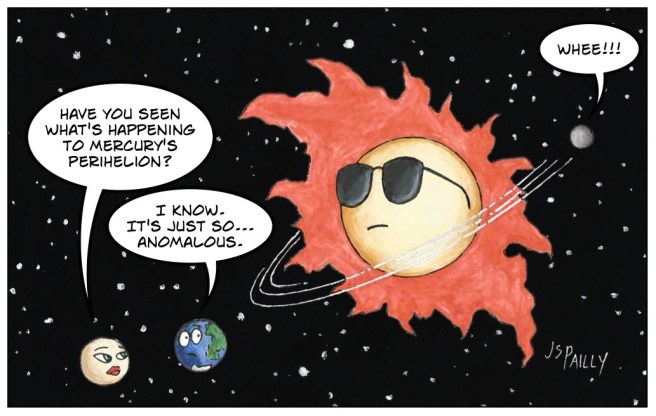
Mercury’s perihelion (the point where Mercury is as close to the Sun as it gets) moves.  That in and of itself isn’t so strange, but the perihelion moves a tiny bit faster than it should according to Newton.
Mercury’s perihelion (the point where Mercury is as close to the Sun as it gets) moves. That in and of itself isn’t so strange, but the perihelion moves a tiny bit faster than it should according to Newton.

The mystery of Mercury’s orbit (or the “anomalous precession of the perihelion of Mercury,” to use the technical lingo) baffled scientists for centuries. That is until Albert Einstein came along.

Gravity According to Einstein

Einstein’s theory of general relativity postulates that space and time are not separate entities but two aspects of what physicists now call space-time. General relativity predicts that the force of gravity causes space-time to bend or warp.

Needless to say, the Sun has a lot of gravity. Turns out that the warping of space-time around the Sun precisely explains Mercury’s weird orbit. In fact, every planet experiences some degree of this anomalous perihelion thing. It’s just that, because Mercury is so much closer to the Sun, the warping effect is significantly more noticeable.

Fe12 Time Warp

This is perhaps the planet Mercury’s greatest contribution to science. The anomalous precession of Mercury’s perihelion provided one of the earliest proofs that general relativity—and all the wibbly-wobbly, timey-wimey stuff that comes with it—is not just science fiction.

Fe12 Albert and Isaac

Links

The 200-Year-Old Mystery of Mercury’s Orbit—Solved! from io9.

The Mysterious Orbit of Mercury from The Great Courses.

Accounting for General Relativity at Mercury from The Planetary Society.

Probing Mercury

In 1974, the first space probe form Earth skimmed past Mercury.

Fe11 Mariner 10
Mariner 10 flies past Mercury for the first time.

As we discussed in a previous post, getting to Mercury is a challenge, so it wasn’t until the early 21st Century that we tried again. This second mission was more ambitious than the first.

The MESSENGER spacecraft achieves Mercurial orbit.

Unfortunately, MESSENGER can’t maintain its orbit forever. By the end of 2015, the probe is expected to run out of fuel. After that, it will eventually crash somewhere on Mercury’s surface.

But don’t worry! The European Space Agency (ESA) and the Japanese Aerospace Exploration Agency (JAXA) have teamed up to send two new probes to Mercury.

Fe11 BepiColombo
The BepiColombo spacecraft will separate into two probes once it reaches Mercury.

The ESA-JAXA mission is named BepiColombo in honor of the Italian mathematician and scientist Giuseppi “Bepi” Colombo. It was Professor Colombo’s calculations that enabled Mariner 10 to safely approach Mercury back in the 1970s.

The BepiColombo spacecraft is scheduled to launch in July of 2016, and the two probes should reach Mercury in early 2024.


Is Mercury Shrinking? (Sciency Words: Lobate Scarps)

Today’s post is part of a special series here on Planet Pailly called Sciency Words. Every Friday, we take a look at a new and interesting scientific term to help us all expand our scientific vocabularies together. Today’s word is:

LOBATE SCARPS

Since the Solar System formed 4.5 billion years ago, Mercury has decreased in size by about 11 kilometers in radius. How do we know this? By studying wrinkly features on the planet’s surface called lobate scarps.

Fe09 Shrinking Mercury

Mercury’s interior is cooling off, and as it cools, the planet shrinks. Unlike Earth, Mercury doesn’t have active plate tectonics, so the planet’s surface is forced to contract like a deflating balloon. Lobate scarps are long, winding ridges standing over the still deflating landscape.

Recent data from the MESSENGER space probe has allowed scientists to measure the height of these scarps. From those measurements, they’ve extrapolated the size Mercury used to be compared to the size it is now.

And it just so happens that these measurements match the theoretical predictions for how much contraction a planet like Mercury should experience due to heat loss. It’s nice when theory and observation agree. It means we’re doing something right.

Links

Mercury Shrinking More Than Thought from Nature.com.

Is Mercury Still Shrinking? Astronomers Confirm The Littlest Planet is Getting Littler from International Science Times.


Colonizing Mercury: How to Live There

If you hunger for a quaint, frontier life far from the noise and bustle of modern society, then moving to Mercury might be for you. Maybe. At first glance, Mercury appears to be the most godforsaken planet in the Solar System. But—assuming you can get there—living there might not be so bad.

One thing you and your fellow colonists won’t have to worry about is energy. You’ll have all the solar power you could ever need. In fact, you might get a little too much solar power. The MESSENGER space probe, currently orbiting Mercury, actually angles its solar panels away from the Sun to prevent overheating.

What about air and water? Turns out certain craters near Mercury’s north pole contain plenty of water in the form of ice. Colonists living in and around these craters would have easy access to that water, and they’d be able to extract oxygen from the water as well.

Fe08 Polar Craters
Water ice lies in Mercury’s polar craters, safely concealed from the Sun’s harsh glare.


Despite Mercury’s proximity to the Sun, keeping cool isn’t impossible. Thanks to a simple sunshade and a series of “diode heat pumps,” MESSENGER’s computers operate at room temperature. In fact, if you’re living inside one of those polar craters, perhaps in some sort of subterranean bunker, your bigger concern should be how to keep warm.

But is a Mercurial colony economically feasible? Well, it’s a safe bet that helium-3 will be the optimal fuel source for any futuristic, Solar-System-spanning civilization. Being so close to the Sun, Mercury has loads of helium-3, so establishing a colony there might someday be highly lucrative.

Believe it or not, some people actually want to live on Mercury. They even argue that colonizing Mercury will be easier and cheaper than colonizing Mars. I doubt that, but after all the research I’ve done for this post and the post before it, I can at least agree that colonizing Mercury isn’t as crazy as it might seem.

P.S.: One of those craters near Mercury’s north pole is named after J.R.R. Tolkien. I can only assume that in the future, any subterranean dwellings in that region will be colloquially known as Hobbit holes.

Links

Colonizing Mercury, Could It Be Done from Colony Worlds.

First Photos of Water Ice on Mercury Captured by NASA Spacecraft from Space.com.

“The Hobbit” Author Gets a Crater on Mercury from Universe Today.

Colonizing Mercury: How to Get There

In several recent posts (here and here), I’ve said that nobody wants to live on Mercury. It’s too hot. It’s also too cold, and there’s no air, et cetera, et cetera. But apparently some people do want to colonize Mercury. If you’re one of them, your first obstacle is getting there.

Only two spacecraft have ever visited the First Rock from the Sun, and the process of getting there was not exactly straightforward. (Get it! No? You will in a minute.) The problem is the Sun.

The Sun is massive, and so is its gravity. By comparison, Mercury’s gravity is minuscule, so trying to achieve Mercurial orbit requires guts, pinpoint accuracy, and a little unconventional thinking.

The MESSENGER spacecraft did it by taking an indirect course through the inner Solar System. It looped past Earth once, Venus twice, and Mercury three times before settling into a safe planetary orbit.

This long, spiraling voyage took six years. A trip to Pluto would take just as long even though Pluto is five times farther away.

Barring some ginormous advances in anti-gravity technology, any effort to colonize Mercury would most likely have to follow MESSENGER’s convoluted path to get there.

Of course, living on Mercury presents a whole other set of challenges. More on that in Wednesday’s post.

Links

How Long Does It Take to Get to Mercury? from Universe Today.

NASA Probe Becomes First Spacecraft to Orbit Mercury from Space.com.

Mercury Orbit Insertion Press Kit from NASA.

Why Doesn’t Mercury Have a Moon? (Sciency Words: Hill Sphere)

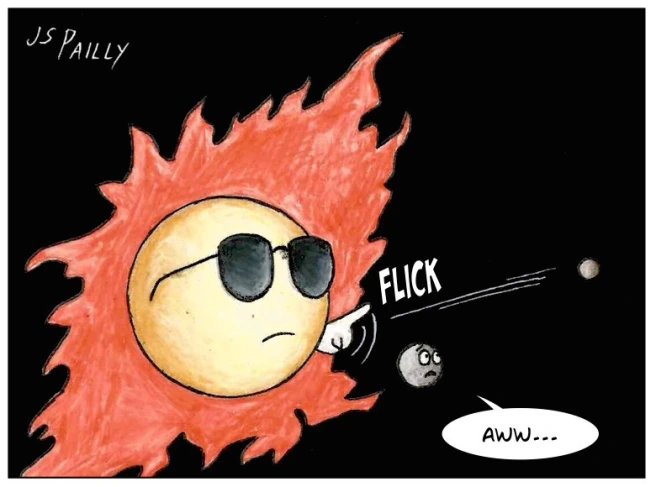
In 2012, NASA announced the discovery of a moon orbiting the planet Mercury. Sadly, this turned out to be an April Fool’s Day prank. In reality, Mercury does not and probably cannot have a moon. Why? Because the Sun is a bully.

Fe06 Flick

For a more complete answer, let’s get to this week’s edition of Sciency Words. Every Friday, we take a look at some new and interesting scientific term so we can all expand our scientific vocabularies together. Today’s word is:

HILL SPHERE

Named after American astronomer George William Hill, a planet’s Hill sphere is the region of space where that planet’s gravity has more influence over orbiting bodies than the gravity of the Sun.

In general, if a moon’s orbit lies within a planet’s Hill sphere, the moon will remain in orbit of the planet. Otherwise, the moon will probably escape the planet’s gravity and begin to orbit the Sun.

To determine the size of a planet’s Hill sphere, we must consider two factors against each other: the planet’s gravity vs. the proximity of the Sun. Even a large, Jupiter-sized planet will have a small Hill sphere if it’s too close to the Sun. Conversely, tiny planets can have surprisingly large Hill spheres if they’re far enough away.

Maybe at some point in the distant past, Mercury did have a moon. But Mercury is too small and way too close to the Sun to have a substantial Hill sphere. Sooner or later, this hypothetical moon would have been yanked away from Mercury and launched into a highly unstable orbit around the Sun.

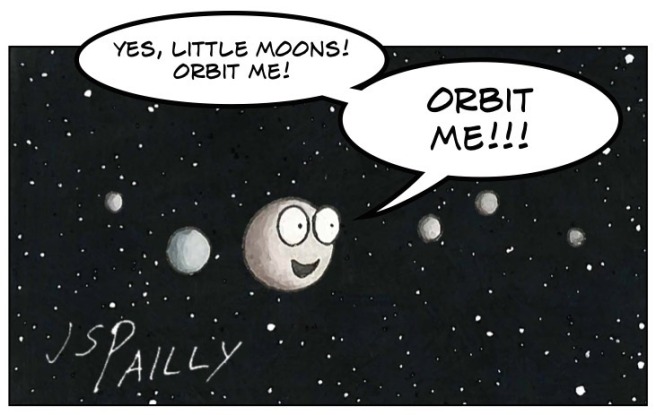
P.S.: Pluto may not be considered a planet anymore, but it still has a Hill sphere, and because Pluto is so far away from the Sun, its Hill sphere is much larger than the Hill spheres of Mercury, Venus, Earth, or Mars. Large enough to hold onto at least five moons.

Fe06 Pluto's Moons

Links

The Moon That Went Up a Hill but Came Down a Planet from Bad Astronomy

File: Hill Sphere of the Planets from Wikipedia