#IWSG: The Writing Lesson I Never Learned

Hello, friends!  Welcome to another episode of the Insecure Writer’s Support Group!  If you’re a writer, and if you feel in any way insecure about your writing, click here to learn more about this wonderful group!

This month, my muse and I have reason to celebrate.  I mean, any time writing gets done, my muse and I have reason to celebrate.  But this month in particular, we have an especially good reason to celebrate.  My manuscript is done, and it is now in the hands of my editor.

At some point, obviously, my editor will hand that manuscript back to me along with a big old list of things that need to be fixed.  But in the meantime, I don’t have to worry about it, and that’s a nice feeling.

Except turning my manuscript over to my editor did not feel like the triumphant moment I thought it would.  Why not?  Because my manuscript was late.  Very late.  I’m taking the self-publishing route with this book, so it’s not like I’m in breech of contract or anything like that.  The only deadline I missed was a deadline I imposed on myself.

But still, I’m really shocked by how long it actually took me to finish that manuscript.  And since I have other self-imposed deadlines looming on the horizon, I’m a little concerned.  Am I going to stay on schedule?  Are those self-imposed deadlines not as realistic as they seem?

Which brings me to one of the very first lessons I (supposedly) learned on my writing journey.  This comes from author/blogger Jon Gibbs.  I attended one of his writing seminars back in 2006 or 2007, and he told me—told a whole group of us young, naive writers—that however much time you think you need to write something, double it.  That’s how you set a deadline.

More often than not, that lesson has proven to be true.  Just about everything takes twice as long as I think it should.

So when I set my deadline for my manuscript, did I follow Jon Gibbs’ advice?  No.  And the two deadlines I have coming up in March and May?  Did I follow Gibbs’s advice for those?  Nope.  So my muse and I are going to have to cut the celebration short and get back right back to work.
Next time on Planet Pailly, have you noticed how windy it is in outer space?

The Peril of Being Self Educated

Hello, friends!

As many of you already know, I blog about science, but I am first and foremost a science fiction writer (fingers crossed, soon to be a published science fiction writer!).

Back in 2010, I started this blog as a way to force myself to do the kind of research that I, as an aspiring Sci-Fi author, thought that I ought to be doing.  In the beginning, I really didn’t know much about science, except for some stuff I remembered learning in school.  And most of that stuff I remembered from school turned out to be wrong or, at best, only half true.

That’s one of the reasons I love being self educated.  Writing this blog has given me an opportunity to discover and correct many of the misconceptions I once had about science.  And my Sci-Fi writing has improved as a result.  I was recently looking over one of my old manuscripts.  So many silly misconceptions are on full display in that text.  Thank God that story never got published!

Another reason I love being self educated: doing deep dives on topics that I find interesting or that I think could be useful in my stories—topics like lithium mining, Troodon intelligence, or Venus’s unknown absorber.  The kinds of topics that never seem to get covered in school or that rarely get attention from the popular press.

I have, on occasion, surprised professional scientists with just how much I know about some weirdly specific topics.  And then I’ve surprised those same scientists with how much I don’t know about more ordinary, more generalized things.  That’s the peril of being self educated.  Your knowledge is splotchy, inconsistent.  You end up with these weird gaps in your knowledge, gaps that someone with a more traditional science education would not have.

And that’s why I keep blogging: because there’s still a whole lot I don’t know, and I’m sure I still have a lot of misconceptions in my head about science, and about other things too.  One thing I didn’t anticipate when I started this blog was how valuable a resource you, dear reader, would be.  You’ve asked me questions.  You’ve challenged me.  Some of you have pointed out my mistakes and suggested new avenues of research.

For that, I just want to say thank you, and please keep it up!

Next time on Planet Pailly, what if I told you Earth is not the perfect planet for life?

I’m Escaping from Prison. Want to Join Me?

Hello, friends!

For this first blog post of 2020, I’d like to share a quote from one of the greatest authors of all time.  As you know, lots of people take a pretty dim view of fantasy and science fiction, and they take an even dimmer view of those of us who enjoy those genres.  J.R.R. Tolkien had the perfect response for those people:

Why should a man be scorned if, finding himself in prison, he tries to get out and go home?  Or if, when he cannot do so, he thinks and talks about other topics than jailers and prison-walls?

J.R.R. Tolkien

Of course Tolkien found his escape in a world of Hobbits and magical rings.  Me?  I find my escape in outer space.  Here on Earth, we humans have created a world of money and politics, of materialism and egotism and self-centered posturing, of winning and losing and grinding each other into the dust.

Okay, maybe it’s not all bad.  There are pleasant things about this world we humans have made for ourselves too.  But still, can you really blame me if, from time to time, I choose to think about or talk about or write about what it would be like to get the heck off this planet?

I know some people will still judge me for my love of science fiction and my obsession with space exploration.  They’ll call me foolish or childish.  That’s fine.  People can say what they like.  I intend to keep dreaming and keep wondering and keep exploring the universe in my own semi-imaginative way.

And friends, you are welcome to join me on this adventure, if you want.  All you have to do is click the subscribe button!

Next time on Planet Pailly: why can’t scientists agree on what the word metal means?

New Pens for My Coffee Mug Full of Pens

A few weeks back, I told you all about my writing zone—that magical place where writing happens.  One of the main fixtures of my writing zone is a coffee mug full of pens, the purpose of which is self-explanatory.

Following that blog post, an anonymous somebody decided to “buy me a coffee” through the website Buy Me a Coffee.  In fact, this unknown benefactor bought me three coffees, equaling a total donation of $9, to help me buy more pens to put in my coffee mug full of pens.

Now I’m rather picky about the pens I use for writing.  I only buy Pilot Precise V5 pens.  They’re self-described as “the ultimate writing machine,” which is marketing hyperbole, of course.  But still, they’re really nice pens.

However, given that that $9 seems so extra special to me, it didn’t feel right to just buy the same old pens I always buy.  So I got these pens instead.

They’re still Pilot Precise V5 pens, but instead of boring old black ink, these pens have an art deco style and come in pretty colors.  My muse (also known as my Best Imaginary Friend Forever or B.I.F.F.) seems to approve.

And the first draft of this blog post was written in a very lovely turquoise ink.

So today I just wanted to say thank you to whoever donated this money.  I really appreciate this, and you’ve helped make the magic of writing just a bit more magical for me!

And if anyone else would like to “buy me a coffee,” please click here.  I don’t actually drink coffee, so the money will be used for writing and art supplies to help keep this blog going, and I promise to keep you all updated on how that coffee money is spent!

Your Life: Now with More Sci-Fi

The nice people over at Fiction Can Be Fun invited me to write a special blog post for them.
Has life got you down? Try turning your problems into science fiction! It won’t make your problems go away. Trust me, it won’t. But you might get a really cool Sci-Fi story out of it!

@breakerofthings's avatarFiction Can Be Fun

As it says on the front page, whilst Debs and I write the majority of the content on this blog ourselves, we’re also delighted to post contributions from others.  The periodic fifth Sunday in the month frequently causes consternation as we try and figure out what we’re going to be putting in that slot.  This time around, that fifth Sunday has coincided with our third birthday (time flies…), and we wanted something extra special.  This month we kicked off with a prompt we came up with in honour of James Pailly.  James runs the Planet Pailly blog, which is completely awesome, and well worth your time (once you’ve finished up here of course).  James has been a great friend to this blog, and he has very kindly written this article for us. I feel very privileged that we get to post it here.

–    David

They say we’re all…

View original post 896 more words

A to Z Reflections

You don’t really understand something until you can explain it to somebody else.  There are lots and lots of quotes out there to that effect, sometimes attributed (or misattributed) to Einstein, sometimes attributed (or misattributed) to other great scientists.  Regardless of where all those quotes really came from, that sentiment has long been the guiding philosophy of this blog.

For this year’s A to Z Challenge, my theme was the scientific search for alien life.  Obviously I’ve written about that topic before, many times over, but I still felt a bit shaky in my knowledge.  So I wanted to dive deep into the science of astrobiology and the closely related field of SETI.  I wanted to double check the things I thought I already knew, and of course I wanted to add to that knowledge.

Writing those 26 blog posts was the final step, the final test. Have I learned this stuff well enough to explain it clearly and concisely?  I suppose only you, dear reader, can be the judge of that. But based on the responses I’ve gotten so far and the conversations I’ve been having with people in the comments, I feel like I must’ve done a decent enough job.

With this year’s A to Z Challenge now behind me, I certainly feel more confident talking about astrobiology and SETI than I did before. More importantly, I feel a whole lot more comfortable incorporating what I’ve learned into my science fiction. After all, I started this blog with one purpose in mind: to force myself to do the kind of research that, in my opinion, a science fiction writer ought to do.

If any of you came away from my A to Z series feeling like you learned something, or even if you just have a newfound sense of wonder for the stars—for all the things that might be out there in the cosmos—I consider that a bonus.  Thank you for reading, and thank you especially to those of you who commented.

On Monday, I’ll be back to my regular blogging schedule.

Big Ideas vs. Small Scheduling Delays

Hello, Internet friends!

So I’ve been working on two new stories, and I’m really excited about sharing them with you.  They’re very brief.  Really, they’re meant to give you just a small taste of the larger story universe I’ve been working on.

Unfortunately, I hit a few snags with this week’s writing/art-making schedule.  As it currently stands, one of these stories is written but not illustrated, and the other is illustrated but not fully written.  It’s an awkward mismatch, to be sure!

Anyway, you can expect to see the first story on Monday of next week, and the other one will be posted the week after that.  In the meantime, I thought I’d share the first episode of a video series I’ve been watching on YouTube.  It’s all about world-building in fantasy and science fiction, and it’s one of the things that’s been feeding my creativity of late.  Please enjoy!

Valerian: A Thousand Stealable Ideas

This post is sort of a book recommendation, but really this is a writing tip.  Way back when I was in college, a professor gave me some advice. When you’re in the middle of a big creative project, spend your free time watching the greatest movies, reading the greatest books, listening to the greatest music.  Surround yourself with the greatest works of art, so that their greatness can inspire your own work.

That’s not bad advice.  But I’ve found that if I spend all my free time with Dune and The Lord of the Rings and the original Star Wars films (things that are, in my opinion, among the greatest works of Sci-Fi/Fantasy ever produced), my own work starts to feel imitative.  Derivative.  And I don’t like that.

But recently I stumbled upon a new source of inspiration, something that seems to work better for my own creative process.

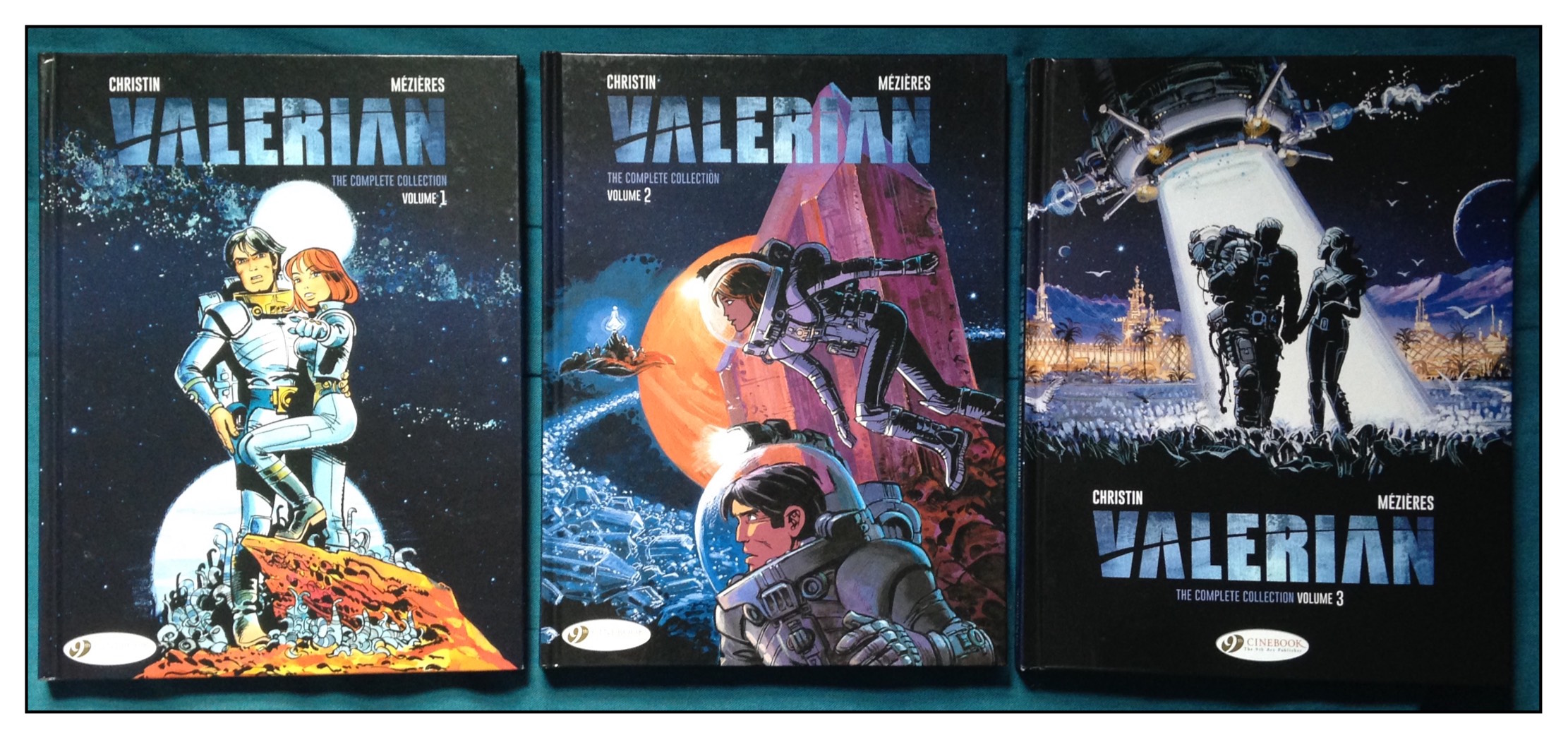
Valerian was a French comic book series that ran from 1968 to 2007.  To American audiences, it’s frequently described as the best comic book you’ve never heard of.  Also, Valerian has a reputation among artists and writers for its “stealable ideas,” and a lot of its ideas have allegedly been stolen by other Sci-Fi properties, most notably Star Wars.

I’ve now read a few volumes of the English translation, and I have to say… it’s not that great.  I’m sorry to any huge Valerian fans who might be reading this, but I just feel like these comics leave something to be desired.  I’m not sure what.  I’ve spent a lot of time thinking about why these comics fall short for me.  I’ve spent a lot of time thinking about what’s missing, what could be done to make them better.

And that is the very reason why I, as a writer/artist, am so fascinated by this series.  It could be better.  It’s almost great.  It’s so close to being great.  Reading Valerian puts me into a “how could I make this better?” mindset.  And that is the mindset I want to be in when I sit down to work on my own Sci-Fi universe.

So that’s my writing tip.  If you’re looking for creative inspiration, maybe don’t turn to the greatest of the greats.  Rather, look to those works of art or literature that you feel are almost great.  Get yourself into that “how could I make this better?” mindset and then apply that mindset to your own work.

The First Art Museum on Mars

Last week, artist James Gurney posed a question on his blog.  He presented two options and asked which you’d prefer:

  • Spend the rest of your life trapped in a library or art museum, with unrestricted access to all the world’s great works of art, literature, film, etc?  Or…
  • Spend the rest of your life outdoors in nature, but never have access to any form of art again?

Personally, I lean toward the life trapped in a library/art museum option, but still… it’s a tough decision.  But then I started thinking more about this. Or perhaps over-thinking it. Why would I be trapped indoors with all this art?  Why can’t I go outside?  And then the answer occurred to me: Mars.

At some point in the future (perhaps not the near future, but at some point in the future, I’m sure) humanity will establish its first colony on Mars.  As that colony grows, the colonists will develop their own customs, their own culture, and ultimately their own art.

There would be a growing interest in having a venue where artists could showcase their work, and someone would have to curate the collection of original Martian artwork.  I guess this isn’t exactly the scenario James Gurney was envisioning.  You could still go outside, if you wear your E.V.A. suit, and you wouldn’t have unrestricted access to all the great art of the world—just all the art of a world.

But still, the more I’ve pondered Mr. Gurney’s original question, the more I’ve liked the idea.  This sounds like an interesting job, being the curator for the first art museum on Mars.  I’d take that job.  Or at the very least, I might write a story about the person who has that job.

So what about you?  If you had to choose, would you choose a life without nature or a life without art?  And what sort of scenario do you imagine might force you to make that choice?

What Kind of Writer Do I Want to Be?

Today’s post is about a personal revelation I recently had.  You see, I spend a lot of time researching for this blog, making sure I understand what I’m talking about, and doing my best to explain it all clearly and concisely.  And all this work, in theory, is supposed to benefit my science fiction writing.

But I don’t want to write hard Sci-Fi.  I used to think science fiction existed on a spectrum from hard science fiction, where everything is super scientifically accurate (and here’s a full chapter explaining the math to prove it), to soft science fiction, where everything’s basically space wizards and technobabble magic (lol, who cares if unobtainium crystals make sense?).

I’ve since discovered another way to think about science fiction, and I find that to be more useful.  But sometimes I’m still left wondering why am I doing all this extra work?  What’s it all for if I’m not trying to write hard Sci-Fi?

Recently, I was talking with a new friend, and somehow the conversation turned to quantum physics.  I swear I wasn’t the one who brought it up!  My friend had seen a video on YouTube, and I felt the need to disillusion him of the weird quantum mysticism he’d apparently been exposed to.  I was doing my best to explain what the Heisenberg uncertainty principle actually means, and I ended up digging into what I remembered about the math.

Mathematically speaking, the momentum of a quantum particle is represented by the variable p, its position by the variable q, and the relationship between p and q is often expressed as:

pq ≠ qp

I don’t have the math skills to explain how this non-equivalency equation works.  I think it has something to do with matrices.  My high school math teacher skipped that chapter. To this day, I still haven’t got a clue how a matrix works.  I just know it’s an important concept in quantum theory.

But by this point, my friend was staring at me with a sort of dumbstruck awe, and he said: “Wow, you really do understand this stuff!”

That brought me up short.

“No, not really,” I said, feeling slightly embarrassed. I couldn’t help but recollect the famous line attributed to Richard Feynman: If you think you understand quantum theory, you don’t understand quantum theory.

So I told my friend about this blog and about my writing, and how I use the research I do for my blog to flesh out the story worlds in my science fiction.  And then I said something that I don’t remember ever thinking before or being consciously aware of, but as soon as the words were out of my mouth I knew they were true: “I just want to make sure I know enough so that I don’t make a total fool of myself in my stories.”

And that’s it.  That’s the answer I needed.  I’m okay with stretching the truth if it suits my story.  I’m okay with leaving some scientific inaccuracies in there.  I just don’t want to make a mistake so glaringly obvious to my readers (some of whom know way more about science than I do) that it ruins the believability of my story world.

And now if you’ll excuse me, I have to get back to writing.  The fiction kind of writing, I mean.  And on Wednesday, we’ll have story time here on the blog.