Hello, friends!
Imagine a story involving G.M.O. crops, ChatGPT, the ebola virus, virtual reality gaming, an accident aboard the International Space Station, a submarine reported missing in the Marianas Trench, and a rogue militant group in possession of a hydrogen bomb. That’s an awful lot of science and technology packed into a single story, but is it a science fiction story? I’d say no. It would be one hell of a story—that’s for sure!—but it probably would not be a science fiction story.
So what is science fiction? There are so many proposed definitions out there, ranging from “an imaginative exploration of the relationship between scientific advancement and social progress” to “it’s that thing nerds like.” I’ve seen people argue that science fiction is just fantasy with a veneer of scientific language. I also once read that the ideal science fiction story should contain 25% science and 75% literature (which is why, whenever I write Sci-Fi, I always measure my science precisely).
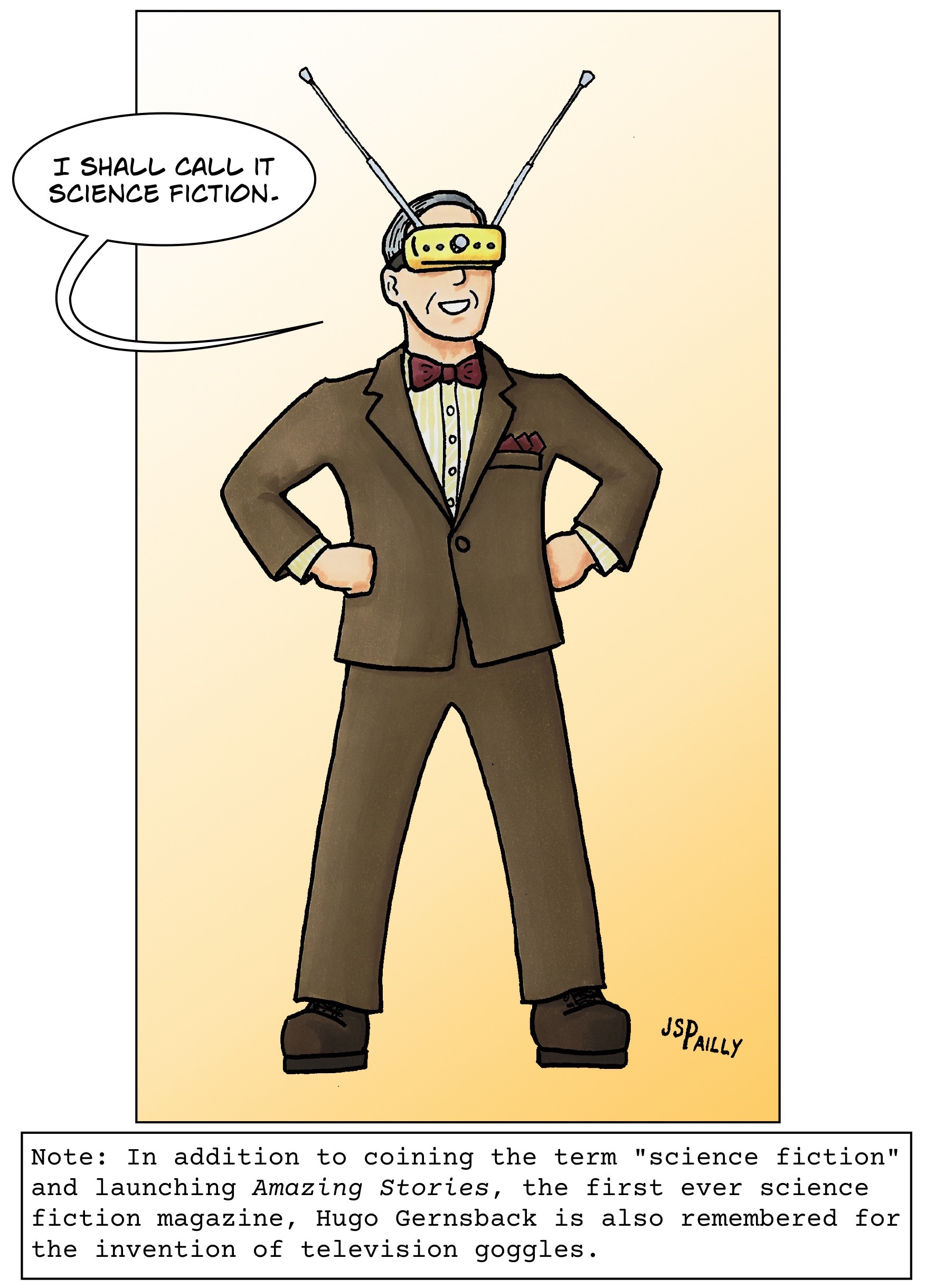
That 25% science thing actually comes from Hugo Gernsback, the man who generally gets credit for coining the term science fiction; or, if he didn’t actually coin the term, then he at least deserves credit for popularizing it as a genre label.
After years of reading about this and thinking about it and debating the topic with other science fiction enthusiasts, I’ve settled on my own personal definition of science fiction. Science fiction is any story where the plot depends upon fictional science.
I like this definition because it’s pithy. It’s easy to remember. More importantly, though, I think it works. Jurassic Park depends upon the fictional science of dinosaur cloning. Frankenstein depends on the fictional science of reanimating the dead. Isaac Asimov’s novels depend on multiple fictional sciences, like psychohistory and the three laws of robotics. And Star Trek depends on the fictional science of warp drive, quantum teleportation, holodecks, extraterrestrial intelligences, etc, etc, etc…. All of these stories may be inspired by real science, and they may touch on real scientific facts from time to time, but they also all depend on the fictional science parts. Remove the fictional science from any of the examples listed above, and the stories totally fall apart.
Going back to that absolutely insane story idea from the beginning of this post—yes, that story is packed with science. That story contains far more than 25% science, I’d say. But all the key plot points, from G.M.O. crops to the International Space Station to hydrogen bombs—all those things are real. The plot of that story may be a wild ride, but it doesn’t depend on any fictional science in order to work. Ergo, it’s not science fiction. It’s just regular fiction with a whole bunch of science mixed in.
Science fiction is about fictional science. Science fiction depends upon fictional science in order for the story to work. That’s the defining feature, at least in my opinion.
Want to Learn More?
Today’s post was prompted, in part, by a new series on Fiction Can Be Fun, examining speculative fiction in its various forms and flavors. Click here to read the first post in that series, and click here for the second post.
And did Hugo Gernsback really coin the term science fiction? There’s some dispute about that, and here’s a list of examples of people using the term before Gernsback introduced it. My stance on the issue is this: other people may have put the words “science” and “fiction” together before Gernsback, but Gernsback still deserves credit for first using the term “science fiction” as the name of a distinct genre of literature.
And lastly, do you want to know more about Gernsback’s television goggles? Click here!
 Planet Pailly
I would still like to read that story about the ISS and the hydrogen bomb!
LikeLiked by 2 people
Yeah, that would be quite a story, regardless of what genre it is.
LikeLiked by 1 person
One thing I’ve learned over the last several years is that definitions are treacherous. None will be perfect. The best we can hope for is one that captures the lion share of the instances, which I think yours does (maybe all if we include the social sciences).
LikeLiked by 2 people
As I was writing this, I kept thinking about entropy, another word where I get the general idea, but it’s hard to pin down a definition. It’s almost like you need at least three different definitions in order to triangulate what the word really means.
I’m perfectly happy to include the social sciences. Asimov’s psychohistory probably qualifies as a fictional social science.
LikeLiked by 2 people
Good point on psychohistory. I was actually thinking about the type of societies that might form under speculative conditions, like the ones in the Mad Max movies.
LikeLiked by 1 person
Hmm… I’ll have to think about that more. The speculative conditions in the Mad Max movies are a post apocalyptic earth, and that, by itself, seems like fictional science to me, without considering any fictional sociology layered on top of that.
But I could also imagine a story where the speculative conditions are just a cool magic system. So a book exploring the sociology of a magical society, populated by wizards and dragons and so forth… is that fantasy or science fiction? My gut says that’s fantasy, but if the story depends on fictionalized sociology, then by my own definition, I might be forced to call that science fiction.
Yeah, I’ll definitely have to think about this more.
LikeLiked by 1 person
You would think once we have outright magic in the mix, we’ve crossed over into fantasy, regardless of the rest. But a lot of fantasy along those lines actually ends up feeling sci-fi. And Clarke’s Third Law can always be invoked.
For me, the real dividing line is whether the audience, at the time of publication, perceives it as mostly science or mostly fantasy. But that gets us into Orson Scott Card’s assertion, that the real distinction is in how it looks and feels. Metal and machinery? Or wizards casting spells?
LikeLiked by 1 person
I’ve been seeing more and more stories lately where the magic system turns out to be powered by ancient machines, or something like that. The last two Zelda games lean pretty heavily on that. The characters may not recognize it as technology, but we the readers (or players) do.
LikeLiked by 1 person
I always get a thrill when it turns out that way. But I’m solidly in the minority. Most like it better when it turns out to be unexplainable magic, and groan when it goes the other way. (Ex- Midi-chlorians)
LikeLike
In most cases, I think it’s pretty neat when that switch happens. That was one of the things I really liked in The Fifth Season.
The midichlorians thing felt kind of clumsy to me, though. I think you need to do more than just slap one sciency sounding word on your magic system.
LikeLiked by 1 person
Lucas once said in an interview that the midichlorian remark was meant as a placeholder that would be expanded in the final trilogy. Of course, he said that long after there was any chance of his version of that trilogy ever being made, so who knows how much he really had thought it out.
LikeLiked by 1 person
I guess that could’ve been interesting. I don’t hate the midichlorian thing on principle, the way some fans do. So if Lucas had done something more with it, I could’ve been on board for that.
LikeLiked by 1 person
Techno-thriller… that genre uses current and cutting edge technologies. I’m not sure what you’d call it if you weren’t including “thriller” tropes.
LikeLiked by 2 people
Yeah, I guess it is a techno-thriller. Well, that’s probably what it is. I didn’t say much about the actual plot or characters, so it _could_ be something else. But you’re probably right. That book would probably be a techno-thriller.
LikeLike
Say JS… may I hijack your post to ask a question? Pls delete this if I’m off-base. I’m finishing up a story about human colonists crossing the galaxy to colonize an exoplanet (fictional science.) But once they arrive, their technology is real or foreseeable. The story mostly involves First Contact (humanoid aliens so fictional science) but I based my alien culture on per-Christian Vikings. So what the devil have I written? I was thinking of: Science Fiction Fantasy Adventure. All your followers are encouraged to comment (even if only to laugh at my lack of writing-to-market skills.)
LikeLiked by 2 people
Sounds like science fiction to me, but then there’s a spectrum of soft to hard Sci-Fi. I didn’t go into that in my post because I was worried about making the post too long. Also, while I do have thoughts about the distinction between hard and soft science fiction, I don’t feel like I’ve pinned down good definitions for those terms.
Based on what I’ve read of your work, I feel like you lean towards hard Sci-Fi, but it sounds like you’re doing more of a mix with this project. Maybe I’ll have an answer for you when I read your story. 🙂
LikeLiked by 1 person
I’d love to have your reactions! This story is a departure for me, a stretch, hopefully in a good way. It’s been fun to write. There seems to be disagreement on what “soft” scifi is. Does the “soft” refer to sciences of psychology, sociology, and such? Or does it refer to scifi elements without attempts at explanation? Or… other? Hard scifi is easier to define, though I hate that it sounds likes it means “hard” to read.
LikeLiked by 1 person
It doesn’t help that a lot of hard Sci-Fi is hard to read. I remember, years back, reading a book where the characters spent three whole chapters in a conference room explaining to each other (and the reader) what was going on.
Glad you’re enjoying your new project. It sounds really fun, and I look forward to reading it!
LikeLiked by 1 person
I’ve seen things like that too – the character attends or presents a lecture! I’ve read advice that says, modern readers don’t want that, but they still buy those old books and give them 5-stars, so who knows?
LikeLiked by 1 person
I think those scenes can work, if they’re handled well. A three chapter long conference room scene is not what I’d call handling it well.
More recently, I read a book where a spaceship crew included an embedded journalist, and the scenes where the scientists explained things to the journalist—for the benefit of the viewers at home—felt pretty natural. I mean, it was super obvious what the author was doing, but it worked.
LikeLiked by 1 person
That does sound like it will work. The reader has to get clued in somehow. And a journalist will probably ask questions the reader wants answered. Maybe even offer reactions in the reader’s place. Yup – sounds good.
LikeLiked by 1 person
If you’re interested, the book was called Saturn Run, by John Stanford and Ctein. I’m not giving it a super strong recommendation, but it was pretty good, and the thing with the journalist on the ship was clever.
LikeLiked by 1 person
Sounds interesting, and more solidly sci-fi than a lot of stuff published in that genre, at least to me based on your description. Unless the aliens can cast magic spells or something… (See Gideon the Ninth for something that really crosses the boundary.)
LikeLiked by 2 people
The aliens believe in magic, but I give a reason. They recite myths, they use herbs. One charcater has visions with hints that drugs are involved. I’m too much of an engineer to give up on reality!
LikeLiked by 3 people
Interestingly, even when it comes to fantasy, a story is expected to follow it’s “rules of magic”. In other words, you can’t just have whatever you want happen each time it’s used. You’re expected to show some consistency. Which if you think about it, is pretty similar to a sci-fi author working out the rules of their fictional science or technology (such as how the FTL works).
Of course, in both cases, movie and TV show script writers are far more lax about this than literary authors.
LikeLiked by 3 people
I think TV/movie writers have an advantage over book writers. Video pulls you along. Yes, you can hit pause, but mostly you are dragged along faster than you can say “Hey, wait a minute. What just happened? and How?” That’s when you’d put your finger between the pages and puzzle over whatever silly thing your author just presented. I’ve noticed some of my favorite films aren’t as “good” after a few viewings, because I start with the “wait a minute.”
LikeLiked by 2 people
Except of course for Star Trek TOS. First loves never tarnish no matter how silly Spock’s Brain was.
LikeLiked by 2 people
Good point about the pace of shows vs books. Although I went through a lot of franchise books as a youngster which inherited the issues from their shows. But it’s definitely true that books have time for more complex explanations on how things work.
Definitely on TOS. I somewhat grandfather anything I saw before age 12. It’s kind of interesting to go back and look at that stuff, and think how the same premise could work in a more rigorous fashion.
LikeLiked by 2 people
Pretty sure I’ve seen episodes of Star Trek where they come across societies with less tech than ours – and with superstitions etc thrown in.
Is the book published yet?
LikeLiked by 1 person
Yes – and I’d love to know what you think. Leave a review https://mybook.to/alienworld Thanks!
LikeLiked by 1 person
Thanks for the shout-out James!
Of course ChatGPT being used to develop new GMOs on the ISS doing a HAL and working on a new Ebola has the makings of a good science fiction thriller…
LikeLiked by 1 person
If ChatGPS becomes sentient and pulls a HAL or a SkyNet in that story, then okay… I think that would be enough to push the story into science fiction territory.
I’m enjoying your speculative fiction series. Keep up the good work!
LikeLiked by 1 person
That would be one heck of a story though.
To me, science fiction also includes the galaxy far, far away. Which is what I write. Not sure I have as much science in it as required.
LikeLiked by 1 person
You’ve got interstellar spaceships. That’s more than enough for Sci-Fi!
LikeLike
In a very basic sense you’re on the nail and yet there’s so much more. 🙂
LikeLiked by 1 person
That’s kind of what I was going for: the most basic sense possible. But yeah, there’s still a whole lot more.
LikeLiked by 1 person
Maybe it never ends….
LikeLiked by 1 person
That’s kind of how I define science fiction: fiction about science that isnt real or has not yet proven to be real even though it may become real in the future. This happens a lot with technology.
LikeLiked by 1 person
Well said. I kind of lump fictional technology together with fictional science for the purposes of my definition, but I see the value in making a distinction between those things.
LikeLiked by 1 person
Good point on psychohistory. I was actually thinking about the type of societies that might form under speculative conditions, like the ones in the Mad Max movies.
LikeLiked by 1 person
Someone else mentioned the Mad Max movies, too. I haven’t actually seen them. Clearly I need to fix that.
LikeLiked by 1 person