Sciency Words: Ashen Light

Sciency Words MATH

Today’s post is part of a special series here on Planet Pailly called Sciency Words. Every Friday, we take a look at a new and interesting scientific term to help us all expand our scientific vocabularies together. Today’s word is:

ASHEN LIGHT

First observed in 1643, ashen light is an as yet unexplained phenomenon on the planet Venus. It’s a mysterious aura or glow sometimes seen on the planet’s night side.

The light can’t be sunlight (this is the night side, after all), and it can’t be reflected moonlight since Venus doesn’t have any moons.

At one time, scientists thought ashen light could be evidence of alien life (maybe the light comes from cities?), but at this point, I think we can rule that possibility out.

Some scientists have dismissed ashen light as an optical illusion, and maybe they’re right. None of the space probes we’ve sent to Venus have been able to detect the phenomenon. Then again, it took decades for our probes to confirm the existence of Moreton waves on the Sun.

So what do you think is going on on Venus? What secrets is our nearest planetary neighbor hiding?

Links

Jan 9, 1643: Astronomer Sees Ashen Light of Venus from Wired.com.

The “Loch Ness” of Venus from Sky News.

IWSG Muse Chat 3: The Law of Writerly Motion

InsecureWritersSupportGroup

As has become my custom for these Insecure Writers Support Group posts, I’m going to turn the floor over to my muse. She has something she wants to say, and maybe its advice your muse would like to hear.

* * *

Hi, I’m James’s muse. As such, I live inside James’s brain, and since James is a huge science geek, I have access to a surplus of sciency factoids. Here’s something from some English bloke named Isaac Newton.

Objects in motion tend to remain in motion and objects at rest tend to remain at rest unless acted on by an external force.

This “law of physical motion” caught my attention. As a muse who’s spent countless hours studying her writer’s habits, both the good and the bad, I would like to propose my own “law of writerly motion.”

A writer who’s writing tends to keep writing and a writer who’s not writing tends to keep not writing unless acted on by an INNER force.

My fellow muses, that inner force is us. We don’t need to hold our writers’ hands through the entire writing process. We only have to provide that initial push. Once writers get started, they generally keep going due to their own momentum.

Mr02 Initial Push

It’s also our responsibility as muses to let our writers know when to stop. I’ve learned to be careful or my writer will either hurt himself or ruin his story. More on that in next month’s Muse Chat.

* * *

If I had my way, I’d keep writing and writing without end. It’s annoying when my muse forces me to stop, but I guess she has her reasons.

Anyway, if you or your muse enjoyed today’s post, please let us know in the comments below. Click here to find out more about the Insecure Writer’s Support Group and to see a full list of participating blogs. Next month, my muse will tell us about the “writing speed limit.”

Women are NOT from Venus

I’d like to dispel a common misconception about Venus. Women do not come from Venus. Nobody comes from Venus.

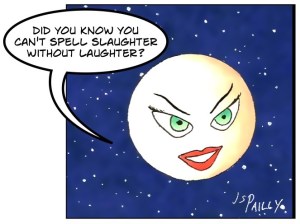
Aside from Earth, no place in the Solar System is exactly friendly to human life, but Venus takes its unfriendliness to a whole other level. In fact, Venus is almost diabolically evil.

Mr01 Slaughter

If you ever decide to go to Venus, here are a few of the many ways Venus will try to kill you.

  • In the upper atmosphere, you will encounter sulfuric acid clouds and sulfuric acid rain.
  • Descending through the atmosphere, atmospheric pressure will increase to 90 times greater than Earth-normal, so you’ll be crushed like a soda can.
  • Due to interactions with the solar wind, spontaneous explosions sometimes occur in Venus’s atmosphere. Let’s file this under “fire hazard.”
  • The surface temperature is almost 900 degrees Fahrenheit, which is well above the auto-ignition temperature of the human body. So again, fire hazard.
  • By the time you reach the planet’s surface, assuming you still have lungs, you’d choke on the extremely high concentration of carbon dioxide in the air.
  • Not that it matters at this point, but there’s no water.
  • Whatever’s left of your corpse may be struck by lightning during one of Venus’s intense thunderstorms.

As we continue our exploration of the Solar System with a month-long visit to Venus, I’d like to take this opportunity to dub the second planet from the Sun “Venus, the Overkill Planet.”

Links

Clouds on Venus from Universe Today.

Planet Venus Facts: A Hot, Hellish & Volcanic Planet from Space.com

The Weather on Venus Calls for Massive Mid-air Explosions from io9.