#IWSG: In Defense of Escapism

Hello, friends!

I’ve been told by several people that I should read The Handmaid’s Tale.  I love science fiction.  The Handmaid’s Tale is science fiction, and it’s really good science fiction—the kind of science fiction that may pretend to be about the future, but it’s really talking about the world we live in today.  All of that, I’m sure, is true, but I’m not going to read The Handmaid’s Tale.  Not any time soon, at least.  Based on everything I’ve read and heard about it, it sounds to me like that book is just too real right now.

“Escapism” is a dirty word, at least to some people.  And I have to admit: if you dive too deep down that rabbit hole, if you spend too much time hiding within a fictional world, if you avoid dealing with the realities of life for too long… yeah, that’s not healthy.  But dealing with reality can be a lot.  It’s okay to take breaks.  It’s okay to escape into a fantasy world for a little while.  Sometimes, that’s what people need.

For those of you who don’t know this about me, I cannot avoid watching the news.  I work in the news business.  That’s my day job.  And I am proud of the work I do.  There are things the public needs to know, that the public deserves to know, and I help make sure the public has access to that information.  But as you might imagine, working in news can be depressing (especially these last few years).  So when I have time to read or time to write, I really just need a break from reality.  Not a reminder.  A break.

None of this is to say that The Handmaid’s Tale is a bad book.  I mean, even if it is a bad book, how would I know?  I’ve never read it!  My point is that all books have their value—the serious books and the unserious books alike.  There ought to be no shame in reading (or writing) what some might label as “escapist fiction.”

A sappy, trashy romance?  A convoluted who-done-it murder mystery?  A pew-pew laser gun Sci-Fi adventure (with dinosaurs)?  Somebody out there really needs a book like that right now.  So if you’re inclined to write anything along those lines, go write it.  You’ll be making life a little bit better for someone.
The Insecure Writer’s Support Group is a blog hop created by Alex J. Cavanaugh and co-hosted this month by Kristina Kelly, Miffie Seideman, Jean Davis, and Liza @ Middle Passages.  If you’re a writer and if you feel in any way insecure about your writing life, click here to learn more about this awesomely supportive group and to see a list of participating blogs!

#IWSG: Involuntary Writing Breaks

Hello, friends!  Welcome to this month’s meeting of the Insecure Writer’s Support Group, a blog hop created by Alex J. Cavanaugh and co-hosted this month by Diedre Knight, Douglas Thomas Greening, Nick Wilford, and Diane Burton.  If you’re a writer and if you feel in any way insecure about your writing life, click here to learn more about this amazingly supportive group!

At some point, every blogger has to say “sorry for not blogging in a while.”  This is then followed by the usual list of excuses: illness, family stuff, trouble at work, etc.  Today, it’s my turn.  Sorry for not blogging in a while.  I got sick (bad mayonnaise, probably), then there was some family stuff, plus a whole lot of trouble at work.  As I result, I didn’t have much time for blogging, or for any kind of writing, all month long.

Sometimes life forces you to take a writing break.  It’s frustrating for two reasons.  First, there’s the involuntary nature of this sort of writing break.  And second, even when life does settle down again, it takes time to get back into the rhythm and flow of writing.  Today, I’d like to share a few of the tricks I use to help myself bounce back from an involuntary writing break.

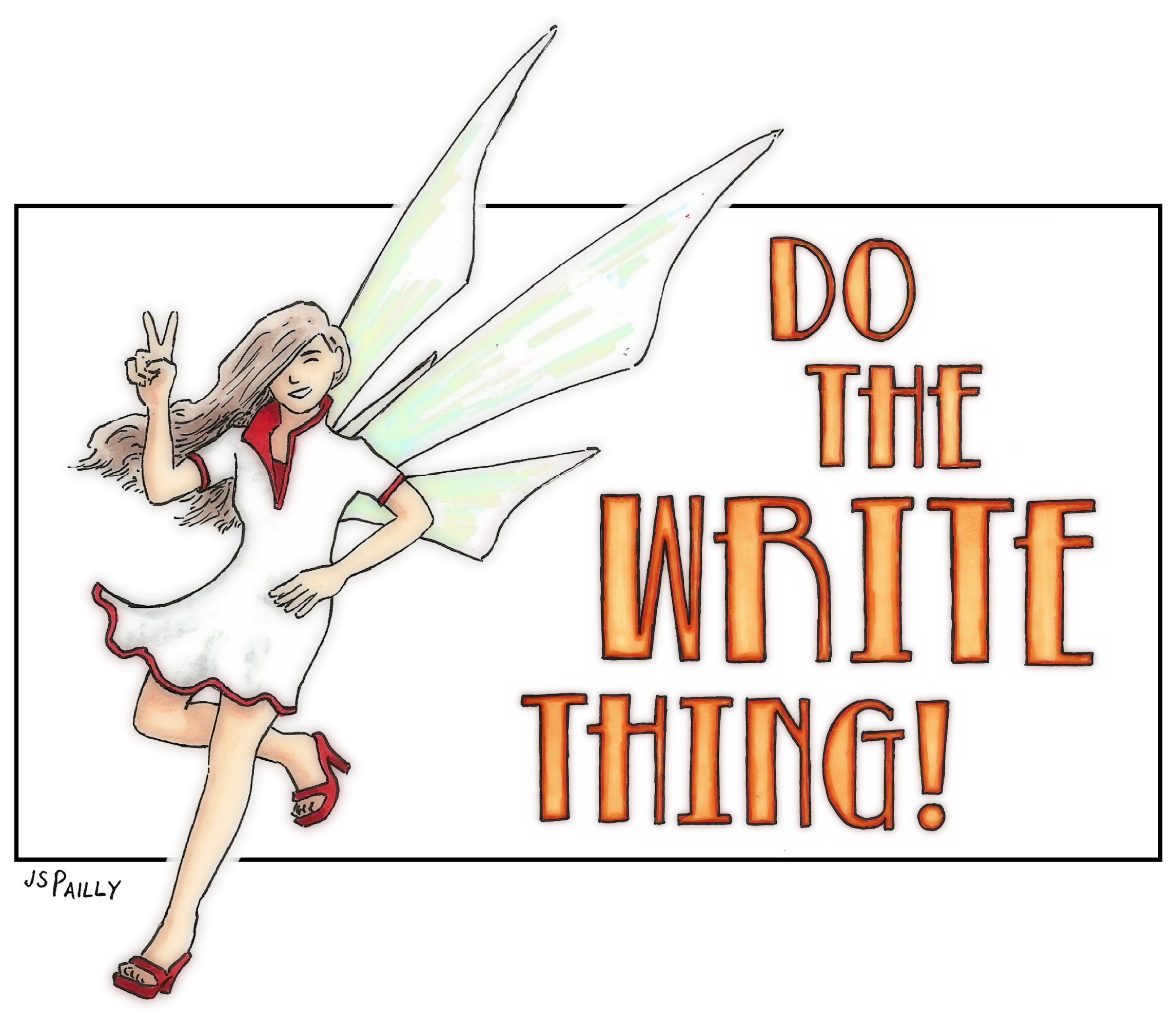
Drawing My Muse: As regular readers of this blog know, my muse is very real to me.  She started out as just another character in a story, then she evolved into something more.  I like to have a picture of my muse nearby whenever I do my writing.  So when I’m trying to bounce back from an involuntary writing break, my first step is to draw a new picture of my muse.  Like this new picture:

Re-Reading My Story: If my involuntary writing break interrupted me in the middle of a writing project, odds are I cannot just pick up again right where I left off.  So I’ll go back, re-read however much writing I got done before the break, and try to immerse myself in that particular story world once more.  This may take some time.  I may end up spending a few days—or perhaps a week or more—editing and re-writing stuff rather than working on new material.  But eventually, I’ll remember what I was trying to do with my story, and I’ll be able to make forward progress once more.

Writing an IWSG Blog Post: And lastly, another great tool to help me bounce back from an involuntary writing break is to write one of these IWSG posts.  I’ve made a commitment, both to myself and to the group, to do this once every month.  It’s a strong enough commitment that it keeps my writing habits alive, even in stressful times, and it’s always helpful to hear from fellow writers, whether they have advice and encouragement to offer, or whether they merely want to commiserate over the struggles we all face from time to time.

So do you have any tricks or techniques that help you bounce back from an involuntary writing break?  Let me know!  Seriously, please tell me.  I think I have a pretty good writing recovery strategy in place, but I’m looking for ideas to make it even better.

#IWSG: Do the Write Thing

Hello, friends!  Welcome to this month’s meeting of the Insecure Writer’s Support Group, a blog hop created by Alex J. Cavanaugh and co-hosted this month by J Lenni Dorner, Janet Alcorn, PJ Colando, Jenni Enzor, and Diane Burton.  To learn more about this amazingly supportive group, click here!

One day, I told my muse what was happening in the news: all the bad stuff that had happened that day, and all the worse stuff that I feared was soon to come.  In response, my muse had only one thing to say: “Do the write thing.”

I tried to make my muse understand how frustrated I felt, how angry I’d become.  I tried explaining how fearful and helpless I was in the face of all these bad things happening in the world out there.  My muse nodded sagely as I talked; then finally, when I ran out of bitter words to say, my muse said again: “Do the write thing.”

She doesn’t understand, I thought, so I started up again.  I told my muse how there’s so much hatred and greed, so much war and disease.  The oppression is relentless, and at some point they (whoever “they” are this week) will even come after me!  How can I protect myself?  How can I protect others when the world is so cruel and heartless?

My muse was patient and kind as she looked me square in the eye, and she said again: “Do the write thing.  A well-told story can do more good than you think.  It can open a mind that was closed.  It can make people think, make them see from a new point of view.  A well-told story can inspire someone to do better, or it can give comfort to someone who needs comfort most.  At the very least, a story may give someone who’s suffering an escape—a brief respite—from all those troublesome things that keep happening in your human world.

“So the best thing you can do, both for yourself and for others, is set your fears and anxieties aside for a while, get your pen ready, and do the write thing.”