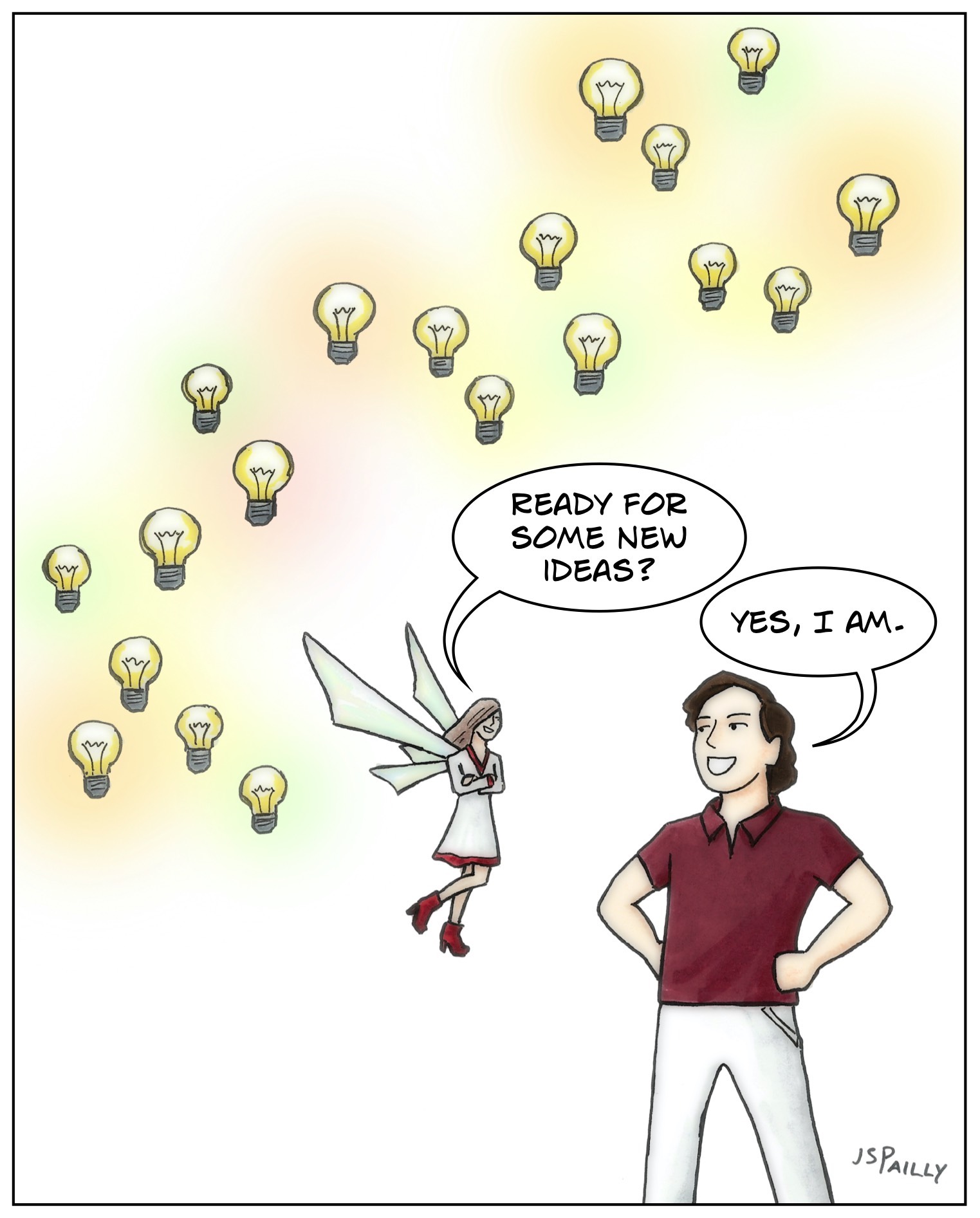
#IWSG: One Thing at a Time

Hello, friends!  Welcome to this month’s meeting of the Insecure Writer’s Support Group, a blog hop created by Alex J. Cavanaugh and co-hosted this month by Joylene Nowell Butler, Olga Godim, Diedre Knight, and Natalie Aguirre.  If you’re a writer and if you feel insecure about your writing life, click here to learn more about this awesomely supportive group!
I felt unsatisfied by my writing last year.  I haven’t felt properly satisfied in my writing life for several years now.  There were extenuating circumstances.  One personal disaster after another.  Finding time to write was difficult.  But 2024 will be different.  That’s more than a vain hope; I have good reason to believe that this year will, in fact, be different, and so I feel confident in making the following New Year’s resolution: I resolve to get back to writing—to get back to writing like I used to write!

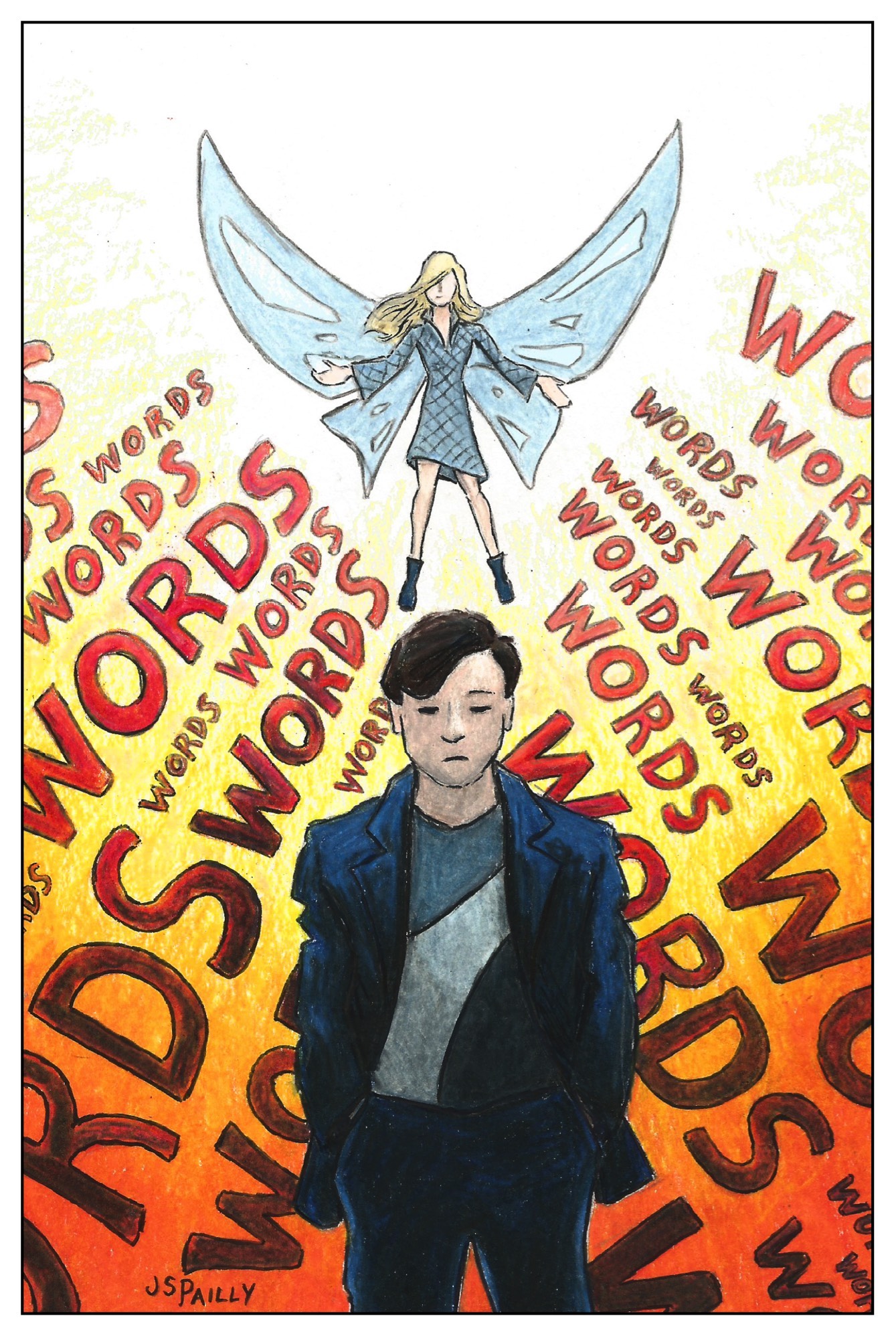
To do that, there are some old writing lessons that I need to relearn.  The first problem I’ve encountered is the temptation of info-dumping.  I’m sure we’ve all come across books like the book pictured below, especially those of us who read fantasy and science fiction.

As a Sci-Fi writer, I’ve developed a vast and complicated new universe for my fiction.  This vast and complicated new universe includes new science, new technology, new political institutions, new economic systems, new environmental hazards, new cultural norms, new fashions of clothes, new styles of art and literature and music—and it really seems like I ought to explain all these new things to my readers before I can expect them to understand what’s going to happen in my story… right?

But I don’t.  I have to keep reminding myself that I don’t have to explain everything up front.  The Hobbit didn’t explain everything up front.  Neither did Dune, and neither did the first Star Wars movie.  Next time you watch Star Wars: A New Hope, take note of how long the movie waits to tell you about the Jedi and the Force.

So as I try to get back to writing like I used to, I’m setting a new rule for myself: explain only one thing at a time.  Just one thing.  Yes, there’s a vast and complicated universe out there that my readers will need to learn about eventually.  But all of that can wait.  The socio-political stuff can wait.  The extraterrestrial biology stuff can wait.  The fashion choices of the future can wait.

Right now, in whatever scene I’m currently writing, I’m only allowed to explain one thing to my readers.  Just one thing.  So what will it be?  What is the one thing—the one and only thing—that my readers need to know about at this point in the story?  Asking myself that question will, hopefully, stop me from info-dumping for 400 pages before my story even begins.

P.S.: It’s the sigma oscillation device.  In the scene I’m currently writing, the one thing I need to explain to my readers is what the heck a sigma oscillation device is.
#IWSG: To Be a Writer…

Hello, friends!  Welcome to this month’s meeting of the Insecure Writer’s Support Group, a blog hop created by Alex J. Cavanaugh and co-hosted this month by PJ Colando, Jean Davis, Lisa Buie Collard, and Diedre Knight.  If you’re a writer, and if you feel insecure about your writing life, click here to learn more about this amazingly supportive group.

I didn’t do any blogging last month (aside from last month’s IWSG post, of course).  I didn’t work on my current WIP either.  I didn’t make any real writing progress last month, now that I’m thinking about it, but that’s okay.  There’s more to being a writer than writing.

To be a writer, you need to live a rich and fulfilling life.  Experience the joy and beauty of the world, but don’t ignore the ugliness or the cruelty.  As a writer, you need to recognize the ugliness and cruelty of the world even as you celebrate the beauty and the joy.

To be a writer, you need to take risks.  You need to try new things, even if they’re stupid things.  You need to embarrass yourself.  Allow yourself to make mistakes.  Big mistakes, sometimes.  It would be nice if we writers could learn everything we need to know the easy way (by reading about it in our favorite books).  But we can’t.  Some lessons can only be learned the hard way.

And after every success and every failure, you need to take the time to feel your feelings, no matter what those feelings might be.  Laugh at yourself.  Cry.  Start plotting your revenge.  Doesn’t matter if these thoughts and feelings are rational or irrational.  You need to feel them.  To be a writer, you need to understand the human condition, and the only way to do that is to experience it in full for yourself.

Meet new people.  Meet people who are just like you.  Meet people who are totally different (or who seem to be totally different at first).  Get to know them.  Try to understand their goals, their passions, their challenges.  And if these people happen to open up to you, try to understand their fears and regrets.  Don’t judge.  Never be judgmental.  To be a writer, you need to have empathy for everyone.  That is a tall order, I know, but I do mean everyone.  As we writers like to say, each villain is the hero of their own story.  Learn that lesson (and other lessons like it) in real life, by talking to real people, and your writing will improve.

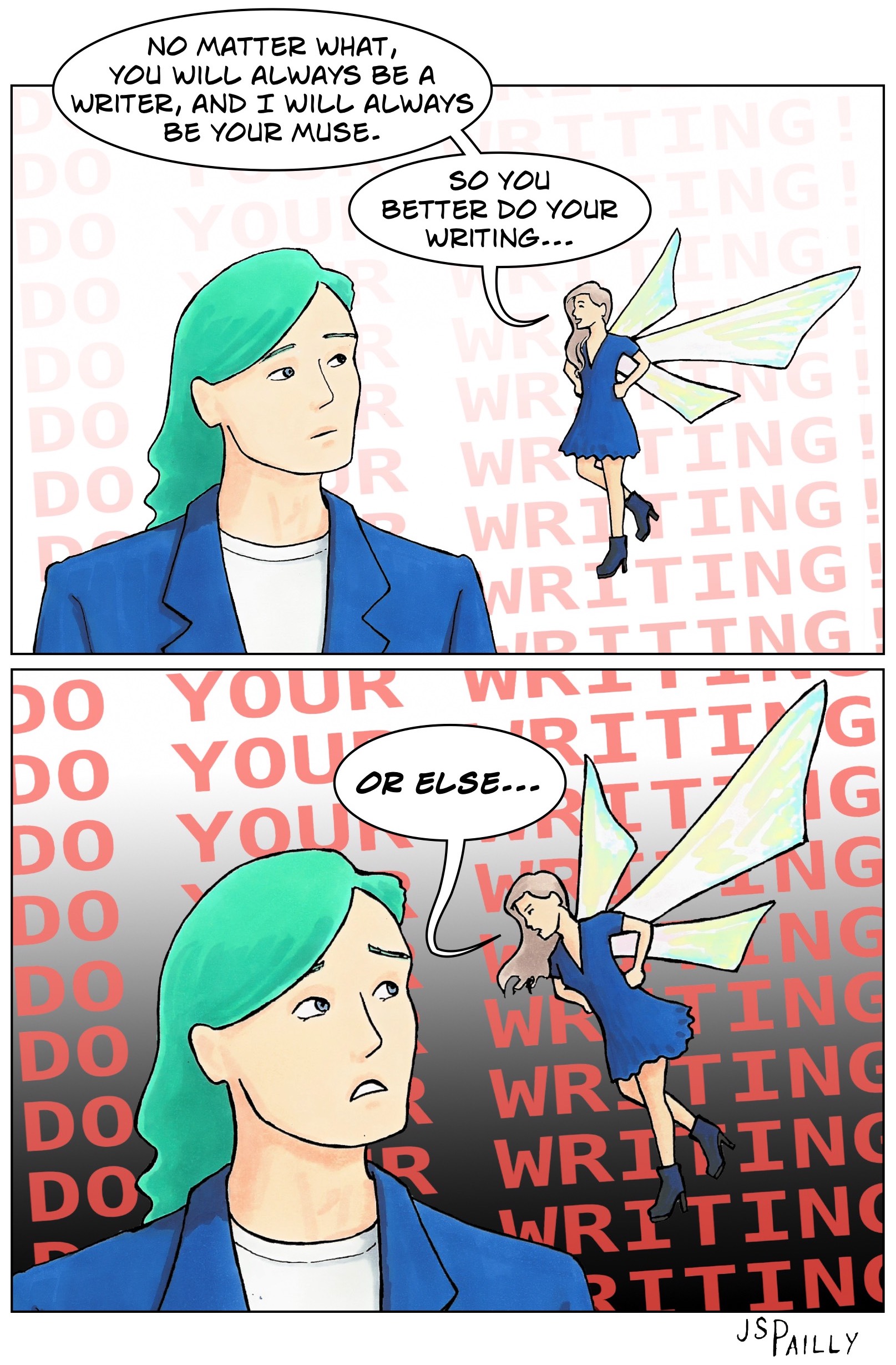
And then, once you’ve done all those things, get back to writing as soon as you can.  The muse will be patient while you’re out there living a rich and fulfilling life, leaning all these things about the world and the human condition.  But the muse can only be patient for so long.

So if you’ll excuse me, I think I better get back to writing.

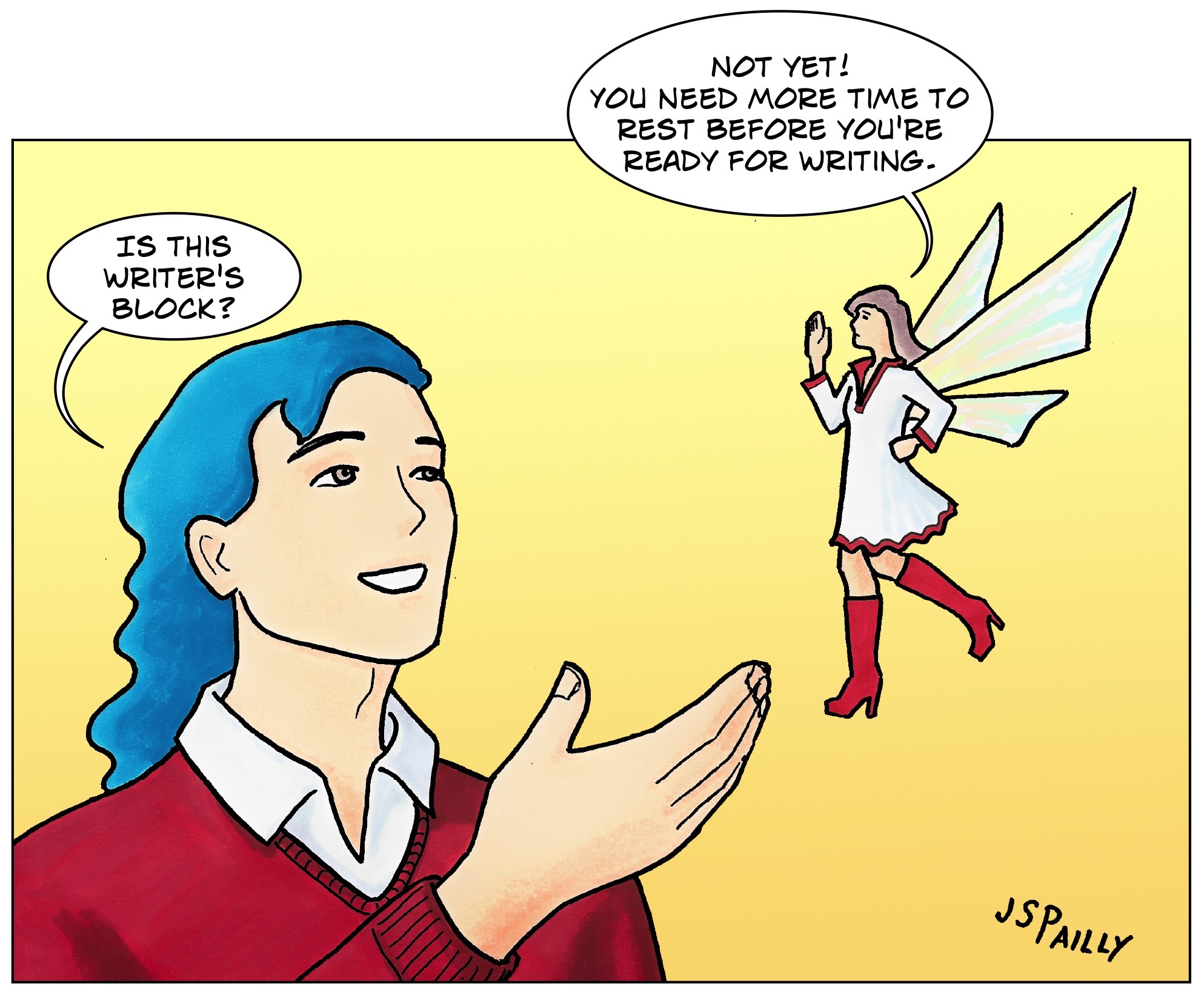
#IWSG: Is This Writer’s Block?

Hello, friends!  Welcome to this month’s meeting of the Insecure Writer’s Support Group, a blog hop created by Alex J. Cavanaugh and co-hosted this month by PJ Colando, Kim Lajevardi, Gwen Gardner, Pat Garcia, and Natalie Aguirre.  To learn more about this group and to see a list of participating blogs, click here!

Last month, I wrote a post about how very ready I was to get back to writing.  I had big plans.  Big hopes and dreams.  Due to circumstances beyond my control, I’d been on a bit of a creative dry spell, but as soon as those circumstances stopped being so totally out of control, I was eager to get back to writing.  And then… nothing.  My muse, it seemed, was not going to help me.

When I first started transitioning from writing as a hobby to writing as a job, I got some sage advice from a more experienced writer friend: however long you think it will take to do something, double it.  That’s how long it will actually take.  I have found that rule of thumb holds up well.  On a few occasions, I’ve taken on a project that turned out to be easier and quicker than expected.  But that’s rare.  In most cases, things really do take twice as long as I expect them to—sometimes more than twice as long.

And that rule of thumb extends to recovery time as well.  I don’t have writer’s block.  I just need rest (and my muse knows it).  So instead of writing, I’ve been recharging my creative batteries.  I’ve been re-reading favorite books and re-watching favorite movies.  I’ve been trying to reconnect with the stories that made me want to be a writer in the first place.

So recovery is taking a little longer than I expected, and that shouldn’t be a surprise.  I still have big plans.  I still have big hopes and dreams.  They’ll just have to wait a little bit longer.

#IWSG: Write vs. Wrong

Hello, friends!  Welcome to this month’s meeting of the Insecure Writer’s Support Group, a monthly blog hop created by Alex J. Cavanaugh and co-hosted this month by Diedre Knight, Tonya Drecker, Bish Denham, Olga Godim, and JQ Rose.  If you’re a writer and if you feel insecure about your writing life, click here to learn more about this awesomely supportive group!

A family emergency happened last week, and I’m still a little bent out of shape because of that.  Getting back into writing after dealing with all that stress has been a struggle, so today I’m going to turn the floor over to my muse.  She has something she wants to say, and maybe it’s something your muse would like to hear.

* * *

Greetings to all my fellow muses, inner critics, and motivational demons.  I am James Pailly’s muse.  It’s my job to give James guidance and inspiration in his writing life, but I am not the only source of guidance and inspiration he turns to (nor should I be).  He reads and does research.  He talks to people.  He talks to other writers.  Sometimes he finds good, sensible advice in this way; other times, the advice he gets is not so sensible.

What works for one writer will not necessarily work for others.  Each writer is unique.  Each writer is special.  They have their own strengths and their own struggles.  But writers are human, and humans can be tempted by broad generalizations and oversimplified explanations—especially when their own unique struggles start to feel overwhelming.

My writer is often told that he should not edit while he writes, as if editing and writing are two separate and distinct activities.  First there’s a writing phase, then there’s an editing phase, and there’s supposed to be a hard line between the two.  Perhaps some writers really do work this way.  Perhaps a majority of them are able to operate this way.  But that is not the way my writer works, and it never will be.

My writer will write a sentence or two—a paragraph—an exchange of dialogue—then he’ll go back and rewrite it all before moving on to the next part.  He’ll finish a page, then go back and fix the page that came before it.  He’ll finish a chapter, then tweak an earlier scene.  Every word my writer writes is subject to change, at any time, for any reason, until the story is finished.  If that means we have to go back and rewrite half of the whole book, that’s fine.  The sooner we get started on those rewrites, the better.  And every time some writing guru tells my writer he’s doing it wrong, I am there to remind my writer what he should already know about himself.  

For my writer, writing and editing are thoroughly intermingled activities.  It’s a messy process.  It’s a labor-intensive process.  My writer does get frustrated, sometimes, and wish there were an easier way.  But this is what’s best for him, and deep down he knows it.

Should your writer write (and edit) the way mine does?  I can’t tell you that.  Ultimately, you will have to determine what is right and what is wrong for your own writer.

#IWSG: The Patience of a Muse

Hello, friends!  Welcome to this month’s meeting of the Insecure Writer’s Support Group, a blog hop created by Alex J. Cavanaugh and cohosted this month by Jacqui Murray, Ronel Janse van Vuuren, Pat Garcia, and Gwen Gardner.  If you’re a writer and if you feel insecure about your writing life, then click here to learn more about this wonderfully supportive group!

I like to write, but I don’t like to talk about writing.  Whenever I talk about writing, I end up reminding myself just how tedious and frustrating the writing process can be.  Fortunately, my muse is always eager to talk about writing, even when I’m not in the mood, so today I’m going to turn the floor over to her.  My muse has something to say, and perhaps it’s something you and your muse would like to hear.

* * *

They don’t tell you this in muse school, but we muses need to play the long game with our writers.  Writers are born to write, but that does not mean they’re born with all the skills and abilities necessary for writing.  The day I first met my writer—the human I was assigned to guide and inspire throughout his creative life—I found him utterly unprepared and woefully ill-suited for writing.

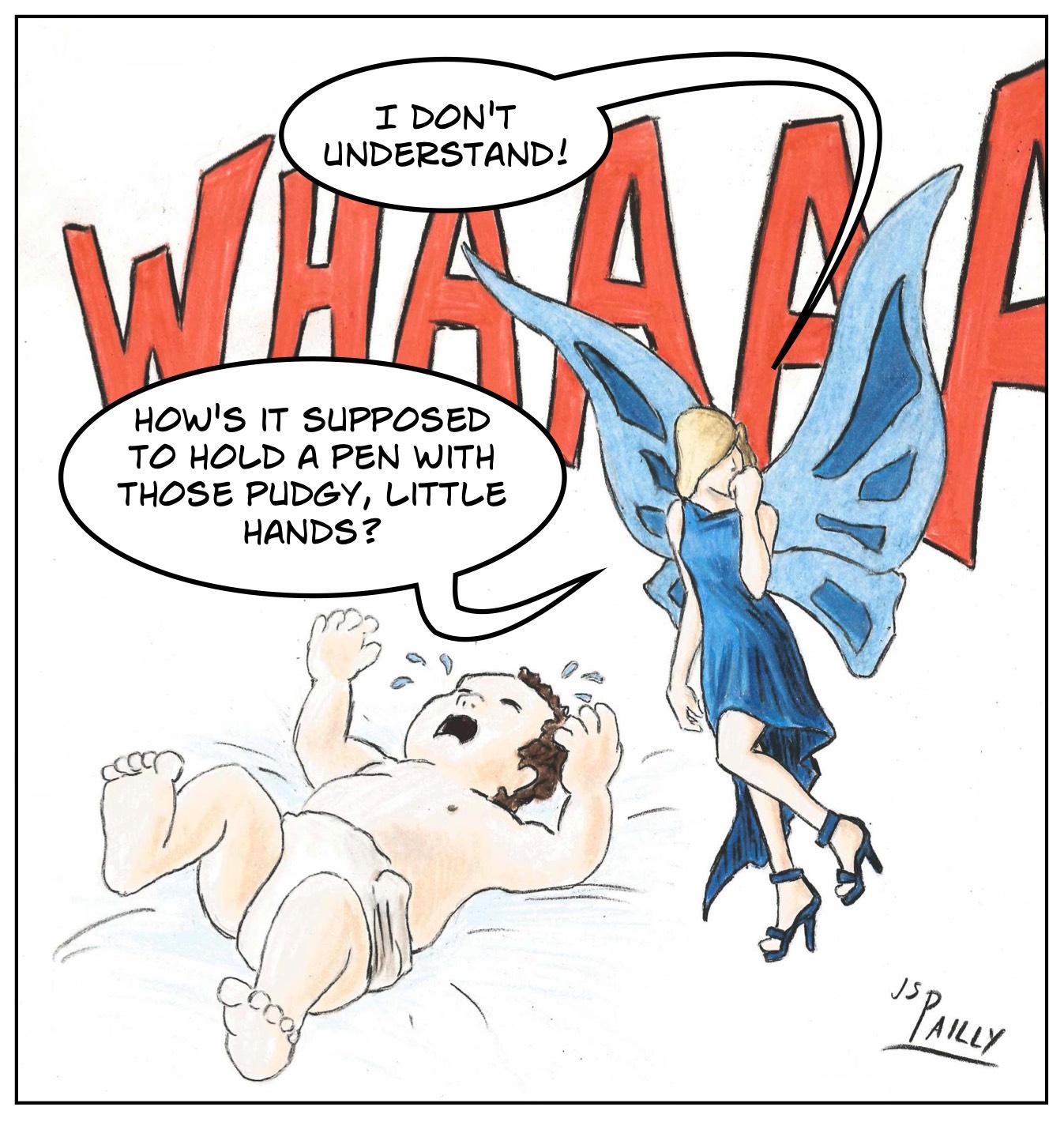
We had to start with the basics.  I began by encouraging my writer to take an interest in the alphabet.  He had these wooden blocks with letters on them.  Those helped.  Then I got him interested in words.  Spelling was a challenge for many, many years, but we worked through that.  Then came grammar, syntax, rhymes and rhythm—allegory, metaphor, irony, parallelism—comedy and tragedy—classic literature and genre fiction…  We made progress.  My writer has learned much since I first met him; he also still has much to learn.

But writers are human, of course, and they can be stupid in the way all humans are stupid.  They like instant gratification.  They want quick, easy solutions to their problems, including their writing-related problems.  But writing is a skill that improves slowly.  Gradually.  The growth of a writer happens so slowly and so gradually that it may be almost imperceptible, even to writers themselves. Some writers may fool themselves into believing that they’re not improving at all, or they may start to fear that improvement is not possible.  They forget how far they’ve come, and they worry themselves sick over how much further they still has to go.

Needless to say, as a muse, you must never give up on your writer.  More importantly, though, never let your writer give up on him or herself.  Make your writer keep writing.  Make your writer keep practicing, keep trying.  Do that, and the writing will get better.  I promise.

#IWSG: Perpetual Self Doubt Machine

Are you a writer?  Do you feel insecure about your writing life?  Well then the Insecure Writer’s Support Group is the support group for you!  IWSG is a monthly blog hop created by Alex J. Cavanuagh and co-hosted this month by Jemima Pett, Debs Carey, Kim Lajevard, Sarah Foster, Natalie Aguirre, and T. Powell Coltrin.  If you want to learn more about this amazingly supportive group and see a full list of participating blogs, click here.

Hello, friends!  For today’s IWSG post, I’ve decided to turn the floor over to my muse, the magical fairy person who encourages me (sometimes by brute force) to do my writing.  She has something to say, and perhaps it’s something your muse would like to hear.

* * *

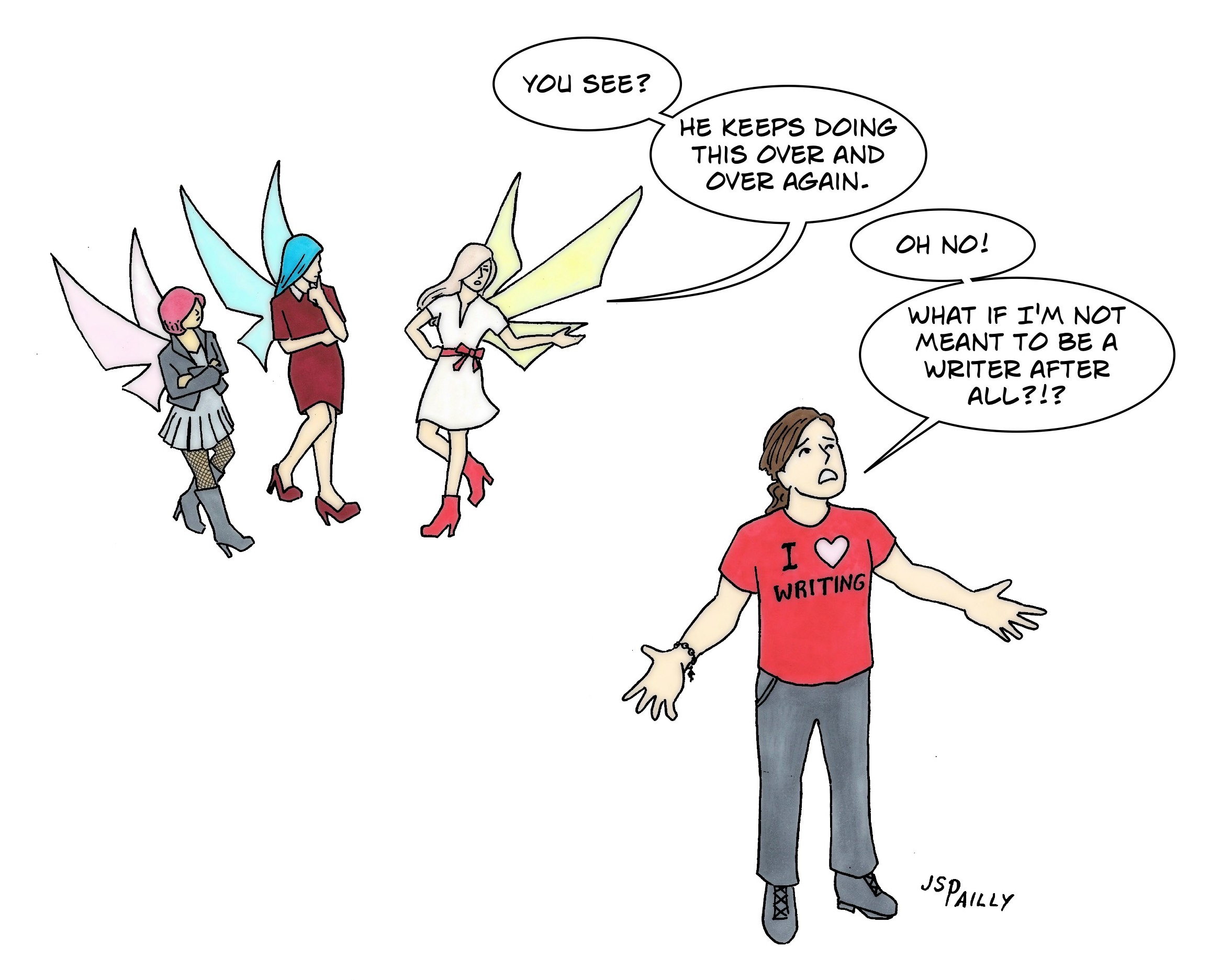
My fellow muses, what do you do when your writer stops believing that they’re a writer?  Writers write.  It’s the most natural and normal thing for them to do.  And yet many writers (my own included) make themselves miserable with self doubt.  My writer often starts asking himself questions like “Is writing really worth it?” or “Why am I doing this to myself?” or “What if it’s time to quit writing?”

From talking with other muses, I’ve learned that many creative humans struggle with these questions.  If only there were a way self doubt could be used to generate energy, the perpetual self doubt of writers and artists could be used to solve the humans’ energy crisis.

Recently, another human said a thing to my writer.  An insensitive and cruel thing.  As a direct result of this thing that was said, my writer started asking himself more frequently and fervently: “Should I give up on writing?”  Again and again, day and night, for weeks on end: “Should I give up?  Should I give up?  Should I give up?”

Obviously, the answer is no, but it was equally obvious that doubts and insecurities of this kind had been simmering beneath the surface for a long time already.  Otherwise, one single, careless comment would not have caused so much duress.  So rather than simply saying “no” to all this self-doubting and self-questioning, I offered a different question: “Should you, perhaps, give up on writing this one project—this one particular project that you’ve been stuck on for the past two or three years?”

That gave my writer pause.  That got my writer thinking again, got him wondering what he might write instead of that old writing project.  It got him to consider ideas that were fresh and new, ideas that are true to the person my writer is today, rather than the person he used to be several years ago.  Of course, my writer did not come up with these fresh new ideas without help.  I contributed to the process.  I am his muse, after all.

So, my fellow muses, if your writer keeps getting stuck on questions like “Should I give up on writing?” a simple “no” may not be sufficient.  A better answer may be to change or rephrase the original question.

#IWSG: We’ll Fly When We’re Ready

Hello, friends!  Welcome to this month’s meeting of the Insecure Writer’s Support Group, a blog hop created by Alex J. Cavanaugh and co-hosted this month by Kim Lajevardi, Cathrina Constantine, Natalie Aguirre, Olga Godim, Michelle Wallace, and Louise – Fundy Blue.  To sign up for IWSG and to learn more about this amazingly supportive group, click here!

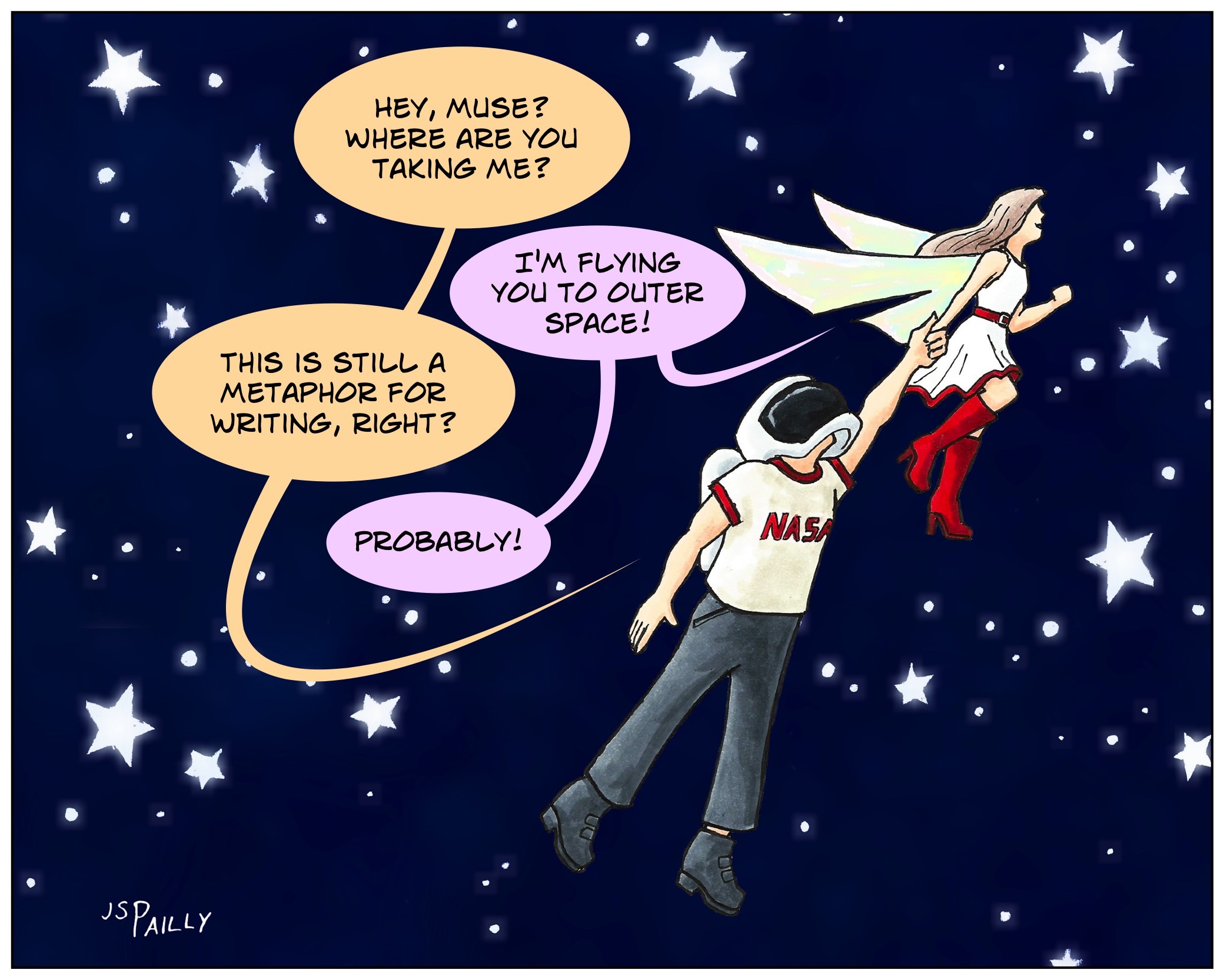
In my last two blog posts, I wrote about the Indian space program and the American space program.  Both have suffered recent delays and setbacks.  Both are still moving forward with their space exploration plans, despite those setbacks.  Whenever I read about real life space programs, I’m always struck by the parallels between space exploration and writing.

Whether we’re talking about space or writing, we’re talking about big ambitions.  Big aspirations.  We’re talking about a lot of hard work (but the fun kind of hard work, the exciting kind of hard work).  We’re also talking about constant setbacks and delays, with certain financial realities looming over us at all times.

A couple years ago, I published my first novella-length Sci-Fi story on Amazon Kindle.  My plan was to follow up, quickly, with a sequel.  Around the same time, I also launched a store on RedBubble so I could sell prints of some of my art.  And then… setbacks.  Delays.  Real life problems.  It was like trying to plug fuel leaks on the Artemis 1 rocket.  As soon as I fixed the problem here, I’d discover liquid hydrogen was spraying all over the place over there.

I can report that 2022 has been a better year for me.  Slowly—very slowly—my writing and my art have gotten back on track.  I’ve been blogging more.  I’m making progress on my next Sci-Fi novella.  Also, I’ve started uploading new art to my RedBubble store for the first time in two years.  But writing takes time.  Art takes time.  As much as I want to rush forward with all my creative dreams, I need to be patient with myself.

After NASA scrubbed the launch of Artemis 1 not once but twice last week, NASA Administrator Bill Nelson had this to say: “We’ll fly when we’re ready.”  Right now, as I get back into the rhythm of writing and illustrating, that’s my mantra.  My muse and I… we’ll fly when we’re ready.

#IWSG: The Spice of Life

Hello, friends!  Welcome to this month’s meeting of the Insecure Writer’s Support Group, a blog hop created by Alex J. Cavanaugh and co-hosted this month by Kim Elliott, Melissa Maygrove, Chemist Ken, Lee Lowery, and Nancy Gideon.  To learn more about this amazingly supportive group, click here!

“Do one thing and do it well.”  I’ve heard this aphorism over and over again throughout my life, and there’s a certain common sense simplicity to it that I find appealing.  Whenever life gets complicated and I feel like I’m being pulled in too many directions at once, I really wish I could pick just one thing to do—I wish I could be permitted to focus all my time and energy on just one thing, without any distractions, so that I could have a chance to do that one thing exceptionally well.

Last month, I participated in the A to Z Challenge.  For anyone who doesn’t know, the A to Z Challenge is a month-long blogging event.  Participants post twenty-six blog posts, one for each successive letter of the alphabet.  All of my posts were about humanity’s future in outer space, or perhaps I should say humanity’s potential future in outer space.  Our species has so much potential!  But I do realize there’s no guarantee that we’ll live up to our potential, though.

In order to ensure my success with the challenge, I canceled any other plans I’d made in the month of April.  I used up a bunch of vacation days at my job.  I made sure I got my taxes done super early this year.  I put a few of my other creative projects on hold, temporarily.  I engineered my whole schedule so that I would able to do just this one thing: blogging.  Did I do it well?  That’s a subjective thing, of course, but I feel that I did the best I possibly could on most of my posts.  And it felt good.

However, there came a point when I started to miss working on my other creative projects.  Being able to “do one thing and do it well” feels nice, but to really thrive, I need variety in my creative life.  My muse was kind enough to hold back on new ideas during the A to Z Challenge.  Now, however, there’s a backlog of ideas that my muse would like me to work on—and I am eager to get to work on those new ideas!

“Do one thing and do it well” can be good advice, for a short time.  When life gets complicated, sometimes we need to stop and have the simplicity of doing one and only one thing for a while.  But when I think about my lifelong goals, when I think about my own future as a writer/artist/blogger, there’s a different aphorism that I’d rather live by: “Variety is the spice of life.”