Sciency Words: (proper noun) a special series here on Planet Pailly focusing on the definitions and etymologies of science or science-related terms. Today’s Sciency Word is:
PLASMA TORUS
Astronomers have discovered thousands of planets out there. Exoplanet hunting techniques have gotten so good that astronmers are now moving on to the next great challenge: finding exomoons. And one possible method for detecting exomoons involves something called a plasma torus.
Ever since the 1960’s, we’ve known something weird was happening with Io, one of the moons of Jupiter. In 1964, an astronomer by the name of E.K. Bigg determined that Io had some strange power over Jupiter’s magnetosphere. Subsequent research identified clouds of ionized sulfur and sodium in the vicinity of Io’s orbit. Then in 1979, NASA’s Voyager 1 space probe photographed Io up close, catching Io in the act of spewing a mix of sulfur compounds and other noxious chemicals into space.
We now know that Io is the most volcanically active object in the Solar System and that Io’s volcanic activity directly affects Jupiter’s magnetic field. As you can see in this totally legit Hubble image, Io has created a nasty mess around Jupiter.
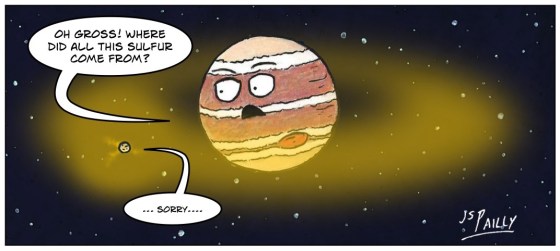
All those nasty chemicals get swept up in Jupiter’s powerful magnetic field, which acts like a supersized particle accelerator, turning those chemicals into a high-energy plasma.
I can’t be sure who coined the term plasma torus, but a multitude of papers from the 1960’s and 70’s (like this one, or this one, or this one) attempt to model the plasma clouds surrounding Jupiter as a torus—torus being the fancy mathematical term for “donut-shape.”
The nifty thing about Io’s plasma torus is that you can detect it even from a great distance. Even if you’re too far away to observe Io directly, you can still infer that she’s there based on all those ionized chemicals swirling around Jupiter and the effect those chemicals have on Jupiter’s magnetic field.
So could we find volcanically active exomoons by looking for plasma tori? According to this paper from The Astrophysical Journal, we sure can—and maybe we already have! The paper identifies the signatures of possible plasma tori encircling several large exoplanets.
One thing I’m not sure about: when we find a plasma torus, can we be 100% certain it’s caused by an exomoon? Are there any other natural (or unnatural) phenomena that might cause a plasma torus to form? I don’t know.
P.S.: Safety warning to any space adventurers who might be reading this. A plasma torus is a high radiation environment. Keep your distance!
 Planet Pailly