
Today’s post is part of a special series here on Planet Pailly called Sciency Words. Each week, we take a closer look at an interesting science or science-related term to help us all expand our scientific vocabularies together. Today’s word is:
SOLAR WIND
The Sun produces more than just sunlight. In addition to boring, electrically neutral photons of various wavelengths, the Sun also unleashes a near constant onslaught of electrically charged particles that wreak havoc upon the Solar System.
These charged particles are collectively known as the solar wind, and they come in two groups: slow and fast. The slow solar wind originates mainly from the Sun’s equator and travels at a leisurely 400 kilometers per second. The fast solar wind moves at almost twice that speed. It comes from coronal holes (low density regions of the corona) which tend to form near the Sun’s poles.
Both types of solar wind exert a slight pressure on everything they touch, from planets and moons to comets and asteroids. This is a slight pressure, but over long stretches of time it’s enough to nudge asteroids off course, clear dust and debris from the inner Solar System, and strip away entire planetary atmospheres.
Luckily for us, Earth can protect itself. Remember: the solar wind is composed of electrically charged particles, and Earth has a global magnetic field. As a result, the solar wind cannot blast Earth directly. For the most part, the magnetic field either repels solar wind particles away or directs them toward Earth’s poles (where the particles trigger auroras).
That’s good news for us humans, but don’t relax yet. The solar wind varies in intensity, turning from a gentle breeze into explosive solar storms.
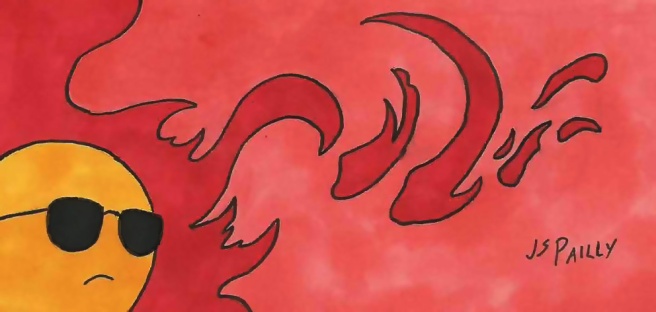
Earth’s magnetic field still protects our planet during these storms, but not our technology. We learned this the hard way in 1859 when a huge coronal mass ejection struck Earth head on. It was too much, and Earth’s magnetic field sort of freaked out, overloading the global network of telegraph wires. If this happened again today, with our fancy Internet and power grids and satellites, it would… actually, no one really knows what would happen.
Also, the solar wind is a form of radiation, composed primarily of broken pieces of hydrogen and helium atoms. The crew of the International Space Station are still protected (somewhat) by Earth’s magnetic field, and the Apollo Missions to the Moon were brief enough to keep total radiation exposure for astronauts fairly low.
But the future of human space exploration, both in reality and in science fiction, very much depends on this question: how do we protect ourselves from the solar wind?
 Planet Pailly