What Color was the Eclipse?

Hello, friends!  I have recently returned from a trip to see the 2024 solar eclipse (my first total solar eclipse!).  I was traveling with a couple of friends.  Due to weather-related concerns, we dropped our original plan to watch the eclipse in Buffalo, New York, and instead drove to a small town called Port Burwell, situated on the Canadian side of Lake Erie.

On the day of the eclipse, Port Burwell was the only place within hundreds of miles with a sunny forecast.  Everywhere else was supposed to be cloudy or partly cloudy.  Port Burwell’s forecast was sunny.  We were not the only ones to realize this, and so we ended up being part of an enormous mob of people who descended upon this cute, lakeside town–a town that was very obviously not expecting so many people to show up.  The locals were super nice, super welcoming, but also, very obviously, very surprised.

I wound up watching the eclipse from a concrete pier, with a cold (increasingly cold, once the event began) wind blowing on me from the lake.  There have been only a few moments in my life where I felt like I’d been transported, body and soul, into another world: exploring the ancient cliff dwellings at Mesa Verde, seeing the bacterial mats at Yellowstone National Park, and standing on that pier in Port Burwell while the last light of the Sun flashed and vanished behind the Moon.

What happened next?  Speaking as a writer, as a man of words, as a person who owns an absurd number of dictionaries and thesauruses, please understand what I mean when I say I have NO WORDS to describe the next three minutes.  Strange?  Beautiful?  Terrifying, on some deep and primal level?  Those words point in the general direction of what this experience felt like.  And that’s the best I, as a writer, can offer.  Sorry.  Words fail me.

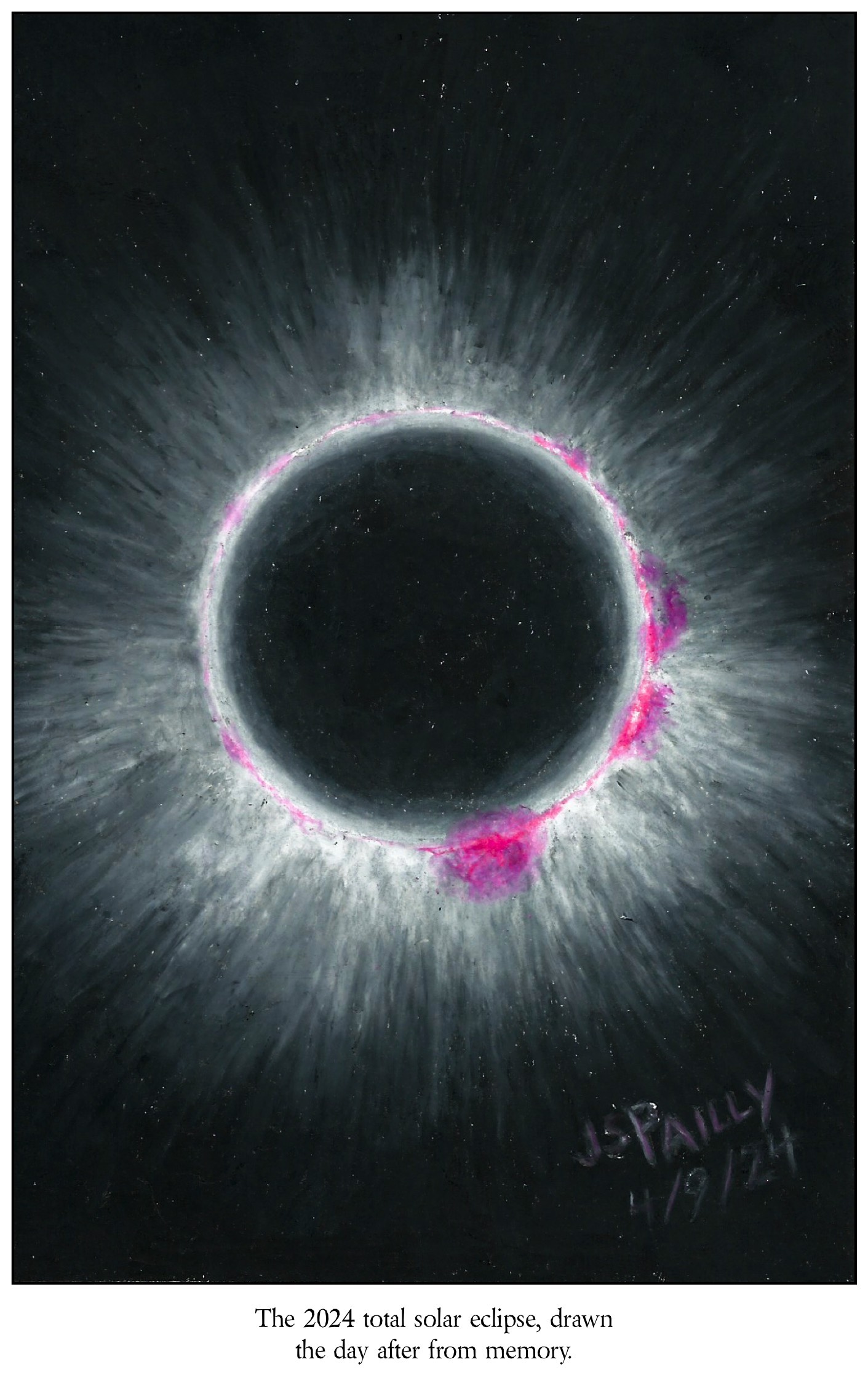
Although, there is one more word I would use to try to communicate what my eclipse experience was like.  It’s the name of a color.  Magenta.  As it so happens, the 2024 eclipse occurred during solar maximum, the most active part of the Sun’s eleven year cycle.  Several solar prominences (those giant, fiery arcs that rise up from the Sun’s surface) were visible to the naked eye during the eclipse.  One extremely bright prominence appeared near the “bottom” of the Sun, and I saw two other large, flickering prominences on the Sun’s righthand side.

To my eye, the prominences were the most perfect magenta color I have ever seen in nature.  It was like the pure magenta that computers generate in a CMYK color pallet.  The next day, I decided to try drawing the eclipse based solely on my own memory (see the image above).  Memory is an imperfect thing.  In my drawing, it seems that I made the bottom and righthand prominences bigger than they really were (probably because those three prominences stand out so prominently in my memory).  But the color is about right.  That color is, I swear to you, the color that I saw.  Which is strange, because my best friend, who was standing right next to me at the time and who was definitely seeing the same eclipse I was, swears the prominences were bright, bright red.  Not magenta.  Red.

After I drew my version of the eclipse, my friend used color correction software to try to approximate the color he saw.  He tells me his version is still not quite right, but it’s close enough.  So here’s the side-by-side comparison:
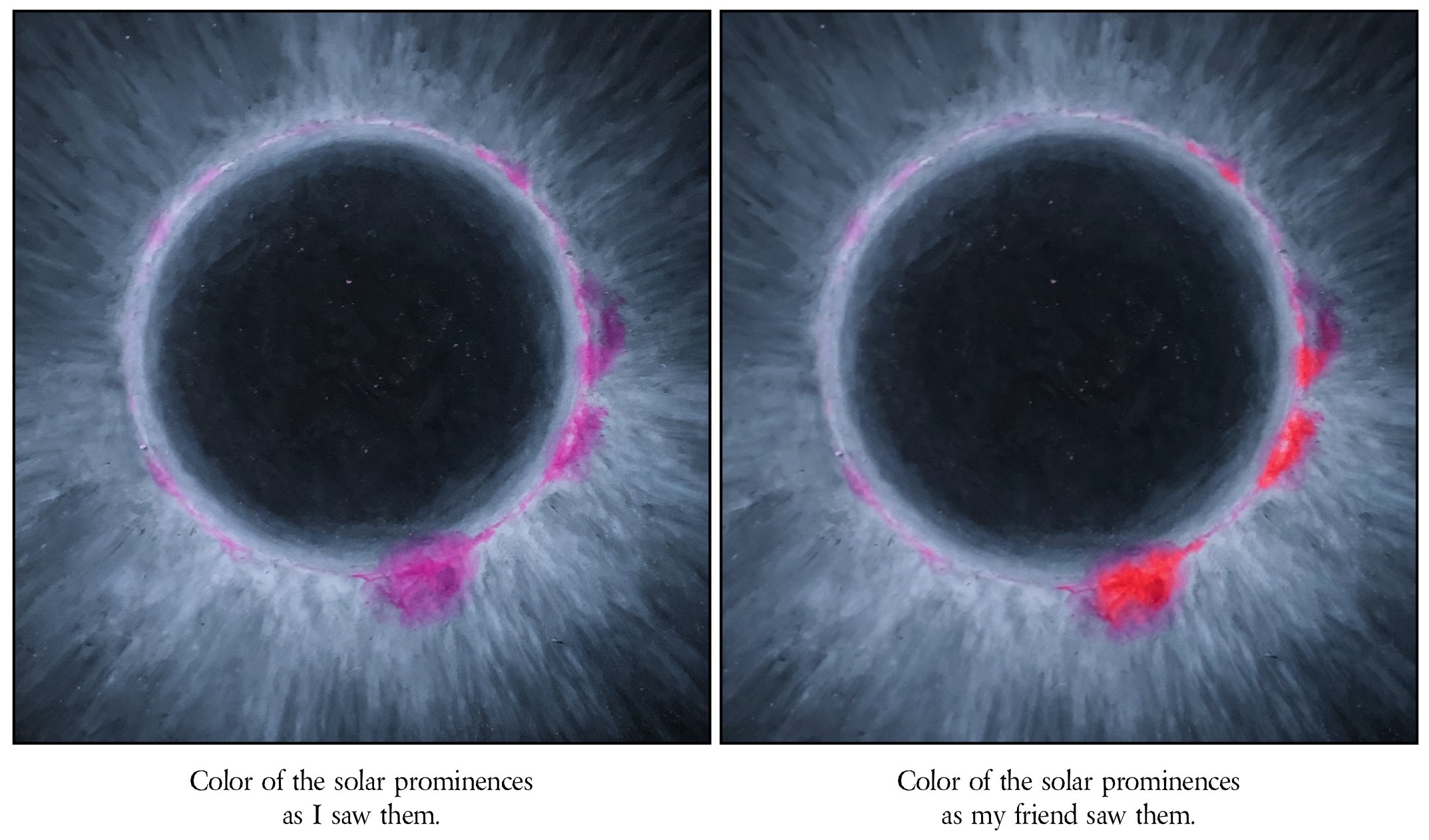
After comparing notes with a few other people who also saw the eclipse, it seems that most people (but not everyone) saw what my friend saw: a bright red color.  One person went so far as to call it an orangey-red color.  Only a few people saw the same magenta color I saw.

There’s so much about the eclipse that I did not expect, but this red vs. magenta thing is the part I expected the least.  So I want to end this post by asking you, dear readers: did you see the eclipse?  And if you did, what color were the solar prominences?  Did they look red to you?  Did they look magenta?  Did you, perhaps, see a different color entirely?

Sciency Words: Coronium

Hello, friends!  Welcome to Sciency Words, a special series here on Planet Pailly where we take a closer look at the definitions and etymologies of scientific terms.  Today on Sciency Words, we’re talking about the word:

CORONIUM

Here on Sciency Words, we usually talk about scientific terms that are relevant and useful in modern science, but sometimes I like to draw attention to scientific terms that didn’t make it.  I think it can be helpful to learn about how and why words drop out of the scientific lexicon.  So today, we’re going to talk about coronium, a chemical element that we now know does not exist.

Definition of coronium: A chemical element that scientists in the late 19th and early 20th Centuries thought existed based on a mysterious green emission line detected in the Sun’s corona.  At least one very prominent scientist (Dmitri Mendeleev) believed coronium to be an element lighter than hydrogen, with chemical properties similar to helium and argon.

Etymology of coronium: In 1869, American astronomers Charles Augustus Young and William Harkness independently detected a green emission line in the Sun’s corona during a solar eclipse.  In 1887, Professor A. Grünwald proposed the name “coronium” for whatever chemical substance caused that green emission line.  Since this unknown substance was first detected in the Sun’s corona, coronium seemed like an obvious name.

The “discovery” of coronium came right on the heels of the discovery of helium, and the story of these discoveries was eerily similar.  Scientists observe a solar eclipse.  A strange, new emission line appears in Sun’s spectrum, as measured using a spectroscope.  This emission line is (or seems to be) the first evidence of a newly discovered chemical element.

Dmitri Mendeleev was initially skeptical about both helium and coronium, because he couldn’t find places for them in his periodic table of the elements.  Toward the end of his life, however, Mendeleev tried to shoehorn these elements, along with several others, into his theories by adding a “group zero” to the periodic table.  Each group zero element is lighter than the group one element it sits next to—for example, argon is lighter than potassium, neon is lighter than sodium, helium is lighter than lithium… and coronium ended up sitting next to hydrogen, indicating that coronium is an element lighter than hydrogen.

Mendeleev was a smart man, but he was wrong about group zero.  After some reshuffling of the periodic table, most of the group zero elements were moved to group eighteen (a.k.a. “the noble gases”), and in the end, it turned out there really was no place for coronium.  No element lighter than hydrogen exists.

So what caused that anomalous green emission line in the Sun’s spectrum?  Turned out it was iron.  In the 1930’s, German and Swedish astronomers Walter Grotian and Bengt Edlén discovered that a form of super-hot, super-ionized iron gives off an emission line at 530.3 nm—an exact match with the 530.3 nm green emission line found in the solar corona.  Without the power of the Sun (or the power of modern laboratory equipment), iron doesn’t get hot enough or ionized enough to reveal that part of its spectrum.  As a result, scientists in the late 1800’s couldn’t have known what that strange, green emission line was.

Coronium is a Sciency Word of the past, from a time when the spectroscope was a relatively new scientific instrument and the periodic table was still a work in progress.  We no longer need to imagine there’s an exotic chemical element found only in the Sun’s corona, not when super-ionized iron explains that green emission line in the Sun’s spectrum just as well.

WANT TO LEARN MORE?

Here’s an interesting article about Dmitri Mendeleev and his mistakes, including his mistakes about coronium and the “group zero” elements.  For anyone involved in science education, this article makes a compelling case about why teaching the history of science is so important, with an emphasis on showing how scientists don’t always get it right on the first try.

I also want to recommend this book, simply titled The Sun.  It is full of cool and useful space facts that I had never read about before anywhere else (including the false discovery of coronium).  The Sun is part of a series called Kosmos, and I highly, highly, highly recommend this series to anyone who loves space.

And lastly, here’s a link to A. Grünwald’s 1887 paper where he first proposed the name “coronium” for a “hitherto unknown corona-substance.”

Science Can’t Explain Everything

Hello, friends!

As you know, I love science.  I’m a little obsessed.  But there are people who get annoyed or even offended by my obsession with science, and every once in a while one of these people will remind me, sternly, that science can’t explain everything.  And you know what?  I generally agree with that sentiment.  But then people start declaring that science will never know this specific thing or that specific thing, and I immediately think of a certain 19th Century French philosopher named Auguste Comte.

Comte was not some scientifically illiterate buffoon.  He wasn’t one of those 19th Century evolution deniers, or one of those latter-day opponents to the heliocentric model of the Solar System.  In fact, Comte is regarded today as the very first philosopher of science, in the modern sense of that term, and he gets credit for coining the word “sociology” and for laying the philosophical foundation for that entire branch of science.  There’s also a wonderful quote from Comte about the mutual dependence of scientific theory and scientific observation.  Basically, you can’t formulate a theory without observation, but you also can’t make an observation without the guidance of a theory.

But that is not the Comte quote I think of whenever somebody starts lecturing me about the things science will never know.  It’s this quote about the stars: “[…] we shall never be able by any means to study their chemical composition or their mineralogical structure…”  Comte also declared that: “I regard any notion concerning the true mean temperature of the various stars as forever denied to us.”

Comte wrote this in 1835, and if you can put yourself into an 1835 mindset you can see where he was coming from.  There’s no such thing as rocketry.  We don’t even have airplanes yet.  And even if you could fly up to a star (or the Sun), how would you measure its temperature?  What kind of thermometer would you use?  And how would you go about collecting stellar material, in order to determine the star’s chemical composition?

According to Comte—a highly intelligent and very pro-science person—this sort of knowledge was utterly impossible to obtain.  And yet only a few decades later, thanks to the invention of the spectroscope, scientists started obtaining some of this unobtainable knowledge.  For those of you who don’t know, spectroscopes separate light into a spectrum.  Some parts of the spectrum may appear brighter or darker than you might otherwise expect, depending on which chemical substances emitted or absorbed the light before it reached the spectroscope.  And so by comparing the spectral lines of chemicals we have here on Earth to the spectrum obtained from the light of a star, you can determine the chemical composition of that star.

You can also measure a star’s temperature thanks to a concept known as black body radiation.  Basically, black body radiation refers to the fact that things glow as they got hotter.  If no other light sources are involved, then the color of a glowing object will be directly related to that object’s temperature.  Ergo, if you know what color a star is, then you can work out a pretty accurate estimate of what temperature that star must be.

Auguste Comte didn’t foresee any of this.  It is certainly true that science does not know everything, and there are surely things that science will never know.  But if you think you know, specifically, what science can never know, I question that.  Someday, some new invention (like the spectroscope) or some breakthrough discovery (like black body radiation) may turn an utterly unknowable thing into a matter of trivial measurements and calculations.

Maybe the one thing science truly can never know is what science’s own limitations are.

WANT TO LEARN MORE?

Here’s a very brief post about Auguste Comte, what he said about stars, and how epically wrong he was with that one prediction.

Also, here’s a short article about some genuine limitations that science has, like aesthetics, moral judgements, etc.

Sciency Words: P-P Chain

Hello, friends!  Welcome to Sciency Words, a special series here on Planet Pailly where we discuss the definitions and etymologies of scientific terminology.  In today’s post, we’ll be discussing the scientific term:

P-P CHAIN

I have, in the past, been accused of covering scientific terms on the basis of how silly they sound, rather than on the basis of pure scientific merit.  But I would never do such a thing.  I have far too much respect for both science and linguistics.  Now with that unambiguously established, let’s talk about the p-p chain.

Definition of the p-p chain: In the field of nuclear physics, the p-p chain refers to a series of nuclear fusion reactions, starting with the fusion of two protons and leading, ultimately, to the creation of a helium-4 nucleus.  The p-p chain is by far the most common fusion process occurring in the core of the Sun, as well as other stars of similar or smaller sizes.

Etymology of the p-p chain: The p’s in p-p chain refer to the two individual protons that fuse together in the very first step of the process.  English astronomer Sir Arthur Eddington first proposed that proton-proton fusion might be occurring inside stars, writing about it in a 1926 article titled “The Internal Constitution of the Stars.”  German-American theoretical physicist Hans Bethe worked out the step by step details of the process in a 1939 paper called “Energy Production in Stars.”  Sadly, I cannot give credit to either Eddington or Bethe for coining this term.  They came up with the idea and worked out the details, but I have not been able to determine who, exactly, first introduced the term “p-p chain” into the scientific literature.

There are at least three versions of the p-p chain, each with different intermediate steps between the individual protons at the start and the helium-4 nuclei at the end (a fourth version is possible in theory, but has yet to be verified in reality).

Recently, scientists at the National Ignition Facility (NIF) in California made significant progress in nuclear fusion research.  That recent experiment has been described as recreating the power of the Sun here on Earth, which is true enough.  But NIF did not recreate the entire p-p chain from start to finish; they did something loosely equivalent to the very last step only.  It seems that reproducing the whole chain is still beyond our current scientific abilities.

So the next time you notice the Sun, shining yellow-gold in the sky, just remember that she can still do p-p chains in ways we humans cannot.

WANT TO LEARN MORE?

If you’re looking for a more detailed and technical explanation of the p-p chain (and the three or four variations thereof), check out this article from encyclopedia.pub.  That article was my main source of information while writing this post.

You can also find Arthur Eddington’s “The Internal Constitution of the Stars” by clicking here and Hans Bethe’s “Energy Production in Stars” by clicking here.

And if you’re looking for a fun way to try nuclear fusion for yourself, check out the game Fe[26].  You slide around tiles marked with the names of different atomic nuclei, trying to combine them to make bigger and bigger elements.  Which nuclear combinations work and which ones don’t?  Play and find out for yourself!

Sciency Words: Barycenter

Hello, friends!  Welcome to Sciency Words, a special series here on Planet Pailly where we talk about those super weird (but super cool) words scientists like to use.  Today’s Sciency Word is:

BARYCENTER

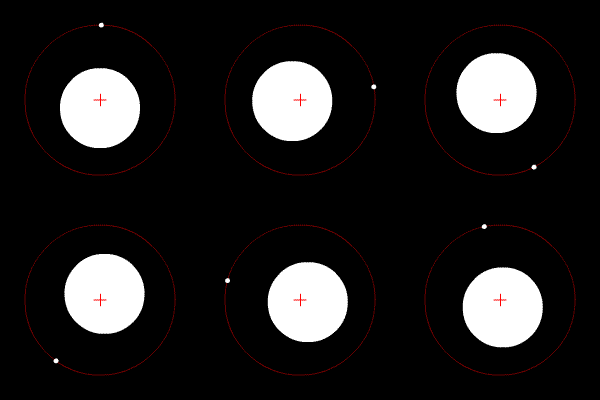
Tell me if you’ve heard this one: every action has an equal and opposite reaction.  This is true even for moons orbiting planets, or planets orbiting stars.  Whenever a star exerts gravitational force on a planet, that planet exerts an equal and opposite gravitational force on the star.  As a result of this ongoing gravitational tug-of-war, we end up with a planet and a star spinning round and round their common center of mass, a point which scientists call a barycenter.

Definition of barycenter: In astronomy, a barycenter is the center of mass of two or more objects in space that are gravitationally bound together.  

Etymology of barycenter: The word barycenter traces back to a Greek word meaning “weighty” or “heavy.”  The word barometer has a related etymology (barometers measure atmospheric pressure—the “weight” of the atmosphere, in other words).

Sometimes a barycenter will be located deep inside the more massive of two celestial bodies, in which case the more massive body will appear to wobble in place.  This is the case for the Earth and the Moon.  The Earth-Moon barycenter is approximately 1700 km beneath Earth’s surface.  Other times, the barycenter will be somewhere in the empty space between objects.  For an example, look at Pluto and its largest moon, Charon.  The Pluto-Charon barycenter is more than 900 km above the surface of Pluto.

The concept of a barycenter dates back to Isaac Newton (though I can’t find any sources saying he coined the word, nor could I find any evidence that he ever used the word himself).  Newton’s Principia Mathematica, originally published in 1687, briefly discusses the Sun-Jupiter barycenter, saying, “[…] the common centre of gravity of Jupiter and the sun will fall upon a point a little without the surface of the sun.”  Newton also discusses the Sun-Saturn barycenter, which he describes as “[…] a point a little within the surface of the sun.”

And then there’s the barycenter of the Solar System as a whole: the “common centre of gravity of all the planets,” as Newton calls it.  Due to the combined gravitational forces of all the planets (most especially that of the giant planets: Jupiter, Saturn, Uranus, and Neptune), the Sun is constantly being pulled in multiple directions at once.

As a result, the Sun does not sit still in the middle of our Solar System.  It is “agitated by perpetual motion,” to quote Newton one last time.  Sometimes, as the Sun moves about, it happens to pass through the Solar System’s barycenter. Other times, it loops and spirals around the barycenter, as if performing an elaborate dance.

WANT TO LEARN MORE?

Here are a few articles that go into a little more detail about barycenters:

And here’s a link to the translation of Newton’s Principia Mathematica that I quoted in this post.  The relevant section is titled “Proposition XII.  Theorem XII.”

Now Open: The Planet Pailly Store!!!

Hello, friends!

If you’ve ever looked at my artwork and thought it would look good on a T-shirt or a notebook cover or a tote bag, well… I have good news for you!  The Planet Pailly store is now open on Redbubble.com!!!

You can get my artwork printed on shirts or coffee mugs or throw blankets… there’s a shockingly wide selection of stuff you can buy.  You can also get stickers in various sizes, so feel free to slap my artwork on anything and everything you want!

Now I was initially concerned about quality.  Redbubble is a print-on-demand service, and I’ve had some bad experiences with print-on-demand services in the past.  But I can assure you that Redbubble stuff is top quality.  I am really, really happy with the way this T-shirt turned out.

This spiral notebook is also really cool.

My only complaint is that Redbubble doesn’t offer free shipping.  They do, however, offer bundle discounts if you order multiple items at once.  So if you buy a T-shirt from me, and maybe a shower curtain from another artist, and a set of coasters from somebody else, your discounts should start stacking up nicely.

The Planet Pailly store currently has three “highly technical diagrams” that have previously appeared on this blog: the Sun, Jupiter, and Pluto.  More astronomical objects will be added soon (if you have requests, let me know in the comments).  Also coming soon: the cover art from Tomorrow News Network.

So if you’re looking for the perfect gift for your sciency friend, or the perfect gift for your sciency self, please check out my Redbubble store.  And be sure to check out some of the other artist stores on Redbubble too!  There’s cool stuff for everybody, and your money will help independent artists (like me) keep doing what we do.

Sciency Words: Syzygy

Hello, friends!  Welcome to Sciency Words, a special series here on Planet Pailly where we take a closer look at the definitions and etymologies of scientific terms.  Today on Sciency Words, we’re talking about the word:

SYZYGY

We’ve all seen pictures like this, with all eight planets lined up in a row:

And sometimes, on extra special occasions, the planets really do line up like that, or at least they come very close to it.  When this happens, we call it a grand syzygy.

The word syzygy traces back to ancient Greek.  It originally meant “yoked together,” as in: “The farmer yoked together his oxen before plowing the field.”  According to my trusty dictionary of classical Greek, the word could also mean “pair” or “union.”

Some closely related words in Greek referred to balance, teamwork, sexy times, etc.  And our modern English words synergy and synchronized have similar etymologies.  Basically, what all these words have in common is a sense of people or things coming together, in one manner or another.

For modern astronomers, syzygy means three or more celestial bodies coming together to form a straight line.  The most commonly cited example of this is the alignment of the Sun, Earth, and Moon that occurs during either a new moon or full moon, as observed here on Earth.

But an alignment doesn’t have to be perfectly straight to be called a syzygy, especially when we’re dealing with more than three objects.  According to this article from The New York Times, a syzygy of the Sun, Venus, Earth, Mars, Jupiter, and Saturn occured between March 25 and April 7, 1981.  The Sun and five planets came “within 2 degree of arc from a perfect straight line.”  Apparently that’s close enough.

But while that 1981 syzygy was pretty grand, it was not the grandest of grand syzygies.  The planets Mercury, Uranus, and Neptune were left out.  According to another article from The News York Times, a truly grand syzygy will happen on May 19, 2161, “[…] when eight planets (excluding Pluto) will be found within 69 degrees of each other […].”

So mark your calendars, friends!  You don’t want to miss the grand syzygy of 2161!

P.S.: And if you’re a Star Trek fan, you may recall that 2161 will be an auspicious year for another reason.  That’s the year when the United Federation of Planets will be founded—a political syzygy, one might say, occurring at the same time as an astronomical syzygy.

A Rainy Day on the Sun

Hello, friends!

I was recently introduced to a new song by Jean Grae entitled “Stop Drawing Sunglasses on the Sun” (click here).  The song raises some valid points.  As an artist who frequently draws sunglasses on the Sun, I guess I have some soul-searching to do.

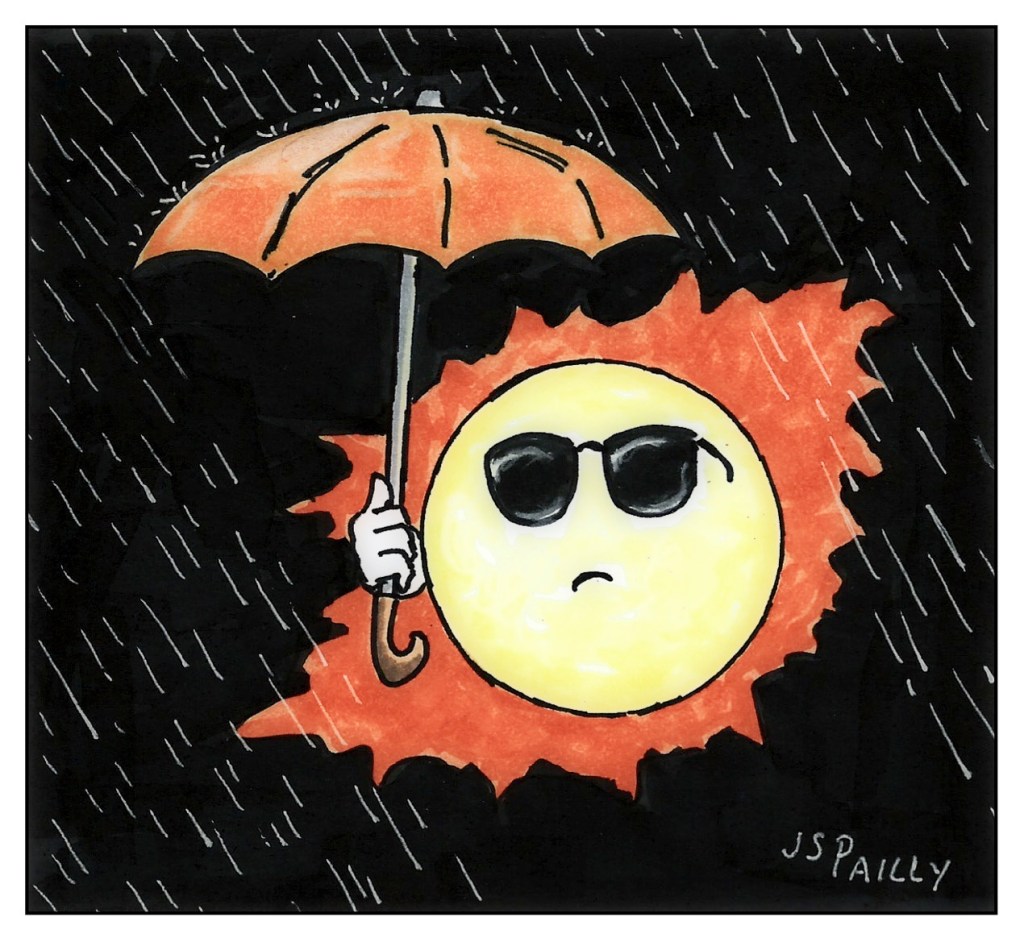
In the meantime, I recently saw a report on spaceweather.com that said it was raining on the Sun.  So naturally, I drew this:

Pretty much everything associated with the Sun it extremely big, extremely hot, and relates somehow to the Sun’s extremely powerful magnetic field.  The Sun’s coronal rain (no relation to the coronavirus) is no exception.

First, let’s talk about the role of the magnetic field.  Ionized gas (a.k.a. plasma) rides up the Sun’s magnetic field lines to form solar prominences: those arch-like or loop-like structures that are often seen suspended above the Sun’s surface.

These prominences are extremely hot, at least by Earth standards, but they’re not quite as hot as the Sun’s surface.  According to this paper from Astrophysical Journal Letters, there are at least two possible explanations for how solar prominences loose their heat.  Whatever the cause of the heat loss, the result is that the cooling plasma begins to condense, much as cooling water vapor condenses in Earth’s atmosphere.  And then rain drops start to form.

But of course, these rain drops are extremely big, more like “rain blobs.”  Due to the technical limitations of Earth-based and space-based solar observatories, we can’t say for sure how big these rain blobs get, but some appear to be “on the order of 5000 km in radius,” according to that same paper from Astrophysical Journal Letters.

So in summation, it rains on the Sun.  Seriously, it rains a lot!  And like pretty much everything else relating to the Sun, this coronal rain is extremely big, extremely hot (by Earth standards), and is associated with the Sun’s extremely powerful magnetic field.  So maybe the Sun doesn’t need sunglasses, but an umbrella seems appropriate.

Next time on Planet Pailly, what is so super about a supermoon?

Sciency Words: Solar Wind

Hello, friends, and welcome to another episode of Sciency Words.  Each week, we take a closer look at some science or science-related term so we can expand our scientific vocabularies together!  Today on Sciency Words, we’re talking about:

THE SOLAR WIND

The stars twinkle in our sky because Earth’s atmosphere scatters starlight.  The Sun has an atmosphere too, so it shouldn’t surprise you to learn that when astronomers observe stars that happen to be near the Sun (as viewed from Earth), they can see that the Sun’s atmosphere also scatters starlight.

What might surprise you—and what did surprise astronomers in the 1950’s—is that this scattering effect can extend very, very far into the space around the Sun.  The Sun’s atmosphere must be huge!  As reported in this 1959 article from Scientific American, the Sun’s atmosphere might be so big that it encompasses Earth!

Pursuing this and other lines of evidence (such as the apparent correlation between flare activity on the Sun and aurorae here on Earth, as well as apparent 11 year fluctuations in cosmic radiation levels), American astrophysicist Eugene Parker wrote this paper in 1958, introducing a concept now known as the solar wind.

As you might imagine, the Sun’s atmosphere is hot.  Absurdly hot.  Remember that temperature is really just a measure of the average velocity of atoms, and you’ll soon realize (as Parker did) that atoms in the Sun’s atmosphere must have enough velocity to escape the Sun’s gravity.  And since those atoms would also be ionized, these streams of ionized particles coming from the Sun would serve as extensions of the Sun’s magnetic field.

The term solar wind doesn’t appear in that 1958 paper.  Parker first introduces that term in this 1959 paper, in which he defends his idea and responds to critiques from other astrophysicists.  As Parker explains:

In view of the simple hydrodynamic origin of the expansion, it seems appropriate to term the stream a solar wind.

Also in 1959, the Soviet Union’s Luna 1 space probe gathered the first empirical evidence that the solar wind really does exist, leading to confirmation that Eugene Parker’s solar wind hypothesis was correct.

And today, a NASA spacecraft named in Parker’s honor is spiraling closer and closer to the Sun, gathering more data about the solar wind and other mysterious phenomena associated with the Sun.

Next time on Planet Pailly, now that we’ve talked about the solar wind in our own Solar System, we’ll check out the space weather forecast for the solar system next door.

Sciency Words: Barycenter

Hello, friends!  Welcome to Sciency Words, a special series here on Planet Pailly where we talk about those big, complicated words scientists use.  Today’s Sciency Word is:

BARYCENTER

Excuse me, but I’m going to do that “um, actually” thing that people who think they’re really smart like to do.  Now you may think the Earth orbits around the Sun.  Um, actually… the Earth and Sun both orbit something called the barycenter.

The word barycenter comes from two Greek words meaning “heavy” and “center,” and it refers to the common center of mass for two or more celestial bodies.  Based on sources I found via Google Ngrams, the term started appearing frequently in astronomical journals during the early 20th Century, and it may have been in use as early as the 1880’s.

Let’s say you have two celestial bodies.  One is really massive, the other is much less massive.  In that case, the barycenter will probably be located somewhere inside the more massive object.  This is the case for the Earth and her Moon.  Based on numbers I got from Wikipedia, the Earth-Moon barycenter is about 1000 miles (1700 km) beneath Earth’s surface.  Or to measure that a different way, the barycenter is about 3000 miles (4600 km) away from the center of the Earth.

Now let’s say you have two celestial bodies of roughly equal mass.  In that case, the barycenter will be located somewhere between them.  Something like this has happened with Pluto and his giant moon, Charon.  Once more using numbers from Wikipedia, it looks like the Pluto-Charon barycenter is about 500 miles (960 km) ABOVE the surface of Pluto.

As for the Earth-Sun barycenter, it’s located deep inside the Sun.  So if you say Earth orbits the Sun, you’re not too far from the truth.  But of course Earth is not the only planet in the Solar System, and when you consider the Solar System as a whole, you’ll find the Sun wibbles and wobbles about in weird, loopy patterns.  As you can see in the highly technical diagram below, the Sun wibbles and wobbles so much it can wobble into a totally new position in just a few years.

Click here for an actual diagram of the Sun’s movement relative to the Solar System’s barycenter.

As explained in this paper, this is mainly due to the gravitational influences of Jupiter and Saturn. Over longer time scales (centuries rather than decades), the subtler influences of Uranus and Neptune also have a noticeable effect.

So the next time someone tells you the Earth orbits the Sun, you can do the “um, actually” thing and explain what a barycenter is.  Trust me, it’s a great way to sound smart and make lots of new friends!

Next time on Planet Pailly, what did people in 1962 think we’d find on other planets?