Our Place in Space: Callisto

Hello, friends!  Welcome to Our Place in Space: A to Z!  For this year’s A to Z Challenge, I’ll be taking you on a partly imaginative and highly optimistic tour of humanity’s future in outer space.  If you don’t know what the A to Z Challenge is, click here to learn more.  In today’s post, C is for…

CALLISTO

The major moons of Jupiter are Io, Europa, Ganymede, and Callisto.  In science fiction, Europa and Ganymede seem to get the most attention.  Sci-Fi writers often end up putting human colonists (or at least a handful of plucky human scientists) on the surfaces of one or both of these icy moons.  But today, I’m going to argue that Callisto would be a far more suitable home for future humans.

First off, and most importantly, there’s the issue of radiation.  The space around Jupiter is one of the most dangerous radiation environments in the entire Solar System.  As you can see in the highly technical diagram below, the radiation is most intense in the vicinity of Io.  The radiation levels get better in the vicinity of Europa and continue to taper off when you reach Ganymede.  You’re still soaking up a lot of radiation, though!  Callisto’s radiation levels, however, are fairly low.  You might even describe the radiation levels on Callisto as “survivable.”

Furthermore, planetary protection laws in the future may mean that both Europa and Ganymede are off limits to human settlers.  Scientists today are 99.99% sure that Europa has a vast ocean of liquid water beneath her surface, and (as you know) wherever there’s water, there may also be life.  There’s evidence suggesting Ganymede may have a subsurface ocean, too.  Europa is often said to be the #1 most likely place where we might find alien life here in the Solar System.  While the odds of finding life on Ganymede are considerably lower, the possibility of Ganymedean life shouldn’t be ignored.

There are already international agreements in place regarding extraterrestrial life.  Space agencies like NASA, the E.S.A., and others are legally obligated to do everything they can to protect suspected alien biospheres from our Earth germs (and also to protect Earth’s biosphere from any germs we might find in outer space).  For obvious reasons, these international agreements haven’t exactly been tested in court, and it’s a little unclear how they would be enforced.

But in a future where human civilization is spreading out across the Solar System, I’d imagine bio-contamination laws would become stronger, not weaker.  Europa would almost certainly be declared off-limits to humans, unless it is proven beyond a shadow of a doubt that no aliens currently live there.  Ganymede may end up being off-limits, too, for the same reason.

Meanwhile, we have Callisto.  Scientists who want to study possible biospheres on Europa and Ganymede could set up a research station on Callisto.  From there, they could keep a close eye on the other moons of Jupiter.  They could operate remote-controlled probes to explore Europa and Ganymede without risking contamination, or they could go on brief excursions to Europa and Ganymede themselves (taking proper safety precautions, of course).  While they’re at it, these scientist could also explore Io.  Io is the most volcanically active object in the Solar System.  There is virtually no chance that we’ll find life there, but studying Io’s volcanoes would still be interesting.

I’d be remiss if I didn’t mention this: Callisto might have liquid water beneath her surface, too.  Not as much liquid water as Ganymede, and nowhere near as much as Europa, but still… it’s possible.  Which means there’s a slim possibility that there could be life on Callisto.  But in Callisto’s case, it is a very slim possibility.  Based on what we currently know about Jupiter’s moons, Callisto still seems like the best place for humans to live.  The radiation levels are much lower, the risk of bio-contamination is negligible…  Yeah, if I were a science fiction writer, I’d put my human colonists on Callisto.

Want to Learn More?

In 2003, NASA published a plan to send astronauts to Callisto, with the intention of using Callisto as a base of operations to explore the other Jovian moons.  Click here to read that plan.  Some of the information is out of date, of course, but it’s still got some interesting ideas.  Maybe someday, something like this plan could work!

I’d also recommend this article on Planetary Protection Policy, covering some of the rules that are already in place to protect planets and moons where we might find alien life.


P.S.: If I were a science fiction writer…?  Wait a minute, I am a science fiction writer!  Click here if you want to buy my first book.  It’s not set on Callisto, unfortunately, but it’s still a fun story.

Our Place in Space: Breakthrough Starshot

Hello, friends!  Welcome to Our Place in Space: A to Z!  For this year’s A to Z Challenge, I’ll be taking you on a partly imaginative and highly optimistic tour of humanity’s future in outer space.  If you don’t know what the A to Z Challenge is, click here to learn more.  In today’s post, B is for…

BREAKTHROUGH STARSHOT

So it’s several hundred years into the future.  Human civilization has spread out across the Solar System.  Large numbers of people are living on the Moon and Mars.  We even have successful colonies on Venus and Mercury (more on that later this month) and a few smaller settlements on the various moons of the outer Solar System.  Does this mean we’re done exploring space?  Heck no!  There’s still plenty more outer space stuff to explore!

Just as NASA scientists here in the 21st Century send robotic space probes to our neighboring planets, scientists in the future will be keen to send robotic probes out to neighboring star systems.  And the model for a robotic mission to another star system already exists.  In 2016, venture capitalist Yuri Milner, theoretical physicist Stephen Hawking, and Facebook C.E.O. Mark Zuckerberg announced funding for a new research project called Breakthrough Starshot.

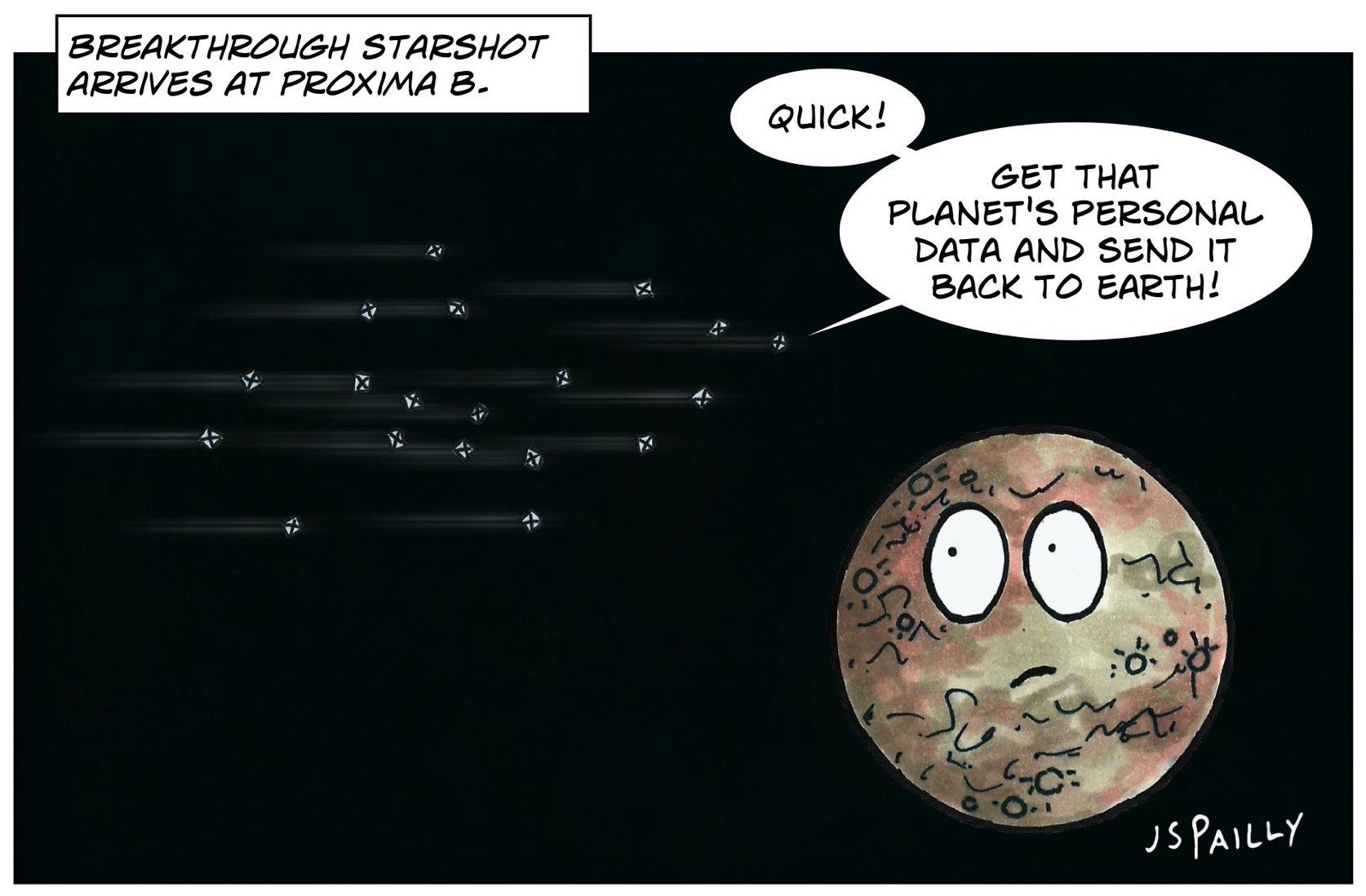
The idea is to build a swarm of teeny-tiny space probes, use high energy laser pulses to accelerate these probes straight out of the Solar System, and then sit back and wait for our probe swarm to transmit data back from another star system.  Specifically, Breakthrough Starshot wants to visit Proxima Centauri, the nearest star system to our own.  Proxima Centauri is known to have at least one planet, an Earth-sized world known as Proxima b.

Get it?  Because the C.E.O. of Facebook is involved in this project!

Could we actually build space probes that small?  Well, computer chips are pretty gosh darn small at this point, and they keep getting smaller.  So do cameras and other advanced electronic devices.  So yeah, this part of Breakthrough Starshot’s plan seems plausible enough.

What about that whole high energy laser pulse thing?  That part does seem more speculative to me, but experiments in Earth orbit have shown that light sail technology does work.  Just as the sail on a sailboat catches the wind, a light sail can catch light and use that light-pressure to propel a spacecraft through space.  A high energy laser aimed at a light-sail-equipped space probe… yeah, that sounds plausible to me, too.

Of course, a lot could go wrong with a space probe traveling through interstellar space.  That’s why we’d send a swarm of these things, rather than just one.  Most of the probes probably won’t make it to Proxima b, but the few that do survive the trip will send us some spectacular images and data.

Personally, I don’t like seeing headlines predicting that Breakthrough Starshot will be launching by such and such date (typically, a date in the late 2020’s or early 2030’s).  Breakthrough Starshot does seem to be founded on good science.  It’s the kind of program that really could work, someday.  But is it going to happen in the next ten to fifteen years?  No, I don’t think so.  That seems overoptimistic, in my opinion.

In the more distant future, however, Breakthrough Starshot (or a program very much like it) absolutely could happen.  This sort of thing could definitely work.  And looking ever further into the future, to a time when humans have thoroughly explored our own Solar System, the idea of sending swarms of microchip space probes to neighboring star systems might become routine.

Want to Learn More?

Click here to visit Breakthrough Starshot’s website.  They’ve got lots of information and videos explaining how they intend to get to Proxima b.

I’d also recommend clicking here to see a list of challenges that the Breakthrough Starshot team know they will need to overcome in order to make their plan work.

And for those of you who are looking for some heavier reading, click here to read “A Roadmap to Interstellar Flight,” a scientific paper that essentially serves as Breakthrough Starshot’s founding document.

October Is Europa Month Here on Planet Pailly!

Hello, friends!  Let’s talk about aliens!

If we want to find alien life, where should we look?  Well, if money were no object, I’d say we should look anywhere and everywhere we can.  Phosphorous on Venus?  Could be aliens.  Let’s check it out.  Melty zones beneath the surface of Pluto?  Let’s check that out too.  Ariel?  Dione?  Ceres?  Let’s check them all for signs of alien life!

But money is an object.  We simply don’t have the resources to explore all of these places.  Space exploration is expensive.  Space exploration will always be expensive so long as we’re stuck using rocket-based propulsion.  The Tsiolkovsky rocket equation makes it so.

Whenever you’re working within a restrictive budget, you need to think strategically.  With that in mind, astrobiologists (scientists who specialize in the search for alien organisms) have focused their efforts on four worlds within our Solar System.  Their names are Mars, Europa (moon of Jupiter), Enceladus (moon of Saturn), and Titan (another moon of Saturn).

This month, I’m going to take you on a deep dive (no pun intended) into Europa.  In my opinion, of the four worlds I just listed, Europa is the #1 most likely place for alien life to be found.  I don’t mean to denigrate Mars, Enceladus, or Titan.  There are good reasons to think we might find life in those places, too.  But there are also good reasons to think we might not.

  • Mars: Life may have existed on Mars once, long ago.  But then the Martian oceans dried up.  We’re unlikely to find anything there now except, perhaps, fossils.
  • Enceladus: Enceladus’s age is disputed.  She may be only a few hundred million years old, in which case she may be too young to have developed life.
  • Titan: If you want to believe in life on Titan, you have to get a little imaginative about how Titanian biochemistry would work.

Europa doesn’t have those issues.  Unlike Mars, Europa has an ocean of liquid water right now, in modern times.  Unlike Enceladus, Europa’s age is not disputed; she’s definitely old enough for life.  And unlike Titan, Europa doesn’t require us to get imaginative about biochemistry.  The same carbon-based/water-based biochemistry we use here on Earth would work just as well for the Europans.

There are still good reasons to search for aliens on Mars, Enceladus, and Titan.  Finding fossils on Mars would be super exciting!  Enceladus’s age is, as I said, in dispute, with some estimates suggesting she’s very young, but others telling us she’s plenty old.  And while life on Titan would be very different than life on Earth, scientists don’t have to imagine too hard to find plausible ways for Titanian biochemistry to work.

But if I were a gambler, I’d put my money on Europa.  And if I were in charge of NASA’s budget, I’d invest heavily in Europa research and Europa missions.  Europa just seems like the safest bet to me, if we want to find alien life. And in the coming month, I plan to go into more detail about why I feel that way.

WANT TO LEARN MORE?

If you’re interested in learning more about the Tsiolkovsky Rocket Equation, you may enjoy this article from NASA called “The Tyranny of the Rocket Equation” (because NASA is the American space agency, and anything Americans don’t like is tyranny).

As for astrobiology, I highly recommend All These Worlds Are Yours: The Scientific Search for Alien Life, by Jon Willis.  Willis frames the search for alien life just as I did in this post: alien life could be anywhere, but you only have a limited budget to use to find it.  So how would you spend that money?

Oops! I Learned Something Wrong About Io

Hello, friends!

As you may remember from a previous post, Io is my favorite moon in the Solar System.  He may not be the prettiest moon, and he certainly isn’t the most habitable.  I, for one, would never, ever, ever want to live there.  You see, Io is the most volcanically active object in the Solar System.  He is constantly—and I do mean constantly!—spewing up this mixture of molten hot sulfur compounds.  It gets everywhere, and it is totally gross.

But it’s also super fascinating—fascinating enough that Io ended up becoming my #1 favorite moon in the whole Solar System.  I’ve read a lot about Io over the years.  I thought I understood Io pretty well.  But I was wrong.  One of the facts in my personal collection of Io-related facts was based on a fundamental misunderstanding of how Io’s volcanism works.  Let me explain:

Io is caught in this gravitational tug of war between his planet (Jupiter) and his fellow Galilean moons (Europa, Ganymede, and Callisto).  Jupiter’s gravity pulls one way; the moons pull another; Io is caught in the middle, feeling understandably queasy.  I always thought this gravitational tug-of-war was directly responsible for Io’s volcanic activity.  But it’s not.  Recently, while reading a book called Alien Oceans: The Search for Life in the Depths of Space, I realized that I had some unlearning to do.

The gravitational tug-of-war has forced Io into a highly elliptical (non-circular) orbit.  This means there are times when Io gets very close to Jupiter, and times when Io is much farther away.  When Io’s orbit brings him close to Jupiter, Jupiter’s gravity compresses Io’s crust.  And when Io moves father away, his crust gets a chance to relax.  This cycle of compressing and relaxing—of squeezing and unsqueezing—causes Io’s interior to get hot, which, in turn, keeps Io’s volcanoes erupting.

This squeezing and unsqueezing action wouldn’t happen if not for Io’s highly elliptical orbit, so the gravitational tug-of-war with Jupiter’s other moons is still partially responsible for Io’s volcanism.  But the tug-of-war is not the direct cause of Io’s volcanism, as I always assumed it to be.

I wanted to share all this with you today because some of you may have had the same misunderstanding about Io that I did.  Hopefully I’ve cleared that up for you!  But also, I think this is a good example of how the process of lifelong learning works.  If you’re a lifelong learner (as I am), you may have favorite topics that you think you know an awful lot about.  But there’s always more to learn, and sometimes learning more means unlearning a few things that you thought you already knew.

WANT TO LEARN MORE?

If you’re an Io fanatic like me, I highly recommend Alien Oceans: The Search for Life in the Depths of Space by Kevin Peter Hand.  The book is mainly about Europa and the other icy/watery moons of the outer Solar System, but there’s a surprising amount of information in there about Io, too.  Apparently, if it turns out that Europa really is home to alien life (as many suspect her to be), then Io may have played a crucial role in making that alien life possible.

Sciency Words: Cyborg

Welcome to another episode of Sciency Words, a special series here on Planet Pailly where we take a closer look at the definitions and etymologies of science or science-related terms so we can expand our scientific vocabularies together.  Today’s term is:

CYBORG

In 1960, two American researchers named Manfred Clynes and Nathan Kline were worried.  How could human beings ever hope to survive in the extreme conditions of outer space?  As they saw it, there were two solutions: we could either create artificial environments for ourselves, or we could alter our bodies to better suit the harsh realities of space.

That first option—creating artificial environments for ourselves in space—seemed utterly impractical to these two men. They equated it to fish inventing mobile fishbowls so they could leave the sea and go explore the land.

No, it would be far safer, easier, and cheaper (they reasoned) to reengineer the human body and mind through the use of technology, pharmaceuticals, and hypnosis.  So, first at a symposium on human space flight and then in this article for the journal Astronautics, Clynes and Kline described a “self-regulating machine-man system,” and they decided to call this hypothetical invention a cyborg.

The word is a portmanteau, combining the first three letters of the word “cybernetic” with the first three letters of the word “organism.” It’s actually Manfred Clynes who’s generally credited with coining the word.  Kline apparently liked the word well enough, but according to this article from The Atlantic, he expressed some concern that it sounded too much like the name of a town in Denmark.

Clynes and Kline seem to have had some rosily optimisitic notions about what our cyborgized future might have been like. Becoming cyborgs would not, in any way, diminish our humanity.  Rather, we would be elevated, both physically and spiritually, by all the new opportunities that would suddenly be available to us to go out and explore the universe.

With the benefit of historical hindsight, I think it’s easy to see at least one flaw in this idea.  The original question was how would human beings be able to survive in space?  Our options were the mobile fishbowl method or the total cybernetic reengineering of our bodies.

Well, since 1960, human beings have been to space quite a few times.  Our mobile fishbowls have their flaws, but they work well enough most of the time.  Replacing the human respiratory and digestive systems with technological alternatives (as Clynes and Kline suggested we’d need to do, among other things) does not sound like a safer, easier, or cheaper solution.  I mean, as difficult and expensive as it was to build the International Space Staion, that’s still probably easier and cheaper than doing the kind of surgery Clynes and Kline were talking about.

Maybe someday, that kind of cybernetic augmentation will become a reality.  But we’ll have to learn a whole lot more about how our bodies work first.  At least that’s how I see it.

P.S.: Clynes and Kline would have argued that cyborgs are still human, but better.  A superior form of human being, perhaps.  That is a position that the titular cyborg in my “Dialogue with a Cyborg” story would not agree with.

Sciency Words: Shirt-Sleeve Environment

Welcome to another episode of Sciency Words, a special series here on Planet Pailly where we take a closer look at the definitions and etymologies of science or science-related terms so we can expand our scientific vocabularies together.  Today’s term is:

SHIRT-SLEEVE ENVIRONMENT

I’ve seen this term, or terms very similar to it, in a lot of different places.  It’s usually obvious what it means from context.  A shirt-sleeve environment is an artificial environment where humans can wear ordinary clothing in safety and comfort. The cabin of a commercial airliner is a good example.  So is the interior of the International Space Station.

In the early days of aviation, pilots were far more exposed to the elements than they are today.  They had to wear specialized clothing, especially for high altitude flights.  It gets really cold up there above the clouds, and the air is very thin. Pressure suits were often essential, and in some cases those early pilots needed to bring supplemental oxygen with them.

There were several experiments in the early 20th Century to create safe, pressurized cockpits.  I guess these were technically shirt-sleeve environments, but they still sound to me like tight and uncomfortable spaces.  Maybe you could have worn your normal, everyday clothing in those cockpits, but I doubt you’d want to.

So the first true shirt-sleeve environment (in my judgment) would have been the Lockheed XC-35, built in 1937 for the U.S. Army Air Corps.  It had a pressurized cockpit, crew area, and passenger cabin, so the crew would have had plenty of room to move around comfortably in their comfortable clothes.

Apparently the Army called this a “supercharged cabin,” not a shirt-sleeve environment.  Based on what Google ngram tells me, it seems the term supercharged cabin was replaced with shirt-sleeve environment by the end of the 1950’s, right around the time the American space program was getting started.

As this 1960 paper from Boeing Airplane Company explains, “The term ‘shirt-sleeve environment’ means that the crew would be comfortable in this environment without any special equipment such as pressure suits.” And according to this 1958 paper on the structural stability of spacecraft, “Shirt-sleeves can become the normal flight clothing in sealed cabins under [sea-level type] conditions.  In terms of human performance, the advantages of a sea-level atmosphere have been clearly demonstrated by the experiences of Ross and Lewis during the recent Strato-Lab High 2 and 3 flights.”

In modern space exploration literature, the International Space Station is typically cited as the most impressive shirt-sleeve environment yet constructed.  The term is also used to describe the kinds of habitats we’d like to build for ourselves on the Moon, Mars, and elsewhere in the Solar System.

So remember: when you’re packing your bags for space, you don’t have to be too picky about which shirts you bring.

My Favorite Moon: Io

Some of you may remember a post I did awhile back declaring Europa to be my favorite moon.  It’s a beautiful and mysterious world, a world that may have an incredible secret hidden beneath its icy crust.  Europa frequently tops the list of most likely places where we might find alien life.

But as I’ve learned more about the Solar System, I’ve developed a deeper affection for another moon, one of Europa’s neighbors, a world that is neither beautiful nor likely to support life.  I’m talking about Io.

Io is the innermost of Jupiter’s four big moons (Io, Europa, Ganymede, and Callisto).  As such, it gets pushed and pulled around pretty hard. Between Jupiter’s enormous gravity and the combined gravitational forces of the other three Galilean moons, it’s enough pushing and pulling to make anyone queasy.  And Io is a notoriously queasy planetoid.

Due to tidal forces, Io’s sulfur-rich interior is constantly boiling and churning.  And Io keeps literally spewing out its guts, making it the most volcanically active object in the whole Solar System.

Like Venus, my favorite planet, Io is a great chemistry professor, especially when it comes to sulfur chemistry.  Io’s also a pretty decent physics professor.  While most of the sulfur from Io’s volcanic eruptions settles back onto the moon’s surface, plenty of it escapes into space. The result: crazy dangerous games of particle physics in the vicinity of Jupiter.

Io’s ionized sulfur has a lot to do with controlling the intense radio emissions coming from Jupiter.  It’s also a major factor contributing to Jupiter’s insanely dangerous (to both humans and our technology) radiation environment. We recently learned that Jupiter has a third magnetic pole, located near the planet’s equator; while I haven’t read anything yet to back me up on this, I have a feeling Io is somehow responsible for that.

And lastly, Io’s ionized sulfur is partially (mainly?) responsible for the magnificent auroras that have been observed on Jupiter. And that’s my favorite bit about my favorite moon.  I love the idea that Io—the ugliest ugly duckling in the Solar System—plays such a crucial role in creating something beautiful.

But of course picking a favorite anything is a purely subjective thing.  Do you have a favorite moon?  If so, what is it?  Please share in the comments below!

I collect stamps now. Stamp collecting is cool.

Well, I cannot deny the truth any longer.  I’m a stamp collector.  Or at least I am a person who is in possession of a stamp collection.  So how did this happen?

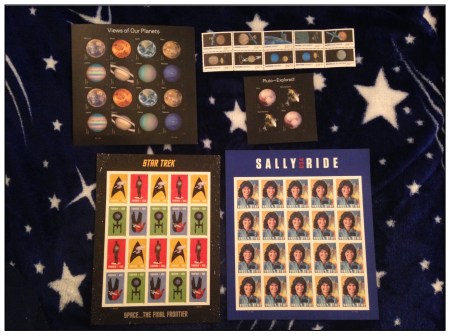
It started with those “Pluto: Not Yet Explored” and “Pluto: Explored!” stamps.  Those particular stamps have an interesting history, which I wrote about in a previous post.

I bought the “Views of Our Planets” stamps at the same time as the “Pluto: Explored!” set.  And then just recently, I saw some Star Trek stamps at the post office.  Naturally, I had to get them.  And the nice man at the register mentioned they had commemorative Sally Ride stamps as well.  Naturally, I had to get those too.  What kind of space enthusiast would I be if I didn’t?

To be clear, I originally meant to use these stamps as stamps.  You know, for postage. Mainly for paying bills.  I wasn’t looking to start a new hobby. But I figured what’s the harm in buying an extra sheet of Pluto stamps to keep, just for fun?  Or an extra sheet of planets?  Or now an extra sheet of Star Trek and Sally Ride?  It’s not like I’m sinking that much money into stamp collecting.

Fast forward to me ten years from now when I have huge albums full of space and Sci-Fi stamps.

Sciency Words: Clarke Orbit

Welcome to another episode of Sciency Words, a special series here on Planet Pailly where we take a closer look at the defintions and etymologies of science or science-related terms so we can expand our scientific vocabularies together.  Today’s term is:

CLARKE ORBIT

So I was once again flipping through my copy of Brave New Words: The Oxford Dictionary of Science Fiction when I discovered a small fact that gave me a big surprise.  It involved Arthur C. Clarke, the legendary science fiction writer who’s best known for co-writing the screenplay of 2001: A Space Odyssey, but who was also a prominent thinker, futurist, and inventor.

In 1945, Clarke wrote this article for Wireless World describing a method for transmitting radio and television signals to the entire globe.  Clarke’s idea involved placing artificial satellites in a very specific and somewhat peculiar orbital arrangement.  Clarke explains:

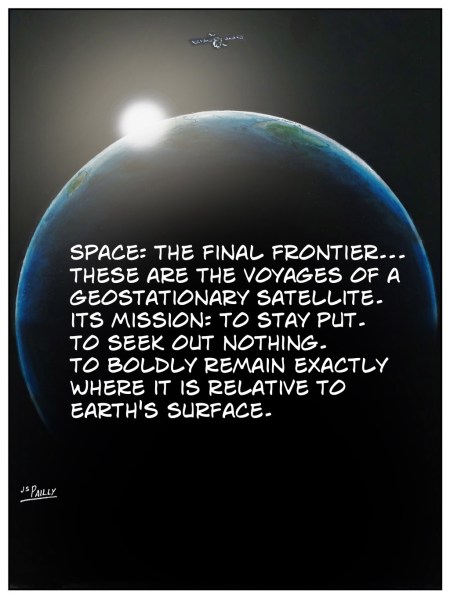
It will be observed that one orbit, with a radius of 42,000 km, has a period of exactly 24 hours.  A body in such an orbit, if its plane coincides with that of the equator, would revolve with the earth and would thus be stationary above the same spot on the planet.

Clarke admits that this idea may sound a little too fantastical to some, but he argues that it’s entirely plausible to do this using current (as of 1945) technology.  His only concern was whether or not radio transmissions would be able to penetrate Earth’s ionosphere, though he was confident that at least some radio frequencies would work.

And of course Arthur C. Clarke was right (he usually was about these sorts of things).  We now know this orbital arrangement as a geosynchronous orbit, or to be more specific a geostationary orbit.  A geosynchronous orbit allows a satellite to move around in Earth’s sky, so long as it always returns to the same positions at the same times of day. A geostationary orbit does not allow a satellite to move at all in Earth’s sky.

And according to Brave New Words, these kinds of orbits are also known as Clarke orbits.

So which term should we be using?  Personally, I’m not sure.  I like how the term Clarke orbit honors Arthur C. Clarke for inventing the idea.  On the other hand, I appreciate how the term geostationary orbit helps define itself, thus making verbal communication a little easier.

So which of these terms would you prefer? Clarke orbit or geostationary orbit?

My Favorite Planet: Venus

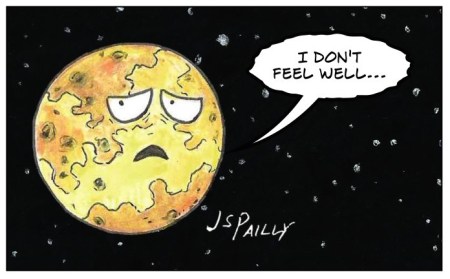
I’m thinking of doing a few of these kinds of posts, if people are into it: my favorite planet, my favorite moon, my favorite asteroid… that sort of thing. Today I’d like to tell you a little about Venus, my favorite planet in the Solar System and also the best chemistry teacher I’ve ever had.

Venus has been my favorite planet for a long time now.  I used to say to people, “It’s because Venus has the most personality.  It’s the personality of a serial killer, but still… so much personality!”

It’s true that Venus is excessively, unreasonably, incomprehensibly hostile toward life.  I mean, all the planets are dangerous (even Earth is a dangerous place in its own ways), but if you ever go to Venus, Venus will try to kill you at least a dozen different ways before you touch the ground.  And when your crushed and crispy remains do reach the ground, Venus will try to kill you again in at least a dozen more ways.

No other planet is so creative and so gleefully enthusiastic about murder.  As a science fiction writer, one of my goals in life is to set a novel on Venus or a Venus-like planet, because no other setting makes for such a deadly antagonist.

But upon further reflection, I think there’s a better reason why Venus holds such a special place in my heart.  I’ve done a lot of space-related research over the years.  It’s all part of my ongoing quest to become a better science fiction writer.  Venus was the first planet to really challenge me intellectually.

Why is Venus so deadly?  In many ways, Venus is Earth’s twin.  The two planets are about the same size, they have almost the same surface gravity, and their chemical compositions are similar. Venus is slightly closer to the Sun, but it’s still within our Solar System’s habitable zone.  So what gives?

It was hard work getting the kind of answers I was looking for.  Venus forced me to learn a lot of new things.  In particular, I had to learn more about chemistry, a subject that I despised in school and had really hoped I could avoid.  But in struggling to understand Venus’s sulfur chemistry, and later its carbon chemistry, I was rewarded not only with a deeper understanding of one planet but of how planets in general are put together, and how they each end up with their own distinct “personalities.”

Picking a favorite anything is obviously a subjective thing. For me, studying Venus was an eye-opening experience in ways I never would have expected.  For that, I’m forever grateful to the planet Venus, and Venus will always be my favorite planet.

So what’s your favorite planet?  If you say “Earth, because I live there,” I’m going to be a little disappointed.  But whatever your favorite planet is, and whatever your reasons for that, please share in the comments below!