Sciency Words: Decouple

Sciency Words BIO copy

Today’s post is part of a special series here on Planet Pailly called Sciency Words. Each week, we take a closer look at an interesting science or science-related term to help us all expand our scientific vocabularies together. Today’s term is:

DECOUPLE

After years of speculation, last September we finally learned the truth. Enceladus, one of Saturn’s moons, has a decoupled crust.

Ap04 Enceladus Decoupled

Sorry, Enceladus. I meant no offense. In fact, having a decoupled crust might be a good thing.

We’ve known for some time now that there is liquid water somewhere beneath Enceladus’s surface. Some of that water periodically spurts out of geysers located near the moon’s south pole. You can see this happening in the totally legit Hubble image of Enceladus above.

The big question: how much liquid water is there? Are we talking about a modest subsurface lake near the south pole…

Ap04 Enceladus Subsurface Lake

… or does Enceladus have a vast global ocean hidden beneath its surface? You know, the kind of environment that might support life.

Ap04 Enceladus Subsurface Ocean

By carefully observing Enceladus as it orbits Saturn, astronomers noticed that the moon appears to wobble more than it should. The best explanation for this: the moon’s crust is not attached to anything solid. It floats freely atop a layer of liquid. Enceladus’s crust is—to use the technical term—decoupled from the moon’s rocky interior.

That’s pretty compelling evidence for a global subsurface ocean, and while it doesn’t prove that Enceladus supports life, it does make the possibility a whole lot more likely.

Or does it? Let me check on that for Monday’s post.

* * *

Alternative definition of decouple: to remove any couples from a party or similar social event, leaving all the single gents and ladies free to mingle.

Sciency Words: Dark Side of the Moon

Sciency Words PHYS copy

Today’s post is part of a special series here on Planet Pailly called Sciency Words. Each week, we take a closer look at an interesting science or science-related term to help us all expand our scientific vocabularies together. Today’s term is:

THE DARK SIDE OF THE MOON

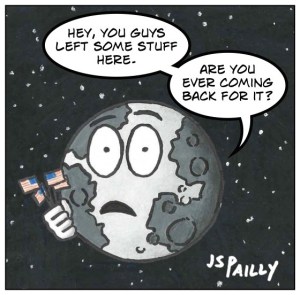
As the Moon orbits the Earth, the same side of the Moon is always facing toward us. It’s like the Moon is staring at us, unblinking, perhaps with some awkward question it’s been meaning to ask.

My06 Stuff on the Moon

But what’s on the other side? What’s on the side facing away from us? Scientists call that the “dark side” of the Moon. Scientists love making Star Wars references, and this one really fits. The dark side of the Moon is cloaked in perpetual darkness, because it is not only turned away from Earth but also away from the Sun.

As a result, we don’t really know much about the dark side of the Moon. There have been rumors that the Apollo Missions, while in lunar orbit, observed secret alien bases in the Moon’s dark region. This is obvious nonsense. The dark side of the Moon is too dark to observe anything!

Maybe some day when humanity finally chooses to return to the Moon, we’ll get some answers. Just so long as we remember to bring a flashlight.

P.S.: Happy April 1st! No, there is no such thing as a “dark side of the Moon.” The side of the Moon facing away from Earth is properly called the “far side of the Moon,” and it gets just as much sunlight as the side facing us.

Voting for the American Space Program

Let’s say you really care about the American space program. You want the United States to return to the Moon, go to Mars, and maybe capture an asteroid. You hope we might put a submarine in Europa’s subsurface ocean or possibly deploy aerostats above Venus’s acid clouds. Oh, and don’t forget about the James Webb Space Telescope!

Let’s say space exploration is a top priority for you. In fact, let’s say it is your #1 political issue. So how should you vote?

On Monday, I made the argument that Republicans are generally more pro-NASA than Democrats. But that doesn’t mean we, as space enthusiasts, have to vote Republican (thank goodness, especially this year). In fact, Republicans tend to set goals for NASA that sound exciting but are perhaps a little too ambitious; you could argue that Republicans just set NASA up to fail. Meanwhile Democrats don’t seem to object to space exploration, but they’d prefer to spend federal dollars elsewhere.

This puts us space policy voters in an awkward position. What do you do when you care about a political issue but that issue doesn’t fit neatly into either the Republican or Democratic camps?

One option is to join an advocacy group (also known as a special interest group). Here are three influential organizations that lobby Congress in support of space exploration:

  • The Mars Society: The Mars Society is focused on one and only one goal: colonizing Mars. Specifically, they advocate for the Mars Direct plan developed by Robert Zubrin. Under that plan, either NASA or a partnership between NASA and foreign space agencies would establish a small outpost on Mars within ten years. Subsequent missions would then expand that outpost into a full-fledged colony. Click here for more on the Mars Society.
  • The National Space Society: The National Space Society, or N.S.S., supports human settlement all across the Solar System, not just on Mars. Their plans include the Moon, Mars, orbital space stations, the asteroid belt… basically they want humans to set up shop wherever possible. Click here for more on the N.S.S.
  • The Planetary Society: The Planetary Society has some pretty big names behind it. It was founded by Carl Sagan and is currently headed by Bill Nye the Science Guy. They’re more focused on robotic space exploration than human space flight, and they’ve done a pretty respectable job convincing Congress to not slash NASA’s planetary science budget (or at least not slash it by too much). Click here for more about the Planetary Society.

Obviously joining any of these groups costs money, but you don’t have to spend zillions of dollars. Small contributions can make a surprisingly big difference for these kinds of organizations.

I just recently rejoined the Planetary Society after letting my membership lapse for a few years. I don’t have much money to spare, but I care enough about space exploration that I want to support it where I can. Also, their quarterly magazine is pretty informative.

I think many people get frustrated with American politics because some issues (like space policy) just don’t seem to fit into the two-party system. So if there’s a political cause you care about, especially if it’s not clearly identifiable as a Democrat issue or a Republican issue, consider joining an advocacy group. Voting is not the only way you can make your voice heard.

Red Planets and Blue Planets: The Politics of Space Exploration

It’s an election year here in the United States. As a blogger, I’m pretty sure I am legally obligated to rant about politics during an election year. Also, as I continue my research about space, I am becoming increasingly aware of how American politics and space exploration are intertwined.

First off, our Solar System is divided between red planets and blue planets.

Mr12 Red Planets and Blue Planets

The partisan divide on space exploration might surprise you. Republicans, famous for wanting to reduce spending everywhere possible, tend to support NASA; Democrats, who generally support more government spending, usually try to cut NASA’s budget.

As an example, you may recall that Newt Gingrich, former Republican Speaker of the House, not only wanted America to return to the Moon but also wanted to make the Moon America’s 51st state. Meanwhile, President Barack Obama put and end to the space shuttle program.

I want to be fair here. When the Obama Administration canceled the space shuttle program, I was disappointed, but that decision paved the way for private companies like SpaceX to get into the space exploration game, which will probably be a good thing in the long run. And as much as I do want America to return to the Moon, that whole 51st state idea was a bit kooky.

Still, Republicans are generally more supportive of NASA than Democrats (except when NASA is doing climate change research). Please do not assume that this makes me a Republican. I have strong opinions about a number of other political issues. Space exploration actually ranks pretty low on my list of priorities when I vote in federal elections.

Fortunately, you don’t have to vote Republican to show your support for space exploration. There are other options, which I’ll review in greater detail on Wednesday.

Sciency Words: Space Adaptation Syndrome

Sciency Words MATH

Today’s post is part of a special series here on Planet Pailly called Sciency Words. Each week, we take a closer look at an interesting science or science-related term to help us all expand our scientific vocabularies together. Today’s term is:

SPACE ADAPTATION SYNDROME

Yeah, we could just call it “space sickness,” but this is Sciency Words, so we have to call it “space adaptation syndrome.” Because NASA has a rule that all space related terms must be turned into acronyms, we can also call it “S.A.S.”

Most astronauts experience space adaptation syndrome at some point, usually during training or during their first few days in space. Relapses are also known to happen. As you can imagine, NASA really wants to figure out what causes S.A.S. and how to prevent it. This is one of the reasons they recently left an astronaut in space for almost a full year.

Mr11 Year in Space
This is totally how the year in space mission happened.

At present, S.A.S. seems to be similar to motion sickness. It is also sort of the exact opposite of motion sickness. Think of it this way:

  • Motion sickness: your inner ear senses motion, but your eyes do not (because you’re playing with your phone in a moving car, for example). In this case, your eyes are feeding your brain false information.
  • Space adaptation syndrome: your eyes see that you’re moving (or not moving), but in the absence of gravity, your inner ear hasn’t got a clue what’s going on. So in this case, your eyes are trustworthy; it’s your inner ear feeding false information to your brain.

The good news is that we humans can adapt. Our brains learn to rely less on our inner ears, allowing the business of human space exploration to continue.

The bad news is that once we humans adapt to space, returning to Earth becomes a problem. I’m not talking about bone loss or muscle atrophy. I’m talking about balance. All of a sudden, your inner ear is working again, and your brain has to relearn how to do this balancing and walking stuff.

There is also a concern—and I’m not sure how seriously to take this concern—that the human body might adapt too well to space. You might spend so much time up there, becoming so acclimated to zero-G, that your brain and inner ear will never function properly together again. You’ll never walk again. You’ll never be able to come home. You’ll be stuck in space for the rest of your life.

That would suck.

Or maybe it wouldn’t. To be honest, if I ever get to go to space, I probably won’t want to come back anyway.

P.S.: Here’s a bonus Sciency Word: lead-head. Lead-head is what astronauts call immunity from space adaptation syndrome.

Europa: My Favorite Moon

Fun fact about me: Europa is my favorite moon.

Mr07 Moon 1

Oh, sorry Moon. You’re cool too. It’s just… you don’t have an ocean. Or chaos terrain. Or possible alien life. It’s nothing personal.

Mr07 Moon 2

Anyway, on Monday I told you that Congress wants NASA to put a robotic lander on the surface of Europa. But the really interesting bit is deep beneath the surface, where the ice turns to liquid water. Is anything alive down there? Any microbes? Maybe fish? What about alien mermaids?

A lander can’t investigate that sort of stuff. At least not directly. But if you’ve ever seen a picture of Europa…

Mr07 Europa

… you’ll notice the surface is covered in dark reddish-colored lines. These lines appear to be cracks. It’s believed that warm water sometimes forces its way to the surface, carrying with it a mix of minerals and possibly other materials from the oceans below. It’s these minerals which cause the reddish discoloration.

So while a lander can’t sample the ocean water directly, it could examine the materials that have been deposited on the surface. Now, if you’ll allow me to switch my science blogger hat for my science fiction writer hat, I’ll tell you exactly what the Europa lander will find.

Salt. Lots of salt. That won’t surprise anyone. It’s been long assumed that Europa’s ocean is much saltier than the oceans here on Earth. It must be; otherwise the ocean would freeze.

The lander will also detect other minerals as well. And amino acids. That’ll raise some eyebrows, but amino acids aren’t that uncommon. We’ve found them on other planets and we’ve found spectrographic evidence of them all across space. As I reported in last week’s Molecular Monday post, there are literally hundreds or perhaps thousands of different kinds of amino acids in our universe.

Mr07 Surface of Europa

That will make headlines. No, it’s not the same 21 amino acids coded for by human DNA, but this cannot be a coincidence. What natural phenomenon, other than life, could produce such a select few amino acids in such large quantities?

But wait, there’s more. These 21 amino acids have something in common. They have the same chirality. And that’s the part where the entire scientific community freaks out.

Tune in for Friday’s edition of Sciency Words to find out what the heck chirality is and why it’s so important in the search for alien life.

P.S.: My second favorite moon is Titan, followed by Io, Miranda, and Triton. Oh, and Naiad! I love Naiad. But Earth’s Moon totally makes in my top ten. Probably.

Europa: To Land or Not to Land?

NASA has big plans for Europa. It is, after all, Jupiter’s most interesting moon.

Ag04 Europa Blush

But the details of these big plans have been in a state of flux for a while. The mission would undoubtedly include an orbiter, but should it orbit Europa or Jupiter? What about also sending a lander or rover? Or maybe a submarine? Europa does have an ocean somewhere beneath its icy shell.

Okay, there’s no way Congress would pay for all that, so NASA decided to scale down its ambitions. In other words, the mission was descoped. No landers, no rovers, and definitely no submarines. Also, the orbiter would orbit Jupiter. Entering orbit of Jupiter requires less delta-v, and therefore less fuel, than trying to enter orbit of any specific Jovian moon.

But even after scaling everything down, this Europa mission would still come with a hefty price tag. Congress held hearings. This couldn’t go well. So what happened?

Congress told NASA to put the lander back in the mission plan and put up money to pay for it.

Mr06 Europa 1

That’s right. Congress suggested—no, commanded—that NASA include a lander as part of its Europa Clipper mission and provided money to pay for it. I guess you could say this mission was de-descoped. Or maybe it was rescoped.

Now I’m not naïve enough to think that Congress has suddenly developed a deep appreciation for planetary science. It’s more likely this lander will be built by some company that donated generously to someone’s campaign, or maybe it will be built within some influential congress-person’s district.

I’m not a political blogger, so I don’t want to get into that. What I do want to say is this: we’re going to Europa, baby!

Mr06 Europa 2

Links

We’re Going to Europa from SciShow Space.

A Lander for NASA’s Europa Mission from The Planetary Society.

Congress: NASA Must Not Only Go to Europa, It Must Land from Ars Technica. This last link is particular interesting because it suggests that NASA doesn’t really want to go to Europa at all, but Congress is forcing them to do it.

Earth Germs on Mars: What Might Happen?

Warning: the word “might” will appear a lot in today’s post.

When the Curiosity rover left Earth, it might have been contaminated with several different strains of Earthly bacteria. This was a big oops for NASA, especially for NASA’s Office of Planetary Protection, which is supposed to make sure we don’t spread our germs to other planets.

But how bad could the damage really be? Curiosity was headed for Mars. It’s not like Mars has water.

Then we found out Mars does have water. Droplets and trickles of water. Modestly sized puddles of the stuff. Now, even though Curiosity is currently located near actively trickling water, the rover is not allowed to go investigate. It might contaminate the water. It might endanger any ecosystem that might exist in the slightly damp Martian soil.

I wrote previously that we should take the risk anyway. Let Curiosity approach the water. Let Curiosity take a sample. Let Curiosity be curious. What are the odds that microorganisms from cushy, life-friendly Earth could survive on Mars? What are the odds that they could outcompete native life forms that are perfectly adapted to the harsh Martian environment?

That’s how I felt, until last week when I learned about bacterial conjugation.

Mr04 Bacteria of Mars

According to the panspermia hypothesis, life on Earth and Mars might (there’s that word again) share a common ancestor. If so, Martian microbes might be genetically compatible with bacteria from Earth. Through bacterial conjugation, they might be able to share DNA.

They might.

Mr04 Martian Earthling Hybrid

Or they might not.

Finding out that bacteria on Earth and Mars are genetically compatible would be a huge discovery, assuming we knew it was happening. But Curiosity is not equipped to test for that sort of thing. Curiosity isn’t equipped to study biological activity of any kind. So the rover’s presence in and around Martian water flows might trigger changes to the local ecosystem without our knowledge.

So grudgingly, I’ll agree. Let’s keep Curiosity away from the Martian wetlands. It might not worth the risk.

Sciency Words: Descope

Sciency Words MATH

Today’s post is part of a special series here on Planet Pailly called Sciency Words. Each week, we take a closer look at an interesting science or science-related term to help us all expand our scientific vocabularies together. Today’s term is:

DESCOPE

What do you call it when a space mission that’s supposed to look like this…

Fb10 Epic Huge Space Probe

… turns out looking more like this?

Fb10 Teeny Tiny Space Probe

It’s called descoping.

Descoping is a term, apparently used at NASA and other space agencies, for when the “scope” of a mission is reduced, usually due to budgetary concerns. At least being descoped is better than being canceled outright, although I can easily imagine missions being descoped to the point that they may as well be canceled.

It seems the term can also apply to military hardware that, once again for budgetary reasons, had to be scaled down. So the verb “to descope” could be doubly useful for science fiction writers.

P.S.: I’d planned to write more for today, but due to budgetary concerns, this blog post has been descoped.

Where Does the Solar System End?

You may remember that the Voyager 1 spacecraft officially “left the Solar System” back in 2012, bidding us all a fond farewell.

Fb05 Voyager 1-1

Specifically, Voyager 1 crossed a boundary known as the heliopause, beyond which the solar wind no longer blows. Out there is true interstellar space, in the sense that the ionized particles Voyager encounters and samples are more likely to come from other stars or other sources than our Sun.

However, Voyager 1 has not quite left the Solar System.

Fb05 Voyager 1-2

This depends a bit on how we define our terms (as so many things do in science), but by one fairly conventional definition, anything that orbits the Sun (or, like the Moon, anything that orbits something that orbits the Sun) is part of the Solar System. So taking that into account, just how big is the Solar System, and where exactly does the Solar System end?

  • Earth: By definition, Earth orbits the Sun at an average distance of 1 astronomical unit (AU). Obviously the Solar System is larger than 1 AU.
  • Neptune: As the most distant known planet, Neptune orbits the Sun at distance of roughly 30 AU. Neptune’s orbit is an important boundary line in astronomy, but it’s definitely not the end of the Solar System.
  • The Kuiper belt: The Kuiper belt, the region Pluto calls home, extends from 30 AU to about 50 AU.
  • The heliopause: Voyager 1 crossed the heliopause at about 121 AU.
  • Voyager 1: As of the writing of this post, Voyager 1 is just over 134 AU from the Sun.
  • Sednoids: By definition, sednoids come no closer to the Sun than 75 AU, but they’re free to travel much, much farther away than that. Sedna, the first known sednoid and the object for which this category of objects is named, reaches a maximum distance of about 936 AU from the Sun.
  • Planet Nine: If such a planet exists (and that’s still a pretty big if), its orbit is estimated to range somewhere between 200 and 1,200 AU from the Sun.
  • The Oort cloud: The Oort cloud has not yet been observed directly, but its existence is inferred from the orbits of long-period comets. It is believed the Oort cloud exists somewhere between 2,000 and 200,000 AU from the Sun.

By the way, Alpha Centauri is 4.35 light years away, which equals about 275,000 AU. If the Oort cloud does extend all the way out to 200,000 AU, that means our Oort cloud and Alpha Centauri’s Oort cloud might overlap (assuming Alpha Centaur has its own Oort cloud).

It would be interesting to know how two overlapping Oort clouds interact with one another and how many comets, asteroids, dwarf planets, etc have been exchanged from one cloud to the other. If only we had a space probe that could go check on that.

Fb05 Voyager 1-3