Sciency Words: Shadow Biosphere

Sciency Words MATH

Today’s post is part of a special series here on Planet Pailly called Sciency Words. Each week, we take a closer look at an interesting science or science-related term to help us all expand our scientific vocabularies together. Today’s term is:

SHADOW BIOSPHERE

Crazy Talk

We are not alone on planet Earth. There are aliens among us. Their existence has gone unnoticed and unsuspected for millions of years.

Truth be told, I shouldn’t call them “aliens.” They evolved here on Earth, side by side with what we, in our arrogance, call “organic life.”

They’re everywhere. There’s a whole biosphere of these weird creatures sharing our planet with us. It’s called the shadow biosphere.

Not Crazy Talk

I first heard about the shadow biosphere on an episode of SciShow, and I’ve been seeing the term more and more lately. It seems like some sort of astrobiology buzzword at the moment.

The idea is that an alternative form of life could have evolved here on Earth, and we just haven’t discovered it yet. Maybe it lives in areas totally inaccessible to us, like deep beneath the Earth’s crust. Or maybe it’s so different from us that we don’t yet recognize it as a life form.

Personally, I take this as more of an astrobiology thought experiment than a serious hypothesis about life on our planet. It’s a way of reminding us how limited our understanding of life is and show how difficult it might be to identify alien life should we happen to find it.

You see, to determine if something is alive, we must try to identify ways in which it is similar to other living things. Does it move? Grow? Reproduce? On a more fundamental level, is it cellular in structure? Does it have a carbon-based biochemistry? A DNA-like genetic code?

oc14-pet-rocks
Little did the humans suspect that their “pet rocks” were in fact silicon-based life forms.

But all these questions presuppose that newly discovered life forms will be similar to life forms we already know about. What if we’re dealing with a life form totally dissimilar to life as we know it? What if they’re non-cellular, non-carbon-based organisms that don’t have anything resembling DNA?

Why, such organisms might be so strange to us that they could exist all around us, even right here on Earth, and we wouldn’t know it. Or so this type of thought experiment may lead you to conclude.

Back to Crazy Talk

It’s not just a thought experiment. The shadow biosphere is real. It’s real, I tell you! Wait, where are you taking me? No, I don’t want to take my medicine. Are you working for them? Did the pet rocks send you?

All These Worlds Are Yours: A Book Review

In his book All These Worlds Are Yours: The Scientific Search for Alien Life, author Jon Willis gives you $4 billion. How many authors do that? Okay, it’s imaginary money, and you’re only allowed to spend it on astrobiological research. But still… $4 billion, just for reading a book!

If you’re new to the subject of astrobiology, All These Worlds is an excellent introduction. It covers all the astrobiological hotspots of the Solar System and beyond, and unlike most books on this subject, it doesn’t gloss over the issue of money.

There are so many exciting possibilities, so many opportunities to try to find alien life. But realistically, you can only afford one or maybe two missions on your $4 billion budget. So you’ll have to pick and choose. You’ll have to make some educated guesses about where to look.

Do you want to gamble everything on Mars, or would you rather spend your money on Titan or Europa? Or do you want to build a space telescope and go hunting for exoplanets? Or donate all your money to SETI? Willis lays out the pros and cons of all your best options.

My only complaint about this book is that Enceladus (a moon of Saturn) didn’t get its own chapter. Instead, there’s a chapter on Europa and Enceladus, which was really a chapter about Europa with a few pages on Enceladus at the end.

oc11-enceladus-is-angry

I agree, Enceladus. On the other hand, Enceladus is sort of like Europa’s mini-me. So while I disagree with the decision to lump the two together, I do understand it.

In summary, I’d highly recommend this book to anyone interested in space exploration, and especially to those who are new or relatively knew to the subject of astrobiology. Minimal prior scientific knowledge is required, although some basic familiarity with the planets of the Solar System would help.

P.S.: How would you spend your $4 billion? I’d spend mine on a mission to Europa, paying special attention to the weird reddish-brown material found in Europa’s lineae and maculae.

Who’s Eating Titan’s Acetylene?

The first Monday of the month is Molecular Monday, the day I write about my least favorite subject from school: chemistry.

Molecular Mondays Header

I’d planned to write something about ammonia today. Ammonia might (might!) serve as a good substitute for water in some alien biochemistry.

But then I was reminded of something. Something important. Something I’m kicking myself for not covering before. So once again, let’s turn our attention to Saturn’s largest moon: Titan.

oc03-titan-acetylene

Making Acetylene on Titan

As we’ve discussed previously, methane gas and other chemicals break apart in Titan’s upper atmosphere. This allows carbon, hydrogen, nitrogen, and possibly other elements to recombine in new ways. The result is a mishmash of organic chemicals collectively refered to as tholins.

Tholins tend to be sticky, yucky, and orange. They slowly fall to Titan’s surface, covering the moon with sticky, yucky, orange sludge. One chemical in the tholin mix should be acetylene (C2H2). In fact, acetylene is a fairly simple molecule compared to the rest of the tholin gunk on Titan, so we should find lots of it.

But we don’t. We’ve detected little to no acetylene accumulation on Titan’s surface. Maybe this means there’s something wrong with our detection techniques. Or maybe some as-yet-unidentified chemical process breaks up acetylene molecules as they fall through Titan’s atmosphere.

Or maybe (maybe!) something eats the acetylene as soon as it touches the ground.

Eating Titan’s Acetylene

I first read about this a few years ago in Astrobiology: A Very Short Introduction. It came up again, in greater detail, in the book I’m currently reading: All These Worlds Are Yours. The case of Titan’s missing acetylene is a hot topic for astrobiologists.

There’s a rather simple chemical reaction that might (might!) explain what’s going on.

C2H2 + 3H2 –> 2CH4 + energy

That’s one acetylene molecule reacting with three hydrogen molecules to produce two methane molecules and some energy. The kind of energy that weird Titanian microorganisms could use to survive (maybe).

In my opinion, it still seems unlikely that life could have evolved on the surface of Titan, if only because liquid methane (Titan’s “water”) is not a good solvent for amino acids. But unlikely is not the same as impossible.

It’s worth noting at this point that a few other weird things are happening on Titan. Hydrogen gas seems to mysteriously disappear near Titan’s surface, and no one has adequately explained how Titan replenishes its atmospheric methane (all the methane should have turned into tholins by now).

If Titan does have an acetylene-eating, hydrogen-breathing microbe that expels methane as a waste product, that would conveniently solve three mysteries at once. I can’t help but think, though, that this might be a little too convenient to be true.

Sciency Words: Patera

Sciency Words PHYS copy

For the last few weeks, we’ve been touring the moons of Jupiter and learning about some of the scientific terms used to describe the weird geological features we’ve found there. Today, we conclude this Jovian moons series with the term:

PATERA

Meet Io, Jupiter’s fifth moon and the inner-most of the Galilean moons. Io, say hello to the nice blog readers.

sp23-queasy-io

Oh jeez. I’m sorry you had to see that. Io is sort of caught in a gravitational tug of war between Jupiter and the other Galilean moons. You’d feel queasy too if you were constantly being yanked back and forth by all that gravity.

The result is that Io is the most volcanically active object in the Solar System. Just about any time you look at Io, its sulfur volcanoes are erupting.

A Caldera by Any Other Name…

Astronomers use the word patera (plural, paterae) when discussing Io’s volcanoes. The term comes from the Latin word for flat dish, and the name is appropriate.

Paterae don’t look much like the kind of volcanoes we typically imagine. They aren’t raised, mountain-like features but rather flattened, crater-like depressions. If you know what a caldera is, a patera is basically the same thing.

How Calderas… I Mean, Paterae… Form

Picture this: somewhere on Io, we find an underground chamber full of a nasty, sulfur-rich brew. The temperature in this chamber rises, and the pressure builds up. Suddenly, an eruption occurs, and Io spews that sulfur mixture all over its surface.

As that subterranean chamber empties, the ground above it starts to sink. The resulting pit-like surface feature is a patera. Or a caldera. They really are the exact same thing. (Here’s a short video demonstrating the caldera/patera formation process).

Paterae are not unique to Io. They’ve also been observed on Mars, Venus, and Titan, among other places. They’re also found on Earth, except you’re not supposed to call it a patera if it’s on Earth.

Patera vs. Caldera: What’s the Difference?

If you really want to, you can use the word caldera when referring to Io’s volcanoes, or similar volcanoes on other worlds. That usage seems to be acceptable. But it is unlikely that you will ever see the word patera used for such features here on Earth.

I think there’s a bit of geocentrism at work here. A lot of planetary features have one name on Earth and some other name everywhere else. You’ll sometimes find Earthly terminology used off-world, because Earth terms are more familiar to the average reader; the reverse is rarely if ever true.

Which is fine. I’m not judging. A little linguistic geocentrism makes sense to me, at least at present. In some distant Sci-Fi future where humanity has spread across the Solar System and beyond… at that point, things like the caldera/patera distinction might seem a bit silly.

Sciency Words: Facula

Sciency Words BIO copy

When Voyager 1 trained its camera on the moons of Jupiter, scientists back on Earth had no idea what to expect. Turned out they were right. Voyager was snapping photos of geological features unlike anything anyone had ever seen before. Which meant it was time to make up some new sciency words!

FACULA

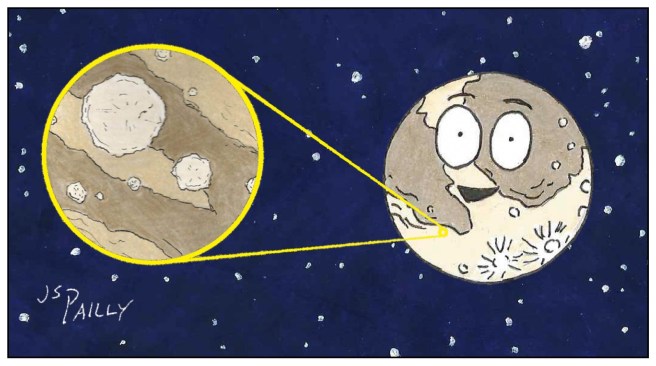
Last week, we learned about the word macula (plural, maculae): a special term for dark spots on the surface of a moon or other planetary body. Now if you’re going to invent a special term for dark spots, you really ought to have a term for bright spots too. And that term is facula (plural, faculae).

To an ancient Roman, facula meant “little torch.” To a modern planetary scientist, it refers to a surface feature that looks brighter than the surrounding terrain. The term was first used this way to describe bright, circular features seen on Ganymede.

sp16-faculae-on-ganymede

If you think Ganymede’s faculae look a little like craters, you’d be on the right track. Like most moons in the outer Solar System, Ganymede is composed of a mixture of rock and ice, and it may have a layer of liquid water beneath its surface.

So the craters left by asteroid impacts on Ganymede sometimes get filled in with icy slush. The slush freezes, and the crater is virtually erased. Only the crater rim remains, and you can see a color difference between old and new surface ice.

The term facula can be used to describe almost any bright spot on a planet-like surface, not just resurfaced craters. For example, there are faculae on the dwarf planet Ceres. Ceres’s faculae are still being investigated by the Dawn spacecraft, but the current best guess is that they’re salt deposits—perhaps salt left behind after very briny water boiled into space.

For next week’s edition of Sciency Words, we’ll conclude our visit to the moons of Jupiter with a quick trip to Io.

Bonus Sciency Word: An impact crater that gets filled in and smoothed over, like the craters on Ganymede, is also called a palimpsest.

SETI Hoopla

SETI discovered aliens! They detected a transmission from an advanced alien civilization located 94 light-years away! I saw it on T.V., so it must be true.

Okay, I actually wasn’t planning to say anything about this. It’s just another case of bad journalism and the misreporting of science. But this story seems to have developed legs—or maybe tentacles—and it just keeping popping up in my newsfeed.

When the story initially broke, I quickly checked SETI’s website. To my amusement, I found nothing: no press release, no mention of an alien signal at all. My thought at the time: where on Earth (pun intended) did the popular press get this story from?

There are others far more qualified than I to get into the nitty-gritty of what happened, or rather what didn’t happen, with this alleged SETI signal. I recommend this post from cosmicdairy.org. From what I gather from everything I’ve read, the basic summary is this:

  • In May of 2015, Russia’s RATAN-600 radio telescope detected “something.”
  • The signal was quickly determined to be a false positive. Apparently this happens a lot with all the radio noise from Earth and satellites in Earth orbit.
  • The story should have ended there.

sp14-hd-164595

Weather Report from Jupiter

Juno has completed its second flyby of Jupiter, skimming close to the atmosphere and managing to get some interesting pictures of Jupiter’s polar regions.

sp12-juno-polar-flyby

Apparently we’ve never gotten a good look at Jupiter’s poles before. I imagine there’s a lot of frantic technical analysis going on right now at NASA, but not a whole lot of info has been released to the public so far.

We do have a press release, which I’m taking as a small preview of the real science that’s still to come. From the press release, we’ve learned that:

  • There’s a heck of a lot of storms, sort of clustered together. It’ll be interesting to find out which way they rotate. Are we looking at cyclones or anticyclones? (The Great Red Spot is an anticyclone, by the way).
  • Apparently cast-shadows are visible, suggesting clouds of varying altitudes. I’m guessing we’ll learn something about regional temperature and pressure variations from that.
  • The clouds have a bluish tint. In my inexpert opinion, that might indicate elevated concentrations of methane (the gas that makes Uranus and Neptune look so blue). That would be a change from the ammonia clouds we’re used to seeing in Jupiter’s upper atmosphere.

In short, it sounds like Jupiter’s polar regions have a whole separate ecosystem of clouds and storms. Do these storm systems function independently from the belts and zones observed at other longitudes, or could there be some complex relationship at work?

The Juno spacecraft has a little less than two years to find out. Good luck, Juno. We’re all counting on you.

Sciency Words: Macula

Sciency Words PHYS copy

When Voyager 1 trained its camera on the moons of Jupiter, scientists back on Earth had no idea what to expect. Turned out they were right. Voyager was snapping photos of geological features unlike anything anyone had ever seen before. Which meant it was time to make up some new sciency words!

MACULA

Last week, we talked about Europa’s lineae: the reddish-brown cracks and fissures crisscrossing this small moon’s surface. But those weren’t the only surprises Voyager 1 observed. Let’s zoom in for a closer look.

Sp09 Macula on Europa

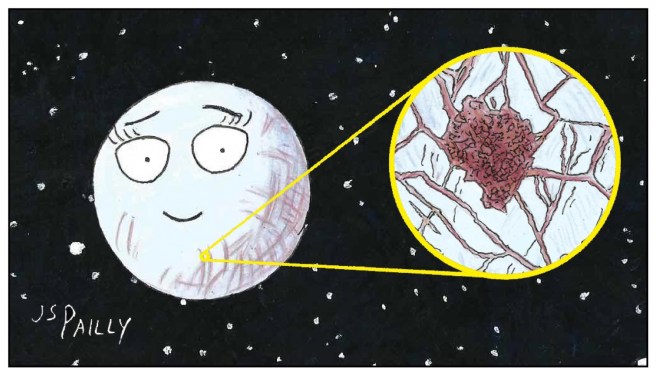
Europa has these peculiar dark splotches on its surface, similar in coloration to the lineae. Scientists came up with the term macula (plural maculae) to describe them. It comes from the Latin word for “spot” or “blemish.” It’s related indirectly to the word immaculate, which literally means “without blemish.”

Although Europa’s maculae were discovered in 1979, it wasn’t until 2011 that anyone could adequately explain them. It seems that Europa’s thick ice shell has a complex relationship with the ocean of liquid water deep beneath the surface, resulting in frequent patterns of melting and refreezing.

Sometimes “lakes” of liquid water become embedded between layers of ice. This causes surface ice to sag and cave in, breaking up into chunky, tightly packed icebergs. Some sort of material (possibly organic material) seeps up with the meltwater, causing the dark discoloration.

Eventually, the lake beneath a macula will freeze. Since ice is less dense than water, this forces the now cracked and broken surface ice to rise above the surrounding landscape. In the process, the already strange-looking maculae transform into even stranger-looking chaos terrain.

The term macula can be used to describe almost any dark, spotty or splotchy feature on a planetary body. That doesn’t mean they have anything in common beyond superficial appearances. For example, while maculae on Europa seem to be caused by melting and refreezing ice, maculae on Titan may be related to some sort of volcanic activity.

For next week’s edition of Sciency Words, we’ll move on to Ganymede. Europa wasn’t the only Jovian moon showing off strange, never-before-seen geological features when Voyager arrived.

Molecular Monday: Liquid Water vs. Liquid Methane

Molecular Mondays Header

Welcome to Molecular Monday! On the first Monday of the month, we take a closer look at the atoms and molecules that make up our physical universe. Today, we’re comparing some of the properties of:

LIQUID WATER AND LIQUID METHANE

So you’re a moon or other planetary body, and you want to get some biochemical action going on. First, you need some organic substances. Titan has set a great example with the tholin haze that forms spontaneously in its atmosphere.

Next, you need a liquid to dissolve that organic material in, in the hopes that the organic material will recombine as amino acids, peptide chains, and ultimately DNA. But which liquid should you choose? Liquid water (as seen on Earth) or liquid methane (as seen on Titan)?

Pick Water!

Water (H2O) makes an excellent solvent for our purposes because it’s a polar molecule. There are two big reasons for water’s polarity.

  • First, oxygen has an extremely high electronegativity, meaning oxygen atoms like to yank electrons away from other atoms. Within a water molecule, oxygen’s electron-hogging tendencies cause it to become negatively charged, while the two hydrogen atoms become positive.
  • Second, you know how water molecules have that Mickey Mouse shape? Because of that shape, with the two hydrogen atoms bent toward each other, the positive charges accumulate on one side of the molecule and the negative charge accumulates on the other.

Thus, water is a polar molecule, and it’ll go around interacting with other polar molecules, like tholins or amino acids.

Don’t Pick Methane

Unlike water, methane (CH4) is a nonpolar molecule. Why?

  • Carbon is slightly more electronegative than hydrogen, but not by much, so the atoms in a methane molecule share electrons almost equally. This minimizes the electric charges that might build up inside the molecule.
  • Methane molecules are symmetrical, with the carbon atom in the center and the four hydrogens evenly spaced around in, like the four corners of an equilateral pyramid.

Sp05 Methane vs Water

Any electrical charges in a methane molecule balance out, due to the molecule’s symmetry. And those charges are fairly weak anyway, due to the similar electronegativities of carbon and hydrogen.

I won’t be so bold as to say life can’t develop in a liquid methane environment, but the idea does seem a bit farfetched in light of the chemistry. Polar molecules like tholins just aren’t likely to dissolve in a methane lake, like the lakes found on Titan.

On the other hand, the universe keeps surprising us, and the giant lake monster I recently met on Titan might dispute my assessment of Titan’s biochemical potential.

P.S.: Titan’s lakes also contain liquid ethane, but that doesn’t really change anything. Ethane is also nonpolar.

Sciency Words: Linea

Sciency Words MATH

When Voyager 1 trained its camera on the moons of Jupiter, scientists back on Earth had no idea what to expect. Turned out they were right. Voyager was snapping photos of geological features unlike anything anyone had ever seen before. Which meant it was time to make up some new sciency words!

LINEA

Europa has the youngest, smoothest-looking surface of any object in the Solar System.

Ag04 Europa Blush

But as you can see in the totally legit Voyager 1 image above, Europa’s icy blue surface is not without blemish.

It’s crisscrossed with cracks and fissures that appear to be filled with some sort of reddish-brown substance. Astronomers adopted the term linea (plural lineae) to describe these features. This was not astronomers at their most creative or imaginative; linea is just the Latin word for line.

Europa has a subsurface ocean of liquid water. There might be alien sea creatures swimming around in that subsurface ocean. Or there might not. If we want to find out, Europa’s lineae may be a good place to start looking.

The reddish-brown substance is believed to seep up through the cracking, fissuring ice. Does it include organic material? Amino acids? Maybe some sort of alien DNA? Hopefully NASA’s Europa Clipper mission will be able to find out (pending Congressional approval and so forth).

Lineae are most commonly associated with Europa, but the term has also been used to describe line-like features on a handful of other worlds, including Mars (although Mars’s recurring slope lineae are very different from lineae on Europa).

In next week’s edition of Sciency Words, we’ll continue exploring the moons of Jupiter. There are plenty of other terms that had to be invented following Voyager 1’s visit.

P.S.: I once ate at a seafood restaurant named Nova Europa. I know it was supposed to be Mediterranean-themed, but that is not what I was thinking about when they served my calamari.