Exoplanet Explorer: Poltergeist

Today’s post is part of a semi-regular series here on Planet Pailly exploring exoplanets: planets orbiting stars other than our Sun. Today, we’re exploring the exoplanet:

POLTERGEIST

In 2015, our friends at the International Astronomy Union gave in to public pressure and finally started assigning actual names to exoplanets. Thus, the exoplanet designated PSR B1257+12 c is now known as Poltergeist.
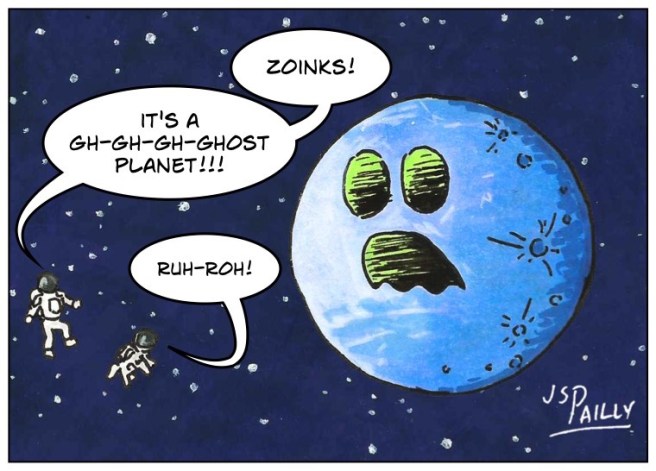
Poltergeist is actually the very first exoplanet we humans ever discovered. It’s approximately four times as massive as Earth, has an orbital period of 66 days, and is located in a star system roughly 2,300 light-years away in the constellation Virgo.

It’s hard to say much else about a planet so far away from us, but based on what we do know at this point, I’m willing to bet Poltergeist is a barren rock stripped of any appreciable atmosphere and depleted of all or almost all of its volatiles.

That’s because Poltergeist’s sun is no ordinary star. It’s a pulsar: the tiny, rapidly-spinning, gamma radiation flashing remnants of a star that went supernova. As of 2015, the I.A.U. has named this pulsar Lich, and there are two other planets in the Lich System: Draugr and Phobetar. The official naming scheme for this system is apparently the undead.

  • Lich: an undead thing with magic powers to control other undead things.
  • Draugr: a reanimated corpse from Norse mythology.
  • Poltergeist: a ghost, especially a noisy and troublesome ghost.
  • Phobetor: the ancient Greek god of nightmares.

According to this paper (published in 1993, right after the discovery of Poltergeist and Phobetor but before the discovery of Draugr), there are quite a few scenarios that could explain how a pulsar like Lich ended up with its own planets. We can’t say for sure which scenario is correct, but all the most likely scenarios have one thing in common: the planets formed after the supernova.

Perhaps the planets that existed before the supernova were destroyed, and Poltergeist and company re-coalesced from the rubble (this paper from 2015 seems to rule that possibility out). Or perhaps Lich was once part of a binary system, and the planets formed after Lich ripped its companion star apart. Or maybe Lich is the product of a violent merger of two white dwarf stars, or a white dwarf and a neutron star, with the planets forming from matter the got spewed into space during the merger (this is reportedly the most plausible scenario).

So it would seem Poltergeist and the other planets of the Lich System really are the ghosts left over by some cataclysmic event (even if we’re not certain which specific cataclysm occurred) which is why their creepy, Halloween-style names are so appropriate.

Molecular Monday: Why Chemistry?

The first Monday of the month is Molecular Monday here on Planet Pailly!

We just wrapped up this year’s A to Z Challenge, and I ended up writing a lot about chemistry. A lot more than I expected. You’d think I must really love chemistry.

But I don’t.

I really don’t.

For a long time, I tried to avoid the subject completely due to bad memories from high school chemistry. My professor was extremely generous in giving me a just-barely-passing grade.

So when I made the commitment to include more science in my science fiction, I figured I could get by with just the “fun” sciences like physics and astronomy. Then in 2015, I did my yearlong Mission to the Solar System, and the planet Venus forced me to start learning this chemistry stuff.

As you can see in this totally legit actual Hubble image, Venus has some very special chemical activity going on.

There’s simply no way to understand what’s happening on Venus without getting into the weird sulfur chemistry of the Venusian atmosphere. But once you do make sense of that sulfur chemistry, a strange new world is suddenly open to you: a world of both heavenly beauty and acid rain hellfire death.

Since my experiences with Venus, I’ve come to realize that understanding chemistry, even at a basic level, makes my work as a science blogger and science fiction writer so much easier.

  • Is there life on Mars or Europa? What about life in other star systems, or silicon-based life? If alien life is out there, it will be the product of chemistry.
  • What about humans traveling to other worlds? What would be safe for us to eat or breathe? Chemistry can help answer that too.
  • Venus isn’t the only world defined by chemistry. Earth has been shaped in large part by the chemistry of oxygen and water; the gas giants by ammonia and methane; and then there’s a true oddball like Titan with its tholen chemistry.
  • And how am I going to get my rocket ship off the ground? By mixing rocket fuel. In other words, by doing chemistry.

Chemistry is by no means the most fundamental science, but for the kinds of things I write, it is the most applicable science. So even though I don’t enjoy the subject, I’ve forced myself to stick with it.

And if I’m being perfectly honest, in those aha-moments when complex chemical reactions suddenly makes sense to me, I may quietly murmur to myself, “Okay, chemistry is kind of fun.”

Sciency Words: Ylem (An A to Z Challenge Post)

Today’s post is a special A to Z Challenge edition of Sciency Words, an ongoing series here on Planet Pailly where we take a look at some interesting science or science related term so we can all expand our scientific vocabularies together. In today’s post, Y is for:

YLEM

When George Gamow and Ralph Alpher were developing the Big Bang Theory (the actual theory, not the T.V. show), they needed a term for the bizarre form of matter they predicted would have existed in the early universe. They ended up picking the awkward-sounding word ylem.

In a 1968 interview, Gamow had this to say about the word’s origins: “You can look in the Webster dictionary. This is a word—I think it’s an old Hebrew word, but Aristotle was using it—in Webster dictionary (sic) is says ‘material from which elements were formed.’”

As a word nerd, I’m compelled to make two points of clarification before we can move on. First, I hate when people cite “Webster’s dictionary” as a source. Webster is not a trademarked name (Merriam-Webster is), so anybody can stick “Webster” on a dictionary and make it sound authoritative. Second, ylem does not come from Hebrew; the etymology traces back to the Greek word for matter (this according to my favorite real dictionary, The New American Heritage Dictionary, Fifth Edition).

Okay, word nerd rant over.

Aristotle did have something to say about the “fundamental matter” from which the elements formed. By elements, of course, he meant earth, fire, wind, and water. Aristotle’s term for this was proto-hyle. Over the millennia since Aristotle’s time, the hyle part of proto-hyle changed phonetically (Latin added an m, French dropped the h), and thus ylem entered English as a philosophy term.

Gamow and Alpher then turned it into a scientific term. Regardless of which dictionary they were looking at, for them it meant the primordial matter that existed after the Big Bang but before the chemical elements formed.

In a sense, this isn’t too far from the proto-hyle Aristotle was talking about. Except by elements, Gamow and Alpher meant things like hydrogen and helium, not earth or fire. Also, they could be a whole lot more specific about what ylem actually was: a highly charged plasma of protons, neutrons, and electrons that took roughly 400,000 years to cool off before it could start combining as atoms.

Next time on Sciency Words: A to Z, animals may not be able to talk, but they have other ways to communicate with us.

Sciency Words: Xena (An A to Z Challenge Post)

Today’s post is a special A to Z Challenge edition of Sciency Words, an ongoing series here on Planet Pailly where we take a look at some interesting science or science related term so we can all expand our scientific vocabularies together. In today’s post, X is for:

XENA

In January of 2005, astronomers at the Palomar Observatory in California discovered a new “planet.” Except this planet had a highly inclined (tilted) and wildly eccentric (non-circular) orbit. Pluto’s modestly eccentric, Neptune-crossing orbit was weird enough, but this? Planets aren’t supposed to have orbits like this, are they?

The Palomar Observatory astronomers decided to name their discovery Xena.

Personally, I think that name fits: a convention defying name for what was, at the time, a convention defying planet. But Xena was only intended to serve as a placeholder until the International Astronomy Union (I.A.U.) could assign an official name, and they chose the name Eris.

In Greek mythology, Eris was the goddess of discord. This name also seems fitting, given the amount of discord that would soon follow, because Eris was officially classified not as a planet but as a dwarf planet, along with Pluto.

There is now a proposal to reclassify Pluto, Eris, and about a hundred other Solar System objects as planets. It’s a proposal I like, for reasons I tried to lay out in a previous post, but it’s not something I expect to go anywhere. Most professional astronomers seem to be against it.

Anyway, the story of Xena/Eris is an example of something that seems to happen a lot in the field of astronomy. New discoveries get temporary names (pop culture references aren’t uncommon here) until the I.A.U. can review the discovery and assign a name officially.

As another example, the team behind NASA’s New Horizons mission came up with a ton of names for geological features on Pluto and its moon, Charon. Many of these names came from Star Trek, Star Wars, Doctor Who, Battlestar Galactica, The Lord of the Rings… apparently there are a ton of nerds at NASA. You can expect the I.A.U. to change most of those names—but perhaps not all of them. Sometimes a pop culture reference gets the I.A.U.’s okay (especially Lord of the Rings references, I’ve noticed).

In the case of Eris, Eris’s moon (originally named Gabrielle) was officially renamed Dysnomia. Dysnomia was the ancient goddess of lawlessness, and Lucy Lawless was the actress who played Xena on T.V. That was apparently an intentional, though rather convoluted, way to honor what could have been Xena: Warrior Dwarf Planet.

Next time on Sciency Words: A to Z, in the beginning there was the Big Bang. Then there was ylem. A whole lot of ylem.

Sciency Words: WIMPs (An A to Z Challenge Post)

Today’s post is a special A to Z Challenge edition of Sciency Words, an ongoing series here on Planet Pailly where we take a look at some interesting science or science related term so we can all expand our scientific vocabularies together. In today’s post, W is for:

WIMPs

Approximately 85% of the matter in the universe is invisible; or if it’s not invisible, then it’s doing a really good job hiding from our telescopes. We call this invisible and/or well-hidden matter “dark matter.” We know about its existence only because of its gravitational effects, and also because of its childish taunting.

Scientists love acronyms, especially clever acronyms. There are many possible explanations for the dark matter phenomenon. One of them is a hypothetical subatomic particle called a WIMP: a Weakly Interacting Massive Particle.

Under the current standard model of particle physics, the universe is governed by four fundamental forces: gravity, electromagnetism, the weak nuclear force, and the strong nuclear force. Click here to learn everything you could possibly need to know about these forces.

If WIMPs exist, they interact with some of the fundamental forces, but not others.

  • Gravity: yes.
  • Electromagnetism: no.
  • Weak nuclear force: maybe yes.
  • Strong nuclear force: probably no.

Light is a result of electromagnetism. Since WIMPs don’t interact with the electromagnetic force, that would explain why we can’t see them.

But invisible particles like WIMPs aren’t the only possible answers to the huge question mark of dark matter. What about matter that’s visible but well hidden? Massive Astrophysical Compact Halo Objects (or MACHOs) are massive but faint objects in space, such as brown dwarfs, rogue planets, or black holes—the kinds of objects that would have a lot of gravity but would be difficult to spot with a telescope.

I have to imagine someone worked really hard to come up with MACHO as an acronym, so it would match well with WIMP. While there are other hypotheses out there, somehow the WIMPs vs. MACHOs debate seems to get the most attention. Which hypothesis does the best job explaining the dark matter mystery?

At this point, to the best of my knowledge as of this writing, physicists still cannot prove or disprove the existence of WIMPs. However, a recent astronomical survey seems to have ruled the MACHOs out of consideration. There simply cannot be enough black holes, brown dwarfs, and other stuff out there to account for 85% of the matter in the universe.

So the WIMPs haven’t won (at least not yet), but the MACHOs definitely lost. Big time. The MACHOs are losers. Big, fat losers. Hey, that’s not me saying that; it’s just what the science acronyms are telling us.

Next time on Sciency Words: A to Z, another reason to get mad at the I.A.U.

Sciency Words: Uranus (An A to Z Challenge Post)

Today’s post is a special A to Z Challenge edition of Sciency Words, an ongoing series here on Planet Pailly where we take a look at some interesting science or science related term so we can all expand our scientific vocabularies together. In today’s post, U is for:

URANUS

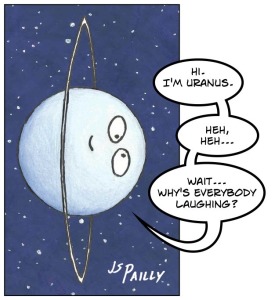
I feel really sorry for the planet Uranus.

I’m really sorry, sideways buddy, but they’re not laughing with you. They’re laughing at you.

Rumor has it NASA wants to send a space probe to Uranus in the late 2020’s or early 2030’s. It’ll be the first time we’ve visited an ice giant since the Voyager 2 flybys of Uranus and Neptune, back in the 1980’s. I’m pretty excited about this, but I can’t talk about a Uranus mission without people starting to snicker at me.

So how did the seventh planet of the Solar System end up with such an unfortunate name? Here’s a quick rundown of how this happened:

  • On March 13, 1781, English astronomer William Herschel discovered a new planet beyond the orbit of Saturn.
  • As a good, patriotic Englishman, Herschal named the new planet Georgium Sidis, Latin for “George’s Star,” in honor of King George III (the same King George mentioned in the Declaration of Independence).
  • For obvious reasons, the name Georgium Sidis wasn’t popular outside of England. Several alternatives were proposed, including Herschel, Neptune, and Uranus.
  • Uranus went on to become the most widely used name around the world, until in the mid-1800’s even England officially accepted the name.

In ancient mythology, Uranus was the god of the sky, the father of Saturn and the grandfather of Zeus. He was an extremely important deity, so it made a certain sense to bestow this prestigious name on such a prestigious discovery: the first new planet discovered since ancient times.

German astronomer Johann Elert Bode proposed the name. As a German, he presumably didn’t realize how it would sound in English—or maybe he did know and was deliberately trolling King George! That’s my personal theory.

Whatever Bode’s intentions were, Uranus is now stuck with its name and all the jokes that come with it. Which is a shame. Such a strange and mysterious planet deserves better.

Next time on Sciency Words: A to Z, we’ll be working with volatile chemicals.

Sciency Words: Spaghettification (An A to Z Challenge Post)

Today’s post is a special A to Z Challenge edition of Sciency Words, an ongoing series here on Planet Pailly where we take a look at some interesting science or science related term so we can all expand our scientific vocabularies together. In today’s post, S is for:

SPAGHETTIFICATION

I have noted that in thought experiments involving black holes, it is traditional to enter the black hole feet first. Therefore, let’s jump feet first into a black hole and try to imagine what happens.

According to a recent paper in the Journal of Physics Special Topics (my all time favorite physics journal), there’s a reasonable chance you’d remain conscious, at least for a while, after crossing the black hole’s event horizon.

That is, assuming the black hole’s mass is greater than 19,000 solar masses. Apparently the more massive a black hole, the longer you’ll last before you pass out. The authors of the paper also assume you were in relatively good health before entering the black hole.

As you continue to fall toward the center of the black hole—a point of infinite density called the singularity—you’ll be accelerating so fast that you’ll start to lose consciousness. The human heart really struggles with pumping blood when you’re experiencing such high G-forces.

And honestly, that’s probably for the best, because things are about to get super weird. The gravity inside a black hole is so intense that, in essence, your feet are falling significantly faster than your head, and the rest of your body is being stretched out in between.

As you keep falling toward the singularity, you become so stretched and elongated that you look less and less like a person and more and more like a spaghetti noodle. And so this process is called—I kid you not—spaghettification.

Next time on Sciency Words: A to Z, if you didn’t like death by spaghettification, how do you feel about death by thagomizer?

P.S.: Other recent papers from the Journal of Physics Special Topics include:

I think you can see why this is my all time favorite physics journal.

Sciency Words: Planet (An A to Z Challenge Post)

Today’s post is a special A to Z Challenge edition of Sciency Words, an ongoing series here on Planet Pailly where we take a look at some interesting science or science related term so we can all expand our scientific vocabularies together. In today’s post, P is for:

PLANET

In 2006, the International Astronomy Union approved a new, official definition of planet, and Pluto didn’t make the cut. Word has it Pluto took the news well.

The I.A.U.’s concern at the time was that more and more small, Pluto-like objects were being discovered, making Pluto seem less like the ninth planet and more like the first of some new class of thing.

To be fair, the I.A.U. did try to come up with a planet definition that would include Pluto while excluding the dozens or perhaps hundreds of other objects potentially out there. But it just didn’t work out.

So to meet the official, I.A.U. sanctioned definition, an astronomical body must meet three requirements:

  • It must orbit the Sun.
  • It must be spherical, due to the pull of its own gravity.
  • It must have cleared its orbital path of debris (this is the part of the planet test that Pluto failed).

Of course, if a definition can be changed once, it can be changed again. Recently, a group of six NASA scientists—specifically, six scientists from NASA’s New Horizons mission to Pluto—put forward a new proposal, which reads:

  • A planet is a sub-stellar mass body that has never undergone nuclear fusion and that has sufficient self-gravitation to assume a spheroidal shape adequately described by a triaxial ellipsoid regardless of its orbital parameters.

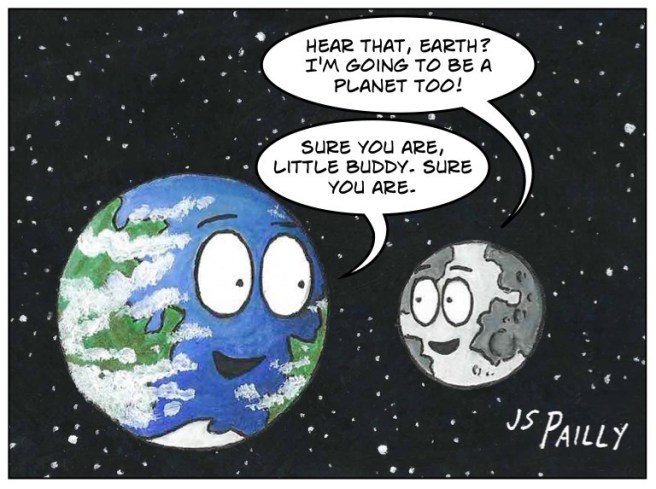
In other words, if it’s round, and it’s not a star or wasn’t a star at some point in the past, then it’s a planet. Under this new definition, Pluto’s back in the planet club! And so is the Moon, weirdly enough, along with many other moons elsewhere in the Solar System. In fact, the new definition would reclassify over one hundred Solar System objects as planets—possibly more than that.

The next I.A.U. general assembly meeting will be held in August, 2018. If they’re going to change the definition of planet again, that’s when they’ll do it. But I very much doubt it’ll happen.

Even though this is probably a lost cause, I want to say something in defense of the New Horizons team’s proposal. The strongest objection seems to be that moons should not be planets. I get that, but in my mind any world that I can picture myself standing on or walking on… I don’t know, that just feels planet-y to me.

I frequently catch myself calling Titan and Europa planets, even though they’re moons. Same for Pluto, Eris, Ceres, and all the other objects currently in the dwarf planet category. And I can’t help myself, but I keep calling Endor from Star Wars a planet, even though it’s specifically referred to multiple times in dialogue as a “forest moon.” All of these places—even fictional moons like Endor—feel planet-y to me.

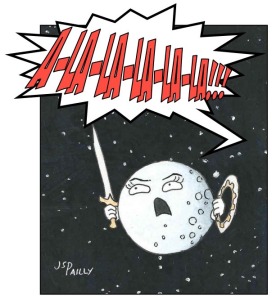
And yes, even the Moon—the most quintessential moon of them all—has a certain planet-esque quality to it when I imagine myself living there, walking around, going about my daily business. I could get used to the Moon being a planet.

Next time on Sciency Words: A to Z, we’ll shrink from planet-scale to the scale of subatomic particles, and we’ll find out what’s so quantum about quantum mechanics.

Sciency Words: Metallicity (An A to Z Challenge Post)

Today’s post is a special A to Z Challenge edition of Sciency Words, an ongoing series here on Planet Pailly where we take a look at some interesting science or science related term so we can all expand our scientific vocabularies together. In today’s post, M is for:

METALLICITY

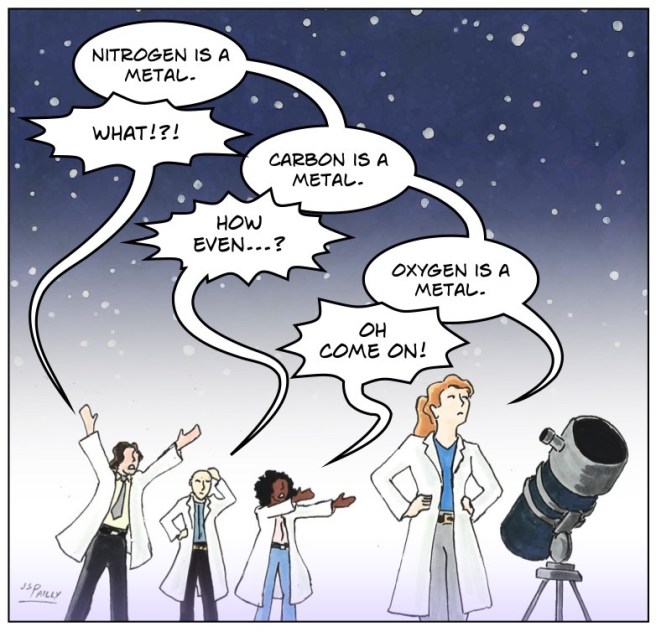
Astronomers. All the other scientists had a meeting, and they all agree: there’s something wrong with those astronomers. For some reason, astronomers do not understand what is or is not a metal.

According to astronomers, the only elements that aren’t metals are hydrogen and helium.

Now it does make sense for hydrogen and helium to be special in astronomers’ eyes. By mass, something like 75% of the observable universe is hydrogen. Helium makes up almost all of the remaining 25%. And the hundred-plus other elements on the periodic table? All combined, all that other stuff constitutes less than 1% of the observable universe.

So for astronomers, it’s convenient to have a word that lumps all this “other stuff” together. But why does that word have to be metal? I’ve never found a wholly satisfactory answer for this, but I do have a personal theory.

Turns out that in technical shorthand, the amount of “other stuff” in a star is represented as [Fe/H]. That’s the chemical symbols for iron (Fe) and hydrogen (H). In other words, the amount of “other stuff” is quantified as a ratio (sort of) of iron to hydrogen (the math is a little more complicated than a simple ratio, but I won’t to get into that here).

I’m guessing that out of all the non-hydrogen, non-helium atoms you might expect to find in a star, iron must be the easiest—or at least one of the easiest—to identify with a spectroscope, and thus iron serves as a convenient proxy for everything else.

The quantity represented by [Fe/H] is called metallicity. Everyone would agree that iron is a metal, so that makes sense. But since metallicity actually tells us more than just the iron content of a star—since it also gives us a sense of how much carbon and silicon and argon etc is in that star—suddenly the word metallicity is covering metals and non-metals alike, in a way that comes across as very odd to everyone who isn’t an astronomer.

Next time on Sciency Words: A to Z, an electron by any other name would still be negatively charged.

Sciency Words: Libration (An A to Z Challenge Post)

Today’s post is a special A to Z Challenge edition of Sciency Words, an ongoing series here on Planet Pailly where we take a look at some interesting science or science related term so we can all expand our scientific vocabularies together. In today’s post, L is for:

LIBRATION

The Moon is tidally locked to the Earth, meaning one side is always facing toward us and the other side is always facing away. Except this tidal locking isn’t perfect. The Moon rocks back and forth just a little bit.

The technical term for this is libration. It comes from a Latin word meaning balance. In the visual simulation above (courtesy of Wikipedia), we can see the phases of the Moon on fast-forward. We can also see that the Moon moves a little closer to us and then a little farther away, due to its elliptical orbit.

And if you watch closely, you can see the Moon rocking or swaying back and forth. If you’re having trouble seeing it, I recommend picking a surface feature—a crater, perhaps—and following it with your eyes.

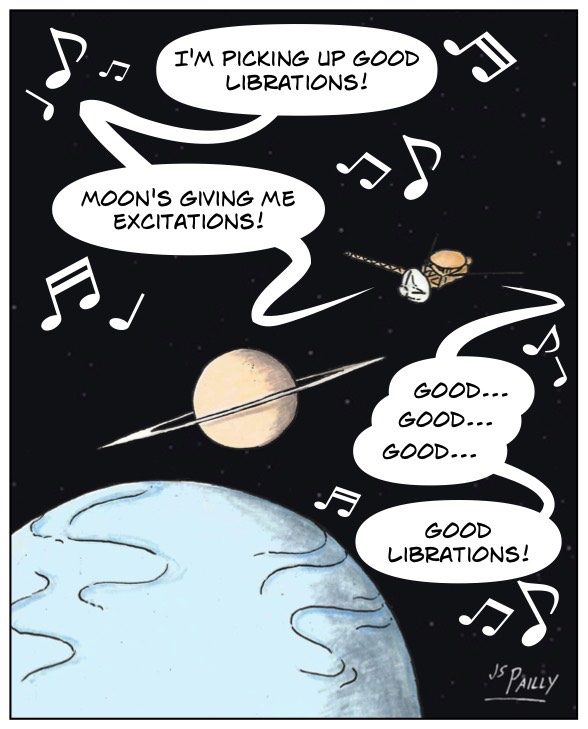
Of course our Moon isn’t the only moon that librates. I first learned about libration from a paper about Enceladus, a moon of Saturn.

Thanks to the Cassini mission, we were able to get extremely precise measurements of Enceladus’s libration, and we discovered Enceladus librates a lot. Like, a whole lot.

Enceladus librates so much that it cannot be solid all the way through. Instead, there must be a vast ocean of liquid water sloshing around inside, with only a thin, icy crust floating on top.

That’s a big deal because with all that liquid water, there’s a chance that maybe—just maybe—Enceladus could support life.

Next time on Sciency Words: A to Z, we’ll talk about metal. Everyone knows what metal is. Everyone except astronomers.