What Color was the Eclipse?

Hello, friends!  I have recently returned from a trip to see the 2024 solar eclipse (my first total solar eclipse!).  I was traveling with a couple of friends.  Due to weather-related concerns, we dropped our original plan to watch the eclipse in Buffalo, New York, and instead drove to a small town called Port Burwell, situated on the Canadian side of Lake Erie.

On the day of the eclipse, Port Burwell was the only place within hundreds of miles with a sunny forecast.  Everywhere else was supposed to be cloudy or partly cloudy.  Port Burwell’s forecast was sunny.  We were not the only ones to realize this, and so we ended up being part of an enormous mob of people who descended upon this cute, lakeside town–a town that was very obviously not expecting so many people to show up.  The locals were super nice, super welcoming, but also, very obviously, very surprised.

I wound up watching the eclipse from a concrete pier, with a cold (increasingly cold, once the event began) wind blowing on me from the lake.  There have been only a few moments in my life where I felt like I’d been transported, body and soul, into another world: exploring the ancient cliff dwellings at Mesa Verde, seeing the bacterial mats at Yellowstone National Park, and standing on that pier in Port Burwell while the last light of the Sun flashed and vanished behind the Moon.

What happened next?  Speaking as a writer, as a man of words, as a person who owns an absurd number of dictionaries and thesauruses, please understand what I mean when I say I have NO WORDS to describe the next three minutes.  Strange?  Beautiful?  Terrifying, on some deep and primal level?  Those words point in the general direction of what this experience felt like.  And that’s the best I, as a writer, can offer.  Sorry.  Words fail me.

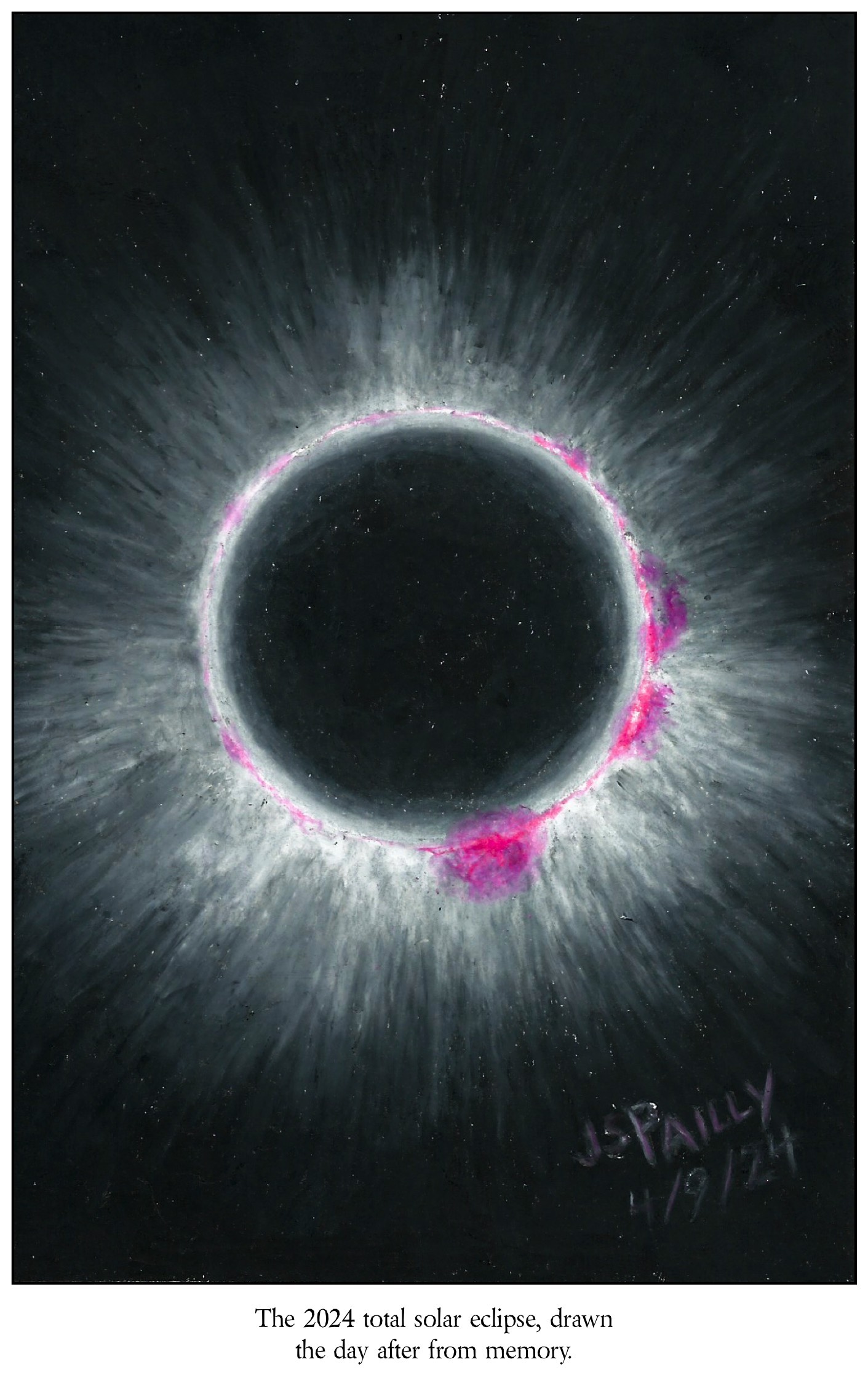
Although, there is one more word I would use to try to communicate what my eclipse experience was like.  It’s the name of a color.  Magenta.  As it so happens, the 2024 eclipse occurred during solar maximum, the most active part of the Sun’s eleven year cycle.  Several solar prominences (those giant, fiery arcs that rise up from the Sun’s surface) were visible to the naked eye during the eclipse.  One extremely bright prominence appeared near the “bottom” of the Sun, and I saw two other large, flickering prominences on the Sun’s righthand side.

To my eye, the prominences were the most perfect magenta color I have ever seen in nature.  It was like the pure magenta that computers generate in a CMYK color pallet.  The next day, I decided to try drawing the eclipse based solely on my own memory (see the image above).  Memory is an imperfect thing.  In my drawing, it seems that I made the bottom and righthand prominences bigger than they really were (probably because those three prominences stand out so prominently in my memory).  But the color is about right.  That color is, I swear to you, the color that I saw.  Which is strange, because my best friend, who was standing right next to me at the time and who was definitely seeing the same eclipse I was, swears the prominences were bright, bright red.  Not magenta.  Red.

After I drew my version of the eclipse, my friend used color correction software to try to approximate the color he saw.  He tells me his version is still not quite right, but it’s close enough.  So here’s the side-by-side comparison:
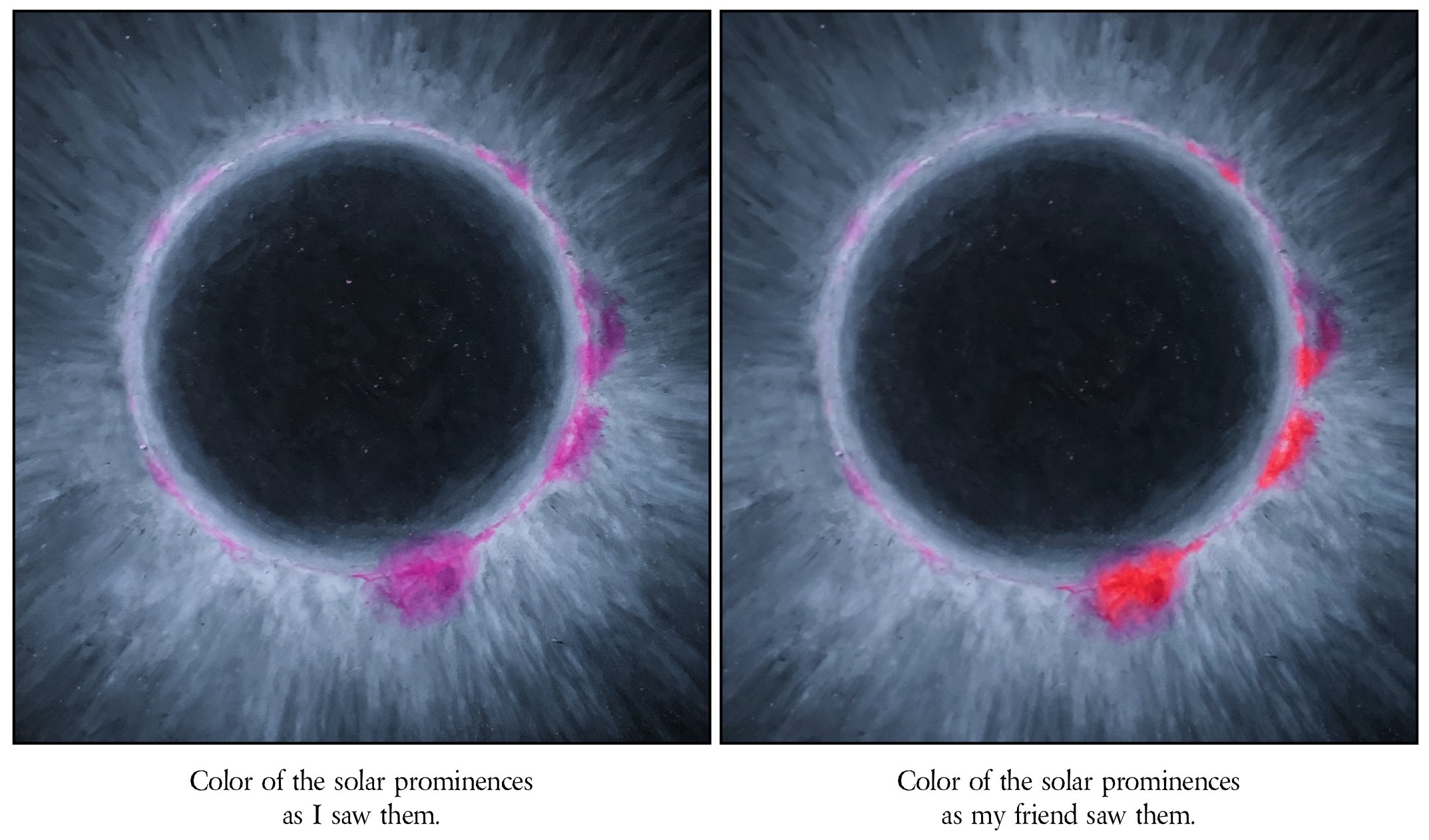
After comparing notes with a few other people who also saw the eclipse, it seems that most people (but not everyone) saw what my friend saw: a bright red color.  One person went so far as to call it an orangey-red color.  Only a few people saw the same magenta color I saw.

There’s so much about the eclipse that I did not expect, but this red vs. magenta thing is the part I expected the least.  So I want to end this post by asking you, dear readers: did you see the eclipse?  And if you did, what color were the solar prominences?  Did they look red to you?  Did they look magenta?  Did you, perhaps, see a different color entirely?

What Color is Neptune?

Hello, friends!

Every now and then, science asks us to unlearn a thing we had previously learned.  Pluto isn’t a planet.  Some dinosaurs were covered in feathers.  And now, according to some newly published research, Neptune is less blue than we thought.  Rather than that rich, royal blue color we usually see in photos, Neptune is more of a light aqua color, similar to the light aqua of Uranus.

The original research, published in the Monthly Notices of the Royal Astronomical Society, was actually more about Uranus than Neptune.  As you probably know already, Uranus is tipped over sideways.  This sideways orientation causes some pretty wild seasonal variations in Uranus’s atmosphere, which leads to changes in Uranus’s color and brightness over the course of a Uranian year (which is equivalent to approximately 84 Earth years).

But aside from the sideways thing, Uranus and Neptune are very similar planets.  They’re about the same size, about the same mass, and they have almost the same chemical compositions.  So if you’re doing research about the atmosphere of Uranus (and the color thereof), then it makes sense to compare and contrast the colors of Uranus and Neptune.  And it’s at this point that the original research paper goes off on a long tangent, explaining that Neptune isn’t as blue as you probably think, and offering reprocessed imaging data to show what Neptune really looks like.

So how did everybody get this wrong for so long?  Well, to make a long story short, somebody at NASA was playing with the color contract.  In 1989, when the Voyager 2 space probe sent the first up close images of Neptune back to Earth, those images revealed some interesting features in Neptune’s atmosphere, like the Great Dark Spot and the South Polar Wave.  Adjusting the color contrast made those features easier to see, and so these color adjusted images were the images that got disseminated to the media and the public.

In NASA’s defense, they did try to call attention to the color adjustments they’d made.  The color enhanced photos originally had captions explaining that they were false color images.  Apparently NASA also showed a true color image of Neptune, side by side with the false color version, at a 1989 press conference.  Still, most people missed the memo, including a lot of people in the scientific community, leading to this popular misconception that Uranus and Neptune are dramatically different shades of blue.

Now I have seen a few amateur astronomy buffs object to this new research, saying that when they look at Neptune and Uranus in their telescopes, Neptune is clearly a darker shade of blue than Uranus.  The research paper does address that.  First, due to differences in atmospheric density, Neptune is a teeny-tiny bit darker than Uranus (but only a teeny-tiny bit).  Additionally, Neptune is farther away from the Sun, which means Neptune gets less sunlight than Uranus.  This makes Neptune look a teeny bit darker still. And also, if you’re observing Neptune from Earth, Neptune will appear to be smaller (and proportionally dimmer) than Uranus, once again due to the fact that Neptune is farther away.

It’s going to take me some time to get used to this, just like it took me some time to get used to the idea of feathered dinosaurs.  I sometimes like to call Uranus “the Turquoise Planet” and Neptune “the Other Blue Planet.”  But I guess I’ll have to change that.  From now on, I’ll have to call Neptune “the Other Turquoise Planet” instead.

WANT TO LEARN MORE?

I don’t normally tell people to just go look at Wikipedia, but I do think the Wikipedia page on Neptune is worth seeing.  Wikipedia was very quick to update its photo of Neptune after this new research was published.

The lead author on the original paper is a professor at the University of Oxford, so here’s the press release from the University of Oxford announcing the paper’s publication.

And here’s a YouTube video with a little more detailed information about Uranus, Uranus’s atmosphere and seasonal variations, and the updated color data for Neptune.

And lastly, for anyone who wants to read the original research paper itself, here’s the link.


P.S.: If you must make a Uranus joke in the comments, I will give you praise and credit if (and only if) it’s a joke I haven’t heard before.

Fly or Die: How Life on Venus Might Survive

Hello, friends!

So I recently found this 100% totally legit JWST image of Venus, revealing some of the weird and scary chemistry that happens in Venus’s atmosphere.  As you can see, Venus sure does love chemicals.  Super noxious, super toxic chemicals.  With all those noxious and toxic chemicals in her atmosphere, you’d think Venus must be a pretty unlikely place to find life.

Now add in a runaway greenhouse effect that makes the surface of Venus hotter than the daytime surface of Mercury.  Now add in atmospheric pressure that rivals the deepest, most-submarine-crushing depths of Earth’s oceans.  Now add in some sort of volcanic activity (the specifics of which remain mysterious) that seems to sporadically spread fresh lava over nearly the entire planet’s surface.

So yes, Venus is an unlikely place to find life.  Venus is among the least likely places in the whole Solar System to find life.  And yet, the possibility of life on Venus does come up in the scientific literature from time to time.  So how would that work?  How could living things survive on a planet so infamously hostile to life?

Have you ever heard the expression “sink or swim”?  Well, if any sort of life exists on Venus today, its motto must be “fly or die.”  Everything about Venus is dangerous and deadly, but the most dangerous and deadly conditions are found at the planet’s surface.  So if you’re a Venusian life form, don’t go to the surface.  Stay aloft in the atmosphere.  At an altitude of about 55 kilometers up, you should be safe safe-ish.  The global lava floods (however frequently or infrequently that happens) will be far below you.  The extreme pressure and temperature will be far below you as well.  You’ll still have to deal with all those scary chemicals in the atmosphere, but if you’re clever (or rather, if evolution is clever for you) some of those scary chemicals might be usable to you as nutrients.

If the idea of perpetually airborne life—of life that never, ever touches the ground—seems farfetched, then I need to tell you that microorganisms can and do live in the upper reaches of Earth’s atmosphere.  That’s not an ideal environment for them.  They’d much rather be down on the ground, where water and nutrients are more plentiful.  But microbes can survive way up there, if they have to.  Earth has a whole “aero-biosphere” of airborne microbes that scientists are only just beginning to understand.

And if Earth has an aero-biosphere, then maybe (maybe!) Venus could have some sort of aero-biosphere, too.  It may not be likely, but it’s not totally impossible.

WANT TO LEARN MORE?

Here’s a link to diagram, originally from a paper on the possible habitability of Venus, showing what the life cycle of Venusian airborne microbes might be like.

And here’s a short press release from the Johns Hopkins Applied Physics Laboratory (A.P.L.) describing the so-called “Venus Life Equation,” which is sort of like the Drake Equation for life in the universe, but for just Venus.

And lastly, regarding the mystery surrounding Venus’s volcanic activity, we know Venus’s surface got “paved over” by fresh lava at some point in the recent past, but we don’t know how frequently this sort of thing happens.  It definitely happened at least one time.  Maybe it’s happened more often than that, or maybe it’s a continuing process that’s still happening today.  Here’s an article from the Planetary Society explaining why the global resurfacing of Venus remains such a big scientific mystery.


P.S.: Okay, I lied.  The image I used at the top of this blog post?  That’s not really from JWST.  Actually, I’m pretty sure JWST cannot safely observe Venus, due to Venus’s proximity to the Sun.  I drew that image myself.  And if you like my drawing of Venus, and if you want to do something to support what I do here on Planet Pailly, please consider visiting the Planet Pailly store on RedBubble.  There, you can buy my “Venus ‘Hearts’ Chemicals” drawing (and other drawings I’ve done) on a T-shirt, pillow case, spiral-bound notebook… personally, I think today’s drawing would look great on a little notebook, maybe for chemistry class!

Green Skies on Mars

Hello, friends!  So I learned a new thing about Mars.  Recent research, published just last year in Nature Astronomy, says that the nighttime sky on Mars sometimes glows green.  Super bright green.  Bright enough that this green glow would be visible to the human eye, if any human eyes were on Mars to see it.  According to one source I read, this green Martian airglow would be comparable to “moonlit clouds on Earth.”

So how does this happen?  Chemistry!  During the day, sunlight zaps carbon dioxide (CO2) gas in Mars’s atmosphere, breaking it up into ionized carbon and oxygen atoms.  At night, those ionized oxygen atoms recombine to form molecular oxygen (O2).  This specific reaction—the formation of O2—produces a little light in the green and infrared parts of the spectrum.  (Please note: I have glossed over an enormous amount of detail here.  See the “Want to learn more?” section below for more information).

The infrared glow of O2 formation had been detected previously.  A very faint green glow had also been detected over the dayside of Mars.  The detection of a green glow at night—that is the new discovery!  And also, this green glow is remarkably and astonishingly bright.  Brighter, it seems, than anyone expected.

Which initially made me wonder: if this green airglow on Mars is that bright, how did it go undetected for so long?  But then again, I sometimes overestimate how much we know about Mars.  You’d think we’d know a lot by now.  Mars is the second most thoroughly explored planet in the Solar System, after Earth.  But in truth, we have just barely scratched the Red Planet’s red surface (and we know even less about all the other planets in our Solar System).

So I see this discovery as a reminder: no matter how much we think we know about space, there is still far, far more we need to learn.

WANT TO LEARN MORE?

This discovery was made by the European Space Agency’s ExoMars Mission, currently in orbit around Mars.  Here is a press release from ESA about this discovery.

And here is an article from Universe Today, which goes into more detail about Mars’s airglow, the chemistry behind it, and the way Martian wind patterns and the changing of Martian seasons affect it.

And lastly, for those of you who want to look at the original research, here’s a link to the original research paper from Nature Astronomy (warning: you may encounter a paywall).

Never Say Never: Life on Ancient Venus

Hello, friends!  Today’s post is about the planet Venus, but the real lesson today is this: never say never.

Could Venus have supported life at some point in the past?  Yes.  In theory, yes.  Despite being closer to the Sun than Earth, Venus still orbits within the so-called habitable zone of our Solar System (this depends a little on whom you ask; some sources say Venus is inside the habitable zone while others will tell you she’s skirting the habitable zone’s edge).  So it is plausible that, at some point in the distant past, Venus could have had more Earth-like temperatures and more Earth-like surface conditions.

But then something went catastrophically wrong.  Carbon dioxide gas somehow started accumulating in Venus’s atmosphere.  Carbon dioxide is naturally good at trapping heat, so rising CO2 levels caused the temperature to also rise.  Rising temperatures caused more CO2 to outgas from the planet’s crust.  The outgassing of more CO2 caused the temperature to rise further, which caused more outgassing of CO2, which caused temperatures to rise further, which caused more outgassing of CO2, which caused… you get the idea.  This process is known as a runaway greenhouse effect.

Cartoon of Venus, looking eager, and Earth, looking shocked, as Venus says, "Oh, Earth! I used to have 'organisms' crawling on me, too.  But then I filled my atmosphere with CO2, triggering a runaway greenhouse effect.  That killed everything!"

I don’t think anyone knows for certain what started the runaway greenhouse effect on Venus (or at least, I’ve read many different ideas about what the initial cause might have been).  All we know for certain is what Venus is like today: hell.  Insane heat.  Insane atmospheric pressure.  Insane levels of CO2 plus insane weather, most notoriously sulfuric acid rain.  I think it’s safe to say that no planet in the Solar System is more hostile to life as we know it than modern day Venus.

But the runaway greenhouse effect was not the only catastrophe to befall Venus.  Venus also experienced something called a global resurfacing event.  Resurfacing may sound like something you’d do to a parking lot, but when we’re talking about planets, resurfacing means spreading fresh lava over a planet’s surface, essentially paving over whatever surface features might have been there before.

So could Venus have supported life at some point in the past?  Sure.  It’s possible.  But this always seemed like an untestable hypothesis to me.  The runaway greenhouse effect would have killed everything (well, almost everything… see my post script), and the global resurfacing event would have paved over any fossils or other evidence of past Venusian life.  So if there ever was life on Venus, we’d never know about it.  Never.

We now come to the “never say never” part of today’s post.  On Venus, there are patches of rough terrain called tesserae (singular, tessera).  As longtime readers of this blog know, Venus is my favorite planet, so naturally I have heard about the tesserae on Venus before; however, I was previously led to believe tesserae were formed by thrust faults, volcanic eruptions, or some other relatively modern geological activity.  But recently, I read a research paper that mentioned, rather casually, that tesserae might also be the remnants of ancient continental crust jutting up above the otherwise smooth, resurfaced landscape.

So the tesserae we see today could be ancient Venus’s version of the Rocky Mountains, the Alps, or the Himalayas.  They are (or were) the highest of high elevation regions on ancient Venus—regions high enough to survive the global resurfacing event.  If true, then the tesserae of Venus may preserve some hard evidence of what Venus used to be like before the runaway greenhouse effect and the global resurfacing event wrecked the place.

So was there ever life on Venus?  It’s possible, but we don’t know for sure.  I once resigned myself to the belief that we could never know, but you should never say never.  Signs of ancient water and ancient life may be preserved on Venus after all, just waiting for us to discover.

P.S.: Some scientists believe there may be life on Venus today.  There is some very circumstantial evidence of microorganisms floating around in Venus’s upper atmosphere.  I do have some thoughts about that, but I’ll save that for another blog post.

Want to Learn More?

Here is the research paper I mentioned that casually mentions tesserae might be the remnants of ancient continental crust.

And here is a paper I found describing possible signs of water erosion on Venus’s tesserae.  Water erosion could not possibly happen on Venus today, so this would be further evidence that tesserae have preserved something of Venus’s ancient history.

And lastly, just because this “tesserae equals continental crust” idea is new to me, that doesn’t mean it’s new to science.  Here’s a paper from 1990 discussing the possibility.  Even if some of the information in this paper is out of date, I think it’s still worth a look, if only to see how much history this idea has.

Uranus and Planet Nine: Exploring Two Planets for the Price of One

Hello, friends!

I don’t like to go out shopping.  My time is valuable.  Traffic is frustrating.  Fuel is expensive.  So if I do need to go out for some reason, I plan my route carefully and try to combine multiple errands into one trip.  Believe it or not, this is a lifeskill that I learned from NASA.  When NASA plans missions into outer space, they too plan carefully and try to double, triple, or quadruple up science objectives for a single mission.

In April of 2022, the U.S. National Academy of Sciences advised NASA to send a mission to the planet Uranus, with a launch date in the early 2030’s.  This mission has not been officially approved yet, nor has it officially been named.  As a placeholder name, it’s often called the Uranus Orbiter and Probe mission, or U.O.P.  As this placeholder name implies, the mission would include two spacecraft: an orbiter, to orbit Uranus, and a probe, which would be dropped into the atmosphere to probe Uranus’s interior.

No spacecraft from Earth has visited Uranus since the 1980’s, so a mission like this is long overdue.  The orbiter will spend four to five years orbiting the planet, studying the planet’s rings, measuring the planet’s weird and wonky magnetic field, and visiting all of the planet’s major moons—several of which may contain subsurface oceans of liquid water.  Oh, and if NASA does launch in the early 2030’s, U.O.P. should arrive in time to observe the changing of seasons on Uranus (something which only happens once ever 42 years).

As for the atmospheric probe, it will spend maybe an hour or so plummeting through the planet’s atmosphere before being crushed by the increasing atmospheric pressure.  Right now, scientists can only make educated guesses about Uranus’s interior structure and chemical composition.  The uppermost layer of the Uranian atmosphere is an opaque haze of hydrocarbons.  Neither ground-based nor space-based telescopes can see through that haze, so an atmospheric probe is the only way to find out what the deeper layers of Uranus’s atmosphere are really like.

But as I said at the beginning of this post, NASA likes to double, triple, and quadruple up science objectives whenever they can, and I just read about a really interesting and exciting side quest U.O.P. may be able to complete while on route to Uranus.  For about a decade now, scientists have suspected that we might have nine planets in our Solar System after all.

According to the Planet Nine hypothesis, something very massive—massive enough to be a large planet or, perhaps, a small black hole—is lurking in the outer reaches of the Solar System, somewhere far beyond the orbit of Neptune.  You see, the orbits of many of trans-Neptunian objects (comets, dwarf planets, etc.) seem to be clustered together in a rather peculiar way.  It’s almost as if a very big, very massive something has been pushing all those trans-Neptunian objects around, corralling them together with the power of its gravity.

As of yet, no one has been able to pinpoint the exact location of the mysterious Planet Nine.  But U.O.P. may be able to help!  Remember that Uranus is very, very far away.  The flight from Earth to Uranus will take a very, very long time.  During that long journey through space, U.O.P. will feel the gravitational influence of all the planets in the Solar System—including the gravitational influence of any planets we don’t currently know about.  So by keeping close tabs on U.O.P.’s exact location in space, astronomers should be able to notice any unexpected gravitational forces that may start tugging on U.O.P.

Even a slight gravitational tug should, over the course of the long journey to Uranus, be enough to point us in the direction of Planet Nine, or at least help us zero in on Planet Nine’s most probable location.

WANT TO LEARN MORE?

Here’s a write-up from the Planetary Society about NASA’s most recent “decadal survey” for planetary science, which includes (among other recommendations) the proposed Uranus Orbiter and Probe Mission.

And here’s the research paper I read pitching the idea of using U.O.P. to help search for Planet Nine.

And lastly, here’s an article from Inverse explaining the above mentioned research paper in layperson’s terms.

How Big are the Mountains on the Moon?

Hello, friends!

So I’ve fallen down a research rabbit hole, or maybe I should say I’ve fallen into a research crater.  I’ve been studying the topography of the Moon: mountains, valleys, craters, cliffs, etc, etc.  Some of these lunar land forms sound like they are stupidly big.  2 or 3 kilometers tall, in a surprising number of cases, or 2 or 3 kilometers deep.  Photos taken from space or by Earth-based telescopes don’t necessarily give you a good sense of just how stupidly large these things are.

Of course we have stupidly large land forms here on Earth, too.  Mt. Everest rises about 8.5 kilometers above sea level, and Mauna Kea (in Hawaii) stands more than 10 kilometers above the ocean floor.  The tallest mountains I’ve seen, personally, would be the Rocky Mountains in the western United States.  According to the Google machine, the tallest of the Rocky Mountains stands about 4 kilometers above sea level; however, if you’re in a place where you can see the Rockies, you’re not standing at sea level.  So I’m guessing that when I saw them, the Rocky Mountains were looming roughly 2 or 3 kilometers over me—comparable to many of the lunar land forms I’ve been reading about.

But here on Earth, mountains like the Rockies or the Alps are exceptional, whereas on the Moon, mountains that big (or cliffs that tall, or craters that deep) seem to be fairly ordinary.  I’m guessing this is due to gravity.  It’s easier to be a big mountain when the pull of gravity is so much less.

So if you and I were standing on the surface of the Moon, is that what the landscape would look like around us?  Rocky Mountain size mountains all around us?  In some regions, yes.  But also no.  Before you try to imagine what the lunar landscape would actually look like, to your human eyes, I need to tell you how your human eyes may play tricks on you when you’re on the Moon.

Here on Earth, when you see a tall mountain in the distance, how can you tell it’s a tall mountain in the distance and not a small hill right in front of you?  Well, certain visual cues help your brain figure that out.  Roads and cars, trees and buildings, birds or other wildlife… you know how big or small these things are, and seeing these things will help you guesstimate how large a nearby hill/far off mountain must be.

The atmosphere also plays a role in this.  Air is not 100% transparent, so even on a clear and sunny day, distant mountains will tend to look a little hazy—noticeably hazier than a nearby hill would look.

But there’s no air on the Moon, so you won’t see any atmospheric haze.  None whatsoever.  There are also no trees on the moon, nor any roads or buildings (yet).  So those visual cues are also missing.  As a result, an optical illusion comes into play which can make nearby hills almost indistinguishable from far off mountains.

Noticing the size of rocks and boulders might help, but the only way to really recognize the sheer scale of some of these lunar land features (as seen from the lunar surface) is to move around, change perspectives, and try to judge size and distance by parallax.

A few weeks ago, I went planet hunting with my telescope.  Mercury, Venus, and Mars were clustered together in the sky, and I didn’t want to miss that.  I also took a look at the Moon that night.  I’ve seen the Moon in my telescope many times, of course.  I always enjoy looking at the shadows cast by mountains, craters, etc.  But thanks to this new “research crater” I’ve fallen into, that night was the first time I fully appreciated the significance of those shadows.  Those are big shadows.  They must be big shadows in order for me and my relatively small telescope to see them so clearly all the way from Earth.  It takes some stupidly tall mountains and stupidly deep craters to cast such stupidly big shadows across the lunar surface.

WANT TO LEARN MORE?

To make landing on the Moon safer and easier, the Apollo missions mostly stuck to flat terrain regions.  Mostly.  The exception is Apollo 15, which landed near a mountain range called Montes Apenninus.  Click here to learn more about Apollo 15 and the terrain around the Apollo 15 landing site.

Additionally, I found this video from Astrum really helpful in understanding the true size and scale of lunar surface features.  The video also talks about how your eyes can deceive you when viewing the lunar landscape.

That Time NASA Discovered Life on Earth

Hello, friends!

As some of you may already know, there is life on Earth.  NASA discovered that fact in 1990.  Let me explain.

In the decades prior to the Space Age, certain astronomers had claimed to observe vegetation growing on the Moon, artificial canals on the face of Mars, and some scientists even speculated that beneath the clouds of Venus (which were surely H2O clouds), we might find a world dense with jungle.  Writers and philosophers had long speculated about how other worlds might be populated by other people, and at least a few theologians argued that there must be life on other planets (for why would God create all these planets and then leave them empty?).

And yet, as both the Soviet and American space programs ventured farther and farther out into space, they found nothing.  No vegetation on the Moon (not even on the far side of the Moon).  No canals on Mars.  Definitely no jungles on Venus (and as for Venus’s clouds, it turns out they’re not made of H2O—they’re not made of H2O at all!!!).

I don’t want to make it sound like everybody expected to find life on the Moon, Mars, or elsewhere, but a lot of people were expecting to find life.  So what happened?  Why couldn’t our space probes find life on any of the other worlds of the Solar System?  There were two possible explanations.  Either there was no life out there to find, OR something was wrong with our space probes.  Maybe they weren’t carrying the right equipment to detect life, or maybe they weren’t performing their experiments properly, or maybe they weren’t sending the correct data back to Earth.

Which brings us to 1990.  NASA’s Galileo spacecraft was heading out to Jupiter, but for navigational reasons it needed to do a quick flyby of Earth first.  A certain scientist named Carl Sagan saw this Earth flyby as an opportunity.  What would happen if Galileo did a thorough scan of our home planet?  Could this fairly standard NASA space probe, equipped with a fairly standard suite of scientific instruments, detect life on a planet where we already knew life existed?

The results were published a few years later in a paper entitled “A search for life on Earth from the Galileo spacecraft.”  This “search for life on Earth” paper is my all time favorite scientific research paper.  First of all, for a scientific paper, it’s a surprisingly easy read.  Turns out Carl Sagan was a good writer with a knack for explaining science in a clear and accessible manner.  Who knew?  Secondly, the experiment itself is really cool.  And third, the results of the experiment are a little more ambiguous than you might expect.

Among other things, Galileo detected both oxygen and methane in Earth’s atmosphere.  If you didn’t already know there was life on Earth, it would be difficult to explain how those two chemicals could both be present.  Oxygen and methane should react with each other.  They should not exist together in the same planet’s atmosphere for very long—not unless something unusual (like biological activity) continuously pumps more oxygen and more methane into the atmosphere.

Additionally, Galileo noticed a strange “red-absorbing” substance widely distributed across Earth’s landmasses.  This mystery substance could not be matched with any known rock or mineral, suggesting a possible biological origin.  This red-absorbing mystery substance was, in fact, chlorophyll—the chemical that allows plants to perform photosynthesis.

And lastly, Galileo picked up radio transmissions.  Galileo couldn’t determine the content of these transmissions, but the transmissions were clearly artificial—an indication that there is not only life but intelligent life on Earth.

I’ve read this “search for life on Earth” paper several times over the years.  Like The Lord of the Rings or Ender’s Game, it’s one of those things I love to read again and again, and each time I feel like I get a little more out of it.  The main take away, I have come to believe, is that if there were anything similar—anything even remotely similar—to Earth’s biosphere on the Moon or Mars or anywhere else in the Solar System, we would know about it.  Our space probes would absolutely be able to detect something like that.

However, there’s still a lot of stuff here on Earth that the Galileo probe missed.  Some little details, for example: chlorophyll absorbs both red and blue light, but Galileo apparently didn’t notice the blue absorption.  Only the red.  And Galileo overlooked some big things, too.  Cities, roadways, the Great Wall of China?  Maybe a follow-up mission to Earth would find those things, but Galileo didn’t see any of that stuff.  And then there’s Earth’s oceans.  Galileo couldn’t detect anything beneath the surface of the water.  Water very effectively blocked all of Galileo’s sensors.

So our space probes are not fundamentally flawed, but they do have a few blind spots.  Today, no one expects to find jungles on Venus or canals on Mars.  Our space probes say those things aren’t there, and we can be confident that our space probes are working properly.  But there are a few niche environments out there were alien life might still be hiding.

WANT TO LEARN MORE?

Science communicators (myself included) dumb things down for their readers, which is why reading actual scientific papers has become an important part of my research process.  Dumbed down science is fine, provided it still says what the actual scientific research says.  But reading these sorts of papers is a skill, and it takes some time and practice to do it.  If you’ve ever wanted to start reading scientific papers for yourself, “A search for life on Earth from the Galileo spacecraft” by Carl Sagan et al. is a good starter paper.

Mercury A to Z: Zero Degrees Longitude

Hello, friends!  Oh my goodness, we made it!  We made it to the end of the A to Z Challenge!  For this year’s challenge, my theme is the the planet Mercury, and in today’s post Z is for:

ZERO DEGREES LONGITUDE

Zero degrees longitude.  The prime meridian.  It’s an imaginary line that helps define the latitude-longitude coordinate system for mapping the surface of a planet.  On Earth, the prime meridian runs through the very English Royal Observatory in Greenwich, England.  On Mars, the prime meridian runs through Airy-0, a crater named after Sir George Airy, the very English scientist who decided where Earth’s prime meridian should be.  So where is the prime meridian on Mercury?

Actually, we talked about this in a previous post.  Mercury’s 0 and 180 degree longitude lines are supposed to run through the planet’s “hot poles,” the two points along Mercury’s equator where the temperature gets highest.  But the hot poles aren’t visible surface features, like Airy-0 or the Greenwich Royal Observatory.  So in the 1970’s, when NASA’s Mariner 10 space probe arrived at Mercury, scientists were hoping they could find an obvious surface feature to serve as an official prime meridian marker.

Mariner 10 visited Mercury three times.  It flew by Mercury, looped around the Sun, then flew by Mercury again, and then again one more time, before the space probe ran out of fuel.  During each of those three visits, only half of Mercury was visible to Mariner 10’s cameras, and unfortunately it was always the same half of the planet.  As a result, Mariner 10 never saw Mercury’s prime meridian, nor could it see any surface features on or near that imaginary line.

So Mercury’s prime meridian ended up being defined in a rather awkward way.  Scientists picked a tiny crater 20 degrees west of where the prime meridian was supposed to be.  They named the crater Hun Kal, which means twenty in an ancient Mayan language (this is one of the rare craters on Mercury not named after an artist, writer, or musician).  Scientists then officially defined Mercury’s prime meridian as a line of longitude exactly 20 degrees east of the center of Hun Kal Crater.

Thanks to NASA’s MESSENGER Mission, we now have photos of the entire surface of Mercury.  Presumably this means scientists could redefine Mercury’s prime meridian, if they wanted to, but nobody seems interested in doing that.  Using Hun Kal Crater to define the prime meridian may not be ideal, but it seems to work well enough.  And if it works, why fix it?

WANT TO LEARN MORE?

Here’s an article from SpaceRef.com, featuring an image of Hun Kal Crater as seen by MESSENGER.

Mercury A to Z: Year of Mercury Watching

Hello, friends!  For this year’s A to Z Challenge, I decided to talk about the planet Mercury.  I wasn’t sure at first if I’d be able to do a whole alphabet’s worth of posts about this one planet, but at this point, I think I just might pull it off!  In today’s post, Y is for:

YEAR OF MERCURY WATCHING

My original plan for this post was to talk about Mercury’s year.  It’s 88 Earth days long, which (oddly enough) is only half the length of Mercury’s solar day.  That’s because of a spin-orbit resonance, sidereal rotation, yada yada… we’ve already talked about this stuff.  So instead, today I want to talk about the rest of this year here on Earth and tell you when the best opportunities to see Mercury will be.

The best time to see Mercury is during an “elongation,” which is when Mercury (as viewed from Earth) is as far away from the Sun as he can get.  To say that another way, if you drew an imaginary line between Mercury and the Sun, elongation is when that line would be at its longest.

Some elongations end up being a little higher (or should I say longer?) than others.  This is because of Mercury’s highly elliptical (non-circular) orbit.  The highest elongation of Mercury this year occurred on April 11.  I wish I’d known that earlier this month, because I definitely would have mentioned it.  Anyway, the next elongation will occur in the morning on May 29, 2023.  After that, there will be an elongation in the evening on August 10.  Another elongation will occur on the morning of September 22, and another will be on December 4.

Don’t worry too much about the specific dates.  You’ll still get a pretty good view of Mercury a few days before and after an elongation occurs.

I have only seen Mercury two times in my life that I know of.  I recently learned, however, that Mercury is known to twinkle like a star, so I may have seen him many times without recognizing him as a planet.  After all the Mercury research, Mercury writing, and Mercury artwork I’ve done for this year’s A to Z Challenge, I am very eager to get out there and see Mercury again (even if it means getting up before sunrise on or around May 29).

WANT TO LEARN MORE?

I found the dates for upcoming elongations of Mercury in this article from EarthSky.org.  The article also goes into a little more detail about how elongations work.