What Color was the Eclipse?

Hello, friends!  I have recently returned from a trip to see the 2024 solar eclipse (my first total solar eclipse!).  I was traveling with a couple of friends.  Due to weather-related concerns, we dropped our original plan to watch the eclipse in Buffalo, New York, and instead drove to a small town called Port Burwell, situated on the Canadian side of Lake Erie.

On the day of the eclipse, Port Burwell was the only place within hundreds of miles with a sunny forecast.  Everywhere else was supposed to be cloudy or partly cloudy.  Port Burwell’s forecast was sunny.  We were not the only ones to realize this, and so we ended up being part of an enormous mob of people who descended upon this cute, lakeside town–a town that was very obviously not expecting so many people to show up.  The locals were super nice, super welcoming, but also, very obviously, very surprised.

I wound up watching the eclipse from a concrete pier, with a cold (increasingly cold, once the event began) wind blowing on me from the lake.  There have been only a few moments in my life where I felt like I’d been transported, body and soul, into another world: exploring the ancient cliff dwellings at Mesa Verde, seeing the bacterial mats at Yellowstone National Park, and standing on that pier in Port Burwell while the last light of the Sun flashed and vanished behind the Moon.

What happened next?  Speaking as a writer, as a man of words, as a person who owns an absurd number of dictionaries and thesauruses, please understand what I mean when I say I have NO WORDS to describe the next three minutes.  Strange?  Beautiful?  Terrifying, on some deep and primal level?  Those words point in the general direction of what this experience felt like.  And that’s the best I, as a writer, can offer.  Sorry.  Words fail me.

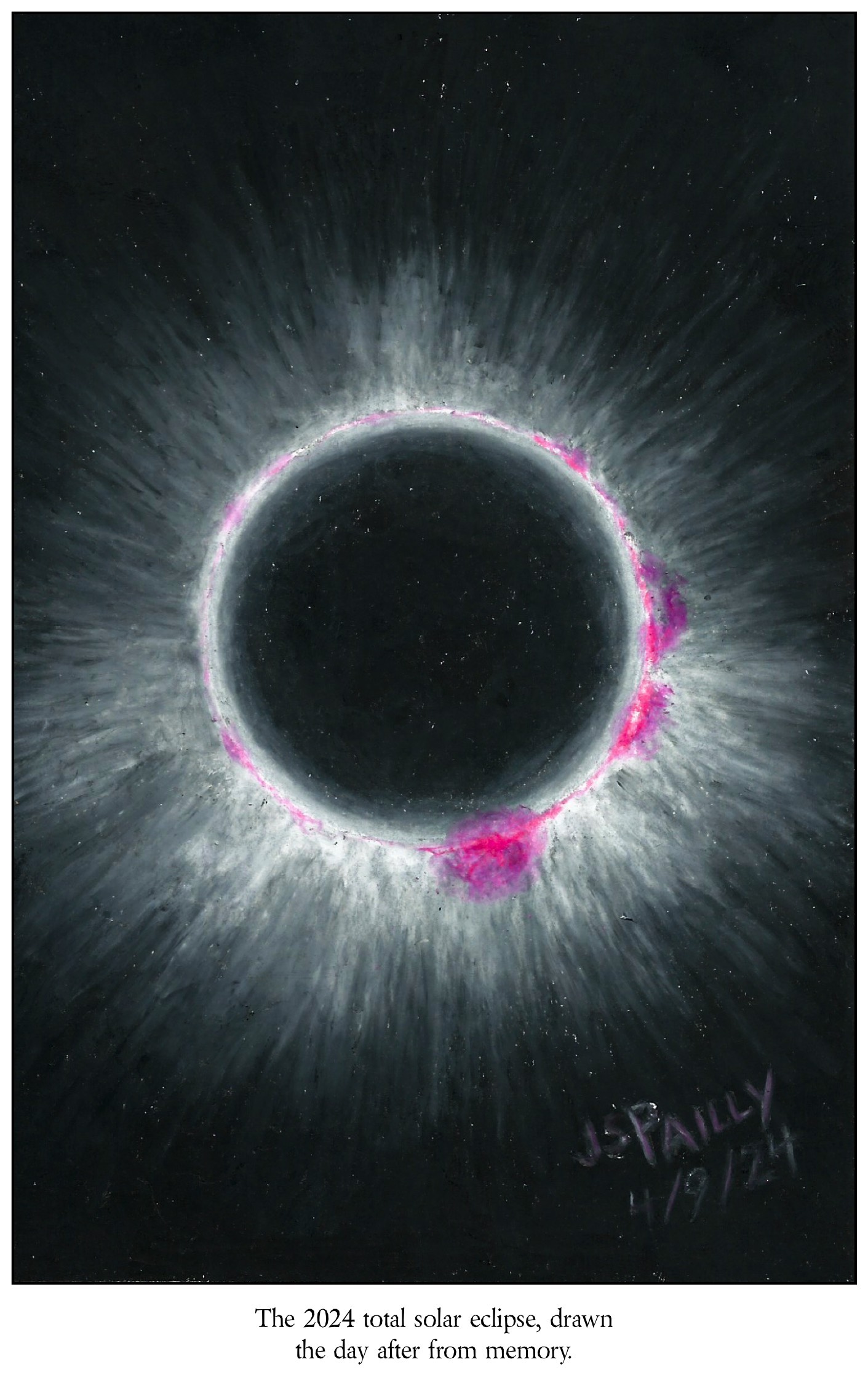
Although, there is one more word I would use to try to communicate what my eclipse experience was like.  It’s the name of a color.  Magenta.  As it so happens, the 2024 eclipse occurred during solar maximum, the most active part of the Sun’s eleven year cycle.  Several solar prominences (those giant, fiery arcs that rise up from the Sun’s surface) were visible to the naked eye during the eclipse.  One extremely bright prominence appeared near the “bottom” of the Sun, and I saw two other large, flickering prominences on the Sun’s righthand side.

To my eye, the prominences were the most perfect magenta color I have ever seen in nature.  It was like the pure magenta that computers generate in a CMYK color pallet.  The next day, I decided to try drawing the eclipse based solely on my own memory (see the image above).  Memory is an imperfect thing.  In my drawing, it seems that I made the bottom and righthand prominences bigger than they really were (probably because those three prominences stand out so prominently in my memory).  But the color is about right.  That color is, I swear to you, the color that I saw.  Which is strange, because my best friend, who was standing right next to me at the time and who was definitely seeing the same eclipse I was, swears the prominences were bright, bright red.  Not magenta.  Red.

After I drew my version of the eclipse, my friend used color correction software to try to approximate the color he saw.  He tells me his version is still not quite right, but it’s close enough.  So here’s the side-by-side comparison:
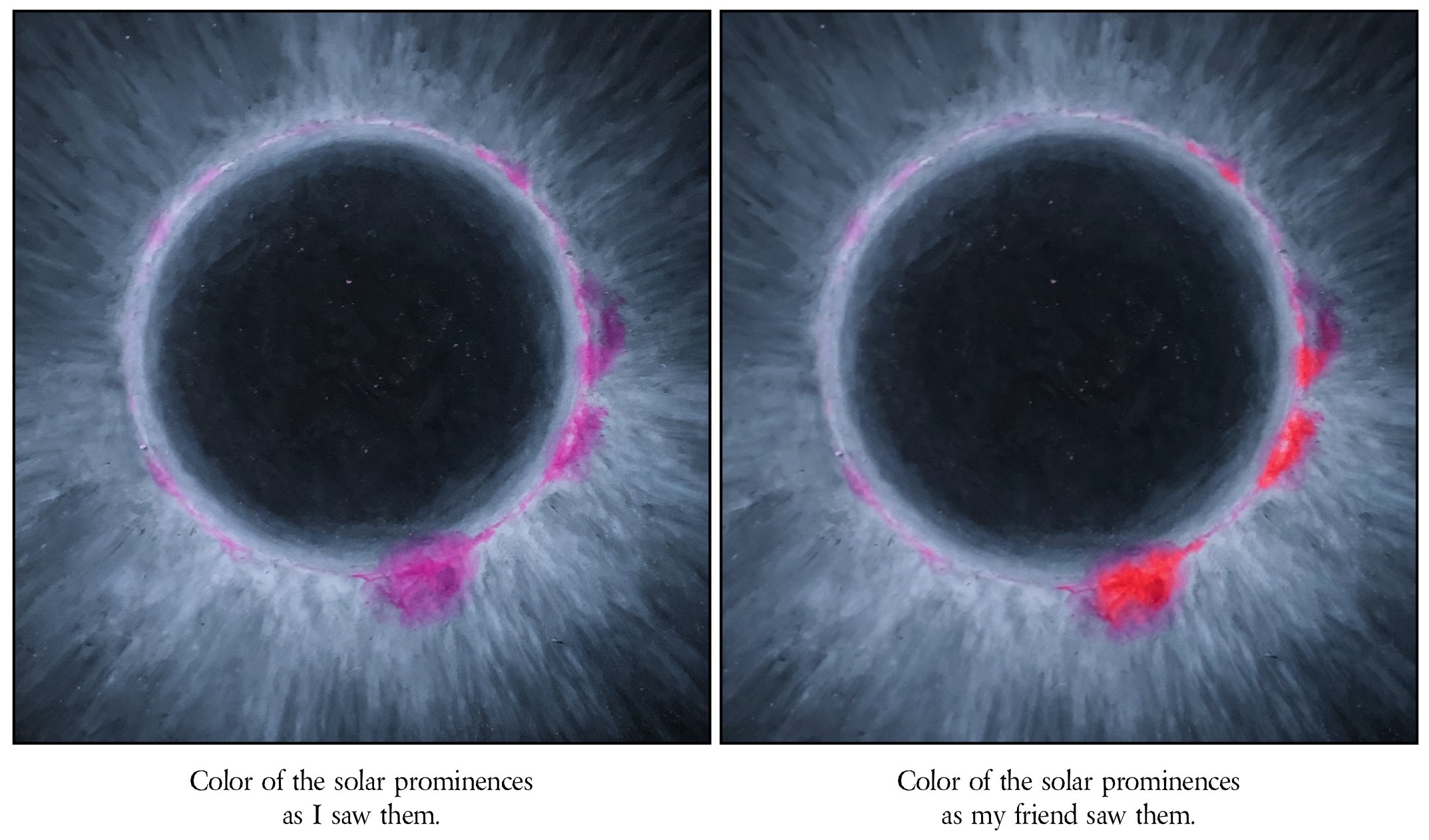
After comparing notes with a few other people who also saw the eclipse, it seems that most people (but not everyone) saw what my friend saw: a bright red color.  One person went so far as to call it an orangey-red color.  Only a few people saw the same magenta color I saw.

There’s so much about the eclipse that I did not expect, but this red vs. magenta thing is the part I expected the least.  So I want to end this post by asking you, dear readers: did you see the eclipse?  And if you did, what color were the solar prominences?  Did they look red to you?  Did they look magenta?  Did you, perhaps, see a different color entirely?

What Color is Neptune?

Hello, friends!

Every now and then, science asks us to unlearn a thing we had previously learned.  Pluto isn’t a planet.  Some dinosaurs were covered in feathers.  And now, according to some newly published research, Neptune is less blue than we thought.  Rather than that rich, royal blue color we usually see in photos, Neptune is more of a light aqua color, similar to the light aqua of Uranus.

The original research, published in the Monthly Notices of the Royal Astronomical Society, was actually more about Uranus than Neptune.  As you probably know already, Uranus is tipped over sideways.  This sideways orientation causes some pretty wild seasonal variations in Uranus’s atmosphere, which leads to changes in Uranus’s color and brightness over the course of a Uranian year (which is equivalent to approximately 84 Earth years).

But aside from the sideways thing, Uranus and Neptune are very similar planets.  They’re about the same size, about the same mass, and they have almost the same chemical compositions.  So if you’re doing research about the atmosphere of Uranus (and the color thereof), then it makes sense to compare and contrast the colors of Uranus and Neptune.  And it’s at this point that the original research paper goes off on a long tangent, explaining that Neptune isn’t as blue as you probably think, and offering reprocessed imaging data to show what Neptune really looks like.

So how did everybody get this wrong for so long?  Well, to make a long story short, somebody at NASA was playing with the color contract.  In 1989, when the Voyager 2 space probe sent the first up close images of Neptune back to Earth, those images revealed some interesting features in Neptune’s atmosphere, like the Great Dark Spot and the South Polar Wave.  Adjusting the color contrast made those features easier to see, and so these color adjusted images were the images that got disseminated to the media and the public.

In NASA’s defense, they did try to call attention to the color adjustments they’d made.  The color enhanced photos originally had captions explaining that they were false color images.  Apparently NASA also showed a true color image of Neptune, side by side with the false color version, at a 1989 press conference.  Still, most people missed the memo, including a lot of people in the scientific community, leading to this popular misconception that Uranus and Neptune are dramatically different shades of blue.

Now I have seen a few amateur astronomy buffs object to this new research, saying that when they look at Neptune and Uranus in their telescopes, Neptune is clearly a darker shade of blue than Uranus.  The research paper does address that.  First, due to differences in atmospheric density, Neptune is a teeny-tiny bit darker than Uranus (but only a teeny-tiny bit).  Additionally, Neptune is farther away from the Sun, which means Neptune gets less sunlight than Uranus.  This makes Neptune look a teeny bit darker still. And also, if you’re observing Neptune from Earth, Neptune will appear to be smaller (and proportionally dimmer) than Uranus, once again due to the fact that Neptune is farther away.

It’s going to take me some time to get used to this, just like it took me some time to get used to the idea of feathered dinosaurs.  I sometimes like to call Uranus “the Turquoise Planet” and Neptune “the Other Blue Planet.”  But I guess I’ll have to change that.  From now on, I’ll have to call Neptune “the Other Turquoise Planet” instead.

WANT TO LEARN MORE?

I don’t normally tell people to just go look at Wikipedia, but I do think the Wikipedia page on Neptune is worth seeing.  Wikipedia was very quick to update its photo of Neptune after this new research was published.

The lead author on the original paper is a professor at the University of Oxford, so here’s the press release from the University of Oxford announcing the paper’s publication.

And here’s a YouTube video with a little more detailed information about Uranus, Uranus’s atmosphere and seasonal variations, and the updated color data for Neptune.

And lastly, for anyone who wants to read the original research paper itself, here’s the link.


P.S.: If you must make a Uranus joke in the comments, I will give you praise and credit if (and only if) it’s a joke I haven’t heard before.

Mercury A to Z: Amorphous Ice

Hello, friends!  Welcome to my very first post for this year’s A to Z Challenge.  You don’t know what the A to Z Challenge is?  That’s okay.  You can click here if you want to learn more.  My theme for this year’s challenge is the planet Mercury, and in today’s post the letter A is for:

AMORPHOUS ICE

It gets really hot on Mercury.  You probably knew that already.  Mercury is, after all, the planet closest to the Sun.  But it may surprise you to learn that it also gets really cold on Mercury.  Extremely cold.  Like, we’re talking spit-goes-clink levels of cold.

Much like the Moon, Mercury has virtually no atmosphere.  That means there’s no atmospheric convection to transfer heat from the dayside of Mercury to the nightside.  Atmospheres can also act as a sort of blanket to keep a planet’s surface warm during the night.  But again, Mercury has virtually no atmosphere.  No blanket effect.  All the heat Mercury’s surface soaks up during the long Mercurian day is lost during the equally long Mercurian night.  As a result, the nightside of Mercury is one of the absolute coldest places in the entire Solar System.

Now, imagine if there were a place on Mercury where it is always night and never day.  Places like that exist at the bottoms of deep, dark craters clustered around Mercury’s north and south poles.  Shielded by crater rims and tall crater walls, the bottoms of those polar craters are cloaked in eternal darkness, and they are eternally cold.  Anything that happens to fall into one of those craters would freeze solid and could stay frozen for millions or even billions of years.

Back in the 1990’s, scientists began to suspect that those deep, dark craters around Mercury’s poles might be full of water (frozen water, obviously, but still… water).  And then in the 2010’s, NASA’s MESSENGER space probe took a closer look and confirmed it.  There is, in fact, water (in ice form) on Mercury.  Water on Mercury, of all places!

But I remind you again, the bottoms of Mercury’s polar craters are obscenely and stupidly cold.  Too cold for water to freeze the way it freezes on Earth.  On a molecular scale, the ice we find here on Earth has a neat and orderly crystalline structure.  Scientists call our Earthly kind of ice “ice Ih” or “hexagonal ice,” because the water molecules fit together in a hexagon pattern.  But the ice on Mercury is more likely to be what scientists call “amorphous ice.”

Amorphous ice is what happens when water freezes so fast that the water molecules don’t have time to arrange themselves in any sort of crystalline structure.  On a molecular scale, the water molecules are scattered haphazardly about.  No hexagons.  No patterns or shapes.  The ice is structurally shapeless—a.k.a., amorphous.  This doesn’t occur often here on Earth, except in certain astrophysics laboratories, but amorphous ice is extremely common out in space.

Comets and asteroids?  Whatever water they have is, partially or wholly, in the form of amorphous ice.  The surfaces of Europa, Ganymede, and the other icy moons of the outer Solar System?  They may be partially composed of amorphous ice.  And the ice inside those polar craters on Mercury (and similar polar craters on the Moon)?  You can bet on that being amorphous ice, too.

WANT TO LEARN MORE?

Water can freeze in so many different ways, with so many different crystalline and non-crystalline structures.  Here’s a brief video from Sci-Show about all the different kinds of ice scientists currently know about.

I also want to recommend this article from ZME Science, briefly summarizing the history of how water ended up on Mercury, how scientists on Earth first detected it, and how the MESSENGER mission later confirmed it.

Lastly, this is a far more technical source than the other two, but this paper on amorphous ice in the Solar System is the best source I could find stating, explicitly, that the ice on Mercury is probably amorphous ice. 

Science Can’t Explain Everything

Hello, friends!

As you know, I love science.  I’m a little obsessed.  But there are people who get annoyed or even offended by my obsession with science, and every once in a while one of these people will remind me, sternly, that science can’t explain everything.  And you know what?  I generally agree with that sentiment.  But then people start declaring that science will never know this specific thing or that specific thing, and I immediately think of a certain 19th Century French philosopher named Auguste Comte.

Comte was not some scientifically illiterate buffoon.  He wasn’t one of those 19th Century evolution deniers, or one of those latter-day opponents to the heliocentric model of the Solar System.  In fact, Comte is regarded today as the very first philosopher of science, in the modern sense of that term, and he gets credit for coining the word “sociology” and for laying the philosophical foundation for that entire branch of science.  There’s also a wonderful quote from Comte about the mutual dependence of scientific theory and scientific observation.  Basically, you can’t formulate a theory without observation, but you also can’t make an observation without the guidance of a theory.

But that is not the Comte quote I think of whenever somebody starts lecturing me about the things science will never know.  It’s this quote about the stars: “[…] we shall never be able by any means to study their chemical composition or their mineralogical structure…”  Comte also declared that: “I regard any notion concerning the true mean temperature of the various stars as forever denied to us.”

Comte wrote this in 1835, and if you can put yourself into an 1835 mindset you can see where he was coming from.  There’s no such thing as rocketry.  We don’t even have airplanes yet.  And even if you could fly up to a star (or the Sun), how would you measure its temperature?  What kind of thermometer would you use?  And how would you go about collecting stellar material, in order to determine the star’s chemical composition?

According to Comte—a highly intelligent and very pro-science person—this sort of knowledge was utterly impossible to obtain.  And yet only a few decades later, thanks to the invention of the spectroscope, scientists started obtaining some of this unobtainable knowledge.  For those of you who don’t know, spectroscopes separate light into a spectrum.  Some parts of the spectrum may appear brighter or darker than you might otherwise expect, depending on which chemical substances emitted or absorbed the light before it reached the spectroscope.  And so by comparing the spectral lines of chemicals we have here on Earth to the spectrum obtained from the light of a star, you can determine the chemical composition of that star.

You can also measure a star’s temperature thanks to a concept known as black body radiation.  Basically, black body radiation refers to the fact that things glow as they got hotter.  If no other light sources are involved, then the color of a glowing object will be directly related to that object’s temperature.  Ergo, if you know what color a star is, then you can work out a pretty accurate estimate of what temperature that star must be.

Auguste Comte didn’t foresee any of this.  It is certainly true that science does not know everything, and there are surely things that science will never know.  But if you think you know, specifically, what science can never know, I question that.  Someday, some new invention (like the spectroscope) or some breakthrough discovery (like black body radiation) may turn an utterly unknowable thing into a matter of trivial measurements and calculations.

Maybe the one thing science truly can never know is what science’s own limitations are.

WANT TO LEARN MORE?

Here’s a very brief post about Auguste Comte, what he said about stars, and how epically wrong he was with that one prediction.

Also, here’s a short article about some genuine limitations that science has, like aesthetics, moral judgements, etc.

Sciency Words: P-P Chain

Hello, friends!  Welcome to Sciency Words, a special series here on Planet Pailly where we discuss the definitions and etymologies of scientific terminology.  In today’s post, we’ll be discussing the scientific term:

P-P CHAIN

I have, in the past, been accused of covering scientific terms on the basis of how silly they sound, rather than on the basis of pure scientific merit.  But I would never do such a thing.  I have far too much respect for both science and linguistics.  Now with that unambiguously established, let’s talk about the p-p chain.

Definition of the p-p chain: In the field of nuclear physics, the p-p chain refers to a series of nuclear fusion reactions, starting with the fusion of two protons and leading, ultimately, to the creation of a helium-4 nucleus.  The p-p chain is by far the most common fusion process occurring in the core of the Sun, as well as other stars of similar or smaller sizes.

Etymology of the p-p chain: The p’s in p-p chain refer to the two individual protons that fuse together in the very first step of the process.  English astronomer Sir Arthur Eddington first proposed that proton-proton fusion might be occurring inside stars, writing about it in a 1926 article titled “The Internal Constitution of the Stars.”  German-American theoretical physicist Hans Bethe worked out the step by step details of the process in a 1939 paper called “Energy Production in Stars.”  Sadly, I cannot give credit to either Eddington or Bethe for coining this term.  They came up with the idea and worked out the details, but I have not been able to determine who, exactly, first introduced the term “p-p chain” into the scientific literature.

There are at least three versions of the p-p chain, each with different intermediate steps between the individual protons at the start and the helium-4 nuclei at the end (a fourth version is possible in theory, but has yet to be verified in reality).

Recently, scientists at the National Ignition Facility (NIF) in California made significant progress in nuclear fusion research.  That recent experiment has been described as recreating the power of the Sun here on Earth, which is true enough.  But NIF did not recreate the entire p-p chain from start to finish; they did something loosely equivalent to the very last step only.  It seems that reproducing the whole chain is still beyond our current scientific abilities.

So the next time you notice the Sun, shining yellow-gold in the sky, just remember that she can still do p-p chains in ways we humans cannot.

WANT TO LEARN MORE?

If you’re looking for a more detailed and technical explanation of the p-p chain (and the three or four variations thereof), check out this article from encyclopedia.pub.  That article was my main source of information while writing this post.

You can also find Arthur Eddington’s “The Internal Constitution of the Stars” by clicking here and Hans Bethe’s “Energy Production in Stars” by clicking here.

And if you’re looking for a fun way to try nuclear fusion for yourself, check out the game Fe[26].  You slide around tiles marked with the names of different atomic nuclei, trying to combine them to make bigger and bigger elements.  Which nuclear combinations work and which ones don’t?  Play and find out for yourself!

Are We Alone in the Universe?

Hello, friends!

I have only recently returned to regular blogging, and in several recent posts I’ve alluded to the fact that I’m planning to take my Sci-Fi writing in a new creative direction.  A lot of things are changing for me right now.  A lot of the things I’m doing (or trying to do) are new.  With that in mind, I feel like this is a good time to restate some of my views and beliefs about science and the universe, starting with my views and beliefs about extraterrestrial life.

When people ask “Do you think we’re alone in the universe?” I get slightly annoyed by that question.  It’s too big a topic to reduce to a simple yes or no question.  In Humanity’s search for extraterrestrial life, there are really three kinds of life we might find out there:

Microbial Life: Almost as soon as Earth existed, terrestrial microorganisms existed, too.  Microbes developed so swiftly and so easily on this planet that the same thing must have happened elsewhere.  For this reason, I believe extraterrestrial microorganisms are plentiful across the cosmos.

Multicellular Life: Complex multicellular organisms—fish, plants, bugs, etc—exist on Earth due to a happy accident.  About 2.4 billion years ago, some of Earth’s microbes started burping up oxygen.  To those microbes, oxygen was a waste product, but that waste product could also be used in biochemical reactions to create energy.  Lots of energy.  Enough energy to make complex multicellular life possible.  If multicellular life requires this sort of happy accident in order to exist, then I suspect multicellular life must be rare across the universe.

Intelligent Life: I’m going to define intelligence as the ability of a species to make and use tools, to communicate complex ideas, and to generally improve upon its knowledge and technology over time.  As far as we can tell, life like that only evolved one time on our planet.  Given the vastness of the entire universe, I think intelligent life must exist elsewhere, but I also think it must be extremely rare.

Some time around 1950, nuclear physicist Enrico Fermi famously asked “Where is everybody?” in reference to alien life.  As Fermi saw it, advanced alien civilizations should be out there, and their activities in space should be obvious to us.  And yet when we look out into the universe, we see nothing.  This apparent contradiction—aliens should be everywhere, and yet they seem to be nowhere—is today known as the Fermi Paradox.

So I guess my answer to questions like “Where is everybody?” or “Are we alone in the universe?” depends on what kind of alien life we’re talking about.  If we’re talking about alien microorganisms, I think they’re plentiful, and I think it’s only a matter of time before we find evidence of alien microbes on Mars or on one of the icy moons of the outer Solar System.  If we’re talking about multicellular life, that sort of life is rare.  And intelligent life must be rarer still—so rare, in fact, that our nearest intelligent neighbors may be hundreds, thousands, or even millions of lightyears away.

But these are just my opinions.  My opinions about this topic have changed over time, and as I keep learning, my opinions and expectations will, no doubt, change again.

So, friends, what are your opinions and expectations concerning extraterrestrial life?  Do you think I’m on the right track, or is there something I’ve missed that you think I should learn more about?

Sciency Words: Hydrogen

Hello, friends!  Welcome to Sciency Words, a special series here on Planet Pailly where we talk about the definitions and etymologies of scientific names and terms.  In today’s episode of Sciency Words, we’re talking about:

HYDROGEN

I want to start this with a personal story.  Imagine me, twenty years ago, fresh out of college with a degree in television and film production.  One of my first jobs was working for a company that made educational cartoons for children.  At one point, I ended up being assigned to a two minute animated music video about water.  The name of the video: “Water Can Never Be New.”

Now I’m no scientist.  I cannot call myself an expert (I’m just very enthusiastic about this subject).  And twenty years ago, I was even less of an expert than I am today.  Still, even way back then, I had a nagging suspicion that this “Water Can Never Be New” video was a lie.  Which brings me to the subject of today’s post: hydrogen.

Definition of hydrogen: Hydrogen is the very first element on the periodic table of elements.  Typically, hydrogen atoms consist of one proton orbited by one electron.  Molecular hydrogen consists of two hydrogen atoms bonded to each other.  Under Earth-like temperatures and Earth-like atmospheric pressure, hydrogen is a gas.  It’s also rather rare here on Earth; elsewhere in the universe, it’s extremely common.  In fact, hydrogen is by far the most common, most abundant chemical element in the universe.

Etymology of hydrogen: Hydrogen was first discovered in 1671 by British natural philosopher Robert Boyle.  Boyle referred to this new kind of air he discovered as “inflammable air,” because of how easily he could light it on fire.  Over a century later, French chemist Antoine Lavoisier found that burning “inflammable air” somehow produced water vapor as a byproduct.  Thus, Lavoisier changed the name of “inflammable air” to hydrogen, from two Greek words meaning “water” and “creation.”

It’s hard to imagine today just how much the discovery of hydrogen must have rocked the world of science (a.k.a. natural philosophy) back in the 17th and 18th Centuries.  Up until that point, the Aristotelian view of world had prevailed.  According to Aristotle, four elements—fire, earth, air, and water—were the fundamental building blocks of nature.  Then Robert Boyle comes along with a new kind of air (can we really call air a fundamental element if there are different kinds of it?), and Lavoisier subsequently demonstrates that you can use this new kind of air to make water (is water really a fundamental element if you can make it out of other stuff?).

Today, we know more about what happens when you light hydrogen gas on fire.  The heat energy from the flame causes hydrogen to react with oxygen, producing H2O molecules.  Water, in other words.  New water.  And, in fact, many chemical reactions involving hydrogen and oxygen-containing compounds will produce water molecules as a byproduct.  Due to the energy involved in these reactions, this new water may be too hot to form a liquid, but water vapor is still water (and it will condense into a liquid eventually, once it has time to cool off).

Of course, hydrogen does much more than help make new water molecules.  Hydrogen is the fuel that keeps the Sun shining.  It’s a necessary component in the organic compounds that make life as we know it possible, and hydrogen ions play an important role in acid-base chemistry (not counting Lewis acids and bases).  Given the wide variety of jobs that hydrogen does, you may wonder why we stick to using a name that means, simply, “water generator.”

But the discovery of hydrogen and its water generating ability helped upend some deeply entrenched and woefully inaccurate scientific ideas.  The name seems appropriate to me as a way to honor that moment in the history of science when the old Aristotelian view of nature really started to crumble.  It’s a shame more people don’t know about this story.  Maybe somebody should make an educational cartoon for children about it.

Nuclear Fusion: A Light at the End of the Tunnel

Hello, friends!

I’m not an expert about, well… anything.  I love space.  I love science.  I love learning about space and science, and I love talking about the stuff I learn (whether the people around me want to hear about it or not).  Still, I’m not an expert.  With that in mind, let me tell you about nuclear fusion.

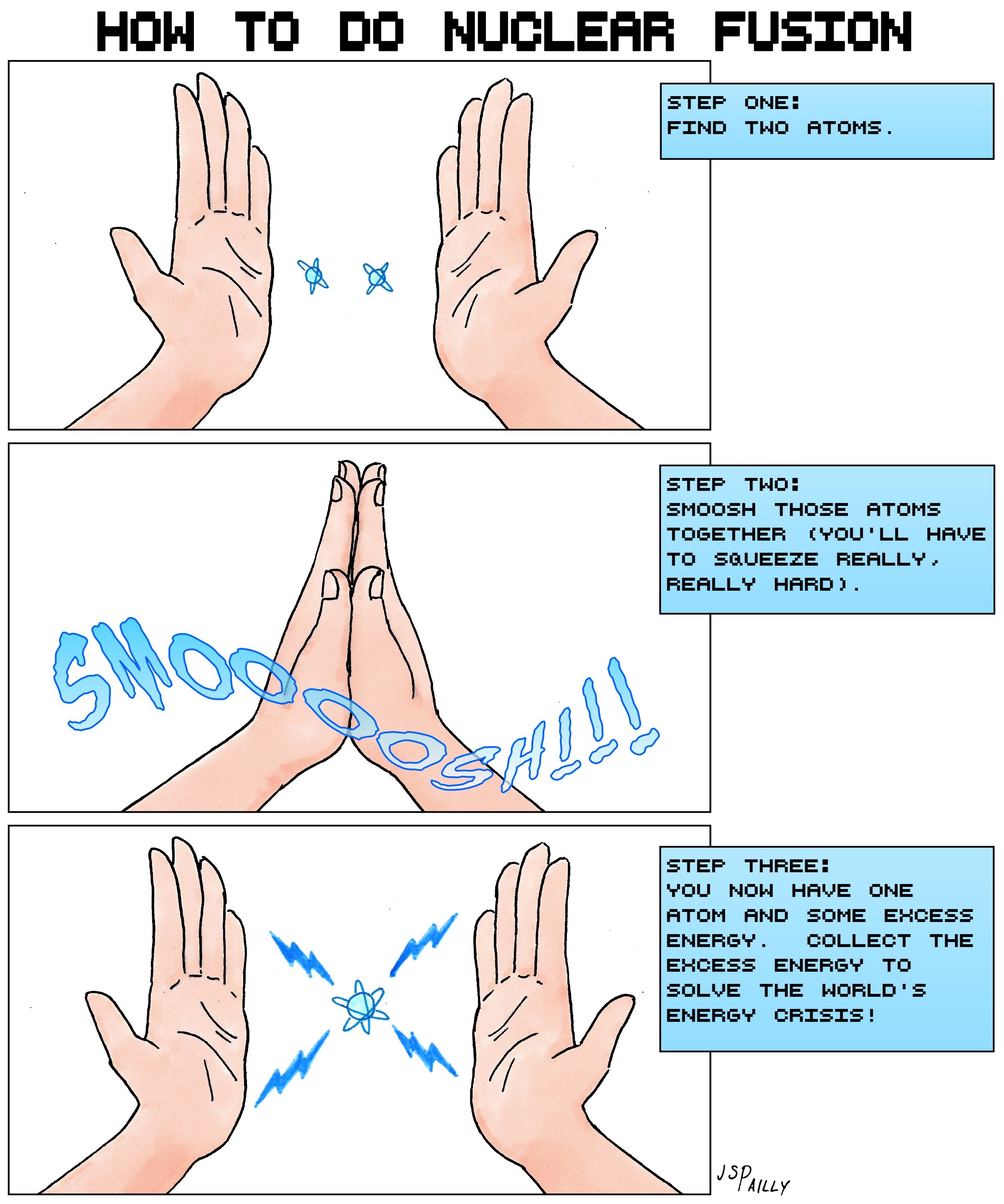
Nuclear fusion is super easy.  Here, let me show you.

The tricky thing is that you do need to squeeze really, really, really hard to make this work.  Atomic nuclei have matching magnetic charges—positive and positive—so whenever you want to fuse atoms together, you have to overcome the force of magnetic repulsion.  It takes enormous amounts of energy to do that.  Like, in the demonstration above, when I squeezed those two atoms together with my hands, I burned a ton of calories doing that.  Yes, the fusion reaction produced some energy at the end, but not as much energy as it took to make the reaction happen in the first place.  All things considered, this was a net energy loss for me.

But on December 5, 2022, researchers at the National Ignition Facility (NIF) in California—i.e., actual experts on this topic—caused a nuclear fusion reaction where the energy output exceeded the energy input.  How did they do it?  For one thing, they didn’t squeeze atoms together with their hands.  They did it with an elaborate system of lasers.  Specifically, they focused 192 lasers on one tiny capsule full of hydrogen isotopes.  It reportedly took 2.05 megajoules of energy to make the reaction happen, and 3.15 megajoules of energy came out of it.

This sort of nuclear fusion reaction, where hydrogen isotopes are fused together to make helium nuclei, does not produce radioactive waste.  There’s no carbon footprint.  If anything ever goes wrong, the reaction automatically stops itself; there’s no chain reaction that would lead to a Chernobyl-style or Three Mile Island-style nuclear meltdown.  NIF researches say that they should be able to improve the lasers, design better reaction capsules, and generally refine and perfect their nuclear fusion technique.  In a few decades, we should expect large scale nuclear fusion reactors to become commercially viable.

For anyone who (like me) worries about the climate and humanity’s growing energy needs, nuclear fusion sounds like a near perfect solution.  But I have learned, both in my personal life and by being a citizen of this planet, that whenever you solve one problem you inevitably create new problems.  You just have to hope your new problems are less problematic than the old ones.  When nuclear fusion becomes a commercially viable technology, it will be economically disruptive.  Companies will go out of business.  People will lose their jobs.  Also, one of the isotopes used in NIF’s experiment (a hydrogen isotope called tritium) is radioactive.  So in the future, nuclear fusion reactors may still require radioactive fuel, even if they don’t produce radioactive waste.

All that being said, commercially viable nuclear fusion is one of those Sci-Fi pipe-dreams that I never really expected to see happen in my lifetime.  Now, for the first time ever, I feel like there’s a light at the end of the tunnel when it comes to climate change and the energy crisis.  We’ll still have to survive the next few decades, and nuclear fusion will create new problems for us even as it solves some of our old ones.  But this is as near perfect a solution to our current problems as I can realistically imagine us finding.

However, as I said at the beginning of this post, I’m not an expert.  There’s still a lot I need to learn about nuclear fusion, climate change, and all the other stuff I mentioned in this post.  All I can say for certain right now is that I feel optimistic—more optimistic about humanity’s future than I have felt in a long, long time.

WANT TO LEARN MORE?

While researching this post, I saw a surprising amount of cynicism in the popular press.  I guess some people think if fusion can’t offer an immediate and 100% perfect solution to climate change, then it doesn’t offer a solution at all.  So if you want to learn more about this, I recommend watching this press conference from the U.S. Department of Energy and the following panel discussion with some of the researchers who were involved in NIF’s experiment.  Together, the press conference and panel discussion are about an hour and a half long, but you’ll be hearing straight from the people who did the work what they did and what it means.

Carcinization in Science Fiction

Warning: This post contains spoilers for The Time Machine by H.G. Wells and Project Hail Mary by Andy Weir.  This post may also contain spoilers for Tomorrow News Network books that I have not yet written.

Hello, friends!

In my research process, there comes a point where my brain switches over from learning science facts to making up science fiction.  Over the last month of so, I’ve been doing a ton of research on carcinization.  In that time, I have not become an expert on this topic—not by a long shot.  But at this point, I have learned enough science facts for my brain to switch over to Sci-Fi mode.

Carcinization is commonly defined as the process of evolving into a crab.  This has happened a surprising number of times, leading to Internet memes about crabs being some sort of “ultimate life form” or some sort of evolutionary end goal.  Given how common carcinization is (or at least how popular the memes about it are), I’ve often thought that we should see way more crab monsters in science fiction.  And nothing in my recent research has dissuaded me from that opinion.

Of course, giant crab monsters have appeared in Sci-Fi before.  The nameless time traveler in H.G. Wells’ The Time Machine has a close call with some giant crabs:

Can you imagine a crab as large as yonder table, with its many legs moving slowly and uncertainly, its big claws swaying, its long antennae, like carters’ whips, waving and feeling, and its stalked eyes gleaming at you on either side of its metallic front?  Its back was corrugated and ornamented with ungainly bosses, and a greenish incrustation blotched it here and there.  I could see the many palps of its complicated mouth flicking and feeling as it moved.

The word carcinization didn’t exist yet when Wells wrote The Time Machine, but the idea of carcinization did.  As far back as the mid-to-late 1800’s, scientists were already puzzling over “the many attempts of Nature to evolve a crab.”  With that in mind, I think H.G. Wells knew exactly what he was doing when he populated the Earth of the distant future with giant, hungry crab monsters.

More recently, a crab-like extraterrestrial appeared in Project Hail Mary, by Andy Weir.  I’m pretty sure Weir even used the word carcinization in his book, to help explain how this crab-like species could exist (though after spending about twenty minutes flipping through my copy of Project Hail Mary, I couldn’t find the reference—it’s possible I’m misremembering things).  Fortunately for the protagonist of Project Hail Mary, the crab-like extraterrestrial he meets turns out to be friendly.  An important ally, in fact!

After all the research I’ve done, I feel pretty comfortable exploiting the concept of carcinization for a Sci-Fi story.  And given that H.G. Wells and Andy Weir already did this, I feel like I’m putting myself in good company, too.  Now I do not currently have a release date set for the next Tomorrow News Network novella, but I can tell you that I’m working on it, and there will be giant crabs from outer space.  Will they be friendly crabs, like the crab-like alien from Project Hail Mary?  Or will they be hostile, like the future crabs from The Time Machine?

Okay, yeah, they’re definitely hostile. Sorry for the spoiler.

WANT TO LEARN MORE?

Please check out some of my previous posts on carcinization, as well as my post on orthogenesis (a closely related concept).

Sciency Words: Carcinization

Hello, friends!  Welcome back to Sciency Words, a regular series here on Planet Pailly where we talk about the definitions and etymologies of scientific terms.  Today, we’re talking about:

CARCINIZATION

In time, we will all evolve into crabs.  Crabs are the ultimate life form, evolutionarily speaking.  At least that’s what certain Internet memes would have you believe.  But like most Internet memes, this whole “we will all become crabs” idea is an oversimplification of the truth.  Carcinization is a surprisingly common evolutionary process, but it doesn’t happen to all animals in all situations.

Definition of Carcinization: In evolutionary biology, carcinization is the process of evolving a crab-like body structure, especially a crab-like carapace (shell) with the pleon (tail) folded underneath the belly.  A surprising number of animals have evolved to have this body structure independently of one another.

Etymology of Carcinization: The term was coined in 1916 by English zoologist Lancelot Alexander Barradaile.  It uses a Greek root word meaning “crab.”  Although the term carcinization was coined in 1916, scientists had noticed the unusual prevalence of crab-like animals well before that.  Research on this phenomenon can be traced back to the mid-to-late 1800’s.

Carcinization seems to happen a lot in nature, but it does not happen to all animals equally.  It is far, far, far more likely to happen to an animal that already has a few crab-like characteristics.  For example, if you’re a lobster, a shrimp, or a prawn—in other words, if you’ve already got a bunch of legs and a pair of claws, and if you’re already living on the ocean floor—then there may be some real benefits to evolving even more crab-like characteristics.

It’s hypothesized that the compact body shape of a crab (compared to the more elongated shape of a lobster, for example) may make it easier to defend yourself against predators.  A lobster’s pleon (tail) is very exposed; crabs have their pleons neatly tucked beneath their bellies.  The compact body shape of a crab may also make it easier to scuttle about on the ocean floor, which could help crabs evade predators, and crabs may find it easier to fit into tight spaces as a way to hide from predators.

As a science fiction writer, I’ve long wanted to include some crab-like extraterrestrials in my Sci-Fi stories.  All those memes about crabs being the “ultimate life form” led me to believe this would be a good idea.  The actual science behind carcinization makes me think otherwise.  Carcinization certainly happens a lot with certain animals (i.e., crustaceans) living in certain environments (i.e., the ocean floor).  But it’s not a universal principle of evolution.

All that being said, I’m going to put some crab-like extraterrestrials in a story anyway, because I still think it’s still a fun idea.

WANT TO LEARN MORE?

Here are the research papers I have read or am in the process of reading on the topic of carcinization.  I will have more to say about carcinization later this week.