
Today’s post is a special A to Z Challenge edition of Sciency Words, an ongoing series here on Planet Pailly where we take a look at some interesting science or science related term so we can all expand our scientific vocabularies together. In today’s post, P is for:
PLANET
In 2006, the International Astronomy Union approved a new, official definition of planet, and Pluto didn’t make the cut. Word has it Pluto took the news well.

The I.A.U.’s concern at the time was that more and more small, Pluto-like objects were being discovered, making Pluto seem less like the ninth planet and more like the first of some new class of thing.
To be fair, the I.A.U. did try to come up with a planet definition that would include Pluto while excluding the dozens or perhaps hundreds of other objects potentially out there. But it just didn’t work out.
So to meet the official, I.A.U. sanctioned definition, an astronomical body must meet three requirements:
- It must orbit the Sun.
- It must be spherical, due to the pull of its own gravity.
- It must have cleared its orbital path of debris (this is the part of the planet test that Pluto failed).
Of course, if a definition can be changed once, it can be changed again. Recently, a group of six NASA scientists—specifically, six scientists from NASA’s New Horizons mission to Pluto—put forward a new proposal, which reads:
- A planet is a sub-stellar mass body that has never undergone nuclear fusion and that has sufficient self-gravitation to assume a spheroidal shape adequately described by a triaxial ellipsoid regardless of its orbital parameters.
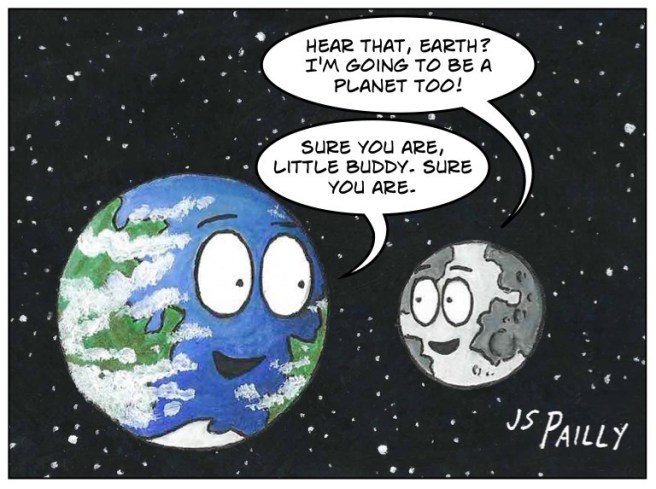
In other words, if it’s round, and it’s not a star or wasn’t a star at some point in the past, then it’s a planet. Under this new definition, Pluto’s back in the planet club! And so is the Moon, weirdly enough, along with many other moons elsewhere in the Solar System. In fact, the new definition would reclassify over one hundred Solar System objects as planets—possibly more than that.

The next I.A.U. general assembly meeting will be held in August, 2018. If they’re going to change the definition of planet again, that’s when they’ll do it. But I very much doubt it’ll happen.
Even though this is probably a lost cause, I want to say something in defense of the New Horizons team’s proposal. The strongest objection seems to be that moons should not be planets. I get that, but in my mind any world that I can picture myself standing on or walking on… I don’t know, that just feels planet-y to me.
I frequently catch myself calling Titan and Europa planets, even though they’re moons. Same for Pluto, Eris, Ceres, and all the other objects currently in the dwarf planet category. And I can’t help myself, but I keep calling Endor from Star Wars a planet, even though it’s specifically referred to multiple times in dialogue as a “forest moon.” All of these places—even fictional moons like Endor—feel planet-y to me.
And yes, even the Moon—the most quintessential moon of them all—has a certain planet-esque quality to it when I imagine myself living there, walking around, going about my daily business. I could get used to the Moon being a planet.
Next time on Sciency Words: A to Z, we’ll shrink from planet-scale to the scale of subatomic particles, and we’ll find out what’s so quantum about quantum mechanics.


 Planet Pailly