
Hello, friends! Welcome to Sciency Words! Each week, we take a closer look at some fun and interesting scientific term so we can expand our scientific vocabularies together! This week’s Sciency Word is:
XENOPHYOPHORE
“Xenophyophore” comes from a smattering of Greek words meaning “the bearer of foreign bodies.” The foreign bodies in question may be grains of sand, bits of debris, the broken remains of dead organisms… pretty much anything you might find at the very bottom of the ocean is fair game to a xenophyophore.
First discovered in the late 19th Century, xenophyophores are organisms that pick up all this “foreign” material and cement it together to create a special sort of shell (the shells of xenophyophores and of similar organisms are called “tests”). Xenophyophore shells may be very simple, or they may be highly elaborate and complex, giving some xenophyophores a superficial resemblance to coral.
According to this paper from the Zoological Journal of the Linnean Society, xenophyophores were classified and reclassified and reclassified again, over and over, for almost a century. Then in 1972, Danish zoologist Ole Secher Tendal “rescued xenophyophores from obscurity.” They are now classified as part of the phylum Foraminifera, within the kingdom Protista. In other words, xenophyophores are unicellular organisms.
And for unicellular organisms, xenophyophores are huge. Some grow to be as much as 20 centimeters in diameter, making them almost as large as basketballs! Based on what I’ve read, it sounds like most xenophyophore species are much smaller than that–maybe a couple millimeters in diameter. Still, for a single-celled organism, a couple millimeters is huge.
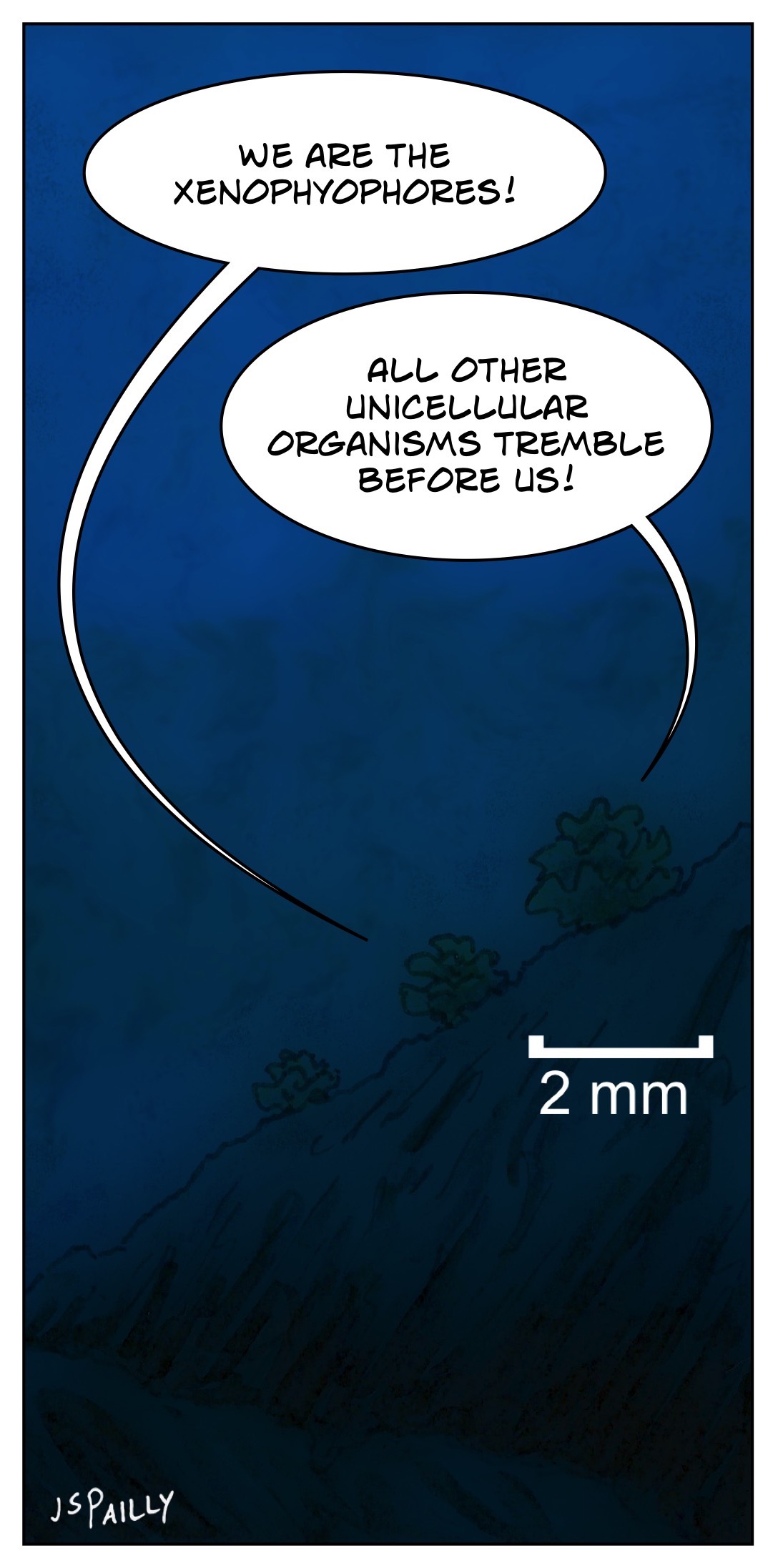
This makes xenophyophores another example of abyssal gigantism: the tendency of organisms in the deepest, darkest, most abyss-like parts of the ocean to grow to gigantic sizes.
P.S.: I couldn’t find a source to back me up on this, but I think it’s safe to assume xenophyophores have started incorporating microplastics into their shells, along with all the other “foreign bodies” they were using before.
 Planet Pailly