What Color was the Eclipse?

Hello, friends!  I have recently returned from a trip to see the 2024 solar eclipse (my first total solar eclipse!).  I was traveling with a couple of friends.  Due to weather-related concerns, we dropped our original plan to watch the eclipse in Buffalo, New York, and instead drove to a small town called Port Burwell, situated on the Canadian side of Lake Erie.

On the day of the eclipse, Port Burwell was the only place within hundreds of miles with a sunny forecast.  Everywhere else was supposed to be cloudy or partly cloudy.  Port Burwell’s forecast was sunny.  We were not the only ones to realize this, and so we ended up being part of an enormous mob of people who descended upon this cute, lakeside town–a town that was very obviously not expecting so many people to show up.  The locals were super nice, super welcoming, but also, very obviously, very surprised.

I wound up watching the eclipse from a concrete pier, with a cold (increasingly cold, once the event began) wind blowing on me from the lake.  There have been only a few moments in my life where I felt like I’d been transported, body and soul, into another world: exploring the ancient cliff dwellings at Mesa Verde, seeing the bacterial mats at Yellowstone National Park, and standing on that pier in Port Burwell while the last light of the Sun flashed and vanished behind the Moon.

What happened next?  Speaking as a writer, as a man of words, as a person who owns an absurd number of dictionaries and thesauruses, please understand what I mean when I say I have NO WORDS to describe the next three minutes.  Strange?  Beautiful?  Terrifying, on some deep and primal level?  Those words point in the general direction of what this experience felt like.  And that’s the best I, as a writer, can offer.  Sorry.  Words fail me.

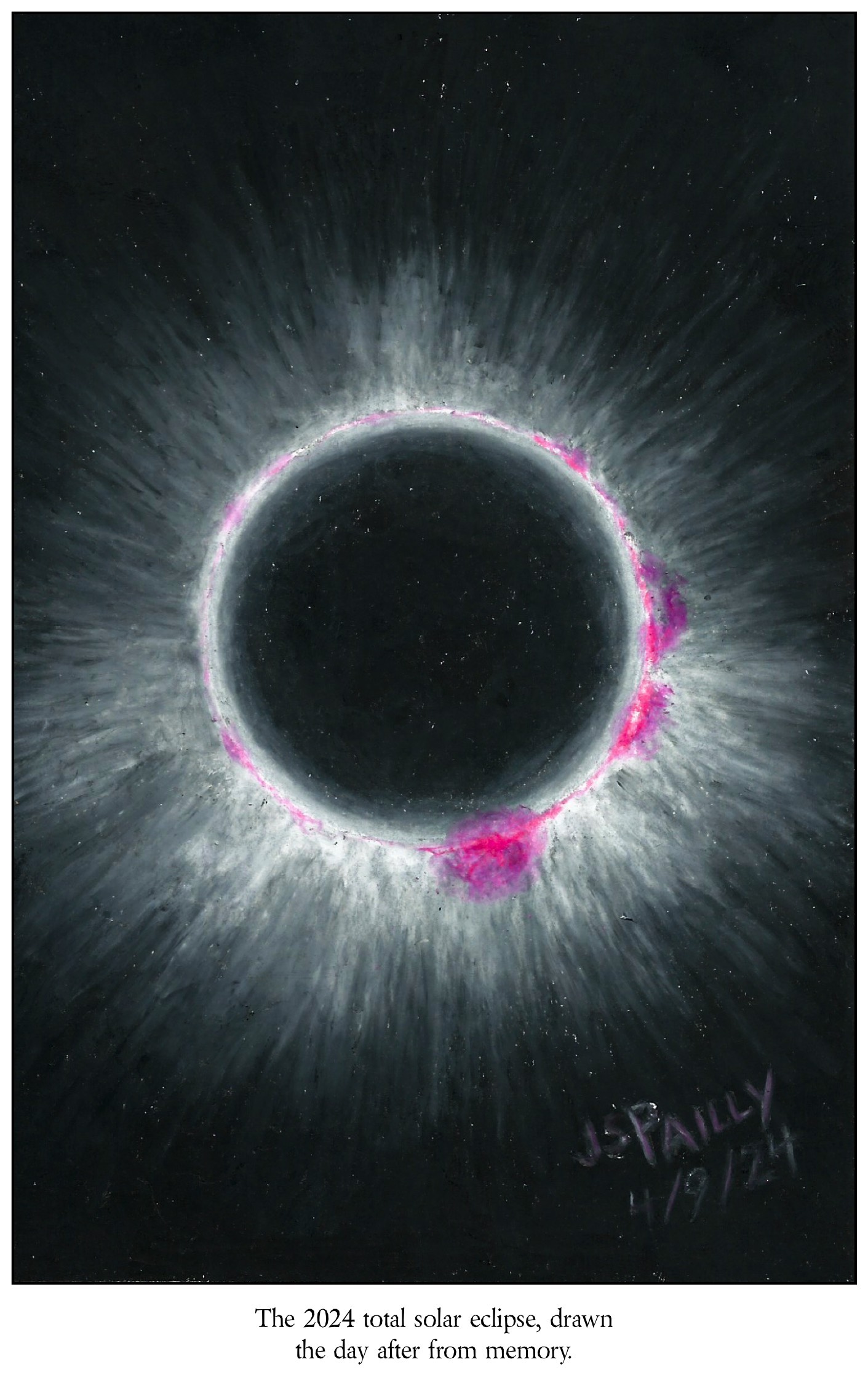
Although, there is one more word I would use to try to communicate what my eclipse experience was like.  It’s the name of a color.  Magenta.  As it so happens, the 2024 eclipse occurred during solar maximum, the most active part of the Sun’s eleven year cycle.  Several solar prominences (those giant, fiery arcs that rise up from the Sun’s surface) were visible to the naked eye during the eclipse.  One extremely bright prominence appeared near the “bottom” of the Sun, and I saw two other large, flickering prominences on the Sun’s righthand side.

To my eye, the prominences were the most perfect magenta color I have ever seen in nature.  It was like the pure magenta that computers generate in a CMYK color pallet.  The next day, I decided to try drawing the eclipse based solely on my own memory (see the image above).  Memory is an imperfect thing.  In my drawing, it seems that I made the bottom and righthand prominences bigger than they really were (probably because those three prominences stand out so prominently in my memory).  But the color is about right.  That color is, I swear to you, the color that I saw.  Which is strange, because my best friend, who was standing right next to me at the time and who was definitely seeing the same eclipse I was, swears the prominences were bright, bright red.  Not magenta.  Red.

After I drew my version of the eclipse, my friend used color correction software to try to approximate the color he saw.  He tells me his version is still not quite right, but it’s close enough.  So here’s the side-by-side comparison:
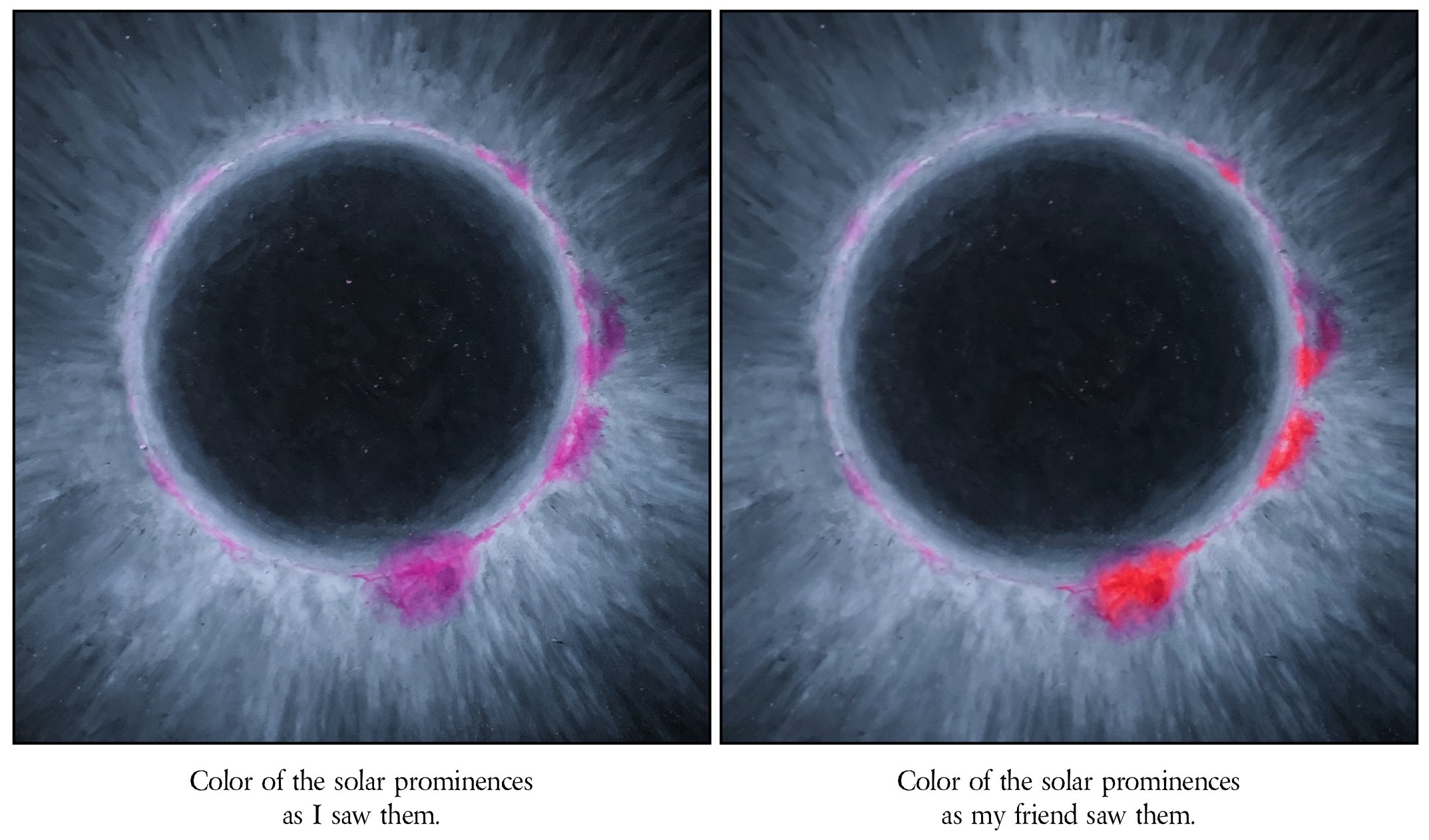
After comparing notes with a few other people who also saw the eclipse, it seems that most people (but not everyone) saw what my friend saw: a bright red color.  One person went so far as to call it an orangey-red color.  Only a few people saw the same magenta color I saw.

There’s so much about the eclipse that I did not expect, but this red vs. magenta thing is the part I expected the least.  So I want to end this post by asking you, dear readers: did you see the eclipse?  And if you did, what color were the solar prominences?  Did they look red to you?  Did they look magenta?  Did you, perhaps, see a different color entirely?

How Big are the Mountains on the Moon?

Hello, friends!

So I’ve fallen down a research rabbit hole, or maybe I should say I’ve fallen into a research crater.  I’ve been studying the topography of the Moon: mountains, valleys, craters, cliffs, etc, etc.  Some of these lunar land forms sound like they are stupidly big.  2 or 3 kilometers tall, in a surprising number of cases, or 2 or 3 kilometers deep.  Photos taken from space or by Earth-based telescopes don’t necessarily give you a good sense of just how stupidly large these things are.

Of course we have stupidly large land forms here on Earth, too.  Mt. Everest rises about 8.5 kilometers above sea level, and Mauna Kea (in Hawaii) stands more than 10 kilometers above the ocean floor.  The tallest mountains I’ve seen, personally, would be the Rocky Mountains in the western United States.  According to the Google machine, the tallest of the Rocky Mountains stands about 4 kilometers above sea level; however, if you’re in a place where you can see the Rockies, you’re not standing at sea level.  So I’m guessing that when I saw them, the Rocky Mountains were looming roughly 2 or 3 kilometers over me—comparable to many of the lunar land forms I’ve been reading about.

But here on Earth, mountains like the Rockies or the Alps are exceptional, whereas on the Moon, mountains that big (or cliffs that tall, or craters that deep) seem to be fairly ordinary.  I’m guessing this is due to gravity.  It’s easier to be a big mountain when the pull of gravity is so much less.

So if you and I were standing on the surface of the Moon, is that what the landscape would look like around us?  Rocky Mountain size mountains all around us?  In some regions, yes.  But also no.  Before you try to imagine what the lunar landscape would actually look like, to your human eyes, I need to tell you how your human eyes may play tricks on you when you’re on the Moon.

Here on Earth, when you see a tall mountain in the distance, how can you tell it’s a tall mountain in the distance and not a small hill right in front of you?  Well, certain visual cues help your brain figure that out.  Roads and cars, trees and buildings, birds or other wildlife… you know how big or small these things are, and seeing these things will help you guesstimate how large a nearby hill/far off mountain must be.

The atmosphere also plays a role in this.  Air is not 100% transparent, so even on a clear and sunny day, distant mountains will tend to look a little hazy—noticeably hazier than a nearby hill would look.

But there’s no air on the Moon, so you won’t see any atmospheric haze.  None whatsoever.  There are also no trees on the moon, nor any roads or buildings (yet).  So those visual cues are also missing.  As a result, an optical illusion comes into play which can make nearby hills almost indistinguishable from far off mountains.

Noticing the size of rocks and boulders might help, but the only way to really recognize the sheer scale of some of these lunar land features (as seen from the lunar surface) is to move around, change perspectives, and try to judge size and distance by parallax.

A few weeks ago, I went planet hunting with my telescope.  Mercury, Venus, and Mars were clustered together in the sky, and I didn’t want to miss that.  I also took a look at the Moon that night.  I’ve seen the Moon in my telescope many times, of course.  I always enjoy looking at the shadows cast by mountains, craters, etc.  But thanks to this new “research crater” I’ve fallen into, that night was the first time I fully appreciated the significance of those shadows.  Those are big shadows.  They must be big shadows in order for me and my relatively small telescope to see them so clearly all the way from Earth.  It takes some stupidly tall mountains and stupidly deep craters to cast such stupidly big shadows across the lunar surface.

WANT TO LEARN MORE?

To make landing on the Moon safer and easier, the Apollo missions mostly stuck to flat terrain regions.  Mostly.  The exception is Apollo 15, which landed near a mountain range called Montes Apenninus.  Click here to learn more about Apollo 15 and the terrain around the Apollo 15 landing site.

Additionally, I found this video from Astrum really helpful in understanding the true size and scale of lunar surface features.  The video also talks about how your eyes can deceive you when viewing the lunar landscape.

Our Place in Space: Shackleton Crater

Hello, friends!  Welcome to Our Place in Space: A to Z!  For this year’s A to Z Challenge, I’ll be taking you on a partly imaginative and highly optimistic tour of humanity’s future in outer space.  If you don’t know what the A to Z Challenge is, click here to learn more.  In today’s post, S is for…

SHACKLETON CRATER

You would not expect to find water on the Moon.  If there ever was water on the Moon, you’d expect it to boil away into the vacuum of space pretty quickly.  And yet there is growing scientific evidence suggesting that craters near the Moon’s north and south poles are full of frozen water.  In the distant future, the most important and famous of these water-filled craters will be Shackleton Crater.

Shackleton Crater is about 21 kilometers across and 4 kilometers deep.  For the sake of comparison, the Grand Canyon is just shy of 2 kilometers deep.  What’s really important, though, is that Shackleton Crater is located almost perfectly at the Moon’s south pole.  As a result, it doesn’t matter what time it is—it doesn’t matter what part of the lunar day/night cycle it it—the bottom of Shackleton Crater is always shielded from sunlight by those 4 kilometer tall crater walls.  Always.

That makes the bottom of Shackleton Crater extremely dark.  More importantly, it makes the bottom of the crater extremely cold—cold enough to overcome water’s natural tendency to boil (or sublimate) in a vacuum.

Shackleton Crater is not unique in that respect.  There are over three hundred craters around the Moon’s north and south poles that are in a state of perpetual darkness.  Any or all of these eternally dark craters could have frozen water inside them.  So what makes Shackleton Crater so extra special?  Well, once again, the crater is located almost perfectly at the Moon’s south pole.  As a result, while the bottom of the crater is always in darkness, sections of the crater rim are always in sunlight.

This combination of perpetual sunlight up here and perpetual darkness down there makes Shackleton Crater the #1 most valuable piece of real estate on the Moon.  If you built a moon base at Shackleton Crater, you could set up solar panels along the crater rim while also having easy access to all that frozen water at the bottom of the crater.

I don’t generally like making “in the next twenty years” predictions, but in the next twenty years, there’s a good chance that somebody will land at Shackleton Crater and build some sort of scientific research station.  Perhaps there will be several research stations, clustered together, almost village-like.

In time, that village on the Moon will grow.  And it will keep growing.  In the distant future, it would not surprise me if Shackleton Crater eventually became one of humanity’s first off-world metropolises.

Want to Learn More?

Check out these links:

Our Place in Space: The Moon Village

Hello, friends!  Welcome to Our Place in Space: A to Z!  For this year’s A to Z Challenge, I’ll be taking you on a partly imaginative and highly optimistic tour of humanity’s future in outer space.  If you don’t know what the A to Z Challenge is, click here to learn more.  In today’s post, M is for…

THE MOON VILLAGE

The last time humans went to the Moon, it was motivated in large part by the Cold War.  Yes, there were scientific and humanistic reasons to go to the Moon as well, but the Cold War was a big part of it.  There’s no denying that.  Let’s hope that next time will be different.  Let’s hope that next time, human beings will set foot on the Moon as a result of international cooperation, rather than as a result of quasi-militaristic competition.

A few years ago, the European Space Agency proposed building a “village” on the Moon.  This International Moon Village would serve as the logical successor to the International Space Station.  Anyone and everyone who wanted to participate would be welcome to participate in the Moon Village program.  As the E.S.A.’s website explains it:

By “Moon Village” we do not mean a development planned around houses, some shops and a community centre.  Rather, the term “village” in this context refers [to] this: a community created when groups join forces without first sorting out every detail, instead simply coming together with a view to sharing interests and capabilities.

It’s hard to say at this point what the Moon Village would look like.  A lot depends on who decides to participate.  A lot also depends on how the various participants want to use the Moon Village once it is built.  The proposal is very open ended about this stuff.  Government run space agencies could join the program.  So could private companies.  The Moon Village could be used for purely scientific and technological research.  At the same time, it could also be used for economic interests, such as mining the Moon for resources.  Even space tourism would be welcome.

When the Moon Village was first proposed a few years ago, my understanding was that the Russian space agency was going to be a key player in this project.  That’s… ummm… I’m guessing that’s no longer the case.  I’m also a little unclear about whether or not the United States is involved.  It sometimes sounds like NASA’s Artemis Program and E.S.A.’s Moon Village Project are totally working together; other times, it sounds like Artemis and the Moon Village are two completely separate and unrelated projects.

Despite all that, and despite everything else happening in the world today, I get the sense that E.S.A. is still moving forward with their Moon Village plans.  This is a project that really could happen, and I really hope that it does happen.  Anyone who wants to participate in the Moon Village is welcome to participate in the Moon Village.  No one will be excluded.  No one will be left out.  Those are the kind of values humanity needs right now, and in the future, those are the kind of values that will help us secure our rightful place in space.

Want to Learn More?

Check out this brief statement from Jan Woerner, the Director General of E.S.A., describing what the Moon Village would be like and how it might be used.

Our Place in Space: The Far Side of the Moon

Hello, friends!  Welcome to Our Place in Space: A to Z!  For this year’s A to Z Challenge, I’ll be taking you on a partly imaginative and highly optimistic tour of humanity’s future in outer space.  If you don’t know what the A to Z Challenge is, click here to learn more.  In today’s post, F is for…

THE FAR SIDE OF THE MOON

The James Webb Space Telescope has been getting a lot of press lately.  It’s the biggest and best telescope we humans have ever put into space.  But today, we’re going to imagine an even bigger and (potentially) an even better telescope.  We’re not going to put this telescope in space, though.  We’re going to build it on the surface of the Moon.

The far side of the Moon is the perfect location to build a radio telescope.  We’ve certainly built radio telescopes here on Earth, but those Earth-based radio telescopes keep running into the same two problems.  First, Earth’s atmosphere (especially the ionosphere) blocks certain cosmic radio wave frequencies from reaching us here on the ground.  And second, there’s a whole lot of terrestrial radio chatter happening here on the ground.  That chatter can interfere with any radio signals that do make it through from outer space.

But on the far side of the Moon, those problems don’t exist.  There’s no atmosphere, and certainly no ionosphere.  And since this is the far side of the Moon we’re talking about—i.e., the side of the Moon that always faces away from the Earth—all that terrestrial radio noise is gone.  The Moon itself would block those signals from ever interfering with our radio telescope.

The telescope itself would be absolutely enormous.  It would be built inside of a crater, with a dish approximately one kilometer wide.  NASA has already approved funding to research this idea; please note, they have not approved funding to build it yet!  Only to research the idea, to see if it’s actually feasible using current technology.  If it turns out that it is feasible, though, building a radio telescope on the far side of the Moon might end up being part of NASA’s new Artemis Program.

What would we do with our new lunar telescope?  Well for one thing, we could “look back in time” to see what the ancient universe was like.  Specifically, we could study a period of time known as the “cosmic Dark Ages.”  This would have been a time after the Big Bang but before the formation of the first stars—literally, the cosmic Dark Ages, like I said.  The hydrogen gas permeating the universe in that era would have emitted some amount of electromagnetic radiation, which we can still detect today in certain radio wave frequencies (or we could detect it, if Earth’s stupid atmosphere would stop getting in the way!).

In addition to looking for these naturally-occurring radio signals, our lunar radio telescope could also watch for radio signals that do not appear to be natural in origin.  Radio transmissions from aliens, in other words.

Searching for aliens would definitely not be the main reason to build a radio telescope on the Moon.  The stuff I said about the cosmic Dark Ages—that’s the main reason to do this.  The aliens thing would just be a side benefit.

For this “Our Place in Space” series, I’ve mostly focused on projects that I think could happen in the distant future.  But this lunar radio telescope project is something that probably needs to happen sooner rather than later.  The far side of the Moon is the perfect location for a radio telescope right now, but as humans start spreading out across the Solar System, things may change.  The far side of the Moon may get a whole lot noisier, in terms of radio chatter.

So in the distant future, rather than building a radio telescope on the Moon, we might prefer to build our radio telescopes farther out.  Places like Pluto, Orcus, Eris, or Quaoar—all those little dwarf planets beyond the orbit of Neptune—may end up being super useful for future radio astronomers.

Want to Learn More?

Check out this article from NASA’s Jet Propulsion Laboratory: “Lunar Crater Radio Telescope: Illuminating the Cosmic Dark Ages.”

Also, here’s an article from Universe Today: “The Moon is the Perfect Spot for SETI.”

Sciency Words: Supermoon

Hello, friends!  Welcome to Sciency Words, a special series here on Planet Pailly where we talk about the definitions and etymologies of science or science-related terms.  Today’s Sciency Word is:

SUPERMOON

I was recently part of a comment thread over on Scott’s Sky Watch.  We were talking about the term supermoon, along with other weird moon names like wolf moon, blood moon, harvest moon, corndog moon, flower power moon, gingivitis moon… you get the idea.  After that, I thought a Sciency Words post on “supermoon” was in order.

The term supermoon was coined by American astrologer (repeat: astrologer, not astronomer) Richard Nolle.  The term first appeared in an article Nolle wrote in 1979 for Horoscope magazine.  To quote Nolle himself from this 2011 webpage article, the term supermoon describes:

[…] a new or full moon which occurs with the Moon at or near (within 90% of) its closest approach to Earth in a given orbit.  In short, Earth, Moon and Sun are in a line, with Moon in its nearest approach to Earth.

This particular alignment of the Sun, Moon, and Earth is also known as a syzygy-perigee.  Perigee means the point when as object orbiting Earth comes closest to Earth, and syzygy refers to the straight line alignment of three celestial objects.

A syzygy-perigee has a marginal effect on Earth’s tides, and if the Sun and Moon are on opposite sides of the Earth (as depicted in the highly technical diagram below), then the Moon will appear to be slightly larger and slightly brighter than normal in our night sky.  Astrologers would have more to say about supermoons, but from an astronomy perspective we’re pretty much done here.

Personally, I don’t really have a problem with the term supermoon.  When the full moon or new moon happens to be 90% closer to Earth than usual, that’s kind of neat.  Sure, the term started as an astrology thing, but there’s a long history of astrology concepts and terminology being borrowed by astronomers.  Supermoon is no different.

And supermoons do tend to get a lot of attention in the popular press.  I’ve had a lot of awesome conversations with people about the Moon and space and science in general that started because of a news report about the latest supermoon.  I think that’s great.  Anything that gets people to take an interest in science is a positive thing in my book.

On the other hand, a few of those conversations have ended with people asking me about their horoscopes, which is a bit disappointing.

Next time on Planet Pailly, please don’t hate anybody, not even the people who deserve it.

Sciency Words: Barycenter

Hello, friends!  Welcome to Sciency Words, a special series here on Planet Pailly where we talk about those big, complicated words scientists use.  Today’s Sciency Word is:

BARYCENTER

Excuse me, but I’m going to do that “um, actually” thing that people who think they’re really smart like to do.  Now you may think the Earth orbits around the Sun.  Um, actually… the Earth and Sun both orbit something called the barycenter.

The word barycenter comes from two Greek words meaning “heavy” and “center,” and it refers to the common center of mass for two or more celestial bodies.  Based on sources I found via Google Ngrams, the term started appearing frequently in astronomical journals during the early 20th Century, and it may have been in use as early as the 1880’s.

Let’s say you have two celestial bodies.  One is really massive, the other is much less massive.  In that case, the barycenter will probably be located somewhere inside the more massive object.  This is the case for the Earth and her Moon.  Based on numbers I got from Wikipedia, the Earth-Moon barycenter is about 1000 miles (1700 km) beneath Earth’s surface.  Or to measure that a different way, the barycenter is about 3000 miles (4600 km) away from the center of the Earth.

Now let’s say you have two celestial bodies of roughly equal mass.  In that case, the barycenter will be located somewhere between them.  Something like this has happened with Pluto and his giant moon, Charon.  Once more using numbers from Wikipedia, it looks like the Pluto-Charon barycenter is about 500 miles (960 km) ABOVE the surface of Pluto.

As for the Earth-Sun barycenter, it’s located deep inside the Sun.  So if you say Earth orbits the Sun, you’re not too far from the truth.  But of course Earth is not the only planet in the Solar System, and when you consider the Solar System as a whole, you’ll find the Sun wibbles and wobbles about in weird, loopy patterns.  As you can see in the highly technical diagram below, the Sun wibbles and wobbles so much it can wobble into a totally new position in just a few years.

Click here for an actual diagram of the Sun’s movement relative to the Solar System’s barycenter.

As explained in this paper, this is mainly due to the gravitational influences of Jupiter and Saturn. Over longer time scales (centuries rather than decades), the subtler influences of Uranus and Neptune also have a noticeable effect.

So the next time someone tells you the Earth orbits the Sun, you can do the “um, actually” thing and explain what a barycenter is.  Trust me, it’s a great way to sound smart and make lots of new friends!

Next time on Planet Pailly, what did people in 1962 think we’d find on other planets?

Sciency Words: Bunny Hopping

Sciency Words: (proper noun) a special series here on Planet Pailly focusing on the definitions and etymologies of science or science-related terms.  Today’s Sciency Word is:

BUNNY HOPPING

So yesterday I was reading up on the latest spacesuit design from NASA, and I came across a term that I don’t remember ever seeing or hearing before.  In this article from Space Daily, NASA Administrator Jim Bridenstine is quoted as saying: “If we remember the Apollo generation, we remember Neil Armstrong and Buzz Aldrin, they bunny hopped on the surface of the Moon.”

This left me wondering: do people really use the term “bunny hopping” to describe how Apollo astronauts moved about on the Moon?  I tried really hard to trace the etymology of this term.  I didn’t find much, but honestly, when you see clips like this one, it’s easy to figure out where the term came from.

In my previous research on this topic, I’ve seen this method of locomotion referred to as “loping-mode” or “skipping-mode.”  But sure, we can call it “bunny hopping” too.  So why did astronauts do this?

Well, there’s something about walking that most of us, in our daily lives, don’t realize: Earth’s gravity does some of the work for us.  When you take a step, first you lift your foot off the ground, then you extend your leg, and then… well, try to stop yourself at this point.  With your leg extended forward like that, you’ll find that your center of gravity has shifted, and you can feel the force of gravity trying to pull you through the remainder of your walk cycle.

So walking feels like a natural and efficient way for us humans to get around because Earth’s gravity helps us.  Take Earth’s gravity away, and walking suddenly feels awkward and cumbersome.  In lunar gravity, which is approximately ⅙ of Earth’s gravity, the Apollo astronauts found other methods of locomotion to be more comfortable, more natural.  In this clip, we hear audio chatter of astronauts disagreeing about whether “hopping” or “loping” is a better way to get around.

Personal preference seems to be important here, both in how astronauts “walked” on the Moon and in how they described the experience of this new kind of “walking.”

Getting back to the new spacesuits from NASA, the new design features a dramatically improved range of motion.  The next astronauts on the Moon will have a much easier time getting around, and according to Administrator Bridenstine there will be no need for bunny hopping.  “Now we’re going to be able to walk on the surface of the Moon, which is very different from the suits of the past.”

And that’s got me confused.  I’m really not sure what Bridenstine means by that statement because, as I just explained, it was the Moon’s gravity—more so than the spacesuits—that made Apollo era astronauts feel the need to “bunny hop” on the Moon.  The new spacesuits, with their improved range of motion, should help astronauts in the new Artemis program avoid gaffs like these…

But without altering the Moon’s gravity, I don’t see any way to avoid “bunny hopping.”

Sciency Words: The 90-Day Report

Sciency Words: (proper noun) a special series here on Planet Pailly focusing on the definitions and etymologies of science or science-related terms.  Today’s Sciency Word is:

THE 90-DAY REPORT

We recently celebrated the 50th anniversary of the Moon Landing. There’s been a lot of talk lately about the old Apollo Program, and also a lot of talk about the new Artemis Program, NASA’s next manned (and womanned) mission to the Moon.

But this is not a Sciency Words post about Artemis (I’m saving that for next week).  Instead, this is a post about the 90-Day Report and how it effectively killed NASA’s plans to return to the Moon in the 1990’s.  I think the story of the 90-Day Report provides some context for what may or may not happen with Artemis.

It was July 20, 1989—the 20th anniversary of the Moon Landing—when President George H.W. Bush announced America’s intention to return to the Moon and establish a permanent presence there.  This would be part of a strategy for America to push onward to Mars.  Following the President’s announcement, a special committee was formed to figure out how to make it all happen.  The committee’s findings were released in a document titled “Report on the 90-Day Study on Human Exploration of the Moon and Mars,” a.k.a. the 90-Day Report.

According to the 90-Day Report, NASA would need to build a huge amount of infrastructure in space.  If you’ve seen Stanley Kubrick’s 2001: A Space Odyssey, that’s basically what the 90-Day Report described: giant space stations, a multitude of space shuttles taxiing equipment and personnel to Earth orbit, and enormous interplanetary space cruisers to transport astronauts to the Moon or Mars.

And how much would this cost?  The 90-Day Report conspicuously didn’t say, but the most commonly cited estimate was $450 billion.  To put that in some context, NASA’s budget at the time was just over $11 billion (according to Wikipedia, numbers not adjusted for inflation).  As Robert Zubrin explains in his book The Case for Mars:

It is doubtful that any kind of program could have survived that price tag. Given its long timelines and limited set of advertised accomplishments on the road to colonizing space, which did little to arouse the enthusiasm of the space-interested public, the 90-Day Report proposal certainly could not.  Unless that $450 billion number could be radically reduced, the [Space Exploration Initiative] was as good as dead, a fact made clear in the ensuing months and years as Congress proceeded to zero out every SEI appropriation bill that crossed its desks.

A lot of people ask why we haven’t returned to the Moon since the days of the Apollo Program.  The 90-Day Report is a prime example of why.  “Too many cooks in the kitchen,” as a dear friend of mine likes to say.  Where President Kennedy set a singular, clearly defined goal for the American space program, President Bush handed the space program over to a committee, which came up with a very complicated, very costly list of ideas, which Congress was unsurprisingly unwilling in paying for.

To be fair, at least one idea from the 90-Day Report did come to fruition.  We did get a giant space station.  But that only happened as a result of an international partnership, which is (in my opinion) a model for how all future space missions should be done.

So with the memory of the 90-Day report in mind, next week we’ll talk about the Artemis Program.

We Chose to Go to the Moon

We choose to go to the Moon!  We choose to go to the Moon….  We choose to go to the Moon in this decade and do the other things, not because they are easy, but because they are hard; because the goal will serve to organize and measure the best of our energies and skills, because that challenge is one that we are willing to accept, one we are unwilling to postpone, and one we intend to win, and the others, too.

J.F.K., 1962

This weekend, we celebrated the 50th anniversary of the Moon Landing.  Much has already been written about this anniversary: about what the Apollo Program meant to the United States and to the world, about why the space program has struggled in the five decades since, about future missions that may or may not be happening.

I’m going to approach this from a different perspective, because as passionate as I am about space, there’s one thing I’m even more passionate about: writing.

I’ve blogged about this before: being a writer is a lot like running the space program.  For a writer, every small step forward feels like a giant leap.  But much like NASA scientists, writers have a tough time setting realistic budgets and deadlines for themselves.  And most significantly, there will always been doubters and naysayers who want to tell you what you’re doing isn’t pragmatic.  You’re wasting time and money.  Aren’t there other problems you should deal with first?  Writing can wait.

So today, if I may borrow the words of President Kennedy, I’d like to say this:

I choose to write my stories!  I choose to write my stories and do the other things (like marketing, blogging, etc), not because they are easy, but because they are hard; because that goal will serve to organize and measure the best of my energies and skills, because that challenge is one I am willing to accept, one I’m unwilling to postpone, and one I intend to win.

– J.S.P., 2019

Now that I’m thinking about it, you could plug just about any goal you set for yourself into J.F.K.’s Moon speech, and it’ll probably still work.  So in the spirit of President Kennedy and the Apollo Program, what do you choose to do?

P.S.: Oh, and much like the Moon Landing, there are weird conspiracy theories about writers too.