Sciency Words: (proper noun) a special series here on Planet Pailly focusing on the definitions and etymologies of science or science-related terms. Today’s Sciency Word is:
MEME
I don’t know about you, but when people talk about memes, I’m not always 100% sure what they mean. However, it turns out that meme is, in fact, a scientific term, or at least it started out as one. And you know how I am about scientific terms!
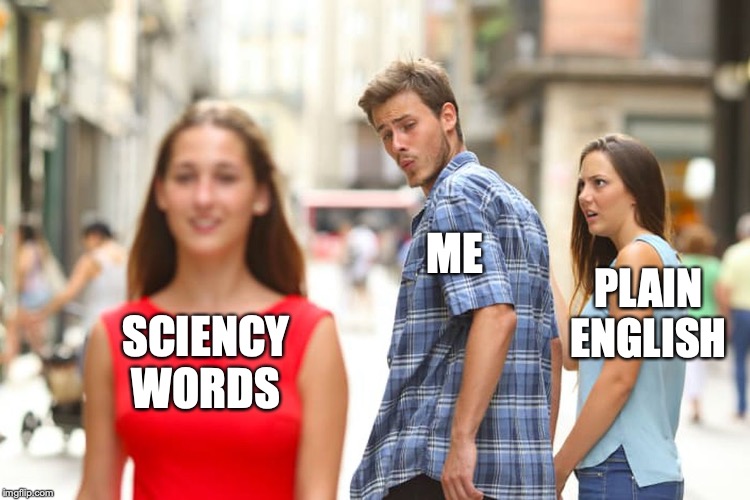
British evolutionary biologist Richard Dawkins gets credit for coining the word meme. In his 1976 book The Selfish Gene, Dawkins posits that culture develops, changes, and spreads when humans beings imitate the behavior of other human beings. Explaining the origin of his new word, Dawkins writes that he wanted:
[…] a noun that conveys the idea of a unit of cultural transmission, or a unit of imitation. “Mimeme” comes from a suitable Greek root, but I want a monosyllable that sounds a bit like “gene.” I hope my classicist friends will forgive me if I abbreviate mimeme to meme. If it is any consolation, it could alternatively be thought of as being related to “memory,” or to the French word même. It should be pronounced to rhyme with “cream.”
In the decades that followed Dawkins’ book, a whole new field of research began to emerge. The science of memetics would take the analogy between genes and memes to an extreme by applying the core concepts of Darwinian evolution. To quote from this 2015 article:
Memes are naturally selected and adapted by human beings based on “competition” within our consciousness. The fittest and best adapted memes will have a better diffusion than the ones which do not fit into the cultural systems they are competing within.
Now if you’re like me and you’re still not 100% sure what, exactly, a meme is, don’t worry. We’re not alone. As that same article goes on to explain, the field of memetics seems to have fallen into decline in the late 1990’s/early 2000’s. The problem: no one, not even the memeticists, could agree on what the word meme means, specifically.
Personally, I think this is a case of an analogy being taken one step too far. Memes are supposed to be like genes. Okay. But genes are tangible things. They exist within your cells. It is possible to test for the presence of a gene in an organism’s D.N.A., and you can link genes to the traits that organisms do or do not have. But memes? This “unit of imitation” thing is intriguing, but it’s also a rather abstract concept. How do you study, in a scientific manner, an abstract concept? How do you test for the presence of an abstract concept?
If we’re talking about the survival of the fittest, perhaps meme is not fit enough for the ecosystem of scientific terms. However, through the process of linguistic evolution, the word seems to have found a different ecological niche to fill. According to the Oxford English Dictionary, the first recorded reference to an Internet meme (or rather a “net meme”) was in 1998, around the same time that the science of memetics was in its heyday. The term was used in a news report about this video clip:
 Planet Pailly