Sciency Words: Entomopters

Sciency Words: (proper noun) a special series here on Planet Pailly focusing on the definitions and etymologies of science or science-related terms.  Today’s Sciency Word is:

ENTOMOPTERS

It is aerodynamically impossible for insects to fly, or so French entomologist Antoine Magnan famously claimed in 1934.  And it’s true.  If aerodynamics means the scientific principles governing the flight of airplanes, then you will have a very hard time explaining how insects fly using aerodynamics alone.

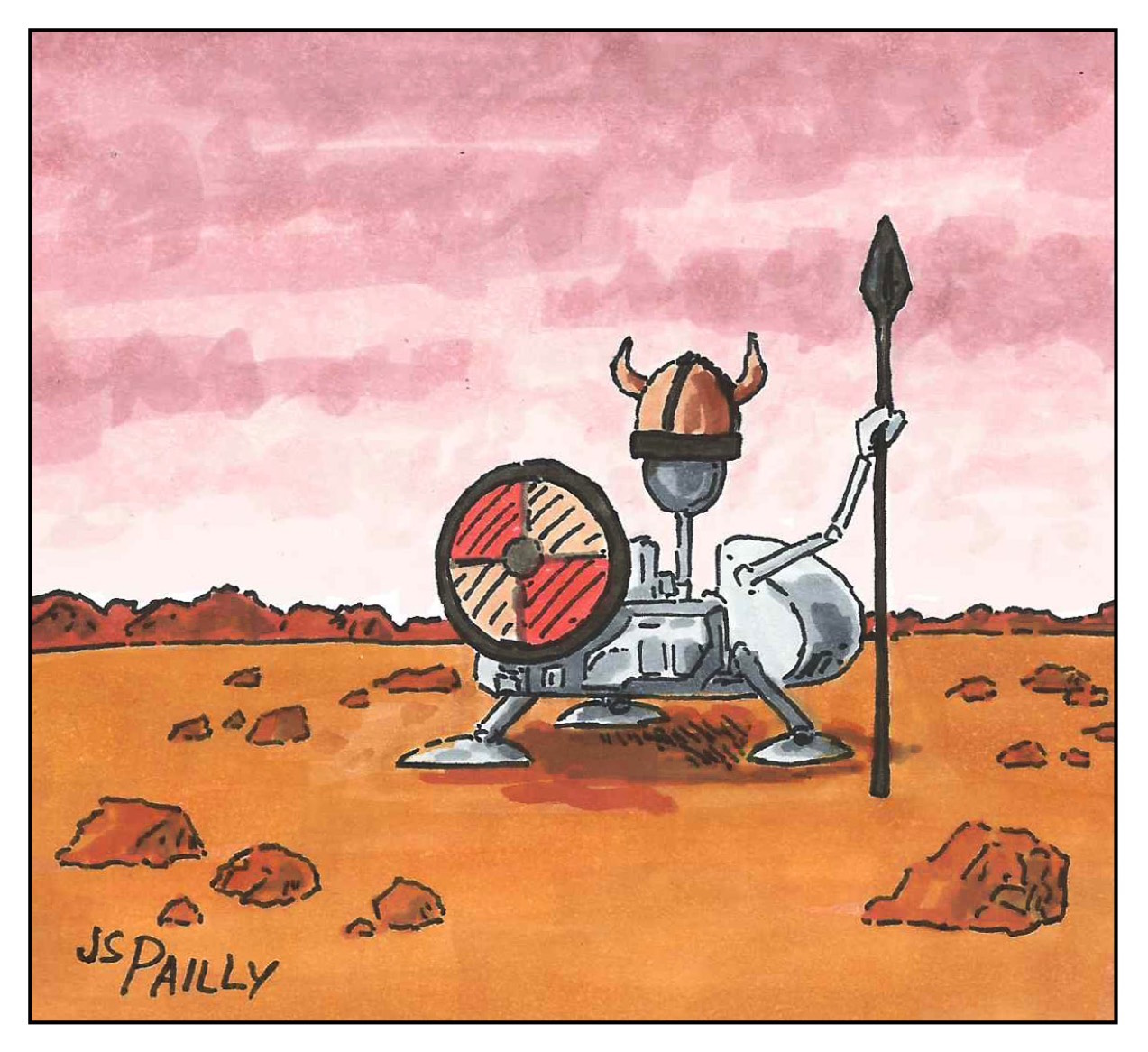
Do you know what else is aerodynamically impossible, or at least aerodynamically very, very difficult?  Flying on Mars.  The atmosphere is too thin for fixed-wing aircraft.  But perhaps where traditional aerodynamics fails, insect aerodynamics might succeed!

At least that was the thought behind the entomopter, a project proposed by Robert Michelson and colleagues at the Georgia Tech Research Institute back in the early 2000’s.  The term entomopter comes from two Greek words—entoma, meaning insect, and pteron, meaning wing.  So an entomopter is a flying machine that mimics the “aerodynamically impossibly” flight of insects.

As Michelson explains in this article:

Aerodynamic analyses of [insect] flight consistently revealed that their wings must produce 2-3 times more lift than conventional wings, and in some cases up to 6-7 times.  The extra load-lifting capacity this would offer Entomopters is highly significant, and indicates that a novel design based on flapping insect flight would outperform a more traditional aerodynamic approach.

The prototype entomopter built by Michelson and his research team was modeled after the hawk moth (scientific name Manduca sexta).  With a ten-centimeter wingspan, the hawk moth is an unusually large insect, which makes it easier to observe and study the movements of its wings. And I have to admit in this concept video from NASA, there is something distinctly moth-y about the way the entomopter flies.

I first learned about the entomopter while researching last week’s post on NASA’s NIAC program.  The entomopter was one of those so-crazy-it-might-work proposals that won grant money through NIAC.

You may have heard about the Mars Helicopter Scout (a.k.a. Marscopter), which will be accompanying NASA’s next Mars rover.  You may have also heard about Dragonfly, the robotic quadcopter that NASA plans to send to Titan sometime in the 2030’s. Neither of these spacecraft qualify as entomopters, and I’m really not sure how much thanks either Marscopter or Dragonfly owe to the entomopter project.  But I strongly suspect there is some sort of connection there.

Sciency Words: The 90-Day Report

Sciency Words: (proper noun) a special series here on Planet Pailly focusing on the definitions and etymologies of science or science-related terms.  Today’s Sciency Word is:

THE 90-DAY REPORT

We recently celebrated the 50th anniversary of the Moon Landing. There’s been a lot of talk lately about the old Apollo Program, and also a lot of talk about the new Artemis Program, NASA’s next manned (and womanned) mission to the Moon.

But this is not a Sciency Words post about Artemis (I’m saving that for next week).  Instead, this is a post about the 90-Day Report and how it effectively killed NASA’s plans to return to the Moon in the 1990’s.  I think the story of the 90-Day Report provides some context for what may or may not happen with Artemis.

It was July 20, 1989—the 20th anniversary of the Moon Landing—when President George H.W. Bush announced America’s intention to return to the Moon and establish a permanent presence there.  This would be part of a strategy for America to push onward to Mars.  Following the President’s announcement, a special committee was formed to figure out how to make it all happen.  The committee’s findings were released in a document titled “Report on the 90-Day Study on Human Exploration of the Moon and Mars,” a.k.a. the 90-Day Report.

According to the 90-Day Report, NASA would need to build a huge amount of infrastructure in space.  If you’ve seen Stanley Kubrick’s 2001: A Space Odyssey, that’s basically what the 90-Day Report described: giant space stations, a multitude of space shuttles taxiing equipment and personnel to Earth orbit, and enormous interplanetary space cruisers to transport astronauts to the Moon or Mars.

And how much would this cost?  The 90-Day Report conspicuously didn’t say, but the most commonly cited estimate was $450 billion.  To put that in some context, NASA’s budget at the time was just over $11 billion (according to Wikipedia, numbers not adjusted for inflation).  As Robert Zubrin explains in his book The Case for Mars:

It is doubtful that any kind of program could have survived that price tag. Given its long timelines and limited set of advertised accomplishments on the road to colonizing space, which did little to arouse the enthusiasm of the space-interested public, the 90-Day Report proposal certainly could not.  Unless that $450 billion number could be radically reduced, the [Space Exploration Initiative] was as good as dead, a fact made clear in the ensuing months and years as Congress proceeded to zero out every SEI appropriation bill that crossed its desks.

A lot of people ask why we haven’t returned to the Moon since the days of the Apollo Program.  The 90-Day Report is a prime example of why.  “Too many cooks in the kitchen,” as a dear friend of mine likes to say.  Where President Kennedy set a singular, clearly defined goal for the American space program, President Bush handed the space program over to a committee, which came up with a very complicated, very costly list of ideas, which Congress was unsurprisingly unwilling in paying for.

To be fair, at least one idea from the 90-Day Report did come to fruition.  We did get a giant space station.  But that only happened as a result of an international partnership, which is (in my opinion) a model for how all future space missions should be done.

So with the memory of the 90-Day report in mind, next week we’ll talk about the Artemis Program.

Sciency Words: Stagnant Lid

Sciency Words: (proper noun) a special series here on Planet Pailly focusing on the definitions and etymologies of science or science-related terms.  Today’s Sciency Word is:

STAGNANT LID

Here on Earth, we have earthquakes.  Lots and lots of earthquakes.  And that’s very odd.

Maybe we should be thankful for all those earthquakes.  Our planet’s system of plate tectonics is unique in the Solar System.  Frequent earthquakes are a sign that Earth’s tectonic plates are still moving, that our planet is still geologically healthy.  The alternative would be stagnant lid tectonics, and that’s something we Earthlings probably don’t want.

In this 1996 paper, planetary scientists V.S. Solomatov and L.N. Moresi coined the term “stagnant lid” to describe what was happening on Venus—or rather what was not happening.  Venus doesn’t have active plate tectonics.  Maybe she did once, long ago.  If so, Venus’s plates somehow got stuck together, forming a rigid, inflexible shell.

The term stagnant lid has since been applied to almost every other planetary body in the Solar System, with the obvious exceptions of the four gas giants, and the possible exceptions of two of Jupiter’s moons: Europa and Ganymede.

According to this paper from Geoscience Frontiers, neither Europa nor Ganymede have truly Earth-like plate tectonics, but something similar may be happening.  The authors of that paper refer to the situation on Europa and Ganymede as “fragmented lid tectonics” or “ice floe tectonics.”  The upcoming Europa Clipper and JUICE missions should tell us more about how similar or different this is to Earth’s plate tectonics.

A stagnant lid does not necessarily mean that a planet or moon is geologically dead.  Venus and Io both have active volcanoes, for example, and it was recently confirmed that Mars has marsquakes.  But none of these stagnant lid worlds seem to be as lively as Earth—and I mean that in more ways than one.

If you buy into the Rare Earth Hypothesis, plate tectonics is one of those features that makes Earth so rare. Plate tectonics is something Earth has that other planets don’t, and thus it may be an important factor in why Earth can support life when so many other worlds can’t.

A Mars Meteorite by Any Other Name

You remember that meteorite from Mars?  The one that purportedly had fossilized Martian microorganisms inside it? The controversy over that meteorite has never been fully settled.  And now, it’s not just one meteorite.  Now there are two of them.

That original meteorite was named ALH-84001. Names are important.  You can learn a lot simply by understanding where a name came from.  The name ALH-84001 tells us a bit about this particular meteorite’s history. It was found in the Allan Hills region of Antarctica (ALH) during a 1984 scientific expedition (84), and it was the first meteorite found by that expedition (001).

This new meteorite is named ALH-77005, so right there you know some important things about it.  It was found in the same region of Antarctica, a few years before ALH-84001. And like ALH-84001, ALH-77005 sat in storage for a while before anyone got around to examining it.  In fact, it sounds like ALH-77005 has been sitting in storage for a whole lot longer than ALH-84001 did.

When I first heard about ALH-77005 and the surprises that were found inside it, my initial reaction was enthusiastic.  Surely this would bolster the Martian fossil hypothesis for ALH-84001, I thought.  But after some of the research and having some time to think, I don’t think this new evidence actually changes anything.

It’s still possible that something happened to ALH-84001 once it landed here on Earth.  For example, maybe Earthly microorganisms somehow wormed their way inside the rock.  If so, the exact same thing may have happened to ALH-77005.  So have we found new evidence of life on Mars, or new evidence of life in Allan Hills?  There’s still no way to tell for sure.

But it does make you wonder: how many more meteorites are just sitting in storage, waiting to be opened up?

Sciency Words A to Z: Xerophile

Welcome to a special A to Z Challenge edition of Sciency Words!  Sciency Words is an ongoing series here on Planet Pailly about the definitions and etymologies of science or science-related terms.  In today’s post, X is for:

XEROPHILE

You can’t have life without water.  Everybody knows that, right?  Right?  Well, apparently there are some microorganisms on this planet who didn’t get the memo.

The Atacama Desert in Chile is one of the most un-Earth-like environments on Earth.  It is severely dry.  It almost never rains there, and even when it does it’s a pathetic trickle. And it’s been like this for over a hundred millions years, making the Atacama Desert the oldest continuously arid region in the world.

At this point, the Atacama Desert has been so dry for so long that, chemically speaking, it has more in common with the surface of Mars. Most notably, in my opinion, the toxic perchlorate salts found on Mars are also present in the Atacama—0.4 to 0.6 wt% for Mars compared to 0.3 to 0.6 wt% for the Atacama, according to this article.  A near perfect match!

It was once thought the sands of the Atacama Desert were sterile, and experiments on soil samples seemed to prove it.  However, thanks to “improved extraction protocols,” we now know better.  As reported in this paper, titled “Bacterial diversity in hyperarid Atacama Desert soils,” it seems a great many bacterial species have found their way into the Atacama and adapted to the harsh environment.

In general, organisms that can survive in extreme conditions are known as extremophiles.  The term applies especially well to organisms that actually thrive in environments that should kill them.  There are many subcategories of extremophile, such as:

  • Thermophiles: organisms that love extreme heat.
  • Barophiles: organisms that love extreme pressure.
  • Acidophiles: organisms that love acid.
  • Halophiles: organisms that love salt.

Any organism that can survive in the Atacama Desert would be considered a xerophile, which comes from a Greek word meaning dryness.  They’d also probably be halophiles, given the presence of those perchlorate salts.  As noted in this article: “Xerophilic organisms are often also halophilic, some of them occurring in hypersaline solutions.”

So what does all this mean for our chances of finding life on Mars?  I think that should be obvious.  However, it’s worth noting that even xerophiles require some water.  Remember, even in the Atacama Desert it rains a little. Fortunately for any xerophiles who might be eeking out an existence on Mars, there seem to be a few rare trickles of water there too.

Next time on Sciency Words A to Z, have you seen Europa, the moon of Jupiter?  She looks a whole lot younger than she really is.  So what’s her secret?

Sciency Words A to Z: Viking

Welcome to a special A to Z Challenge edition of Sciency Words!  Sciency Words is an ongoing series here on Planet Pailly about the definitions and etymologies of science or science-related terms.  In today’s post, V is for:

VIKING

You know, I’ve noticed something about those early pioneers in the field of astrobiology.  They thought they knew an lot about what aliens would be like, how aliens would behave.  It seems awfully presumptuous in hindsight.  People even thought they knew how alien microorganisms would behave.

In the late 1960’s, NASA was putting together a mission to Mars, and they decided to name this new mission Viking.

As explained in this book on NASA’s history of naming things:

The name had been suggested by Walter Jacobowski in the Planetary Programs Office at NASA Headquarters and discussed at a management review held at Langley Research Center in November 1968.  It was the consensus at the meeting that “Viking” was a suitable name in that it reflected the spirit of nautical exploration in the same manner as “Mariner” […].

In NASA’s early years, nautical exploration was the theme for naming all missions to other planets.

The Viking 1 and Viking 2 landers arrived on Mars in 1976. They were the first space probes to successfully land (as opposed to crash) on Mars, and they were the first to send back photos from the surface.  They were also the first, and so far the only, space probes to conduct experiments directly testing for Martian life.

And one of those tests came back positive!!!

Except it may have been a false positive.  It was probably a false positive.

This test was called the labeled release experiment, and here’s how it worked: the Viking landers scooped up some Martian soil and added a nutrient mix—in other words, we tried to feed the Martians.  The nutrient mix was “labeled” with a radioactive carbon isotope, so if any Martian microbes were living in the soil, they’d take the food and then release gaseous waste that had this special isotope in it.

But there were some problems with this idea.  How do we know what Martian microbes eat?  How do we know what waste products they produce?  And—here’s the biggest problem of all—given how little we knew about Mars at the time, how do we know our nutrient mix wouldn’t react with some previously unknown chemical in the Martian soil, giving us a false positive result?

These are the kinds of questions that were asked after the labeled release experiment took place (but apparently not before).  As a result, there was wild disagreement about what that positive test result might actually mean.  The general consensus today is that we got a false positive.  Our nutrient mixture must have reacted with something in the soil, something that was not alive.

But while the Viking Mission could not give us a definitive answer about whether or not there is life on Mars, Viking still taught astrobiologists a valuable lesson.  When exploring strange, new worlds, trying to tell the difference between chemistry and biochemistry can be really hard.

Next time on Sciency Words A to Z, wow… just, wow!

Sciency Words A to Z: Noachian

Welcome to a special A to Z Challenge edition of Sciency Words!  Sciency Words is an ongoing series here on Planet Pailly about the definitions and etymologies of science or science-related terms.  In today’s post, N is for:

NOACHIAN

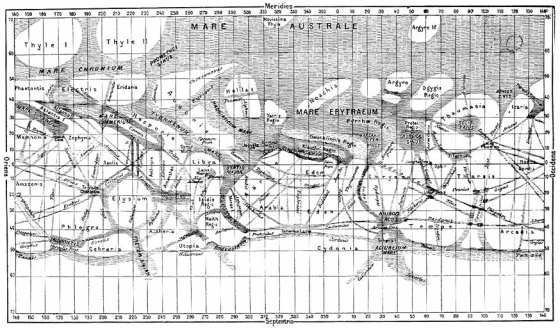
In the 1870’s, Italian astronomer Giovanni Schiaparelli began producing the most detailed and accurate maps of Mars anyone had ever seen.  Schiaparelli also assigned many of the names we still use today for Martian surface features today. One of those regions on Schiaparelli’s map got the name Noachis Terra—the Land of Noah.

In my opinion, no other name could have turned out to be more apt.  Schiaparelli got many of his names from the Bible, and I’m sure you remember the biblical story of Noah and the Great Flood.

Schiaparelli’s map of Mars.

Much like the geological history of Earth, Mars’s geological history is divided up into different periods.  Noachis Terra spawned the name for Mars’s Noachian Period, a time that roughly corresponds with the Archean Eon here on Earth—the time when the very first microbes were appearing on our planet.

So what was happening on Noachian Mars?  Based on the evidence presented in this textbook on Astrobiology, it wasn’t quite like the Great Flood in the Bible, but it was close!  Most if not all of Mars’s northern hemisphere was probably covered in water.  Circumstantial evidence of shorelines can be seen today.

And in the southern hemisphere, in regions like Noachis Terra, we see unambiguous evidence of ancient flowing water.  Craters show obvious signs of erosion.  There are dried up lakes and rivers, and those rivers appear to have been fed by tributaries, which tells us it used to rain on Mars.

And there’s more.  Many Noachian-aged minerals and rock formations are most easily explained if we assume there was water.  In some cases, water is the only possible explaination.  Our Mars rovers have found mudstone, clay minerals, sedimentary rock… iron and magnesium carbonate… hematite, jarosite, and more!  Some of these minerals would have required a hot and slightly acidic environment, like you might find in a hot spring or near a hydrothermal vent.

We shouldn’t jump to conclusions.  After all, there’s still so much we don’t yet know about Mars, and new discoveries are being made all the time.  But I’m going to go ahead and call a spade a spade here: Noachian Mars sounds an awful lot like Arcean Earth, and it’s easy to imagine that whatever was happening on Arcean Earth (by which I mean LIFE!!!) must’ve also been happening on Noachian Mars.

However, the Noachian Period did not last long—a mere 400 million years.  Earth and Mars have had very different geological histories since then.  After the Noachian, Mars rapidly lost its internal heat, its atmosphere, and its oceans.  By the time of Earth’s Cambrian explosion, when complex, multi-cellular organisms really “exploded” onto the scene, Mars had fully transformed into the barren, inhospitable world we know today.

Modern day Mars has been trying really hard to get our attention and convince us that it might still support life.

And maybe that’s true.  During the Noachian, life had a great opportunity to get started on Mars, and it’s possible that some isolated remnant of a Noachian ecosystem has persisted to this day.  But in my opinion, it’s far more likely that we’ll find fossils left over from the Noachian Period (assuming we haven’t found some already).

Next time on Sciency Words A to Z, did you know there’s a deadly chemical in the air you breathe?  It’s called oxygen.

Sciency Words A to Z: Goldilocks Zone

Welcome to a special A to Z Challenge edition of Sciency Words!  Sciency Words is an ongoing series here on Planet Pailly about the definitions and etymologies of science or science-related terms.  In today’s post, G is for:

GOLDILOCKS ZONE

Once upon a time, there was a little girl from outer space who came to visit the Solar System.  Her name was Goldilocks.  First, she landed on Mars, but she didn’t like it there.  It was too cold.  Then she tried to land on Venus, but she didn’t like it there either. It was too hot—way too hot.  And then finally, Goldilocks landed her spaceship on Earth.  When she came out of the airlock and walked down the landing ramp, she said to the astonished Earthlings, “Ah yes, this planet is just right!”

At least that’s how my version of the Goldilocks story goes.

Anyway, the concept of a Goldilocks zone (also known as a habitable zone, continuously habitable zone, or circumstellar habitable zone) is pretty simple.  Fairy tale simple, you might say.  The Goldilocks zone is the region of space around a star where liquid water can exist on a planet’s surface.  And as you know, if a planet has liquid water on its surface, then it could have life!

For a long time, our search for alien life has focused almost exclusively on Goldilocks planets.  But there are problems with limiting our search in that way.

In my post on carbon chauvinism, I told you there are other chauvinisms that astrobiologists have to deal with. One of them is water chauvinism, the presumption that water is necessary for life.  Another is surface chauvinism, the presumption that life can only exist on a planet’s surface.  Our obsession with Goldilocks zones is largely based on those two chauvinisms.

But looking to the moons of Jupiter and Saturn, we’ve already learned that there is more liquid water outside the Goldilocks zone than in it!  Several of those moons have vast oceans of liquid water beneath their surface, with only a relatively thin crust of ice overtop.  These subsurface oceans might be ideal environments for alien life.  So much for our surface chauvinism.

And then there’s Titan, a moon of Saturn, which has lakes of liquid methane and ethane on its surface.  Could those liquid hydrocarbons serve as a substitute for water in an alien biochemistry?  We don’t know.  It’s possible.  We certainly shouldn’t rule that possibility out.  And thus, so much for our water chauvinism.

To quote from Exoplanets by Michael Summers and James Trefil, “[…] the current focus on finding a Goldilocks planet amounts to a search for the least likely location of water and, presumably, life.”  I think there’s a bit of hyperbole in that statement, but I agree with the general point.  There are probably far more worlds in our galaxy like Europa, Enceladus, or Titan than there are like Earth.

Next time on Sciency Words A to Z, we’ll crack the surface of one of those icy moons and see what might be hidden in those dark, extraterrestrial depths.

Sciency Words A to Z: B.S.O.

Welcome to a special A to Z Challenge edition of Sciency Words!  Sciency Words is an ongoing series here on Planet Pailly about the definitions and etymologies of science or science-related terms.  In today’s post, B is for:

B.S.O.

When you study the planets, when you really get to know them well, you soon start to feel like they each have their own unique personalities.  Jupiter is kind of a bully, pushing all the little asteroids around with its gravity.  Venus hates you, and if you try to land on her she will kill you a dozen different ways before you touch the ground. And Mars… I can’t help but feel like Mars is kind of jealous of Earth.

I get the sense that Mars wishes it could be just like Earth, and that Mars is trying its best to prove that it has all the same stuff Earth has.

In 1996, Mars almost had us convinced. A team of NASA scientists led by astrobiologist David McKay announced that they’d found evidence of Martian life.

As reported in this paper, McKay and his colleagues found microscopic structures (among other things) within a Martian meteorite known as ALH84001.  They interpreted those structures to be the fossilized remains of Martian microorganisms.

This was a truly extraordinary claim, but as Carl Sagan famously warned: “extraordinary claims require extraordinary evidence.” Or to put that another way, when it comes to the discovery of alien life, astrobiologists must hold themselves and each other to the same standards as a court of law: proof beyond a reasonable doubt.

In follow-up research, those supposed Martian fossils came to be known as bacteria shaped objects, or B.S.O.s for short.  I kind of wonder if somebody was being a bit cheeky with that term. I wonder if someone was trying to say, in a subtle but clever way, that the whole Martian microbe hypothesis was just B.S.  As this rebuttal paper explains:

Subsequent work has not validated [McKay et al’s] hypothesis; each suggested biomarker has been found to be ambiguous or immaterial.  Nor has their hypothesis been disproved.  Rather, it is now one of several competing hypotheses about the post-magmatic and alteration history of ALH84001.

In other words, those B.S.O.s might very well be fossilized Martian microorganisms.  Yes, they might be.  It is possible.  But no one has been able to prove it beyond a reasonable doubt, and therefore no one can say with any certainty that we’ve found evidence of life on Mars. At least not yet.

Still, the ALH84001 meteorite and its B.S.O.s are an important part of the history of astrobiology.  As that same rebuttal paper says:

[…] it will be remembered for (if nothing else) its galvanizing effect on planetary science.  McKay et al. revitalized study of the martian meteorites and the long-ignored ideas of indigenous life on Mars.  It has brought immediacy to the problem of recognizing extraterrestrial life, and thus materially affected preparations for spacecraft missions to return rock and soil samples from Mars.

Next time on Sciency Words A to Z, are we prejudiced against non-carbon-based life?

Mars: The Little Planet That Could

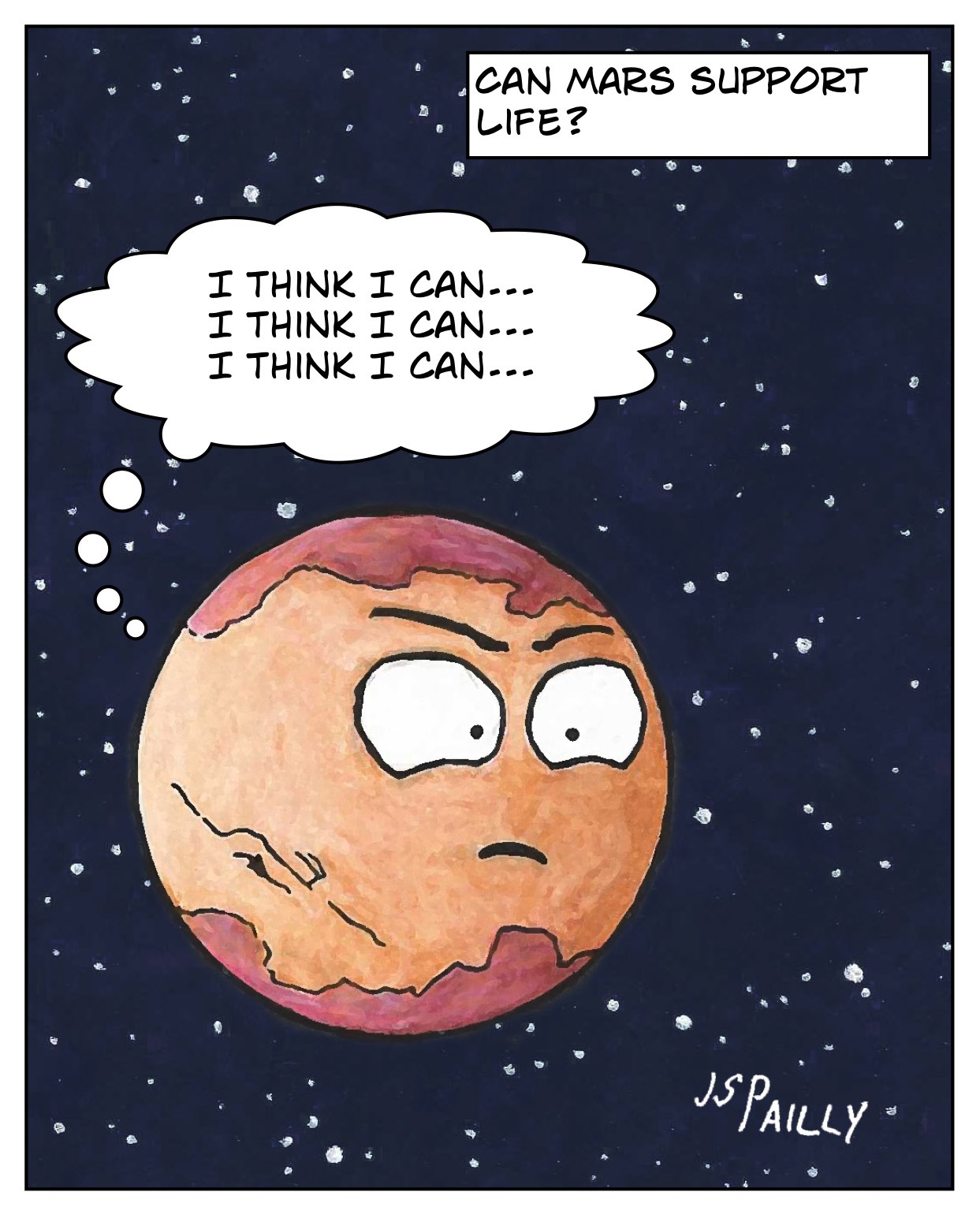
Do you remember the children’s story “The Little Engine That Could”?  Well, I’ve come up with a new nickname for Mars: the little planet that could.  There are plenty of good reasons to believe that Mars is a dead world, totally devoid of life; and yet, stubbornly and persistently, Mars just keeps trying and trying to prove otherwise.

Last year, it was announced that scientists had discovered an underground lake near the Martian south pole, in a region known as Planum Australe.  According to this paper published in the journal Science, radar profiles of Mars’s south polar region revealed “a well-defined, 20-km-wide subsurface anomaly.”

The authors do say this in the abstract of their paper: “We interpret this feature as a stable body of liquid water on Mars.”  So I get why the popular press was calling this an underground lake.  However, based on what it says in the rest of the paper, it sounds more like we’re talking about mud: polar melt water plus Martian regolith.  But I could be misreading this.  And there are apparently a lot of uncertainties about this anomaly anyway due to the technical limitations with our space probe at Mars.  So who knows?

But there can be no doubt about this: we found something. Something anomalous.  A distinctly watery kind of anomaly, based on comparisons with similar radar observations of Greenland and Antarctica. And again, because of the technical limitations of our space probe, there may be more watery anomalies all around the Martian poles.  Maybe the Planum Australe anomaly is just “the big one,” and there are many other patches of mud that are too small for our instruments to detect.

So could Mars support life?  Mars is still a very cold, bleak, hostile place. But yes, more and more it’s looking like Mars could… it could… it could….