Time: Mission to Mars, A Book Review

A few years back, I picked up a special edition of Time Magazine that was all about Albert Einstein. It had a lot of new-to-me biographical information, and it did a surprisingly good job explaining Einstein’s physics. So when I saw Time’s “Mission to Mars: Our Journey Continues” on the magazine rack, I bought it.

oc31-time-magazine-mission-to-mars

Quick Review

It was just okay.

Longer Review

It’s worth taking stock of the fact that there is so much Mars-related stuff going on, but I think the writers were trying to cram too much into a magazine (booklet?) that’s less than 100 pages.

They touched on the search for Martian life, the Curiosity rover, India’s Mars Orbiter Mission, Scott Kelly’s Year in Space, the competition between SpaceX and Blue Origin, President Obama’s space policy, production of The Martian staring Matt Damon… they touched on all of this stuff, but they didn’t go into detail about any of it.

Any one of those topics could have filled a whole magazine by itself (in fact, Time did do a special edition on the Year in Space mission). If they had narrowed their focus just a little, I think they could have produced a much more interesting and informative publication.

Recommendation

If you don’t know much about Mars and the current state of space exploration, and you want to be better informed, this isn’t a bad place to start. For people like myself who are already huge space enthusiasts, the forward by Buzz Aldrin is worth a look. Otherwise, I’d say give this one a pass.

All These Worlds Are Yours: A Book Review

In his book All These Worlds Are Yours: The Scientific Search for Alien Life, author Jon Willis gives you $4 billion. How many authors do that? Okay, it’s imaginary money, and you’re only allowed to spend it on astrobiological research. But still… $4 billion, just for reading a book!

If you’re new to the subject of astrobiology, All These Worlds is an excellent introduction. It covers all the astrobiological hotspots of the Solar System and beyond, and unlike most books on this subject, it doesn’t gloss over the issue of money.

There are so many exciting possibilities, so many opportunities to try to find alien life. But realistically, you can only afford one or maybe two missions on your $4 billion budget. So you’ll have to pick and choose. You’ll have to make some educated guesses about where to look.

Do you want to gamble everything on Mars, or would you rather spend your money on Titan or Europa? Or do you want to build a space telescope and go hunting for exoplanets? Or donate all your money to SETI? Willis lays out the pros and cons of all your best options.

My only complaint about this book is that Enceladus (a moon of Saturn) didn’t get its own chapter. Instead, there’s a chapter on Europa and Enceladus, which was really a chapter about Europa with a few pages on Enceladus at the end.

oc11-enceladus-is-angry

I agree, Enceladus. On the other hand, Enceladus is sort of like Europa’s mini-me. So while I disagree with the decision to lump the two together, I do understand it.

In summary, I’d highly recommend this book to anyone interested in space exploration, and especially to those who are new or relatively knew to the subject of astrobiology. Minimal prior scientific knowledge is required, although some basic familiarity with the planets of the Solar System would help.

P.S.: How would you spend your $4 billion? I’d spend mine on a mission to Europa, paying special attention to the weird reddish-brown material found in Europa’s lineae and maculae.

Lego Mars Rover

I have a new hobby. When I’m not reading about space or writing about space or drawing pictures of space, you can probably find me in my basement building Lego things. Specifically, I’m building Lego space things.

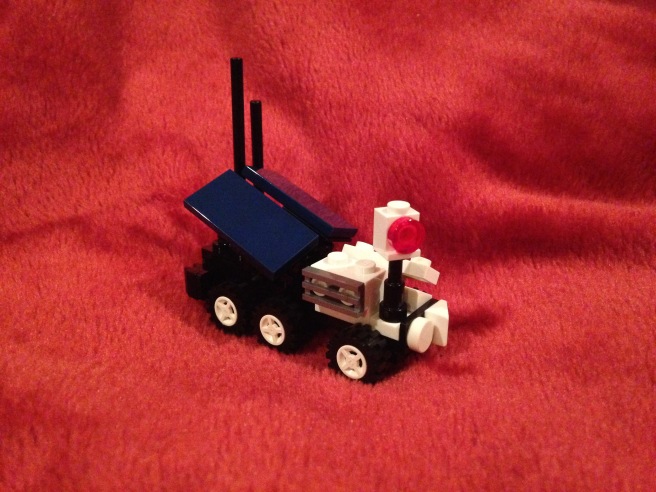
This is my first official creation for my new Lego space program: a Mars rover.

Rover begins exploring Martian landscape.

In real life, there have been a total of four Mars rovers: Sojourner, Spirit, Opportunity, and Curiosity. I did not design mine to look specifically like any of them.

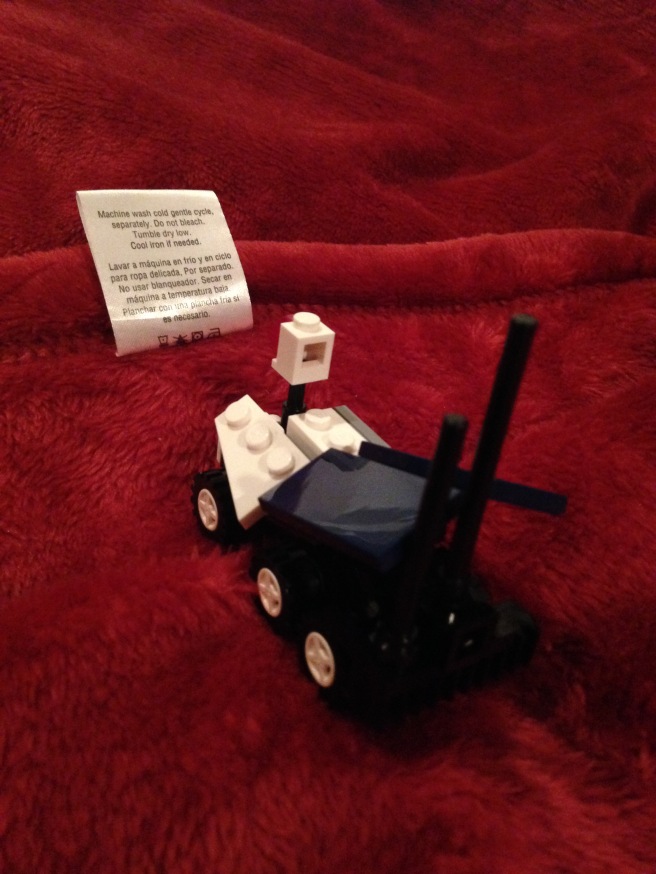
Rover reports the surface of Mars is soft and fuzzy.

As a result, I don’t have a name for this little guy.

Jn08 Lego Rover 3
Rover determines that the surface of Mars is composed of 100% polyester and is “machine washable.”

So before I send my Lego rover to Lego Mars (which will surely take me a while to build), I want to get some suggestions. I’m asking for input from the public, as NASA might say.

So what do you think my Mars rover should be named?

Mars vs. the Moon: Where Do You Want to Go?

Okay, fellow humans. Where should we go next? Should we return to the Moon or push onward to Mars?

Ap12 Mars vs the Moon

It would be nice if we could do both, but space exploration is expensive. So at least in the near future, we as a species will probably have to choose.

If you pay any attention to NASA’s public relations, you know the United States is aimed for Mars. Almost every new piece of NASA tech is billed as Mars-ready or Mars-capable. Almost every experiment, including Scott Kelly’s Year in Space mission, is somehow Mars related. NASA has produced tons of videos, posters, and infographics, and they’ve made #JourneytoMars a thing on Twitter.

But an actual Mars landing is still at least twenty years away. A lot could happen in twenty years, politically and economically speaking. Regarding the politics of space exploration, international partnerships play a key role. Big, expensive projects become a lot more feasible when costs are divvied up among multiple countries.

Right now, the European Space Agency (ESA) is mulling over the idea of establishing a permanent outpost on the Moon. This moon base, or “moon village” as it’s sometimes called, would be the successor to the International Space Station.

If ESA does get their moon village started, no doubt the Russians and the Japanese will want to be part of it. And so will the U.S. But where will that leave NASA’s #JourneytoMars ambitions?

Personally, I’d really like human beings to finally set foot on Mars, preferably in my lifetime. But ESA’s moon base proposal seems more achievable in the near-term. In a way, it does feel like a logical next step after the International Space Station. But that’s just my opinion.

So what do you think? Were do you, fellow humans, want to go next: back to the Moon or onward to Mars?

Earth Germs on Mars: What Might Happen?

Warning: the word “might” will appear a lot in today’s post.

When the Curiosity rover left Earth, it might have been contaminated with several different strains of Earthly bacteria. This was a big oops for NASA, especially for NASA’s Office of Planetary Protection, which is supposed to make sure we don’t spread our germs to other planets.

But how bad could the damage really be? Curiosity was headed for Mars. It’s not like Mars has water.

Then we found out Mars does have water. Droplets and trickles of water. Modestly sized puddles of the stuff. Now, even though Curiosity is currently located near actively trickling water, the rover is not allowed to go investigate. It might contaminate the water. It might endanger any ecosystem that might exist in the slightly damp Martian soil.

I wrote previously that we should take the risk anyway. Let Curiosity approach the water. Let Curiosity take a sample. Let Curiosity be curious. What are the odds that microorganisms from cushy, life-friendly Earth could survive on Mars? What are the odds that they could outcompete native life forms that are perfectly adapted to the harsh Martian environment?

That’s how I felt, until last week when I learned about bacterial conjugation.

Mr04 Bacteria of Mars

According to the panspermia hypothesis, life on Earth and Mars might (there’s that word again) share a common ancestor. If so, Martian microbes might be genetically compatible with bacteria from Earth. Through bacterial conjugation, they might be able to share DNA.

They might.

Mr04 Martian Earthling Hybrid

Or they might not.

Finding out that bacteria on Earth and Mars are genetically compatible would be a huge discovery, assuming we knew it was happening. But Curiosity is not equipped to test for that sort of thing. Curiosity isn’t equipped to study biological activity of any kind. So the rover’s presence in and around Martian water flows might trigger changes to the local ecosystem without our knowledge.

So grudgingly, I’ll agree. Let’s keep Curiosity away from the Martian wetlands. It might not worth the risk.

Sciency Words: Planetary Protection

Sciency Words PHYS copy

Today’s post is part of a special series here on Planet Pailly called Sciency Words. Each week, we take a closer look at an interesting science or science-related term to help us all expand our scientific vocabularies together. Today’s word is:

PLANETARY PROTECTION

I swear this isn’t science fiction. The Office of Planetary Protection is a real department at NASA which follows the guidelines set by COSPAR, an international council with jurisdiction over the safe and responsible exploration of space.

The three core tenets of planetary protection are:

  • Don’t contaminate other worlds (we don’t want to harm alien life, if it exists).
  • Seriously, don’t contaminate other worlds (it would suck if the “alien life” we discover on Mars turns out to be E. coli).
  • While you’re at it, don’t contaminate Earth either (have you seen the Andromeda Strain?).

Under COSPAR rules, different mission categories require different levels of planetary protection. Categories I, II, and III require only minimal precautions. Nobody cares if we contaminate Venus. Nothing lives on Venus (probably). Category VI covers missions on the surfaces of worlds that could theoretically support life, and category V is for sample return missions that could theoretically bring alien organisms back to Earth.

Until recently, planetary protection has been a fairly esoteric concern. But now we know there’s water on Mars, and scientists really, really want to get a closer look at that!

Ja07 Curiosity on Mars 1

The Curiosity rover is currently located near a potential recurring slope line (RSL) site, meaning it’s only a few kilometers from what appears to be actively flowing water. But NASA won’t allow Curiosity to investigate.

First off, I should mention there is a logistical concern. Remember the slope part of recurring slope linea. The slope may be too steep for Curiosity to climb.

But the bigger issue is planetary protection (I mean, we could let Curiosity at least try to climb that hill). Under current planetary protection rules, the exploration of an RSL zone is a category IV mission. Specifically, it’s a category IVc. Curiosity is only rated for category IVb, because at the time of launch no one knew there was water on the surface of Mars. So there is a chance—a remote chance, but a chance nonetheless—that it is carrying live bacteria from Earth.

In my opinion, Curiosity should be allowed to investigate the RSL site anyway. It would be a miracle if any microorganism from Earth could survive on Mars. There’s too much radiation, and the water is brimming with toxic perchlorate salts. And the idea that organisms from cushy, comfortable Earth might outcompete native Martian life forms—life forms that are perfectly adapted to the harsh environment found on Mars—sounds 100% preposterous to me.

Ja07 Curiosity on Mars 2

At the same time, I know any evidence of life Curiosity might find would be justifiably suspect. We could never rule out the possibility of a contaminated sample.

So what do you think? Should Curiosity keep its distance from potential RSLs, or are COSPAR and the Office of Planetary Protection being over-precautious?

Links

The Office of Planetary Protection (official website).

COSPAR Planetary Protection Policy from COSPAR and the IAU.

Water on Mars: NASA Faces Contamination Dilemma over Future Investigations from The Guardian.

A Tale of Two Marses, Part Two

Mars

The discovery of water on Mars has forced us to reevaluate everything we thought we knew about the Red Planet. Right now, scientists have to be cautious when talking about Mars. Too much remains unknown or uncertain.

But I’m no scientist. I’m a science fiction writer. Yesterday, I took you on an imaginative tour of one possible version of Mars: a Mars that managed to trap immense quantities of water deep underground, protecting it from the ravages of the solar wind.

Today, let’s visit a rather different kind of Mars.

MARS: AN ATMOSPHERIC WATER WORLD

Ancient Mars possessed a dense atmosphere of carbon dioxide and vast oceans of liquid water. This environment supported a fledgling ecosystem of anaerobic bacteria, much like that found on ancient Earth.

But unlike Earth, Mars lost its protective magnetic field, most likely due to the natural cooling of the planet’s interior. As the magnetic field collapsed, the solar wind began ravaging the planet’s surface, stripping away most of that CO2 and water.

At this point, our story diverges from yesterday’s account. Little if any water was trapped underground. Mars managed to retain its polar ice caps, but that was basically it. Just a little ice—no liquid—beneath a dusting of frozen CO2.

It’s hard to believe anything could have survived in this scenario, and yet life is resilient. Like many microorganisms on Earth, some Martian microbes could enter a state of suspended animation, waking up to feed and mate only when conditions become favorable to them.

Though the Martian atmosphere is thin, there’s enough atmospheric pressure to allow liquid water to exist within a narrow temperature range. During the Martian spring and summer, the polar ice starts melting, and the polar CO2 starts sublimating.

The sudden influx of CO2 into the atmosphere stirs up weather patterns, triggering Mars’s infamous sandstorms but also spreading minute traces of water from the poles to every corner of the planet’s surface.

Perchlorate salts, which are ubiquitous on Mars, have a way of sucking water right out of the air and trapping it in the Martian soil. And because they’re salts, they also lower water’s freezing point, expanding slightly the narrow temperature range in which liquid water can exist.

And so every spring and summer, as melt water trickles from the poles and is carried upon the Martian winds, Martian microbes emerge from their suspended animation and go into a frenzy of eating, breathing, and mating.

Most of these microbes live in the permafrost surrounding the poles, where seasonal melt water is a little more dependable. Others eek out an existence farther afield, perhaps even in and around the recurring slope lineae (RSLs) that we humans have only just noticed on the surface of Mars.

* * *

Once again, this is a bit of a stretch. Could there really be enough seasonal melt water to sustain life on Mars? Maybe not, but as a science fiction writer, I can take a few liberties with the currently available scientific facts.

So which version of Mars is closer to the truth? Yesterday’s or today’s? It all depends on what we can learn from those RSLs. Does RSL water seep up from underground, or is it sucked out of the air by perchlorate salts?

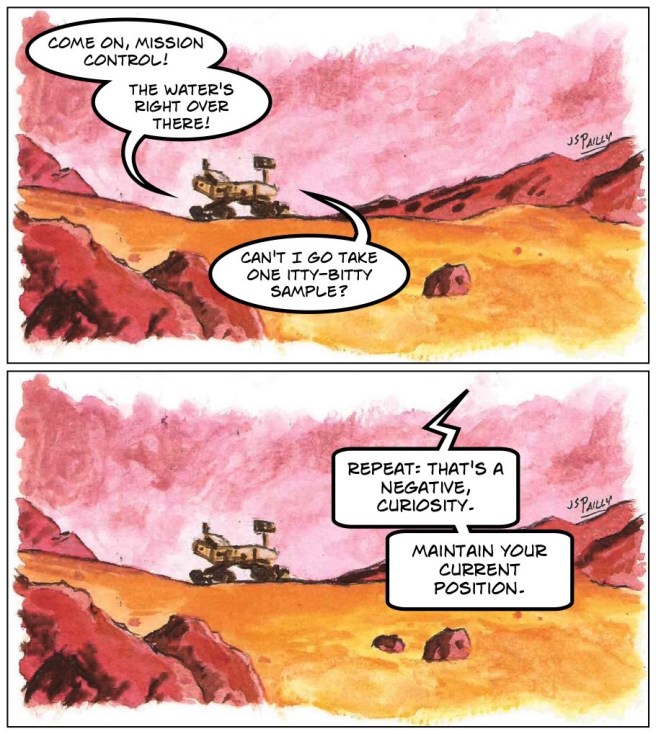
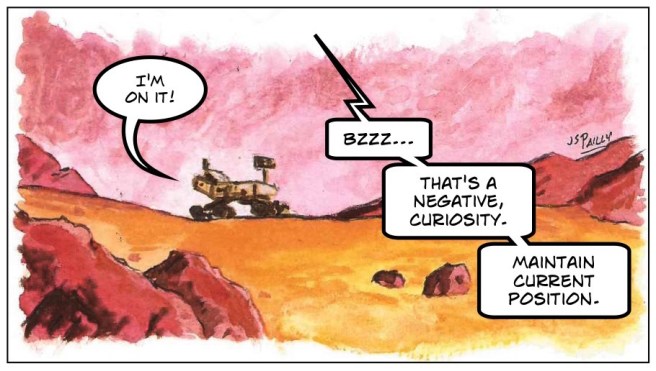
If only we had some kind of robot on the surface of Mars, a robot equipped with an assortment of scientific instruments, a robot conveniently located near an RSL.
Ja06 Mars in Watercolor

Turns out the Curiosity rover is just the robot we need, currently located within a few kilometers of a possible RSL site. But NASA won’t let Curiosity anywhere near it. Why not? We’ll find out in Friday’s edition of Sciency Words.

P.S.: In honor of Mars’s water, the above illustration of Curiosity traversing the Martian landscape is painted in watercolor.

A Tale of Two Marses, Part One

Mars

Mars is not the dry, desiccated corpse of a planet we thought it was. In just the last few months, our whole understanding of the Red Planet has changed. There’s water! Liquid water!!! On the surface!!! Seriously, why isn’t everybody freaking out about this?

So if Mars isn’t the absolute desert world we thought it was, then what is it? A lot depends on further investigation of recurring slope lineae (or RSLs). Does RSL water seep up from subterranean reservoirs, or is it sucked out of the atmosphere by chemicals in the surface sands?

Right now, scientists are understandably circumspect when talking about Mars. Too much remains unknown. Too many things that we thought we understood we no longer understand. But I’m not a scientist. I’m a science fiction writer. So let’s now take an imaginative tour of one possible version of Mars.

MARS: A SUBTERRANEAN WATER WORLD

Ancient Mars possessed a dense atmosphere of carbon dioxide and vast oceans of liquid water. This environment supported a fledgling ecosystem of anaerobic bacteria, much like that found on ancient Earth.

But unlike Earth, Mars lost its protective magnetic field, most likely due to the natural cooling of the planet’s interior. As the magnetic field collapsed, the solar wind began ravaging the planet’s surface, stripping away most of that CO2 and water.

And yet, not all was lost. Enough of Mars’s water was trapped underground, shielded from the solar wind, that life still had a chance to survive. The environment would be forever cold and dark, but not so inhospitable that life couldn’t evolve and adapt.

Lingering geothermal heat could provide the Martian survivors the energy they needed to keep going, or perhaps they generated their own energy through chemical reactions using perchlorate salts (strong oxidizers that are ubiquitous in Martian soil).

Much as oxygen (another strong oxidizing agent) enabled the evolution of complex multicellular life on Earth, perchlorate-based respiration could lead to the development of multicellular Martian organisms. And so today, fungus-like plants with elaborate root systems and earthworm-like animals with a keen instinct for finding water may dwell deep underground, concealed from the view of humanity’s most sophisticated landers and rovers and orbiters.

* * *

Okay, this is all a bit of a stretch. Especially that last paragraph. But as a science fiction writer, I’m allowed to stretch the currently available scientific facts.

However, this entire scenario depends on one big assumption: that RSL water comes from somewhere underground. While that seems to be the prevailing wisdom, there is another compelling possibility. What if the water we’ve observed on the surface of Mars has an atmospheric origin?

Tomorrow, we’ll take an imaginative tour of a rather different kind of Mars, and perhaps we’ll encounter a very different kind of Martian.

Sciency Words: Recurring Slope Linea (RSL)

Sciency Words MATH

Today’s post is part of a special series here on Planet Pailly called Sciency Words. Each week, we take a closer look at an interesting science or science-related term to help us all expand our scientific vocabularies together. Today’s word is:

RECURRING SLOPE LINEA

By now, I’m sure you’ve heard the news. In fact, this is kind of old news. There’s water on Mars. Liquid water. On the planet’s surface. It was discovered through spectral analysis of something called a recurring slope linea or RSL (plural: recurring slope lineae or RSLs).

I suppose recurring slope linea is really three words, so lets examine each word individually:

  • Recurring: these things go away and come back, apparently due to the changing of the Martian seasons.
  • Slope: they appear on sloped terrain, usually with inclines between 25º and 40º.
  • Linea: this is a fancy Latin word meaning straight line. In both geology and astronomy, lineae are lines on the surfaces of planets or moons, like the criss-crossing pattern of lines on Europa.

So RSLs are straight lines, only a few feet wide but often many miles long, that appear and disappear on sloped surfaces on Mars in correlation with seasonal temperature changes. It seems Mars has an embarrassing problem. The Red Planet just can’t keep itself from…

Ja04 Mars Interrupts

Anyway, this raises a big question, something for scientists and science fiction writers alike to ponder. Where is all that water coming from?

The obvious answer is that RSLs are just the tip of the iceberg (pun intended). Vast quantities of water must be trapped beneath the planet’s surface. Much of this water—though perhaps not all of it—is frozen, and during warmer seasons the top most layer of ice starts melting.

As much as I like that explanation and what it implies about Mars’s habitability, there’s a problem. If RSL water is coming from underground, we should expect it to first appear at lower elevations. Instead, RSLs tend to originate uphill and slowly trickle downward.

An alternative explanation is that the water has an atmospheric origin. Perchlorate salts are common in Martian soil, and these salts have a way of sucking water vapor out of the air.  While this would mean that water is present uphill, downhill, and everywhere in between, significant water flow might only be noticeable on sloped surfaces.

But there’s a problem with that explanation too. I mean, have you seen Mars? Do you really think the Martian atmosphere contains that much water vapor? It seems unlikely, but some scientists say it’s not completely impossible.

So we’re left with an enigma. We now know Mars has liquid water, at least seasonally. But where the heck does it come from?

Correction: I previously stated that water accumulates in Martian soil due to the condensation of atmospheric water vapor into frost, overlooking the role perchlorate salts play.  Condensation is not currently believed to be an important factor in the formation of RSLs.