
Welcome to a special A to Z Challenge edition of Sciency Words! Sciency Words is an ongoing series here on Planet Pailly about the definitions and etymologies of science or science-related terms. In today’s post, F is for:
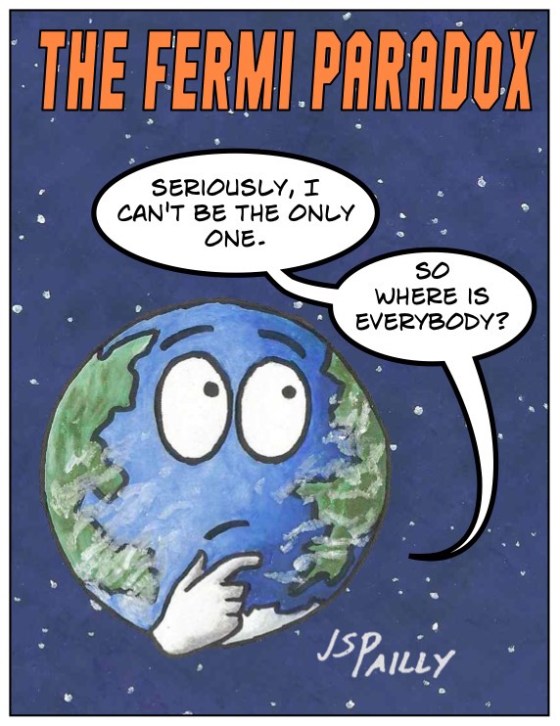
THE FERMI PARADOX
The birth of the Fermi Paradox is, perhaps, one of the most poorly documented scientific events in recent history. Nuclear physicist Enrico Fermi did not present his famous paradox at some scientific symposium or write it up for some academic journal. No, the whole thing started (apparently) with a comment Fermi made half-jokingly over lunch.
I normally draw all the illustrations on this blog, but I’m making an exception today. In 1950, New York City was suffering an epidemic of disappearing garbage cans. No one could figure out where the city’s garbage cans were going or who was taking them, so the New Yorker published this cartoon offering one possible explanation:

According to the historical narrative reconstructed in this report, that summer (or sometime thereabout) Fermi was visiting the Los Alamos National Laboratory in New Mexico. He and a bunch of old friends from the Manhattan Project had seen that cartoon and were joking about extraterrestrial life over lunch.
As the conversation progressed, Fermi suddenly, almost out of the blue, said these fateful words: “But where is everybody?” He then proceeded to lay out the fundamental problem that is now known as the Fermi Paradox.
In short, our galaxy is old—over ten billion years old by most estimations. Earth is less than half that age, and our civilization—why, we’ve been around for barely a blink of an eye on the cosmic scale. If civilizations like ours can pop up so suddenly, so abruptly, then over the last ten billion years advanced civilizations should have filled up the whole galaxy. The aliens should be everywhere, and yet we can’t seem to find any evidence of their existence.
So where is everybody?
Many answers to that question have been proposed over the years. Fermi and company are said to have run through most of them that day while they finished up their lunch.
- Maybe Earth is part of a galactic nature preserve, or maybe intergalactic law forbids anyone from making contact with “primitive” cultures like our own.
- Maybe Earth is out in the boondocks of the galaxy, far, far away from where all the aliens like to hang out.
- Maybe interstellar travel is harder than we think, and so all the alien civilizations tend to keep to themselves and never leave their home planets or home solar systems.
- Maybe intelligent life has an innate tendency to destroy itself.
That last one is a sobering thought, especially when you remember that these were the people who worked on the Manhattan Project!
Personally, I kind of like the notion that we’re part of a nature preserve. I have no scientific justification for thinking that; I just find it comforting to suppose that maybe the aliens do know about us and think we’re worth preserving. But what do you think the solution to the Fermi Paradox might be? Let me know in the comments!
Next time on Sciency Words: A to Z, why is Earth “just right” for life?
Correction/Clarification: After reading some of the responses to this post, I think I may have been a little too flippant about the galactic nature preserve thing. I think that’s a cool idea, and I think it’s a fun thing to think about. But there is absolutely no scientific evidence to support that hypothesis at this point, and I do not actually take the idea seriously. I should have been clearer about that.
 Planet Pailly