#IWSG: Dreams vs. Passions

I’ve known people who chased a dream and made themselves miserable in the process.  When they finally gave up on that dream, it was a relief—both for them and for all the people in their lives who loved them.  I sometimes wonder if I should follow their example.  On rough writing days (or rough writing weeks, months, years…), I sometimes wonder if I ought to give up on my writing dreams.

Except writing is not a dream for me.  It’s a passion.  Let me explain.  For the purposes of this blog post, I’m going to define a dream as an end goal that you really, really want.  As an example, I really, really want to go to space.  I think that would be an amazing experience!  But I’ve read enough astronaut autobiographies to know that I do not want to do all the hard work it takes to get myself to space.  Chasing that dream would make me absolutely miserable (miserable enough that I’d probably fail the psych tests and be disqualified from spaceflight, anyway).

But writing?  Writing is a passion.  What I mean by that is that I am excited about the work itself, not the end goal.  Getting my stories published would be nice.  Winning lots of awards and making lots of money would be cool.  Knowing that complete strangers are reading and enjoying my work would be great!  But none of that motivates me to sit down and do my writing day after day.  The process of putting words down on paper—that, in and of itself, makes me happy.  Even if I never get published, even if no one ever reads my stories, even if I never get any recognition or accolades at all… I still want to do my writing.

Dreams still matter.  They tell you something about who you are.  My dream of going to space gives me a pretty big hint as to what I should write about.  But it is absolutely okay to give up on a dream.  Just don’t give up on your passions.
Today’s post is part of the Insecure Writer’s Support Group, a blog hop created by Alex J. Cavanaugh and co-hosted this month by Janet Alcorn, T. Powell Coltrin, Natalie Aguirre, and Pat Garcia.  If you’re a writer and if you feel insecure about your writing life, click here to learn more about this amazingly supportive group and to see a list of participating blogs.

#IWSG: In Defense of Escapism

Hello, friends!

I’ve been told by several people that I should read The Handmaid’s Tale.  I love science fiction.  The Handmaid’s Tale is science fiction, and it’s really good science fiction—the kind of science fiction that may pretend to be about the future, but it’s really talking about the world we live in today.  All of that, I’m sure, is true, but I’m not going to read The Handmaid’s Tale.  Not any time soon, at least.  Based on everything I’ve read and heard about it, it sounds to me like that book is just too real right now.

“Escapism” is a dirty word, at least to some people.  And I have to admit: if you dive too deep down that rabbit hole, if you spend too much time hiding within a fictional world, if you avoid dealing with the realities of life for too long… yeah, that’s not healthy.  But dealing with reality can be a lot.  It’s okay to take breaks.  It’s okay to escape into a fantasy world for a little while.  Sometimes, that’s what people need.

For those of you who don’t know this about me, I cannot avoid watching the news.  I work in the news business.  That’s my day job.  And I am proud of the work I do.  There are things the public needs to know, that the public deserves to know, and I help make sure the public has access to that information.  But as you might imagine, working in news can be depressing (especially these last few years).  So when I have time to read or time to write, I really just need a break from reality.  Not a reminder.  A break.

None of this is to say that The Handmaid’s Tale is a bad book.  I mean, even if it is a bad book, how would I know?  I’ve never read it!  My point is that all books have their value—the serious books and the unserious books alike.  There ought to be no shame in reading (or writing) what some might label as “escapist fiction.”

A sappy, trashy romance?  A convoluted who-done-it murder mystery?  A pew-pew laser gun Sci-Fi adventure (with dinosaurs)?  Somebody out there really needs a book like that right now.  So if you’re inclined to write anything along those lines, go write it.  You’ll be making life a little bit better for someone.

The Insecure Writer’s Support Group is a blog hop created by Alex J. Cavanaugh and co-hosted this month by Kristina Kelly, Miffie Seideman, Jean Davis, and Liza @ Middle Passages.  If you’re a writer and if you feel in any way insecure about your writing life, click here to learn more about this awesomely supportive group and to see a list of participating blogs!

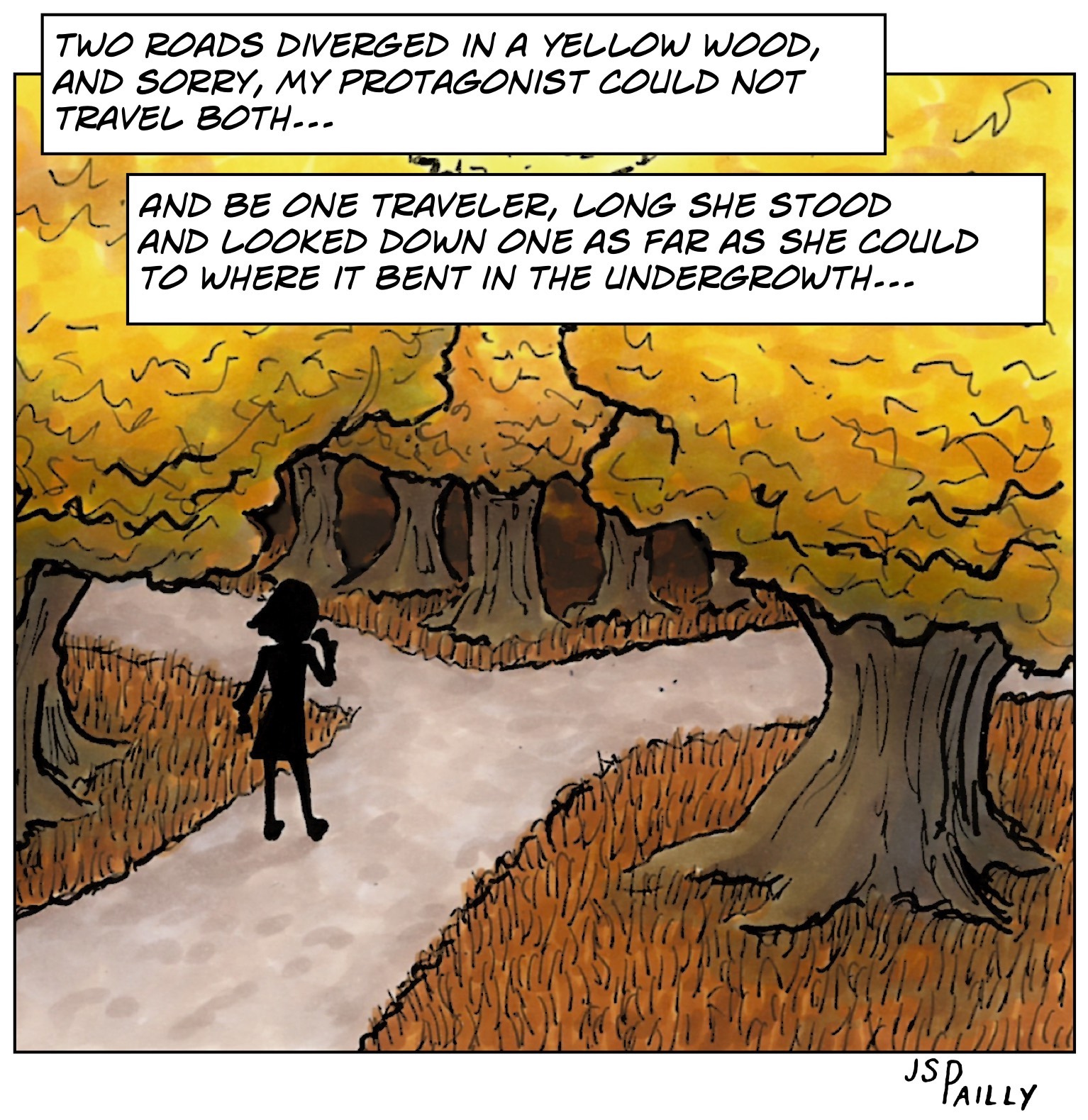
#IWSG: When Two Roads Diverge…

Hello, friends!  Welcome to this month’s meeting of the Insecure Writer’s Support Group.  This month, I am still slowly getting back into the rhythm of writing.  It’s happening more slowly than I expected and more slowly than I would have wanted, but it is still happening.  And right now, all of my writing related thoughts can be summed up in a single word: choice.

Not the creative choices I make as a writer, but rather the choices my characters have to make.  The choices I am forcing them to make.  The kind of choices that my characters would, quite honestly, prefer not to make at all, if they could help it.

I’ve read many stories where characters have to choose between two things, but the two things are not really equal.  Like, Mr. McHero must choose between spending time with his children or saving the world from a nuclear holocaust.  I mean… yes, it sucks that Mr. McHero doesn’t get to spend more time with his kids, but if there’s a nuclear holocaust, he won’t get to spend much time with his kids anyway.  There isn’t a real choice here.  If Mr. McHero is the only person who can stop the nuclear holocaust from happening, he needs to go do that.

I’ve also read stories where story events make a difficult choice become an easy choice.  For example, Sally Romance has to choose between two equally attractive male suitors.  But then it turns out that one of those suitors murdered Sally’s grandfather, and he’s only interested in marrying Sally because he’s after the inheritance money.  So who will Sally choose?  There isn’t a real choice to be made anymore!

Stories like Sally Romance’s story or Mr. McHero’s story can be fun and interesting in their own ways, but that’s not the direction I want to go with the story I’m currently writing.  My protagonist is in a bit of trouble.  He doesn’t want to admit that he’s in trouble, but it’s true.  Sooner or later, my protagonist is going to have to make a decision.  Whatever decision my protagonist makes, it will have consequences, and he’d really rather not think about that.  He’d rather pretend the problem isn’t there.  Or, if he must make a decision, he’d like it if somebody or something would intervene and make the decision easy.

As the author, I will not make this decision easy for my protagonist.  I hate to see my protagonist suffer.  I hate to prolong his suffering.  But I will allow my protagonist’s decision making process drag out for the entire length of the book, because that is what’s right for this book.


The Insecure Writer’s Support Group is a blog hop created by Alex J. Cavanaugh and co-hosted this month by Janet Alcorn, SE White, Victoria Marie Lees, and Cathrina Constantine.  If you’re a writer and if you feel in any way insecure about your writing life, click here to learn more about this awesomely supportive group and to see a list of participating blogs!

#IWSG: One Thing at a Time

Hello, friends!  Welcome to this month’s meeting of the Insecure Writer’s Support Group, a blog hop created by Alex J. Cavanaugh and co-hosted this month by Joylene Nowell Butler, Olga Godim, Diedre Knight, and Natalie Aguirre.  If you’re a writer and if you feel insecure about your writing life, click here to learn more about this awesomely supportive group!

I felt unsatisfied by my writing last year.  I haven’t felt properly satisfied in my writing life for several years now.  There were extenuating circumstances.  One personal disaster after another.  Finding time to write was difficult.  But 2024 will be different.  That’s more than a vain hope; I have good reason to believe that this year will, in fact, be different, and so I feel confident in making the following New Year’s resolution: I resolve to get back to writing—to get back to writing like I used to write!

To do that, there are some old writing lessons that I need to relearn.  The first problem I’ve encountered is the temptation of info-dumping.  I’m sure we’ve all come across books like the book pictured below, especially those of us who read fantasy and science fiction.

As a Sci-Fi writer, I’ve developed a vast and complicated new universe for my fiction.  This vast and complicated new universe includes new science, new technology, new political institutions, new economic systems, new environmental hazards, new cultural norms, new fashions of clothes, new styles of art and literature and music—and it really seems like I ought to explain all these new things to my readers before I can expect them to understand what’s going to happen in my story… right?

But I don’t.  I have to keep reminding myself that I don’t have to explain everything up front.  The Hobbit didn’t explain everything up front.  Neither did Dune, and neither did the first Star Wars movie.  Next time you watch Star Wars: A New Hope, take note of how long the movie waits to tell you about the Jedi and the Force.

So as I try to get back to writing like I used to, I’m setting a new rule for myself: explain only one thing at a time.  Just one thing.  Yes, there’s a vast and complicated universe out there that my readers will need to learn about eventually.  But all of that can wait.  The socio-political stuff can wait.  The extraterrestrial biology stuff can wait.  The fashion choices of the future can wait.

Right now, in whatever scene I’m currently writing, I’m only allowed to explain one thing to my readers.  Just one thing.  So what will it be?  What is the one thing—the one and only thing—that my readers need to know about at this point in the story?  Asking myself that question will, hopefully, stop me from info-dumping for 400 pages before my story even begins.

P.S.: It’s the sigma oscillation device.  In the scene I’m currently writing, the one thing I need to explain to my readers is what the heck a sigma oscillation device is.

#IWSG: Illogical Tactics

Hello, friends!  Welcome to this month’s meeting of the Insecure Writer’s Support Group, a blog hop created by Alex J. Cavanaugh and co-hosted this month by C. Lee McKenzie, JQ Rose, Jennifer Lane, and Jacqui Murray.  If you’re a writer and if you feel insecure about your writing life, click here to learn more about this wonderfully supportive group.

If you know anything about me, you know I love a good Star Trek quote.  This year, Star Trek: Lower Decks delivered one of my new, all time favorites: “Illogical tactics can sometimes lead to logical solutions.”  As a Trekkie, I’m delighted by how Vulcan and simultaneously un-Vulcan that statement is.  But as a writer, I’m even more delighted by that quote because it sums up a core truth of writing, a truth that I have struggled for years to put into words.

Whether it’s a novel or a short story or a quick blog post, there is always a certain logic to any finished piece of writing.  There’s the logic of grammar.  There’s the logic of pace and rhythm.  There’s the logic of an argument being made in an essay (or a blog post), and there’s the logic of plot, setting, characterization, etc. in any work of fiction.  Yes, there’s always some sort of logic to a written work, but the process of creating that written work may involve a great deal of illogical tactics.

One of my favorite cures for writer’s block is alphabet soup.  Literally, I eat a bowl of alphabet soup.  Something about shoveling spoonfuls of letters into my mouth makes me feel like I’m replenishing my writing ability.  Logically speaking, this shouldn’t work.  But it does.

I changed my hair color this year.  I have blue hair now (or green hair, depending on the light).  Why did I do this?  I don’t know.  It’s something I always wanted to do, but until this year I wasn’t brave enough to actually do it.  I did not expect that to help me with my writing, but somehow it did.  Maybe being brave enough to experiment with my hair color made me brave enough to experiment more in my writing.  Or maybe this has helped me tap into some deep inner truth about myself.  As my muse said when I first got my hair done: “It was always blue on the inside.”  Or maybe I just like my new hair.  Maybe just doing something that makes me happy leads to happier, more productive writing sessions.  I don’t know why it helped.  I just know that it did.

I mentioned my muse.  I talk to her regularly.  Every day, in fact.  Multiple times a day.  We talk about writing, and we talk about things that are not writing.  I try to pretend that she is a real flesh and blood person, and as much as possible, I treat her accordingly.  Is that weird?  Yes.  Even my muse thinks it’s a little weird sometimes.

The important thing is it works.  When I talk to my muse regularly, she gives me good writing advice (and sometimes she gives me good advice about other things, too).

A written work is a logical work.  A written work must, by necessity, have a certain logic to it.  But the process of creating a written work is chaotic, messy, and strange.  The process is not always logical.  It may involve all sorts of weird and wacky tricks, peculiar superstitions, and quirky secret techniques (for example, the technique I used to write this blog post… it was weird, it was quirky, and it is my little secret—I’ll never tell!).  Whatever works works.

So friends, what are some of the illogical tactics you use in your writing process?

#IWSG: To Be a Writer…

Hello, friends!  Welcome to this month’s meeting of the Insecure Writer’s Support Group, a blog hop created by Alex J. Cavanaugh and co-hosted this month by PJ Colando, Jean Davis, Lisa Buie Collard, and Diedre Knight.  If you’re a writer, and if you feel insecure about your writing life, click here to learn more about this amazingly supportive group.

I didn’t do any blogging last month (aside from last month’s IWSG post, of course).  I didn’t work on my current WIP either.  I didn’t make any real writing progress last month, now that I’m thinking about it, but that’s okay.  There’s more to being a writer than writing.

To be a writer, you need to live a rich and fulfilling life.  Experience the joy and beauty of the world, but don’t ignore the ugliness or the cruelty.  As a writer, you need to recognize the ugliness and cruelty of the world even as you celebrate the beauty and the joy.

To be a writer, you need to take risks.  You need to try new things, even if they’re stupid things.  You need to embarrass yourself.  Allow yourself to make mistakes.  Big mistakes, sometimes.  It would be nice if we writers could learn everything we need to know the easy way (by reading about it in our favorite books).  But we can’t.  Some lessons can only be learned the hard way.

And after every success and every failure, you need to take the time to feel your feelings, no matter what those feelings might be.  Laugh at yourself.  Cry.  Start plotting your revenge.  Doesn’t matter if these thoughts and feelings are rational or irrational.  You need to feel them.  To be a writer, you need to understand the human condition, and the only way to do that is to experience it in full for yourself.

Meet new people.  Meet people who are just like you.  Meet people who are totally different (or who seem to be totally different at first).  Get to know them.  Try to understand their goals, their passions, their challenges.  And if these people happen to open up to you, try to understand their fears and regrets.  Don’t judge.  Never be judgmental.  To be a writer, you need to have empathy for everyone.  That is a tall order, I know, but I do mean everyone.  As we writers like to say, each villain is the hero of their own story.  Learn that lesson (and other lessons like it) in real life, by talking to real people, and your writing will improve.

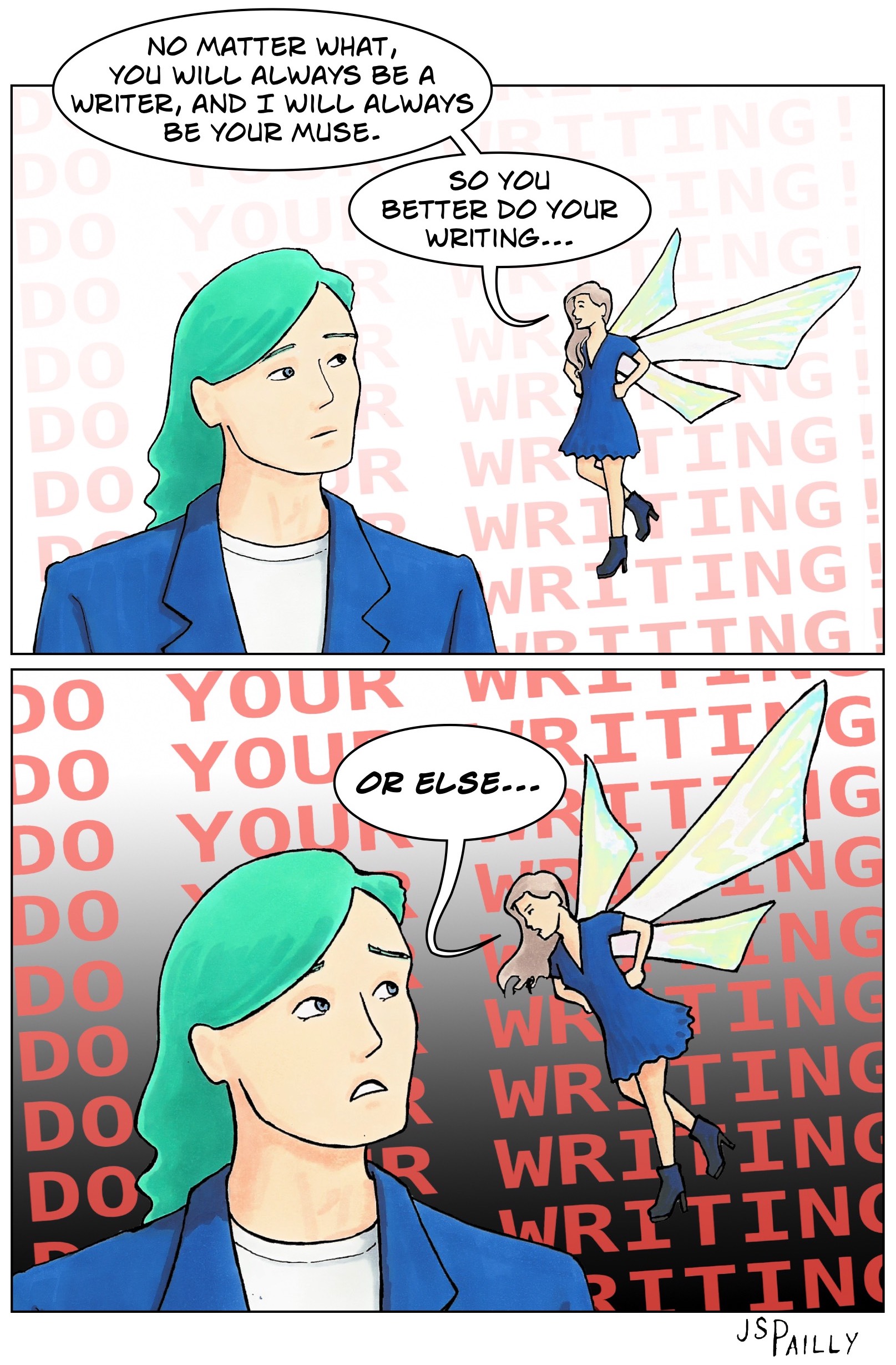
And then, once you’ve done all those things, get back to writing as soon as you can.  The muse will be patient while you’re out there living a rich and fulfilling life, leaning all these things about the world and the human condition.  But the muse can only be patient for so long.

So if you’ll excuse me, I think I better get back to writing.

#IWSG: Take an Interest in Things

Hello, friends.  Welcome to this month’s meeting of the Insecure Writer’s Support Group, a blog hop created by Alex J. Cavanaugh and co-hosted this month by Natalie Aguirre, Kim Lajevardi, Debs Carey, Gwen Gardner, Patricia Josephine, and Rebecca Douglass.  If you’re a writer and if you feel insecure about your writing life, click here to learn more about this amazingly supportive group.

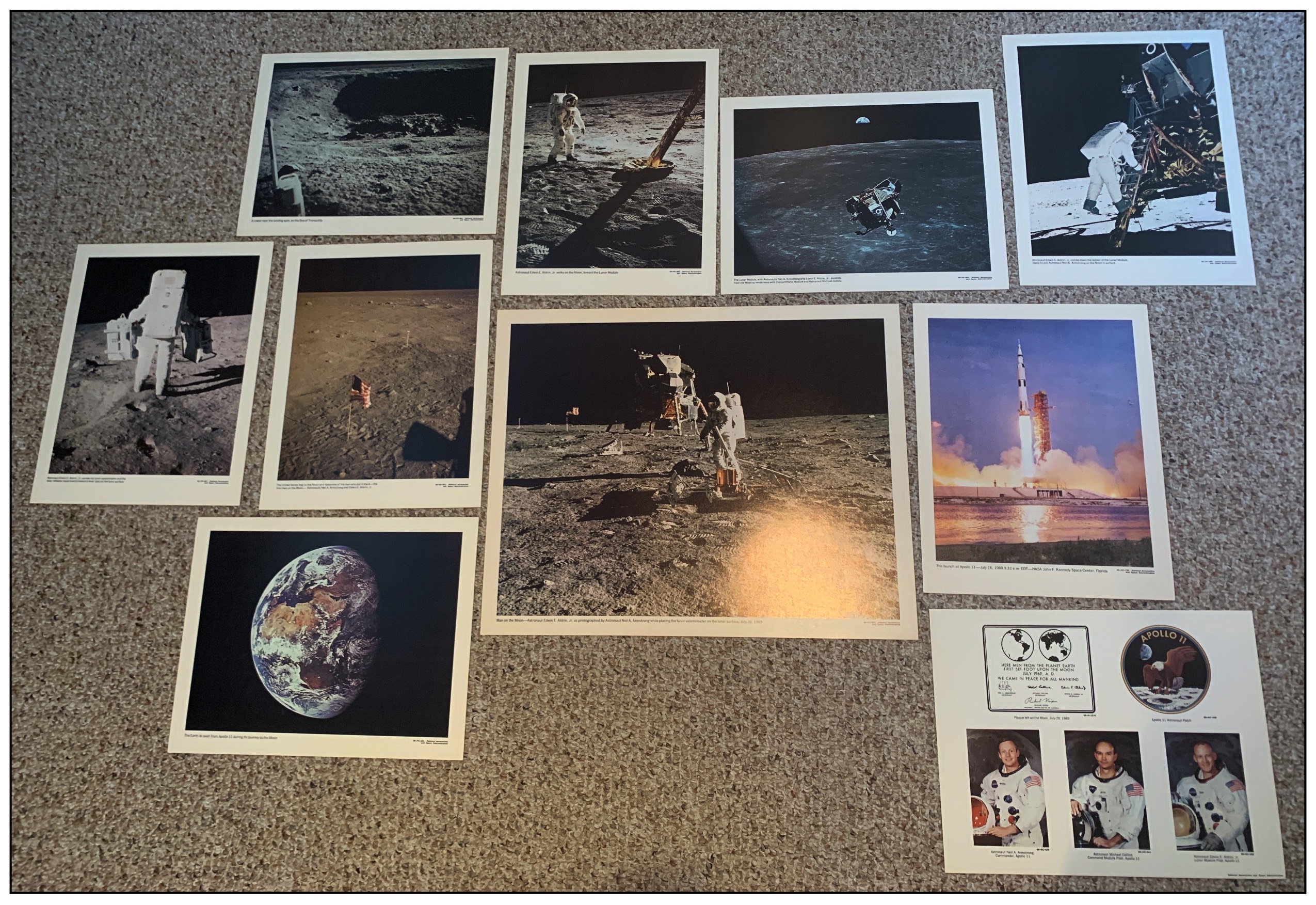
Friends, last month my grandmother passed away.  She was 103 years old.  She spent most of her professional life working for the United States Department of State, and she was peripherally involved in many of the ups and downs of the Cold War.  That is a period of time which includes the Moon Landings, and I am in proud possession of several poster-size photographs of the Apollo 11 Moon Landing which “went missing” during my grandmother’s time working for the government.

My grandmother was also an avid reader, and she encouraged me to be an avid reader, too.  At a time in my life when school really pushed the idea that only certain books counted as “real reading,” my grandmother encouraged me to read anything and everything I wanted.  She promised to buy me any book I asked for, and so, even though she didn’t personally care for science fiction, she bought me many of the Star Trek and Star Wars novels I read as a kid when I was supposed to be reading actual homework.

And in my teenage years, when I started writing my own Sci-Fi stories, my grandmother became my first editor.  She corrected my spelling and grammar, and she asked interesting questions about my characters and the weird Sci-Fi worlds they inhabited (all this, again, despite the fact that she didn’t personally care for science fiction).

My grandmother lived a fascinating life.  I don’t know all the details.  She said something to me once implying that some details of her life might actually be national secrets, and to this day I have no idea whether or not she was joking.  But I do remember, quite vividly, what she would say whenever someone asked her about her incredible life: “Oh, I just take an interest in things.”

Obviously I met other people who worked for the State Department when I was growing up.  You’d think everyone at the State Department would know a lot about the world, but they didn’t.  My grandmother was unique.  She knew more about the world than anyone else I’ve ever met, and it’s all because she just took an interest in things—all sorts of things—even things that may not have seemed like they were worth knowing about, at first glance.

So my writing advice this month is this: take an interest in things, as my grandmother did.  Take an interest in all sorts of things, even things that don’t seem particularly interesting or important, at first.  Whether you are protecting America’s foreign policy interests or writing your next awesome story, you never know what little tidbits of knowledge might end up mattering.

#IWSG: Do Your Own Research

Hello, friends!  Welcome to this month’s meeting of the Insecure Writer’s Support Group, a blog hop hosted by Alex J. Cavanaugh and co-hosted this month by Sonia Dogra, J Lenni Dorner, Pat Garcia, Sarah – The Faux Fountain Pen, and Meka James.  To learn more about this amazingly supportive group and to see a list of participating blogs, click here.

I write a blog about outer space, which means I sometimes attract the ire of Flat Earthers, Moon Landing deniers, and other “free thinking” people.  One especially self-righteous commenter once admonished me for believing all of NASA’s lies and then said the classic line: “Do your own research!”  If I had been drinking tea at that moment, I would have spit my tea out laughing.  Do my own research?  That’s my whole shtick!  That’s basically my mission statement on this blog.  I’m a Sci-Fi writer, and I blog about my research.

So for today’s IWSG post, I’d like to share some tips and tricks to help any other writers who want to do their own research.  Some of this may seem to be specific to researching science, but there are general principles that I think you can adapt to any kind of research you might need to do.

First of all, start by learning the vocabulary.  Every field of study (scientific or otherwise) has its own unique jargon.  When I first started doing my science research, someone told me (rather sternly) that just knowing a bunch of science jargon is not the same as actually understanding science.  That’s certainly true; however, if you learn the jargon first, the rest of your research will be considerably easier.  You’ll know what terms to search for on Google (or better yet, Google Scholar).  You won’t have to stop so often during your research to look up words.  And if the opportunity comes up, you’ll be able to ask more intelligent questions and have more productive conversations with people who actually work in whatever field you’re researching.

Next, if you end up reading more technical (i.e., more confusing) books, articles, research papers, etc., then I recommend reading the end first.  Don’t worry about spoilers.  Not when you’re doing research.  So for example, whenever I read a scientific research paper, I’ll skip to the end and read the section titled “Conclusions” first (or sometimes that section is titled “Discussion”); then I’ll go back to the beginning and read the whole paper.  I find it’s a lot easier to follow along, step by step, how a new discovery was made if I already understand, in some detail, what the discovery is.

And lastly, after you learn a new thing, I recommend trying to explain whatever you’ve learned in your own words.  The act of putting something into your own words is a clever brain hack that will increase the odds of you retaining that new knowledge long term.  This process can also help you identify gaps in your knowledge where you still need to do more research.  One option: you could simply talk to a friend about whatever you’re researching.  Or you can write a research diary.  Or you could do what I do and blog about your research (although I recently started keeping a research diary as well, because if I don’t feel confident that I understand something, then I don’t want to spread my own misconceptions to others on the Internet).

All of that may sound like a lot of work.  That’s because it is a lot of work.  Doing your own research is a lot of work.  I wish more people on the Internet understood that.  However, if you’re willing and able to commit the time and energy to doing it right, doing your own research can do you a lot of good—especially if you’re a writer.

So if you’re a writer looking to dive into your own research, I hope something I’ve said here was helpful to you.  And if you’re someone who’s been doing your own research for a while now, I’d love to hear about how your research process works in the comments below.

This is a #IWSG Post about U.F.O.s

Hello, friends!  Welcome to this month’s meeting of the Insecure Writer’s Support Group, a blog hop created by Alex J. Cavanaugh and co-hosted this month by Kate Larkindale, Diane Burton, Janet Alcorn, and Shannon Lawrence.  To learn more about this amazingly supportive group, click here.

As you’ve probably heard by now, the U.S. Congress recently held hearings about Unidentified Aerial Phenomena (U.A.P.s), which are more commonly known as Unidentified Flying Objects (U.F.O.s).  There was some… let’s say “interesting” testimony in that hearing.  Now I don’t know if anyone will find this IWSG post relatable, even a little bit, but U.F.O.s make me feel deeply insecure about my writing.

I’ve always been obsessed with space, and there was a time in my life, long ago, when that obsession included an obsession with U.F.O.s.  I believed U.F.O.s were real.  I was convinced that aliens were here, visiting Earth, possibly studying us the way we study dolphins or gorillas.  It was only a matter of time, I thought, before the truth finally came out.  Many times, I’d see something on the news or read something on the Internet that would get my hopes up.  Every single time, my hopes would be disappointed.

Today, I am much more skeptical.  Admittedly, a congressional hearing is a little different than previous U.F.O.-related news stories, but I’m not getting my hopes up.  Not anymore.  Maybe American pilots are seeing strange, hard to explain things in the sky, but lots of strange things happen on this planet without aliens getting involved.  At this point, unless stronger evidence is made public, I’m inclined to believe that that congressional hearing had more to do with Chinese spy balloons than anything like an extraterrestrial intelligence.

However, watching the congressional U.F.O. hearing did trigger this weird insecurity of mine, as a Sci-Fi writer.  What if, at some point in the near future, we do discover alien life?  The moment probably won’t involve a flying saucer landing on the White House lawn.  More likely, it’ll be the detection of weird gases in the atmosphere of some distant exoplanet, or maybe we’ll find a suspicious mix of amino acids on one of Jupiter’s moons, or perhaps (if we’re really lucky) we’ll find fossils buried in the strata of Mars.

As a space enthusiast, I’m eager for the discovery of alien life; but as a Sci-Fi writer, I’m dreading the day a discovery like that is announced.  Why?  Because I’ve done a lot of world building for my Sci-Fi universe.  I’ve invented multiple alien species.  I’ve put a lot of thought into where all these different species come from, how they evolved, what sort of technology they each use.  So if the day comes when we do discovery alien life, in real life, I’m dreading all the rewriting and retconning I’ll probably have to do.

Anyone relate?

#IWSG: Is This Writer’s Block?

Hello, friends!  Welcome to this month’s meeting of the Insecure Writer’s Support Group, a blog hop created by Alex J. Cavanaugh and co-hosted this month by PJ Colando, Kim Lajevardi, Gwen Gardner, Pat Garcia, and Natalie Aguirre.  To learn more about this group and to see a list of participating blogs, click here!

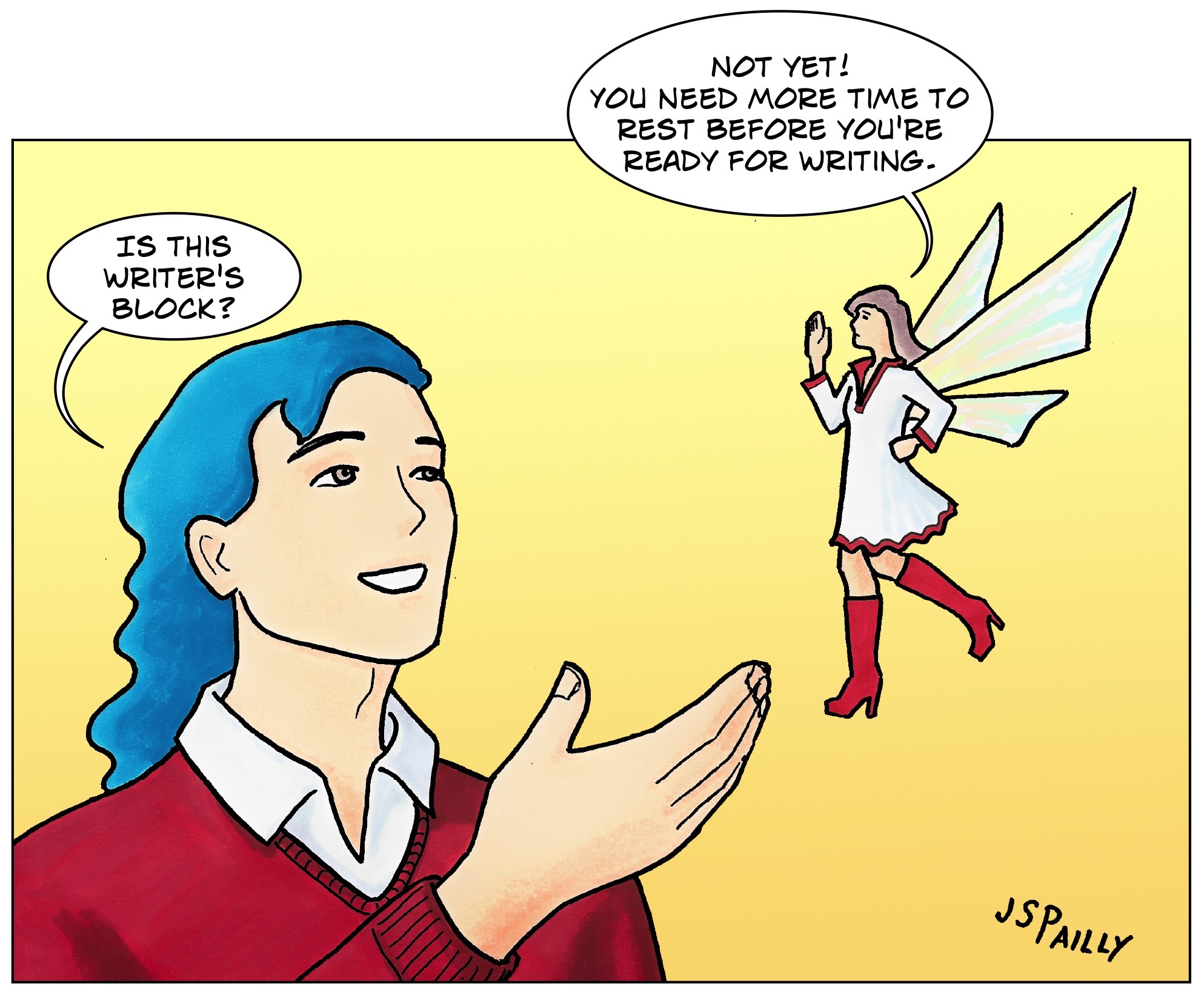
Last month, I wrote a post about how very ready I was to get back to writing.  I had big plans.  Big hopes and dreams.  Due to circumstances beyond my control, I’d been on a bit of a creative dry spell, but as soon as those circumstances stopped being so totally out of control, I was eager to get back to writing.  And then… nothing.  My muse, it seemed, was not going to help me.

When I first started transitioning from writing as a hobby to writing as a job, I got some sage advice from a more experienced writer friend: however long you think it will take to do something, double it.  That’s how long it will actually take.  I have found that rule of thumb holds up well.  On a few occasions, I’ve taken on a project that turned out to be easier and quicker than expected.  But that’s rare.  In most cases, things really do take twice as long as I expect them to—sometimes more than twice as long.

And that rule of thumb extends to recovery time as well.  I don’t have writer’s block.  I just need rest (and my muse knows it).  So instead of writing, I’ve been recharging my creative batteries.  I’ve been re-reading favorite books and re-watching favorite movies.  I’ve been trying to reconnect with the stories that made me want to be a writer in the first place.

So recovery is taking a little longer than I expected, and that shouldn’t be a surprise.  I still have big plans.  I still have big hopes and dreams.  They’ll just have to wait a little bit longer.