Hello, friends! Welcome to Sciency Words, a special series here on Planet Pailly where we talk about the definitions and etymologies of scientific names and terms. In today’s episode of Sciency Words, we’re talking about:
HYDROGEN
I want to start this with a personal story. Imagine me, twenty years ago, fresh out of college with a degree in television and film production. One of my first jobs was working for a company that made educational cartoons for children. At one point, I ended up being assigned to a two minute animated music video about water. The name of the video: “Water Can Never Be New.”
Now I’m no scientist. I cannot call myself an expert (I’m just very enthusiastic about this subject). And twenty years ago, I was even less of an expert than I am today. Still, even way back then, I had a nagging suspicion that this “Water Can Never Be New” video was a lie. Which brings me to the subject of today’s post: hydrogen.
Definition of hydrogen: Hydrogen is the very first element on the periodic table of elements. Typically, hydrogen atoms consist of one proton orbited by one electron. Molecular hydrogen consists of two hydrogen atoms bonded to each other. Under Earth-like temperatures and Earth-like atmospheric pressure, hydrogen is a gas. It’s also rather rare here on Earth; elsewhere in the universe, it’s extremely common. In fact, hydrogen is by far the most common, most abundant chemical element in the universe.
Etymology of hydrogen: Hydrogen was first discovered in 1671 by British natural philosopher Robert Boyle. Boyle referred to this new kind of air he discovered as “inflammable air,” because of how easily he could light it on fire. Over a century later, French chemist Antoine Lavoisier found that burning “inflammable air” somehow produced water vapor as a byproduct. Thus, Lavoisier changed the name of “inflammable air” to hydrogen, from two Greek words meaning “water” and “creation.”
It’s hard to imagine today just how much the discovery of hydrogen must have rocked the world of science (a.k.a. natural philosophy) back in the 17th and 18th Centuries. Up until that point, the Aristotelian view of world had prevailed. According to Aristotle, four elements—fire, earth, air, and water—were the fundamental building blocks of nature. Then Robert Boyle comes along with a new kind of air (can we really call air a fundamental element if there are different kinds of it?), and Lavoisier subsequently demonstrates that you can use this new kind of air to make water (is water really a fundamental element if you can make it out of other stuff?).
Today, we know more about what happens when you light hydrogen gas on fire. The heat energy from the flame causes hydrogen to react with oxygen, producing H2O molecules. Water, in other words. New water. And, in fact, many chemical reactions involving hydrogen and oxygen-containing compounds will produce water molecules as a byproduct. Due to the energy involved in these reactions, this new water may be too hot to form a liquid, but water vapor is still water (and it will condense into a liquid eventually, once it has time to cool off).
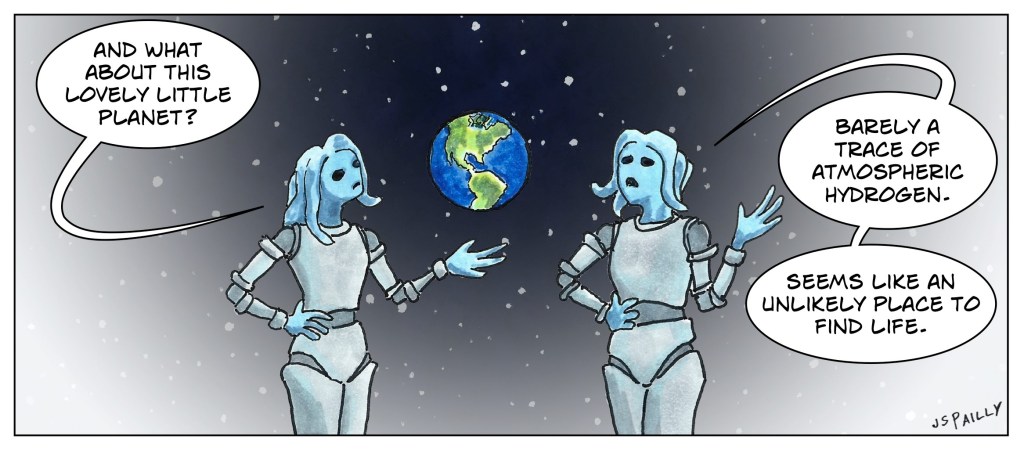
Of course, hydrogen does much more than help make new water molecules. Hydrogen is the fuel that keeps the Sun shining. It’s a necessary component in the organic compounds that make life as we know it possible, and hydrogen ions play an important role in acid-base chemistry (not counting Lewis acids and bases). Given the wide variety of jobs that hydrogen does, you may wonder why we stick to using a name that means, simply, “water generator.”
But the discovery of hydrogen and its water generating ability helped upend some deeply entrenched and woefully inaccurate scientific ideas. The name seems appropriate to me as a way to honor that moment in the history of science when the old Aristotelian view of nature really started to crumble. It’s a shame more people don’t know about this story. Maybe somebody should make an educational cartoon for children about it.
 Planet Pailly