Mercury A to Z: q

Hello, friends!  Welcome back to the A to Z Challenge.  My theme for this year’s challenge is the planet Mercury, and in today’s post Q is for:

q

Today, I’m going to expand a little on something we already talked about in a previous post.  Back in the late 1800’s, Italian astronomer Giovanni Schiaparelli made a bold effort to observe and characterize the planet Mercury.  He saw several prominent surface features (or at least he thought he saw them), and he determined that Mercury has a rotation period that is approximately 88 Earth days long (we now know this is incorrect).  So what happened?  Where did Schiaparelli go wrong?

In a previous post, I told you about Schiaparelli’s five.  When he looked in his telescope, he kept seeing a surface feature on Mercury that looked like a gigantic numeral five.  Looking at photographs of Mercury today, most people can’t find Schiaparelli’s five, and it’s really unclear what the heck Schiaparelli was looking at.

Specifically, Schiaparelli saw (or thought he saw) this gigantic five whenever Mercury happened to be east of the Sun, as seen in Earth’s sky.  And whenever Mercury appeared west of the Sun, as viewed from Earth, Schiaparelli saw (or thought he saw) a different large surface feature.  On his hand drawn maps on Mercury, Schiaparelli labeled this other large surface feature “q” (always lower case).

Unlike Schiaparelli’s five, which supposedly looked like the number five, q did not look like the letter q.  In Schiaparelli’s drawings of q, it reminds me a little of that Æ symbol (the combination of A and E) that you sometimes see in fantasy novels, very old English literature, and a few modern languages like Icelandic or Norwegian.  I’m not sure why this Æ feature got named q, but Schiaparelli labeled several other surface features on Mercury with lower case letters, so there must have been some method to his madness.

The important thing is that the five and q appeared, consistently, when Mercury reached certain points in his orbital path—either east of the Sun for the five or west of the Sun for q, as viewed from Earth.  Or at least they appeared consistently whenever Schiaparelli went looking for them.

The surface of Mercury is covered in light and dark splotches, making it a bit like a Rorschach test.  You see whatever your brain wants to see in those light and dark patterns.  I have tried my best to match Schiaparelli’s hand drawn maps to actual photos of Mercury.  I can kind of see the five, some of the time, but it takes a little squinting and a lot of imagination to make things line up right. I cannot find q, no matter how hard I try.

But Schiaparelli wasn’t too far off to believe he was seeing the same surface features time and again, whenever Mercury reached specific points in his orbital path.  Schiaparelli was only half wrong about that.  Exactly half wrong, in a sense.  I will try to explain what I mean by that in tomorrow’s post.

WANT TO LEARN MORE?

For this third time this month, I’d like to recommend Mercury, by William Sheehan.  It’s part of the Kosmos series, published by Reaktion Books, and it includes a lengthy and fascinating discussion of Schiaparelli and his sightings of five and q on Mercury.

Mercury A to Z: Five

Hello, friends!  Welcome back to the A to Z Challenge.  For this year’s challenge, my theme is the planet Mercury, and in today’s post F is for:

FIVE

Today’s post is really an important life lesson: you can’t always trust your own eyes.  Your eyes will play tricks on you, and they may cause you to make some pretty embarrassing mistakes.  Back in the late 1800’s, Italian astronomer Giovanni Schiaparelli’s eyes played a trick on him, causing him to miscalculate Mercury’s rotation rate.

We touched on this briefly in a previous post.  Based on telescopic observations of Mercury, Schiaparelli determined that Mercury has a rotation rate of approximately 88 Earth days.  This matches nicely with Mercury’s orbital period, which is also about 88 Earth days long.  If Schiaparelli’s calculations were correct, this would mean that Mercury is tidally locked to the Sun.  The same thing happened to Earth’s Moon.  The Moon’s rotation rate and orbital period are both approximately 27 Earth days long, which is why the same side of the Moon always faces toward the Earth.

But Schiaparelli’s calculations were not correct.  We now know that Mercury’s true rotation rate is about 59 Earth days, not 88.  So how did Schiaparelli, an otherwise highly competent and highly accomplished astronomer, get this so wrong?  It’s because when he started his observing campaign of Mercury, he noticed a pattern of splotches on Mercury’s surface that kind of looked like the number five.  And as he continued his observations, he kept seeing this splotchy five shape on Mercury’s surface.

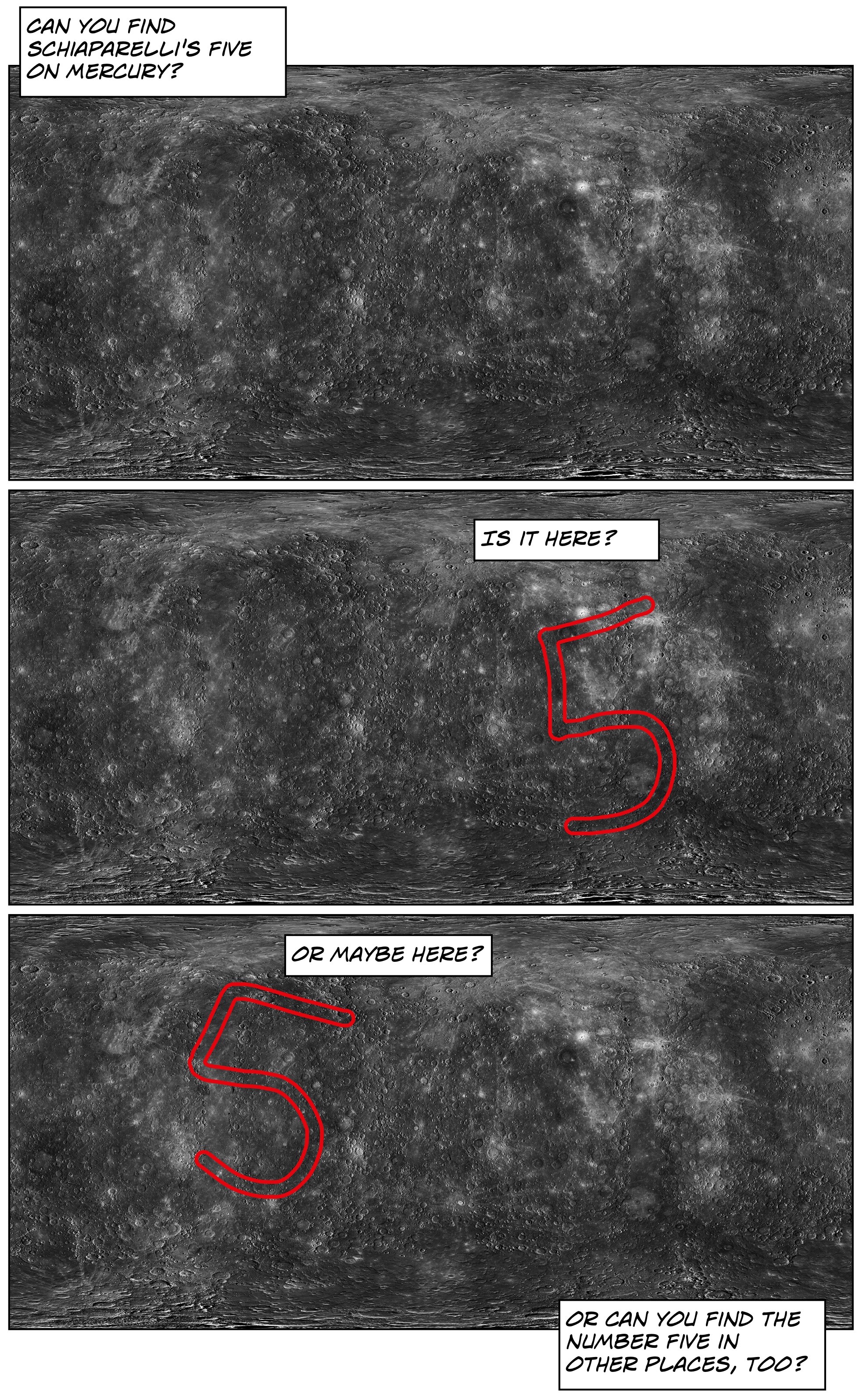
The thing is, if you stare long enough and hard enough at the surface of Mercury, you can probably find the number five in several different places.  I’d normally include one of my own drawings here, but in this case I think you really need to see an actual map of Mercury.

Map of the surface of Mercury, reproduced three times, with outlines showing locations where Giovanni Schiaparelli's figure of five might be.
Original map from NASA, public domain image.

A bit of confirmation bias was probably at work.  After seeing a five on Mercury the first few times he looked, Schiaparelli had an expectation.  He expected to see the five again, and every time he did find a five on Mercury, Schiaparelli assumed it was the same five.  To make matters worse, Schiaparelli also thought he could see clouds on Mercury, so whenever he saw only part of a five, he could easily deceive himself into assuming the rest of the five must be hidden under cloud cover.

As a result, Schiaparelli calculated Mercury’s rotation rate based on faulty observations, and he got a result that triggered a second case of confirmation bias.  Just as the Moon is very close to the Earth, Mercury is very close to the Sun, so it made sense—it fit well with Schiaparelli’s expectations—that Mercury rotation rate would match its orbital period.  It made sense, in Schiaparelli’s mind, for Mercury to be tidally locked to the Sun.

To be fair to Schiaparelli, another astronomer had previously tried to calculate Mercury’s rotation rate and gotten an answer of 24 hours (the same as Earth’s rotation rate).  So while Schiaparelli was wrong, he was, at least, less wrong than the last guy.  And that’s often the way science advances.  Science isn’t always right, but it keeps becoming less and less wrong than it was before.

WANT TO LEARN MORE?

Here’s an article from Astronomy.com about Schiaparelli’s five, and some of the other shapes he thought he saw on Mercury’s surface.

And regarding that point I made at the end, about science being less and less wrong than it was before, here’s a famous article by Isaac Asimov called “The Relativity of Wrong.”  It’s a must read for anyone who has even a passing interest in how science works.