Sciency Words: Syzygy

Hello, friends!  Welcome to Sciency Words, a special series here on Planet Pailly where we take a closer look at the definitions and etymologies of scientific terms.  Today on Sciency Words, we’re talking about the word:

SYZYGY

We’ve all seen pictures like this, with all eight planets lined up in a row:

And sometimes, on extra special occasions, the planets really do line up like that, or at least they come very close to it.  When this happens, we call it a grand syzygy.

The word syzygy traces back to ancient Greek.  It originally meant “yoked together,” as in: “The farmer yoked together his oxen before plowing the field.”  According to my trusty dictionary of classical Greek, the word could also mean “pair” or “union.”

Some closely related words in Greek referred to balance, teamwork, sexy times, etc.  And our modern English words synergy and synchronized have similar etymologies.  Basically, what all these words have in common is a sense of people or things coming together, in one manner or another.

For modern astronomers, syzygy means three or more celestial bodies coming together to form a straight line.  The most commonly cited example of this is the alignment of the Sun, Earth, and Moon that occurs during either a new moon or full moon, as observed here on Earth.

But an alignment doesn’t have to be perfectly straight to be called a syzygy, especially when we’re dealing with more than three objects.  According to this article from The New York Times, a syzygy of the Sun, Venus, Earth, Mars, Jupiter, and Saturn occured between March 25 and April 7, 1981.  The Sun and five planets came “within 2 degree of arc from a perfect straight line.”  Apparently that’s close enough.

But while that 1981 syzygy was pretty grand, it was not the grandest of grand syzygies.  The planets Mercury, Uranus, and Neptune were left out.  According to another article from The News York Times, a truly grand syzygy will happen on May 19, 2161, “[…] when eight planets (excluding Pluto) will be found within 69 degrees of each other […].”

So mark your calendars, friends!  You don’t want to miss the grand syzygy of 2161!

P.S.: And if you’re a Star Trek fan, you may recall that 2161 will be an auspicious year for another reason.  That’s the year when the United Federation of Planets will be founded—a political syzygy, one might say, occurring at the same time as an astronomical syzygy.
Sciency Words: Supermoon

Hello, friends!  Welcome to Sciency Words, a special series here on Planet Pailly where we talk about the definitions and etymologies of science or science-related terms.  Today’s Sciency Word is:

SUPERMOON

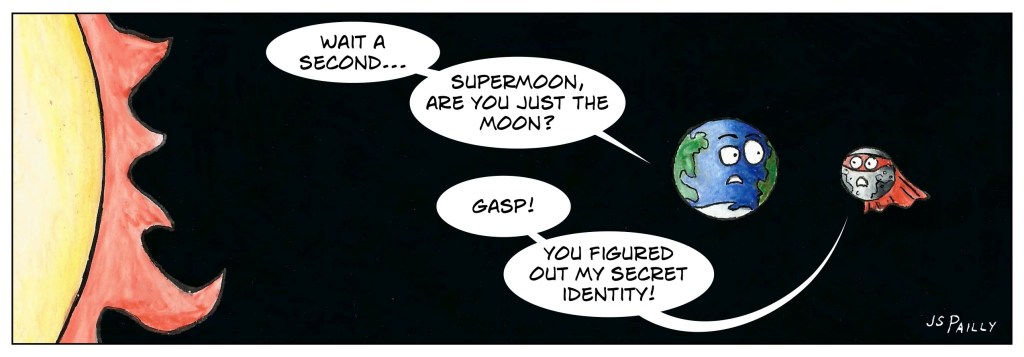
I was recently part of a comment thread over on Scott’s Sky Watch.  We were talking about the term supermoon, along with other weird moon names like wolf moon, blood moon, harvest moon, corndog moon, flower power moon, gingivitis moon… you get the idea.  After that, I thought a Sciency Words post on “supermoon” was in order.

The term supermoon was coined by American astrologer (repeat: astrologer, not astronomer) Richard Nolle.  The term first appeared in an article Nolle wrote in 1979 for Horoscope magazine.  To quote Nolle himself from this 2011 webpage article, the term supermoon describes:

[…] a new or full moon which occurs with the Moon at or near (within 90% of) its closest approach to Earth in a given orbit.  In short, Earth, Moon and Sun are in a line, with Moon in its nearest approach to Earth.

This particular alignment of the Sun, Moon, and Earth is also known as a syzygy-perigee.  Perigee means the point when as object orbiting Earth comes closest to Earth, and syzygy refers to the straight line alignment of three celestial objects.

A syzygy-perigee has a marginal effect on Earth’s tides, and if the Sun and Moon are on opposite sides of the Earth (as depicted in the highly technical diagram below), then the Moon will appear to be slightly larger and slightly brighter than normal in our night sky.  Astrologers would have more to say about supermoons, but from an astronomy perspective we’re pretty much done here.

Personally, I don’t really have a problem with the term supermoon.  When the full moon or new moon happens to be 90% closer to Earth than usual, that’s kind of neat.  Sure, the term started as an astrology thing, but there’s a long history of astrology concepts and terminology being borrowed by astronomers.  Supermoon is no different.

And supermoons do tend to get a lot of attention in the popular press.  I’ve had a lot of awesome conversations with people about the Moon and space and science in general that started because of a news report about the latest supermoon.  I think that’s great.  Anything that gets people to take an interest in science is a positive thing in my book.

On the other hand, a few of those conversations have ended with people asking me about their horoscopes, which is a bit disappointing.

Next time on Planet Pailly, please don’t hate anybody, not even the people who deserve it.

Sciency Words: The Yarkovsky Effect

Hello, friends!  Welcome to Sciency Words, a special series here on Planet Pailly where we talk about those weird and wonderful words scientists use.  Today on Sciency Words, we’re talking about:

THE YARKOVSKY EFFECT

Have you ever tried to count all the stars in the night sky?  Well, that might be an easier job than finding and tracking all the asteroids that keep whizzing by our planet.  Part of the problem is due to something called the Yarkovsky Effect.

Ivan Yarkovsky was a Polish engineer working in Russia.  He was also a huge science enthusiast.  If Yarkovsky were alive today, I imagine he’d be writing a blog about all the cool sciency research he was doing in his free time.

But it was the late 19th/early 20th Century.  Blogging wasn’t an option, so instead Yarkovsky wrote pamphlets about science, which he circulated among his science enthusiast friends. And almost fifty years after Yarkovsky’s death, an Estonian astronomer by the name of Ernst Öpik would remember reading one of those pamphlets.

Imagine an asteroid orbiting the Sun.  Sunlight causes this asteroid’s surface to get hot.  Then, as the asteroid rotates, that heat energy radiates off into space.  Would this radiating heat produce any thrust?  Would there be enough thrust to push an asteroid off its orbital trajectory?

Öpik thought so, and in 1951 he wrote this paper introducing the idea to the broader scientific community.  Today’s Sciency Words post would probably have been about the “Öpik Effect,” except Ernst Öpik was kind enough to give credit to the obscure blogger pamphlet writer who originally came up with the concept.  Thus we have the Yarkovsky Effect.

And in 2003, radar observations of the asteroid 6489 Golevka confirmed that the Yarkovsky Effect is real!  The asteroid had wandered 15 km away from its original course!

Around the same time, a copy of Ivan Yarkovsky’s original pamphlet was found in Poland.  As described in this article, it seems Yarkovsky was working on the basis of some faulty premises and a few rather unscientific assumptions.  He more or less stumbled upon the right idea by accident (but let’s not dwell on that part of the story).

Next time on Planet Pailly, no one’s going to name a scientific theory after me, but maybe there’s another sciency honor I can aspire to.

Sciency Words: Superhabitable

Hello, friends!  Welcome to Sciency Words, a special series here on Planet Pailly where we talk about the meaning and origin of scientific terms.  Today’s sciency word is:

SUPERHABITABLE

The word “habitable” traces all the way back to ancient Latin.  Think of a residence or dwelling.  Think of tenants and landlords and the act of paying rent.  That’s the sort of thing words like habitabilis, habitator, or habitatio referred to.

Of course when we talk about planets, the meaning of “habitable” and “habitability” is a bit different.  Unless…

In our ongoing search for extraterrestrial life, it’s generally assumed that Earth is typical of habitable planets.  But why should we assume that?

In this 2014 paper, physicists René Heller and John Armstrong claim that Earth is not as perfectly suited for life as it seems.  In some ways, Earth is kind of a dangerous place to live, and there have been several instances where life on Earth nearly got snuffed out.  Heller and Armstrong then go on to argue that other worlds may “offer more benign environments to life than Earth does.”

If we insist on calling Earth “habitable,” then Heller and Armstrong propose calling those other worlds “superhabitable.”  Though really, if we’d stop being so geocentric and anthropocentric in our terminology, it is the “superhabitable” planets that should set the standard for habitability, and Earth would be better described as “marginally habitable.”

So what sort of planet would offer a more benign environment for life than Earth does?  Well, according to Heller and Armstrong, planets that are two to three times as massive as Earth would do nicely.  More massive planets will remain geologically active for longer, and they’ll have stronger magnetic fields to protect life from solar and cosmic radiation.  Shallower oceans and a thicker atmosphere would help too.

A smaller and cooler star would also be preferable.  A K-type “orange dwarf” would spew out less harmful radiation than our own G-type Sun, and K-type stars last longer.  A whole lot longer.  No need to worry about the day the sun dies if your planet orbits a K-type star!

Personally, I feel like Heller and Armstrong are making a lot of big assumptions in describing their superhabitable planets.  There may be some wishful thinking at work here.  But then again, it’s also a pretty big assumption to assume that Earth is a typical example of a habitable world.  There’s probably some wishful thinking at work there too.

Next time on Planet Pailly, the nearest superhabitable planet could be a lot closer than you think (unless you clicked that link above, in which case you probably know where Heller and Armstrong said the nearest superhabitable planet might be).

Sciency Words: Barycenter

Hello, friends!  Welcome to Sciency Words, a special series here on Planet Pailly where we talk about those big, complicated words scientists use.  Today’s Sciency Word is:

BARYCENTER

Excuse me, but I’m going to do that “um, actually” thing that people who think they’re really smart like to do.  Now you may think the Earth orbits around the Sun.  Um, actually… the Earth and Sun both orbit something called the barycenter.

The word barycenter comes from two Greek words meaning “heavy” and “center,” and it refers to the common center of mass for two or more celestial bodies.  Based on sources I found via Google Ngrams, the term started appearing frequently in astronomical journals during the early 20th Century, and it may have been in use as early as the 1880’s.

Let’s say you have two celestial bodies.  One is really massive, the other is much less massive.  In that case, the barycenter will probably be located somewhere inside the more massive object.  This is the case for the Earth and her Moon.  Based on numbers I got from Wikipedia, the Earth-Moon barycenter is about 1000 miles (1700 km) beneath Earth’s surface.  Or to measure that a different way, the barycenter is about 3000 miles (4600 km) away from the center of the Earth.

Now let’s say you have two celestial bodies of roughly equal mass.  In that case, the barycenter will be located somewhere between them.  Something like this has happened with Pluto and his giant moon, Charon.  Once more using numbers from Wikipedia, it looks like the Pluto-Charon barycenter is about 500 miles (960 km) ABOVE the surface of Pluto.

As for the Earth-Sun barycenter, it’s located deep inside the Sun.  So if you say Earth orbits the Sun, you’re not too far from the truth.  But of course Earth is not the only planet in the Solar System, and when you consider the Solar System as a whole, you’ll find the Sun wibbles and wobbles about in weird, loopy patterns.  As you can see in the highly technical diagram below, the Sun wibbles and wobbles so much it can wobble into a totally new position in just a few years.

Click here for an actual diagram of the Sun’s movement relative to the Solar System’s barycenter.

As explained in this paper, this is mainly due to the gravitational influences of Jupiter and Saturn. Over longer time scales (centuries rather than decades), the subtler influences of Uranus and Neptune also have a noticeable effect.

So the next time someone tells you the Earth orbits the Sun, you can do the “um, actually” thing and explain what a barycenter is.  Trust me, it’s a great way to sound smart and make lots of new friends!

Next time on Planet Pailly, what did people in 1962 think we’d find on other planets?

Sciency Words: Love Numbers

Sciency Words: (proper noun) a special series here on Planet Pailly focusing on the definitions and etymologies of science or science-related terms.  Today’s Sciency Word is:

LOVE NUMBERS

My friends, I was recently doing research about the planet Neptune.  Astronomers have a new model for the Neptune system, a model that seems to do a better job predicting the orbits of all those unruly and rambunctious Neptunian moons.  While reading about this new model, I came across the following statement: “We also investigated sensitivity of the fit to Neptune’s Love number […].”  And that gave me a delightful mental picture:

“Love numbers” are named after English mathematician Augustus Edward Hough Love.  They’re also sometimes referred to as “Love and Shida numbers” to recognize the contribution of Japanese scientist T. Shida.

In the early 20th Century, Love introduced two ratios—traditionally represented by the variables h and kh has to do with the elasticity (stretchiness) of a planetary body, and k is related to the redistribution of mass within a planetary body as it stretches.  Shortly thereafter, Shida introduced a third ratio—represented by the variable l—involving the horizontal displacement of a planetary crust.

Taken together, h, k, and l tell you how much a planet, moon, or other celestial body can flex due to tidal forces.  As explained in this paper on Earth’s Love numbers:

If the Earth would be a completely rigid body, [its Love numbers] would be equal to zero, and there would be no tidal deformation of the surface.

But of course Earth is not a completely rigid body.  Tidal forces caused by the Sun and Moon cause Earth to flex “up to tens of centimeters,” according to that same paper.  Tens of centimeters doesn’t sound like much, but as we all know, it’s enough to keep the ocean tides going!

In conclusion, I guess you might say that what’s true for planets is also true for people.  Being completely rigid produces Love numbers equal to zero.  So be flexible.  Allow yourself to stretch a little, and your Love numbers will go up.

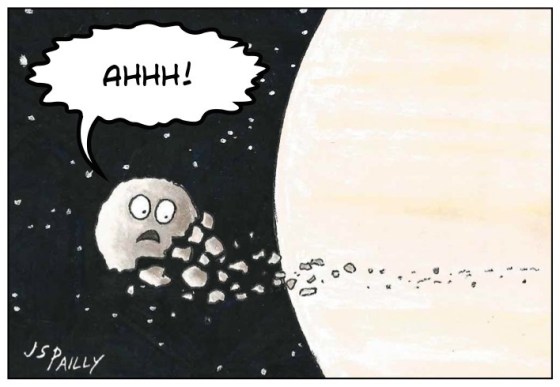
P.S.: Being flexible is healthy in any relationship, but at the same time don’t let others tug on you too hard.  Know your limits—your Roche limit, I mean—because you don’t want to end up like this:

Will the Moon Become a Ploonet?

You may have heard that the Moon is slowly moving away from the Earth.  Following up on last week’s episode of Sciency Words, does this mean the Moon will one day become a ploonet: a moon that’s escaped its original orbit and become a planet in its own right?

Currently, the Moon is receding from the Earth at a rate of approximately 4 centimeters per year.  Simultaneously, and not by coincidence, Earth’s rotation rate is slowing down.  The exact reasons for this are, I admit, too math-heavy for my artistic/writerly brain to comprehend, but it has something to do with tidal forces and the exchange of angular momentum.

As explained in this article from Universe Today:

The same tidal forces that cause tides on Earth are slowing down Earth’s rotation bit by bit.  And the Moon is continuing to drift away a few centimeters a year to compensate.

And as further explained in this article from Futurism:

As is true of many rocky relationships, the Earth and Moon only need a bit of time and space to work things out.  Ultimately, we just need to be patient.  In about 50 billion years, the Moon will stop moving away from us and settle into a nice, stable orbit.

So in the very, very, very distant future, assuming the expansion of the Sun doesn’t destroy us first, Earth and the Moon will achieve a new balance.  Earth’s day will be considerably longer, and the Moon will be considerably farther away.  Also, just as the same side of the Moon always faces the Earth, the same side of Earth will always face the Moon.

But the Moon will still be a moon.  It will not become a ploonet.

Sciency Words: Stagnant Lid

Sciency Words: (proper noun) a special series here on Planet Pailly focusing on the definitions and etymologies of science or science-related terms.  Today’s Sciency Word is:

STAGNANT LID

Here on Earth, we have earthquakes.  Lots and lots of earthquakes.  And that’s very odd.

Maybe we should be thankful for all those earthquakes.  Our planet’s system of plate tectonics is unique in the Solar System.  Frequent earthquakes are a sign that Earth’s tectonic plates are still moving, that our planet is still geologically healthy.  The alternative would be stagnant lid tectonics, and that’s something we Earthlings probably don’t want.

In this 1996 paper, planetary scientists V.S. Solomatov and L.N. Moresi coined the term “stagnant lid” to describe what was happening on Venus—or rather what was not happening.  Venus doesn’t have active plate tectonics.  Maybe she did once, long ago.  If so, Venus’s plates somehow got stuck together, forming a rigid, inflexible shell.

The term stagnant lid has since been applied to almost every other planetary body in the Solar System, with the obvious exceptions of the four gas giants, and the possible exceptions of two of Jupiter’s moons: Europa and Ganymede.

According to this paper from Geoscience Frontiers, neither Europa nor Ganymede have truly Earth-like plate tectonics, but something similar may be happening.  The authors of that paper refer to the situation on Europa and Ganymede as “fragmented lid tectonics” or “ice floe tectonics.”  The upcoming Europa Clipper and JUICE missions should tell us more about how similar or different this is to Earth’s plate tectonics.

A stagnant lid does not necessarily mean that a planet or moon is geologically dead.  Venus and Io both have active volcanoes, for example, and it was recently confirmed that Mars has marsquakes.  But none of these stagnant lid worlds seem to be as lively as Earth—and I mean that in more ways than one.

If you buy into the Rare Earth Hypothesis, plate tectonics is one of those features that makes Earth so rare. Plate tectonics is something Earth has that other planets don’t, and thus it may be an important factor in why Earth can support life when so many other worlds can’t.

Sciency Words: The Torino Scale

Sciency Words: (proper noun) a special series here on Planet Pailly focusing on the definitions and etymologies of science or science-related terms.  Today’s Sciency Word is:

THE TORINO SCALE

Are you worried about an asteroid or comet smashing into Earth and annihilating human civilization?  Well, you should be worried about that a little bit.  But only a little bit.  Let me tell you about the Torino Scale, and while that won’t put all your fears to rest, it may help put things in perspective.

In the late 1990’s, M.I.T. Professor Richard Binzel came up with a system which he initially called the Near Earth Object Hazard Index.  In 1999, Binzel presented his system to a conference on Near Earth Objects (N.E.O.s) in Torino, Italy.

People at that conference loved Binzel’s idea and voted that the system should be adopted by the scientific community at large. They also voted to rename Binzel’s system the Torino Scale.

The Torino Scale asks two questions about any given N.E.O.: how likely is it to hit us, and how much destructive energy would be released if it did?  Taking those two factors into consideration, the Torino Scale then produces a score between zero and ten.  Zero means we have nothing to worry about.  Ten means “WE’RE ALL GONNA DIE!!!  AAAHHHHHH!!!” as the experts would say.

According to Wikipedia, the comet that caused the Tunguska Event would have probably scored an eight, and the asteroid that caused the K-T Event (the event widely believed to have killed off the dinosaurs) would have scored a ten.  Wikipedia also tells me that the 2013 Chelyabinsk meteor would have scored a zero, because while that particular N.E.O. was definitely on a collision course with Earth, it’s destructive energy was relatively low (I wonder if the residents of Chelyabinsk, Russia, agree with that assessment).

As of this writing, there are no known N.E.O.s that score higher than zero on the Torino Scale, as least not according to this website from NASA’s Jet Propulsion Laboratory.  It is possible for an N.E.O.’s threat level to change as we learn more about it.  As explained in this article from NASA:

The change will result from improved measurements of the object’s orbit showing, most likely in all cases, that the object will indeed miss the Earth. Thus, the most likely outcome for a newly discovered object is that it will ultimately be re-assigned to category zero.

Sooner or later, another eight, nine, or ten on the Torino Scale will come along.  Fives, sixes, and sevens could also be bad news for us.  But for now, at least within the next one hundred years, it sounds like we probably don’t have too much to worry about.

Probably.

Sciency Words A to Z: Rare Earth Hypothesis

Welcome to a special A to Z Challenge edition of Sciency Words!  Sciency Words is an ongoing series here on Planet Pailly about the definitions and etymologies of science or science-related terms.  In today’s post, R is for:

THE RARE EARTH HYPOTHESIS

Once upon a time, it was believed that the Sun, Moon, planets, and all the stars revolved around the Earth.  This was known as the geocentric theory.

Copernicus, Galileo, Kepler, and others set us straight about our planet’s physical location in space.  However, it is still sometimes asserted that Earth is special or unique in other ways.  Such assertions are often referred to in a derogatory sense as “geocentrisms.”

It’s tempting to dismiss the Rare Earth Hypothesis as just another geocentrism.  The idea was first presented in 2000 in a book called Rare Earth: Why Complex Life is Uncommon in the Universe by Peter Ward and Donald Brownlee.  In that book, Ward and Brownlee go through all the conditions they say were necessary for complex life to develop on this planet.  Crucially, they point out all the ways things could have gone wrong, all the ways complex life on Earth could have been prematurely snuffed out.

In other words, we are very, very, very lucky to be here, according to Ward and Brownlee, and the odds of finding another planet that was as lucky as Earth must be astronomically low.  Sure, there might be lots of planets where biology got started. Simple microorganisms may be quite common.  But complex, multicellular life like we have here on Earth—that’s rare.  And intelligent life forms like us are rarer still.  Perhaps intelligent life is so rare that we’re the only ones.

My favorite response to the Rare Earth Hypothesis comes from NASA astronomer Chris McKay.  In All These Worlds Are Yours, McKay’s argument is described as the Rare Titan Hypothsis.

Imagine intelligent life has developed on Titan (such a thing seems unlikely, I know, but there may be something living on Titan).  Titanian scientists look through their telescopes and soon realize that no other world in the Solar System is quite like their own.  Earth, for example, if too hot for life as the Titanians know it, and there’s far too much of that poisonous oxygen in the atmosphere anyway.  Furthermore, water would wreak havoc on what the Titanians would consider a biomolecule.

Perhaps a pair of Titanian scientists then decide to publish a book.  They list all the conditions required for complex life to develop on Titan, point out all the ways Titanian life could have been snuffed out prematurely, and argue that the odds of finding another Titan-like world must be astronomically low.

Personally, I think there’s some validity to the Rare Earth Hypothesis, but McKay’s point is worth bearing in mind.  There could be many different ways for life to develop in our universe.  Earth is but one example.  Planets that are just like Earth may indeed be rare—extremely rare—but there’s no reason to conclude that Earth-like life is the only kind of complex life out there.

Next time on Sciency Words A to Z… oh my gosh, we’ve finally made it to S!  It’s finally time to talk about SETI!