Sciency Words: Yehudi Lights (The First Cloaking Device)

Sciency Words: (proper noun) a special series here on Planet Pailly focusing on the definitions and etymologies of science or science-related terms.  Today’s Sciency Word is:

YEHUDI LIGHTS

Last week, we talked about cloaking devices, a term and a concept that were invented by the writers of Star Trek.  But in fact, during World War II the U.S. military conducted experiments that rendered aircraft virtually invisible.  The technology came to be known as the Yehudi lights.

Yehudi Menuhin was a well-known Jewish violinist at the time.  There ended up being a running joke about him on Bob Hope’s radio show, spawning popular (and very annoying) songs like this one:

Basically, Yehudi became the name for some mysterious person whom no one could seem to find.  In this declassified military document, he’s referred to as “the little man who wasn’t there.”  This is offered as an explanation for why the Yehudi lights got their name.

Essentially, the Yehudi lights were an optical illusion. To quote from that same declassified document:

It is known from data on the visual acuity of the human eye that, at a distance of two miles, individual lights are indistinguishable as such, if their spacing is less than about four feet.

So by mounting lights on the wings and forward fuselage of an aircraft, and matching the color temperature of those lights to the surrounding sky, and flying the aircraft in just the right way relative to an observer, you could create the illusion of invisibility.  At least from a distance.  But by the time you got close enough to an enemy target that the enemy could see you, it was probably too late for the enemy to do much about it.

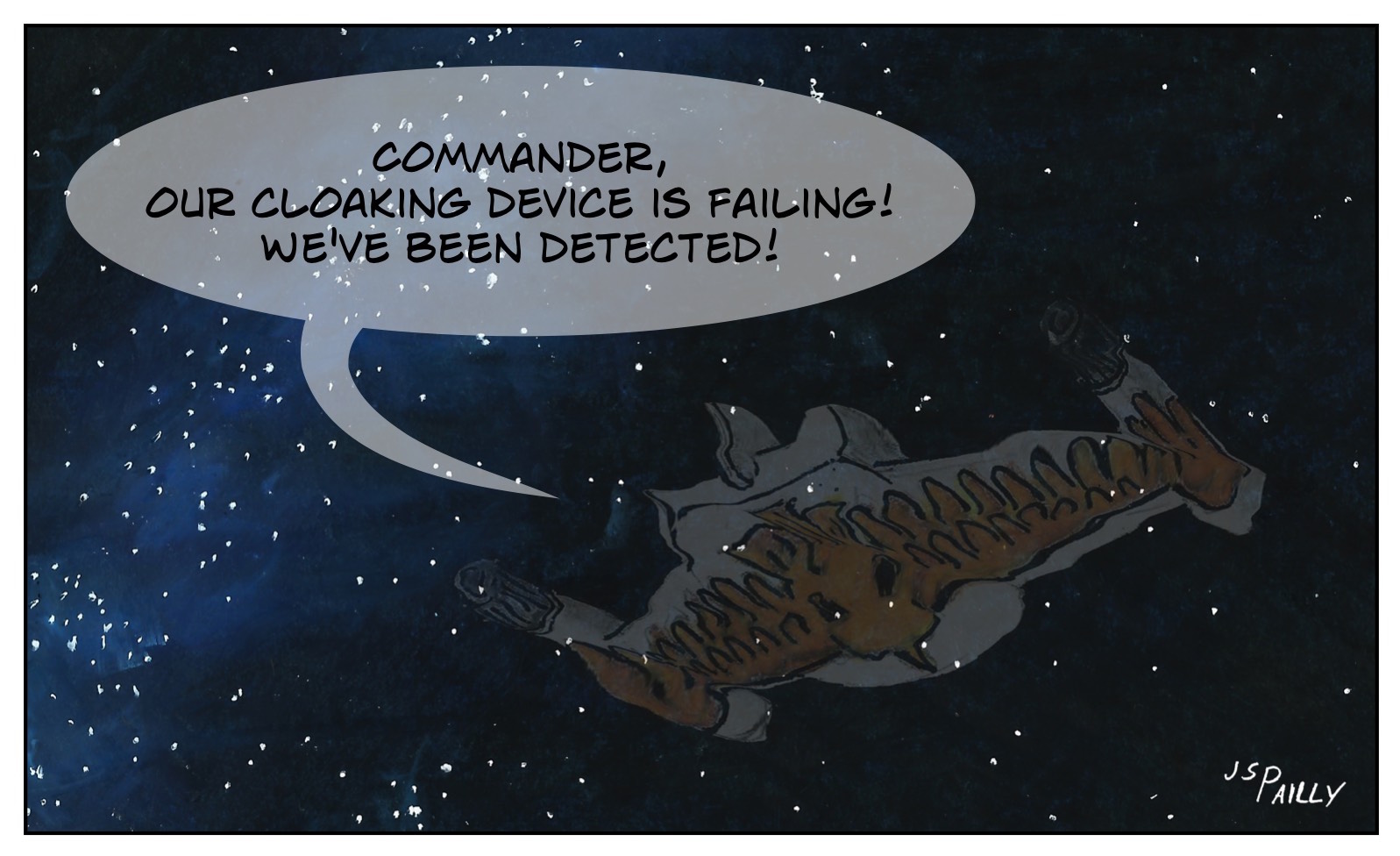
Getting back to the Star Trek  universe, there is a constant “arms race” going on over cloaking technology.  The Federation keeps figuring out new ways to detect cloaked ships; the Romulans and Klingons keep figuring out ways to make their cloaked ships undetectable again.  No one ever seems to hold the advantage for long.

As Mr. Spock says about the latest Romulan cloaking device: “Military secrets are the most fleeting of all.”  The same could be said about the Yehudi lights. They worked well enough, but only for a brief while.  Then RADAR came along, and the Yehudi lights became basically useless.
Sciency Words: Cloaking Devices

Sciency Words: (proper noun) a special series here on Planet Pailly focusing on the definitions and etymologies of science or science-related terms.  Today’s Sciency Word is:

CLOAKING DEVICES

There are certain topics that I think I know a lot about. Star Trek is one of those topics.  But this post is the story of me being wrong about Star Trek things.

Cloaking devices are a common trope in science fiction.  They’re most closely associated with the Romulans, an alien race that sneaks around the Star Trek universe in their invisible spaceships, like the invisible spaceship pictured below.

Star Trek often gets credit for popularizing cool ideas, but not for inventing them.  I always assumed Star Trek popularized the cloaking device trope, but I figured the writers must have gotten the idea from somebody else—probably one of the early Sci-Fi writers of the pulp era.

But I was wrong.  According to Brave New Words: The Oxford English Dictionary of Science Fiction, the writers of Star Trek really did come up with the whole cloaking device thing.  The term “cloaking device” first appeared in an episode called “The Enterprise Incident” in 1968.

Except being the knowledgable Star Trek fan that I am, I still thought Brave New Words had made a mistake.  If nothing else, they’d overlooked the 1966 episode “Balance of Terror,” when the Romulans and their cloaking technology made their first appearance (or rather, their first disappearance).

But again, I was wrong, technically speaking.  In “Balance of Terror,” Mr. Spock explains that the Romulans are using a “practical invisibility screen.”  The Romulan commander refers to this as a “cloak” or “cloaking system.”  But strictly speaking, no one ever uses the term “cloaking device.”

Even after reading other sources (like this one) that said Star Trek really did invent the term cloaking device, and furthermore that the term really was first used in “The Enterprise Incident” and not “Balance of Terror,” I still didn’t believe it. When you think you know so much about a topic, it’s hard to admit when you’re wrong.  I had to rewatch both episodes to see for myself.

The point of all this is not just to tell you a cool thing about the history of Star Trek or how Star Trek has contributed to the Sci-Fi lexicon.  The real lesson is this: no matter how knowledgeable you think you are about a given topic, there is always still something more you can learn!